Cuando Odiseo le dice al cíclope aquello de "Nadie es mi nombre", el original de las principales ediciones de la Odisea muestra un juego de palabras más sutil, condenado a perderse en las traducciones, a no ser que el traductor quiera incurrir en un retruécano o romper una frase que quedó grabada en el imaginario. Recordemos, por ejemplo, el final del famoso soneto de Borges: «[...] ¿dónde está aquel hombre // que en los días y noches del destierro / erraba por el mundo como un perro / y decía que Nadie era su nombre?».
El caso es que el rey de Ítaca le da al cíclope un nombre propio perféctamente verosímil, declinado por la tercera, como Paris. Es como si en español le dijera que se llama Nádiez. Basta un acento distinto al del pronombre y la palabra cambia por completo: Οὖτις frente a οὔτις. Hay un cambio de categoría léxica. El cíclope entiende la gramática y no sospecha. Lo que es incapaz de ver (como sí los lectores) es la gracia agazapada. El episodio de Polifemo es también un pequeño ensayo de morfología griega :-).
En este post repescado tratábamos este asunto de los acentos. Y en el post de más abajo (secuela filológica) intentábamos explicar por qué esa lectura prevaleció en las ediciones canónicas (siendo, además, minoritaria en los manuscritos), cuando la notación gráfica de los acentos en griego apareció mucho después de las primeras fijaciones por escrito de la Odisea. 👇
#RepescasHoméricasVeraniegas
Vete. No vuelvas nunca. No te dejes vencer por la nostalgia. Hagas lo que hagas, ámalo; como amabas la cabina del cine Paradiso cuando eras niño.
Una de las escenas más emotivas del cine.
“Most men, the herd, have never tasted solitude. They leave father and mother, but only to crawl to a wife and quietly succumb to new warmth and new ties. They are never alone, they never commune with themselves.”
— Hermann Hesse
neurocientíficamente, canalizar la atención hacia el ejercicio, aprendizaje o pasatiempos genera neuroplasticidad autodirigida. al enfocar la corteza prefrontal en metas individuales, el cerebro deja de hipervigilar el entorno externo y reduce la producción de cortisol.
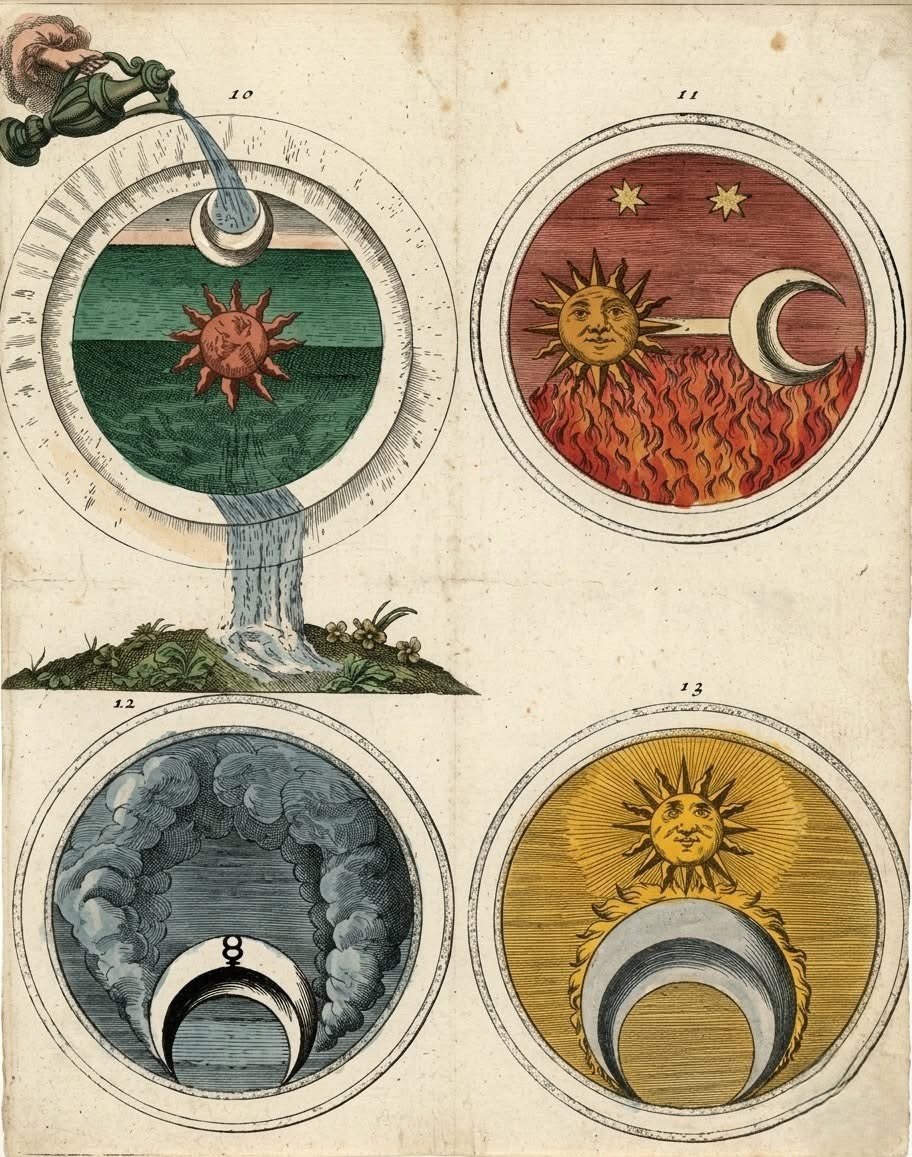
This picture is a famous table taken from the work "Elementa Chemiae" (1718) by Johann Conrad Barchusen. It represents a series of alchemical symbols illustrating the different stages of the creation of the “Philosopher’s Stone”. Here is an analysis of the four medallions shown:1. Medallion 10 (upper left)The Water of Life: A hand pours water from above, crossing a circle containing the Sun and the Moon. It represents the solution or purification phase. Water washes the earth (the central circle), indicating the union of opposites under the celestial influence.2. Medallion 11 (Top Right) Fire and Stars: The Sun and Moon are now engulfed in flames, with two stars shining high. Symbolizes calculation or combustion. Extreme heat transforms matter; the stars indicate the attainment of a new degree of spiritual purity. 3. Medallion 12 (Bottom left) Darkness and Smoke: An overturned moon is overpowered by dark clouds of smoke or vapor. It represents the stage of Nigredo (the Black Opera). It is the moment of decomposition and symbolic death of matter, necessary before rebirth.4. Medallion 13 (Bottom right)The Radiant Union: The Sun Rises Over the Moon in a Luminous, Golden Field. Illustrates the Conjunction or the beginning of Albedo (the Opera in White). Opposites (male/Sun and female/Moon) are now harmonized, bringing to light and stability of the alchemical process. Barchusen was one of the first to integrate mystical alchemy with modern experimental chemistry, and these illustrations served to guide the initiation through transformations both physical and spiritual.
Three of the people who made this film died of the same cancer: the director, his wife, and one of the lead actors. All three had been on the same set.
Stalker was shot on a river in Estonia. Just upstream from the set, a working chemical plant was dumping poison straight into the water. That white foam you sometimes spot drifting past on screen is the actual pollution.
The first death came in 1982. Anatoly Solonitsyn, who plays the Writer in the film, died of lung cancer at age 47. Tarkovsky was next. He died of the same cancer in Paris in December 1986, age 54. His wife Larisa, who was also the film's assistant director, died of it in 1998. The sound designer Vladimir Sharun, who was on the same set and survived, has been saying since 2001 that the river killed them. No medical study has ever proved that. But three of the same lung cancer from one crew is hard to wave off as bad luck.
Tarkovsky shot the entire film once in 1977. Took him a whole year. When the Soviet lab developed the footage, it came back ruined. A year of work, gone. He had a heart attack. The Soviet film board wanted to shut the project down right there.
So he tried something. He told the board he was making a two-part film. They gave him more money. He fired his cameraman, brought in a new one, and reshot the entire film from June to November 1978.
Stalker is based on a novel by two brothers, Arkady and Boris Strugatsky. They had also written the script. Tarkovsky put them through nine rewrites of it. The original location was supposed to be in Tajikistan, but a 1976 earthquake destroyed the area and forced the whole production to move to Estonia.
Stalker came out in May 1979. In the film, the "Zone" is a contaminated wasteland around a fourth bunker, with a wish-granting room hidden somewhere inside. Seven years later, Reactor Four at Chernobyl exploded. The contaminated land around the real reactor became known as the Zone of Exclusion. Today, the people who illegally smuggle tourists into Chernobyl still call themselves stalkers, named after the film.
Stalker is now considered one of the greatest films ever. The shot you are looking at right now is from a movie that, according to the people who made it, took the lives of the director, his wife, and the actor who plays the Writer.
Qué fuerte ha sido y es la Sra. Navas. Mi madre no hubiera aguantado tanto esa incertidumbre y destino.
Por eso es que cuando salimos a la calle vemos tanta gente rota y hasta trastornada. Aunque variadas, las heridas psíquicas son muy evidentes.
Stalker (1979) was filmed in a decaying Soviet industrial zone where toxic waste and contaminated water were part of the location itself. The crew spent weeks shooting in those conditions, something modern safety standards would shut down immediately.