You can’t ask for nor build for what you can’t name.
Engineers in Midland will be outperforming engineers is SF in building oil field agents soon…if not, already.
If you're an engineer or in industrial operations, the most valuable skill for AI execution right now just may be knowing which problems are actually solvable with the tools we have.
It's appearing to be the case that the engineers that have a good understanding of where AI is and where it's going coupled with deep engineering / systems thinking = big advantage in executing AI and realizing 10x ROI.
Now run it through industrial, where revenue doesn't work like that.
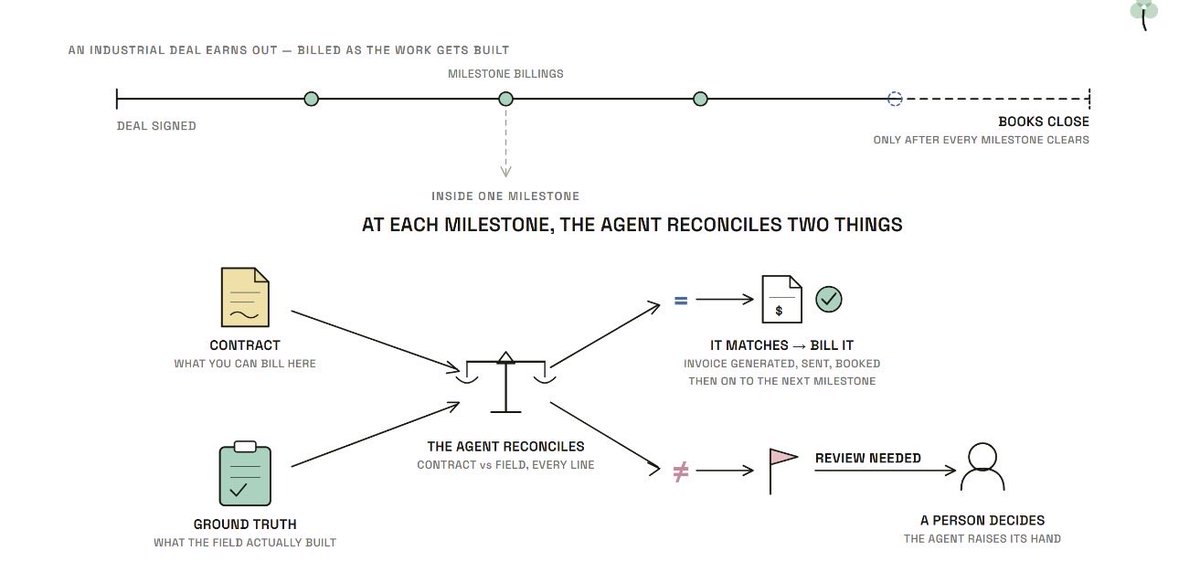
In our world the contract doesn't close when it's signed. It earns out. Projects bill on milestones and percentage of completion.
There are change orders, retainage, liquidated damages, progress payments, take-or-pay, multiple entities and tax jurisdictions.
The deal is a living document tied to steel going in the ground, and revenue is recognized as the work actually happens, not when the PO lands.
That changes the whole job.
The hard part of agentic finance here isn't generating the invoice. It's knowing what was actually delivered.
The ground truth is field tickets, daily progress
reports, change orders someone signed on a tailgate, half of it lagging and some of it disputed.
An agent can produce a beautiful invoice in seconds. Producing the right one means reconciling the contract against physical reality, over and over, for the life of the project.
And the stakes are different. A misclassification in a SaaS book is a cleanup.
A misclassification in percentage-of-completion revenue is a restatement, an audit finding, maybe a covenant problem.
Which is why the best part of that post is the
part everyone will gloss over: REVIEW NEEDED.
In industrial, that flag isn't a feature. It's the product.
Nobody hands revenue recognition to a black box.
The agent earns its way in by doing the relentless reconciliation our people can't keep up with, and by escalating the genuinely contested calls with its work shown, so an auditor can follow it.
And to be clear: people didn't get contracts wrong because they were careless.
They got them wrong because industrial contracts are hard and tied to a physical world that keeps moving. The win is building an agent that never stops reconciling and always raises its hand when
the contract and the ground truth don't agree.
That's the agentic finance that ships in heavy industry. Not the one that closes fastest. The one that knows what was actually built, and can prove it.
For 10+ years, our humans got contracts wrong. Almost all of them. Sales would just log them “closed” in Salesforce. Accounting wouldn’t read the contacts and mis-classify them in Quickbooks.
First, we added CPQ, and yes that helped, in part. But only a bit. And it didn't help on accounting side and logging them into Salesforce wrong.
🚀Now as of last week 10K our AI VP of Revenue does this automatically.
It creates all contracts, reviews them, makes sure they are classified properly, closes the opportunity, generates the invoice, sends it, and closes the books on the deal. And cleanses Salesforce and makes sure that's 100% correct.
Even better, it flags deals that need human review “REVIEW NEEDED”
This is just the start of agentic finance for us at least. It’s awesome.
Everyone's landing on the same explanation for why agents work: you have to get the agent the context it needs, in a shared working area a human can read too. A filesystem both the person and the agent pass work through.
Hard to argue with.
In an industrial setting that idea stops being good design and becomes the price of admission.
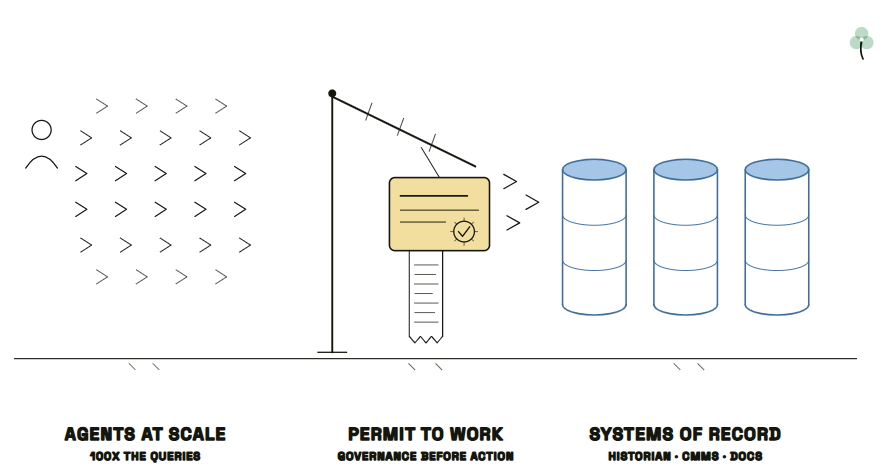
We already have the working area. It's the work orders, the field logs, the historian, the P&IDs, the systems of record we've run for decades.
The win isn't a shiny new AI app off to the side. It's letting the agent work inside the systems our people already use, in a way that's optimized for it, while staying legible to the human.
And legible isn't a nice-to-have here. It's the gate.
Nobody lets a black box near the work. When a bad call isn't a rollback but downtime or an incident, the agent doesn't get permission to act until people can see what it's working from, what it decided, and why.
That shared working set is the audit trail. It's how the agent earns trust.
Trust is the only currency that matters in a careful industry. A legible working set earns a little.
That earns permission to do a little more. That's how an
agent actually gets deployed where the stakes are real: one verified step at a time.
The teams that win won't have the flashiest agent. They'll be the ones who let it work where the work already lives, out in the open where the team can check it.
Software teams are realizing that before they let AI agents loose on their systems, they need guardrails, an approved source of truth, and a full audit trail. They're treating it as a hard new problem.
In industrial, it isn't new. It's the permit to work. It's Management of Change. It's PSM. We've run "show what you're changing, why, and against what approved record, before you touch the asset" for decades, because the stakes are physical and the regulators are real.
Here's why that matters right now.
Agents are about to work our systems far harder than people ever have. One agent on one task can pull more records in a single pass than an engineer gets near in a normal week, and it runs around the clock across every workflow: the historian, the CMMS, the work orders, the engineering docs, the asset registry, the OT layer.
In pure software you can ship the agent and tighten the controls later, because a mistake is a rollback. We can't. A mistake here is a wrong setpoint, a wrong isolation, a crew sent to the wrong valve.
The control has to come first.
So the real question isn't whether industrial can trust agents. It's how fast we connect them to the discipline we already run. The governance scaffolding the rest of the market is busy inventing, we've operated for fifty years.
That isn't a reason to sit still. It's a head start. It means agents in our world can be handed real work sooner, because the framework for trusting them is already built and already audited.
The teams that win the next few years won't have the flashiest demo. They'll be the ones that plug agents into that existing discipline and let them run at full scale, safely.
We don't have to choose between moving fast and staying safe the way the software world does. We already paid for the safe part. Now we get to move.
Need a startup called Tabs. Takes all the tabs open in wife's mind and her to-do-list - sends to agent to classify - house work, outside errands, can be done online - then, divvys the tasks out to Agents / Husband / Kids depending on schedule / execution criteria etc.
Would relieve a ton of stress.
If I’m leading any industrial business right now, I’m taking my education budget and turning it into a “go play with AI” budget.
And, I’m doing it today.
Find the people on your team who are curious. The ones who like to build things. Give them room to experiment.
No rules. No use cases. No ROI requirements.
Just play.
Once a month, have them show what they built.
Could be work stuff. Could be a home project.
Could be something completely random.
Here’s why this matters more than another training program:
The people who will transform your operations with AI aren’t going to come out of a classroom.
They’re going to come out of a garage.
They’ll figure out what’s possible by tinkering, not by taking notes.
And the stuff they build for fun on a Saturday?
That’s where the real ideas come from. That’s where someone says “wait… I could do this with our work orders” or “what if we pointed this at our maintenance data.”
Give them the budget. Give them the space. See what happens.
The "perfect data" trap is the most expensive mistake in industrial Agentic AI.
The common mistake is requiring a 100% complete Knowledge Graph before starting.
This is why many reliability engineers are still manually cross-referencing asset IDs in spreadsheets years into a project.
The foundation is never "ready" because industrial knowledge is inherently a mess of fragmented data and undocumented workflows.
Insightful article from Bolo AI’s Chief Architect, Eric Parker, points out below, waiting to realize value / ROI with Agentic AI is no longer a technical constraint.
https://t.co/3qNshxzvmr
Utilities focus on the 80 hours it takes to file a final SF6 report.
They ignore the 12,000 hours of distributed field labor buried in manual cylinder weights and paper logs.
Agentic AI solves this by deploying an orchestration of agents that autonomously extract weights from dirty field data and match them to nameplate inventory in real-time.
This converts a year-end audit into an autonomous stream, reducing labor by 85%.
For larger companies that millions of dollars.
The most valuable demographic for industrial AI isn't the fresh grad.
It is the 35-44 year old operator.
They possess the "context" that LLMs lack: the tribal language, the shortcuts, and the unspoken codes of the plant.