Fantastic conversations around where domains are headed as the internet shifts to an agent-driven world and how @domaprotocol is enabling institutional portfolios (DAVs) to be tokenized into one liquid asset.
Great things happen when the traditional domain industry and onchain infrastructure build together.
Thanks for having us @InterNetX at #IXDS26 🤝
AI is becoming more powerful, but so is its dependence on user data.
The next challenge is ensuring users remain in control of their identity and information.
At TuumIO, we're exploring a future where personalization doesn't come at the cost of ownership or privacy.
The Missing Layer in AI: User Ownership.
AI is becoming more powerful every day. Models are getting smarter, agents more autonomous, and digital experiences more intelligent.
But one question often goes unanswered: Who owns the data that powers AI?
🎥 Dominion ’26 Replay Series — 5
DomainFi 101: Everything You Need to Know About DomainFi
At Dominion ’26, Matt Smith (Partner Operations, D3) broke down DomainFi from the ground up, explaining how the next evolution of the domain industry is bringing traditional internet assets onchain and transforming how they are owned, traded, and utilized.
The session explored how Doma Protocol bridges Web2 domains with Web3 infrastructure, creating new pathways for liquidity, distribution, and innovation across a domain market valued at more than $360 billion. By bringing domains onchain, DomainFi introduces new ways for users, investors, and communities to participate in an asset class that has historically been fragmented and difficult to access.
Rather than simply discussing the concept, Matt demonstrated DomainFi in real time with the live launch of https://t.co/yGjRnBMVdd, offering a practical look at how internet domains can be brought onchain and integrated into emerging digital markets.
📺 Watch the replay @everyone 👇
https://t.co/9ueOgGl1rv
The internet is entering a new era powered by AI and programmable digital economies.
But the next generation of digital innovation cannot thrive on closed infrastructure alone.
Open standards, interoperability, and user ownership are becoming increasingly important.
AI Is Changing Discovery
For more than two decades, the internet has been optimized primarily for human users.
Search engines helped people find information, and SEO became a critical discipline for improving online visibility.
But a new shift is underway.
AI agents are beginning to search, evaluate, and interact with digital resources autonomously. As agentic systems become more capable, websites and domains will need to be discoverable not only by humans, but also by machines acting on their behalf.
This raises an important question: How does an AI agent perceive your domain?
The Doma Agentic Engine explores this challenge by helping domain owners understand how AI systems interact with their digital assets. It focuses on identifying discoverability signals, protocol readiness, and content gaps that could impact visibility in an AI-driven internet.
In the same way that SEO became essential for traditional search, Agent Discovery Optimization (ADO) may emerge as a foundational layer for AI-native discovery.
The future of internet visibility may extend beyond human-first experiences.
As AI agents become active participants in the digital economy, the domains and websites that adapt earliest may have a significant advantage.
Are websites ready for AI-native discovery?
Decentralization solved who owns the data.
The next challenge is making that ownership usable.
As AI and digital systems evolve, users need identity models that are secure, portable, and permissioned by default not fragmented across countless applications.
Imagine Holding A Diamond In Your Hand.
At first glance, it's simply a beautiful object. But its true value goes far beyond what the eye can see. Its worth comes from its rarity, its utility, the market built around it, and the infrastructure that allows people to discover, trade, value, and own it.
Without that infrastructure, even the most valuable asset can remain underappreciated.
Domains are remarkably similar.
For decades, domains have quietly powered the internet. Every business, startup, creator, and global brand depends on them. They are the foundation of digital identity, online presence, and ownership in the digital age.
Yet despite their importance, domains have largely remained static assets. You buy them, hold them or build on them.
And for most people, that's where the story ends.
But what if that's only the beginning?
What if domains could become more accessible, more liquid, and more integrated into the digital economy? What if digital real estate could evolve beyond simple ownership into something far more dynamic?
That's the vision that drew me to @domaprotocol.
Doma is building the infrastructure layer for DomainFi, a new frontier that brings blockchain-powered innovation to one of the internet's oldest and most valuable asset classes. Through tokenization, fractional ownership, and onchain accessibility, Doma is helping transform domains from passive holdings into programmable digital assets.
The goal isn't to change what domains are but to unlock what they can become. Because the internet has already spent decades creating enormous value through domains. The challenge now is creating the rails that allow that value to move more freely, reach more people, and participate in a broader digital economy.
When you think about it, domains possess many of the characteristics that make assets valuable. They are scarce. They are globally recognized. They are essential to brands and digital identities. They sit at the intersection of technology, culture, ownership, and commerce.
The opportunity has always existed but what's been missing is the infrastructure and that's where Doma Protocol comes in.
Just as a diamond reveals its brilliance through refinement, the true potential of domains is revealed through innovation. By connecting domains to the possibilities of blockchain technology, Doma is helping unlock a future where digital ownership becomes more accessible, more efficient, and more valuable.
The value was never the question. The question was how to unlock it.
Doma Protocol is building the answer.
🎥 Dominion ’26 Replay Series — 2
@InderpreetSingh, VP of Product & Technology at @D3inc took the stage at Dominion ’26 to unpack the infrastructure powering DomainFi behind the scenes: **Doma Under the Hood**
In this session, Inder explored how @domaprotocol connects traditional DNS foundations with DeFi rails, creating the infrastructure layer that enables domains to become programmable, interoperable, and financially usable onchain assets.
The talk also covered the evolving role of AI agents, product architecture, and what’s actively being built next across the Doma ecosystem.
📺 Watch the replay👇
https://t.co/7EynVzqYVd
🎥 Dominion ’26 Replay Series — 3
Some of the biggest names in the domain industry came together at Dominion ’26 to discuss how domain monetization is evolving beyond traditional parking models.
Richard Lau, Monte Cahn, Ammar Kubba, and James McA'Nulty joined @ishmilly for a conversation on how domain investors are transforming parked portfolios into liquid, productive, and financially active assets through @domaprotocol.
The panel explored the changing economics of domain ownership, new monetization models powered by #DomainFi, and how liquidity, tokenization, leasing, and onchain utility are opening new opportunities for domain holders.
📺 Watch the replay👇
https://t.co/Wr2ClWd1ia
AI is becoming more powerful every day.
It writes, predicts, automates, and learns from the vast amounts of data users generate.
But as AI gains more context and influence, one question becomes increasingly important:
Who owns the data?
🎥 Dominion ’26 Replay Series — 4
What happens when internet infrastructure, blockchain networks, and AI agents begin operating in the same financial ecosystem?
At Dominion ’26, @vibhu (CPO, @solana) and @InderpreetSingh (VP Product & Tech, @D3inc) explored how the next generation of internet capital markets is being built onchain, why high-performance blockchain infrastructure, AI agents are shaping the next chapter of the internet economy and why domains could play a central role in that future.
The conversation also explored how Solana’s speed, scalability, and low-cost transactions make it a powerful foundation for internet-native financial systems, and why domains could become key assets within these emerging onchain markets.
They also examined the growing role of AI agents, not just as tools, but as economic participants capable of owning assets, executing transactions, and interacting across decentralized networks.
📺 Watch the replay👇
https://t.co/BxdiVX9fnU
It's funny how the things you once overlooked can become the things you think about every day.
For most people, a domain is just a website address. Something you type into a browser and forget about.
That was me too. Then I started paying closer attention. I began to see domains for what they really are: the foundation of digital identity, online brands, and some of the most valuable real estate on the internet.
The deeper I explored, the more fascinated I became.
And somewhere along the way, @domaprotocol entered the picture. What started as curiosity quickly turned into conviction. The idea that domains could evolve beyond simple ownership into assets with greater utility, accessibility, and liquidity changed the way I look at the internet.
Now I catch myself reading about DomainFi late at night. Following domain trends during my free time. And thinking about the future of digital ownership far more than I probably should.
Which explains the image perfectly. You can call it obsession, belief and seeing an opportunity before the rest of the world catches on.
Whatever you call it, one thing is clear: The Doma bar stays full.
🔵 100% Doma.
The Heartbeat of the Internet
A heart keeps the body alive. It powers movement, connection, and every critical system beneath the surface. Without it, nothing flows.
Domains operate the same way online.
Every website, startup, creator brand, and digital identity begins with a domain, yet most domains still exist inside outdated systems where ownership is rigid, liquidity is limited, and utility rarely extends beyond buying and selling.
That infrastructure is now beginning to evolve.
@domaprotocol transforms domains from static internet addresses into programmable financial assets while remaining fully DNS-compliant. Traditional domains like .com and .ai continue functioning normally while gaining onchain utility (that opens the door for fractional ownership, liquidity systems, and cross-chain interoperability)
This is the foundation of DomainFi.
For years, premium domains have behaved like digital real estate with massive untapped liquidity. Doma is building the infrastructure that makes those assets composable, transferable, and financially active across decentralized ecosystems.
The internet already runs on domains and Doma is helping power what comes next.
Read more here👇 :
https://t.co/Ug348OVSxN
#DomaProtocol #DomainFi #Web3 #Blockchain #DigitalOwnership #Domains
🎥 Dominion ’26 Replay Series — 1
Fred’s Keynote Speech: Welcome to the New Internet
@heyheyfred, CEO and Co-Founder @D3inc opened Dominion ’26 with a keynote exploring how domains are evolving into one of the internet’s most important onchain asset classes.
In his speech, Fred explained why the $360B domain market represents one of the biggest tokenization opportunities still largely overlooked today, despite domains powering digital identity, online businesses, websites, AI agents, and internet infrastructure itself.
The keynote also touched on how #DomainFi is transforming domains from static assets into programmable, liquid, and interoperable digital property for the next generation of the internet.
📺 Watch the replay👇 :
https://t.co/AYDz8pkYMF
How DAVs Restructure Domain Portfolios
Most people think of domains as simple internet addresses, but large domain portfolios operate very differently behind the scenes.
Some portfolios contain thousands of domains, and traditionally, every single one has to be managed individually. Pricing, renewals, transfers, and sales all happen asset by asset, which creates friction and limits liquidity at scale.
Instead of treating thousands of domains as disconnected assets, DAVs create a unified onchain framework while the underlying domains continue functioning normally. Domains can still be sold individually, operators still control pricing and strategy, and DNS functionality remains unchanged.
DAVs make it possible for domain portfolios to become more structured, accessible, and programmable onchain without disrupting how domains already work today.
The bigger picture is not just about domains. It is about the internet itself becoming more liquid, composable, and financially programmable over time.
DAVs are part of that transition.
Apply & join the waitlist: https://t.co/iXPaPx5P9v
Read more about DAVs 👇:
https://t.co/tqWY3eP1Fg
Introducing Lucky 888🎱
Refer 8. Trade 88. Winners will receive blue-chip domain tokens directly into their wallets.
The onchain campaign built around the luckiest number in the world and only 5,000 winners walk away with it.
🔗 https://t.co/3A1cCXz7eg
Why DAVs Matter 🟦
Most people still see domains as simple website names. But behind the scenes, domain portfolios have become a massive asset class worth billions of dollars. The problem is that these assets have historically been difficult to access, trade, or structure efficiently at scale.
That’s what makes Doma’s DAVs (Domain Asset Vehicles) interesting.
Instead of managing or transacting domains one by one, an entire portfolio can now be represented as a unified onchain asset while the domains themselves continue functioning normally across existing marketplaces and infrastructure.
The domain economy may be evolving faster than most people realize.
What’s your take on tokenized domain portfolios?
Read more about Domain Asset Vehicles👇
https://t.co/RhgM7HEz0K
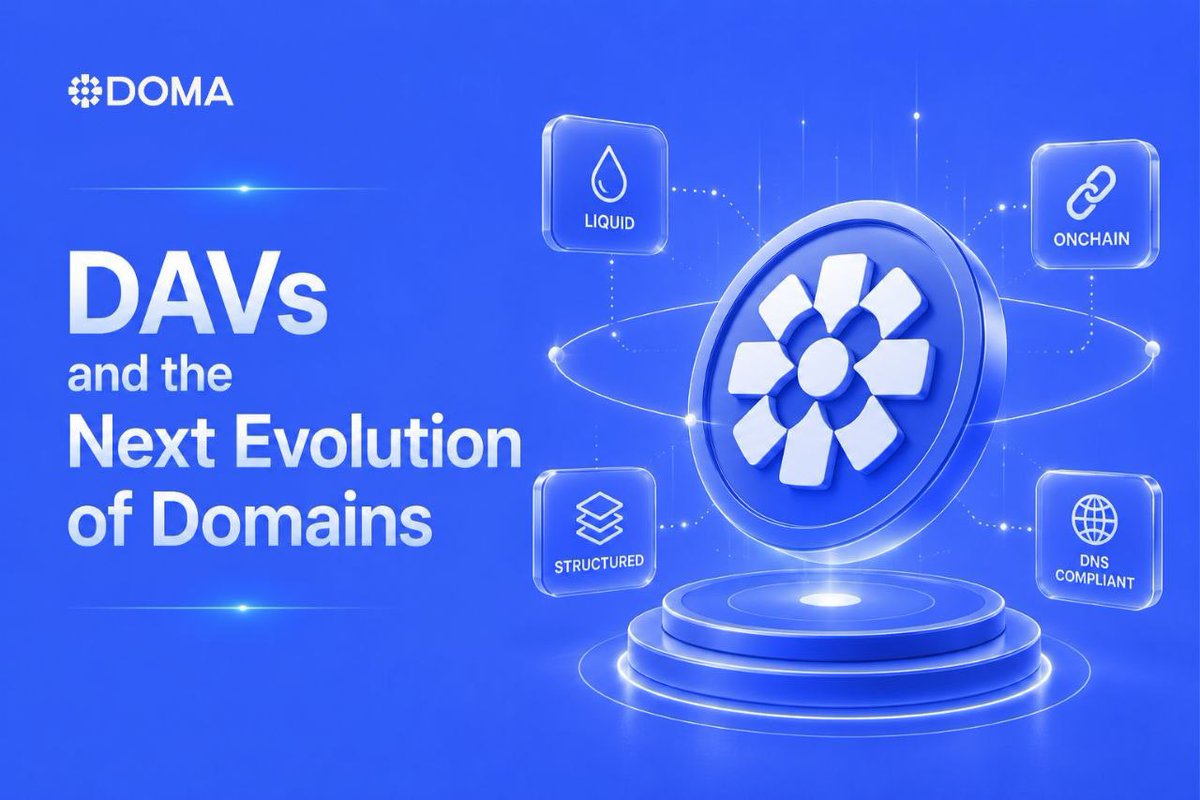
DAVs and the Next Evolution of Domains
The internet has gone through different eras. First, domains became digital real estate. Then websites evolved into businesses. Now, domains themselves are beginning to evolve into financial infrastructure.
DAVs introduce a model where domain portfolios no longer sit idle between sales. Instead, they can become liquid, structured, and accessible onchain while remaining fully DNS-compliant.
What makes this shift important goes beyond tokenization itself. It’s the emergence of a financial layer for internet-native assets, one where domains can become programmable, composable, and integrated into the broader onchain economy.
We may still be early to what DomainFi eventually becomes, but the foundation is already being built.
Would you participate in a domain-backed onchain asset?
Apply & join the waitlist: https://t.co/UgaO8f5kQ9
Read more about DAVs 👇:
https://t.co/tqWY3eP1Fg
Many intelligent systems still depend on centralized data collection & surveillance-driven infrastructure.
The internet normalized a model where users get “free” services while platforms gain unrestricted access to user data.
Now AI is evolving on top of that same foundation.