I used to be in charge of all the crude and product tank inventories in the refinery.
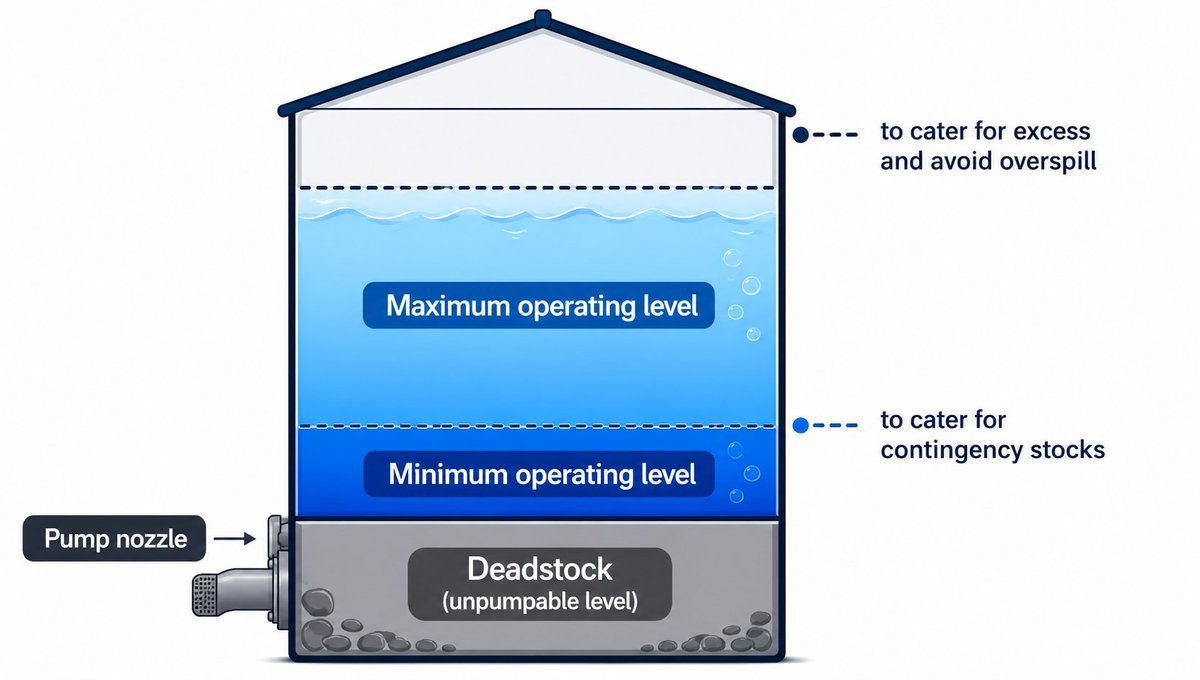
Here is a simple picture of the operating levels of the tank. You've got deadstocks at the bottom of the tank because the pump nozzle is positioned slightly above a certain level. We used to call this 'the unpumpables'. Go below this level and your feed pump would cavitate. Big no-no.
Then you get a minimum working level after catering for contingency levels (e.g. enough product stocks to cater for x days of unplanned shutdown).
And although you have a huge tank that can technically fill to the brim, the actual working volume at the top is lower than the absolute max to also factor in for contingency levels (e.g. enough capacity to store off-spec rundown for an unplanned shutdown). Tank top scenario is a horror nobody wants to face due to risk of loss of primary containment (i.e. a safety incident).
In the current low stocks environment in the US, you are going to 'scrape tank bottoms', up to the minimum working level. So you will always have some stocks because you can't draw to absolute zero.
#oott
Hopefully, Ukraine can keep sending drones to St. Petersburg throughout the five days of the St. Petersburg International Economic Forum.
The guests need to understand two things: Russia is losing, and you don't fuck with Ukraine.
Ukraine fired its first domestically produced ballistic missile — the FP-7.
Range up to 200 km. Warhead: up to 150 kg. Top speed: 1,500 meters per second.
Supply chains are starting to break down
- motor oil, diesel oil, and specialty fluids categories to drop by 40%
- 70% of the dollar value of goods shipped in the US are transported by truck
Less motor oil and specialty fluids mean supply chains are becoming more fragile and more expensive.
Critical maintenance products become scarce, transportation costs rise, equipment downtime increases, and bottlenecks start to appear throughout the economy.
Meanwhile markets are at all time highs
Naphtha hit $1,300 a ton when Hormuz closed.
ADNOC found a workaround.
It's now $788.
In April, ADNOC halted exports of roughly 1 million metric tons per month of naphtha from its Ruwais refinery.
Hormuz was too risky.
Asia supply collapsed.
Prices spiked to record levels $1,300/ton, margins of $467/ton over Brent.
Last month, ADNOC quietly resumed exports through the Omani port of Sohar.
tankers collect cargoes from inside the Gulf, sail to Sohar, transfer ship-to-ship to outbound vessels headed for Asia.
Longer, more complex, more expensive but it works.
2 vessels loaded ADNOC naphtha at Sohar around May 30 and are now heading to Asia.
Prices tumbled to $788/ton.
Margins collapsed to $84/ton over Brent.
This is the Hormuz workaround thesis playing out in real time.
Middle East producers aren't waiting for the strait to reopen.
They're rerouting.
STS transfers off Oman.
Alternative loading terminals. Longer voyages at higher freight cost but supply is moving.
Every workaround that works chips away at the geopolitical risk premium the market was pricing.
But read the demand side carefully before calling this a clean reversal.
The $512/ton price collapse isn't only workaround supply... It's also demand destruction.
Insufficient feedstock supply has already triggered widespread run cuts and force majeures at petrochemical complexes across Asia.
Plants that shut don't immediately restart when supply returns. Buyers that restructured their feedstock sourcing don't immediately unwind.
The IEA now expects global naphtha demand to fall 80,000 b/d this year.
That demand loss doesn't come back when Hormuz normalises it's already been destroyed.