@Patriot_S_A He must go with those 4 small Zimbabweans as well! Why did you open your legs for a Zimbabwean in the first place? You taught him roll on first!?
Zimbabwe has nothing bro:
No 5 star hotels
No mega cities
No speed trains
No world class stadium
No Tap water😭
No Sewage systems
No Healthcare
No currency
No roads
No leadership😭
Just Churches, regime enabler socialites, Zvigananda, demonic politicians and Podcasts.
@SandileMakeba You don't own land. I'm in the process of buying land in Zimbabwe. There is something you don't understand! Zimbabwe is an investment. Most South Africans we are investing land in Zimbabwe. You people are too slow!
@daddyhope@SandileMakeba o ngwana you are a child let us grown ups teach you about land! Black Zimbabweans never ever owned land they benefited from 2000 violence and corruption Mugabe rigime without making production! I'm going to prove to you I'm going to buy a farm in Zimbabwe!
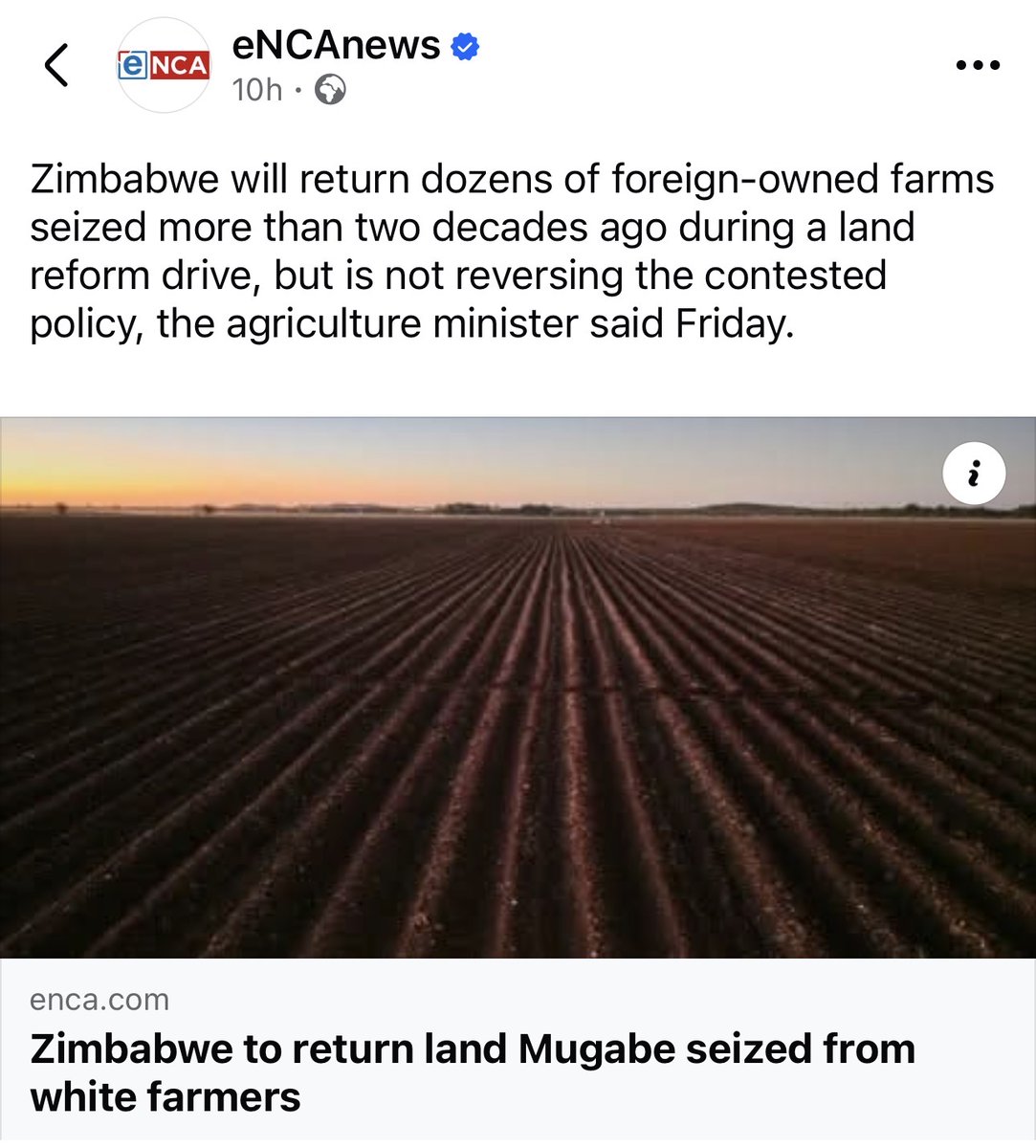
People are misunderstanding this issue completely. Zimbabwe is not reversing the entire land reform programme. These are specific farms protected under Bilateral Investment Promotion and Protection Agreements, BIPPAs, signed between Zimbabwe and foreign countries.
Many of these farms were bought after independence, not during colonial rule, and their expropriation violated legally binding agreements that Zimbabwe itself had signed.
What happened in 2000 was chaotic, violent, and deeply political. Mugabe had just lost the constitutional referendum in 2000 and his grip on power had weakened significantly.
ZANUPF was facing growing opposition from a restless population, particularly people who supported the party and were angry that they still did not have land 20 years after independence. To regain political control, Mugabe latched onto the land issue and unleashed a fast-track land reform programme that was often violent and lawless.
The tragedy is that while the principle of land reform itself was necessary because of colonial land imbalances, the implementation became corrupted. Productive farms were handed to political cronies, chefs, military elites, judges, and connected individuals, many of whom could not farm.
Some received multiple farms while genuinely capable black farmers were sidelined. Even today, some of that land is being rented back to white commercial farmers because the beneficiaries failed to utilise it productively.
Zimbabwe’s agriculture has never fully recovered from that chaos. The country destroyed an advanced agricultural system without putting in place a competent replacement system based on productivity, financing, skills, irrigation, and accountability. You cannot build agricultural success by simply handing land to politically connected people who have no farming capacity.
So what the government is doing now is not a reversal of land reform. It is trying to correct a legal and economic mess it created 26 years ago by violating its own laws and international agreements. It was criminal for the Zimbabwean government to sign BIPPAs and then ignore them when it became politically convenient.
The important question now is not whether the farms are being returned. The important question is who currently holds those farms, whether they were being used productively, and what happens going forward. I can guarantee you that many of those farms were not being fully utilised anyway. Land must be in the hands of people who can actually produce.
That is why I always say to countries considering land reform that land cannot simply be taken and distributed randomly. Even in precolonial African kingdoms, land belonged to the king and was allocated to people who could use it productively. You did not automatically get land simply because you belonged to the kingdom.
I always use my own example. I was the third biggest Boer goat breeder in Zimbabwe, operating from just two acres at my ancestral village, yet producing far more than all Zimbabwean farmers sitting on massive commercial farms except for only two.
Had I been given access to proper farming land, which I would have bought, I would probably have become the number one goat breeder in Zimbabwe. But that opportunity never came because productive land was often allocated to the wrong people for political patronage rather than agricultural competence.
Robert Mugabe and ZANUPF’s chaotic and violent land reform programme was not really designed to build a productive Zimbabwean agricultural society. It became a political patronage system. Of course, some ordinary Zimbabweans benefited from the land redistribution, but the system was structured in such a way that land ownership often depended on political loyalty to ZANUPF. If you spoke against the government, you risked losing that land.
Many black Zimbabweans have lost farms over the years simply because they fell out of political favour. That alone tells you that this was never truly about empowering citizens equally under the law. It became a tool of political control.
And as we saw during the divorce case involving Mugabe’s daughter, she was given 21 farms. One person with 21 farms in a country where millions were supposedly land hungry tells you everything about how chaotic, corrupt, and mismanaged the entire programme became.
Land reform was supposed to correct colonial imbalances and create productive black commercial farmers. Instead, in many cases, productive land was captured by politically connected elites, multiple farm owners, and people without farming expertise, while genuinely capable farmers struggled to access land.
The current leadership in Zimbabwe, the President, the Vice Presidents, and many men and women of the old guard will not be in power in ten to twenty years’ time. They will all be gone. A new generation will eventually take over, and a lot more will be done to restructure Zimbabwe’s agriculture and bring back sanity, productivity, professionalism, and proper land utilisation.
No country can build a strong agricultural sector on political patronage, chaos, and fear. Eventually, competence and productivity will have to matter more than political connections.
It is embarrassing that with all that productive commercial farming land not being put to proper use, Zimbabwe now has to import maize from South Africa. That alone tells you how badly the agricultural sector was damaged.
And unfortunately, the Zimbabwean example is now making many South Africans fearful of land reform because they look across the border and see collapse instead of increased productivity. But Zimbabwe should never be used as the standard example of proper land reform because what happened there was not a properly planned agricultural transformation programme.
It became a violent, chaotic, and corrupt political project driven largely by patronage and power retention rather than long-term agricultural productivity and economic sustainability.
Real land reform should increase production, strengthen food security, empower capable farmers, and grow the economy. It should not destroy a country’s ability to feed itself. Zimbabwe has capable black farmers, those are the ones that should have been given access to land not these grifters who are renting out famers and running protection rackets.
@odedanilo You are settling the score. Now my question is do you wanna be a celebrity or a primary school teacher? Because you must choose! I always knew you were bottom!
@matinyarare@SandileMakeba I told you stop insulting black South Africans! Black Zimbabweans to start with never owned land! You are a small boy stop posting things you have little knowledge about!
𝗠𝗡𝗔𝗡𝗚𝗔𝗚𝗪𝗔 𝗥𝗘𝗧𝗨𝗥𝗡𝗜𝗡𝗚 𝗟𝗔𝗡𝗗, 𝗬𝗘𝗧 𝗧𝗔𝗚𝗪𝗜𝗥𝗘𝗜 𝗦𝗔𝗜𝗗 𝗧𝗜𝗧𝗟𝗘 𝗗𝗘𝗘𝗗𝗦 𝗪𝗢𝗨𝗟𝗗 𝗥𝗔𝗜𝗦𝗘 𝗠𝗢𝗡𝗘𝗬 𝗧𝗢 𝗣𝗔𝗬 𝗭𝗜𝗠 𝗗𝗘𝗕𝗧𝗦. 𝗪𝗛𝗬?
Last year, Kuda Tagwirei, Chairman of the Land Tenure Implementation Committee, sold the idea of giving title deeds to Zimbabweans as a way to unlock $20 billion in capital. That capital could then be used to compensate white farmers, pay off national debt, and finance black farmers.
It was a strong idea—if carried out to the letter. But less than a year after Kuda pitched the capital-raising plan, President Mnangagwa, true to his selfish short-term focus, is now returning the same land to white farmers, to try and appease the West to accept his mutilation of the constitution to extend his term in office.
This is why some of us are saying that this selfish old man should go and rest in 2028 and give new leaders with fresh ideas and a long-term stake in the country’s future, a chance to govern it.
@SandileMakeba I thought you said you were a Xhosa? You can't even write Xhosa rather Shona! You are always in South African affairs yet you are oppressed as African in your own country! Forced to write Shona in order to fit in! Sies!
@SandileMakeba Wena you think South Africans are from Mutara neh? You think we are driven by fear like the rest of Zimbabweans fearing one old man who beats you like nobody's business! Go ahead and ask Rutendo who are we? Small talks don't shake us!