- The dollar loses 7% a year.
- AI is coming for white-collar work.
- Robots are 10 years out.
@saylor just laid out what young people should actually do about it.
12 lessons:
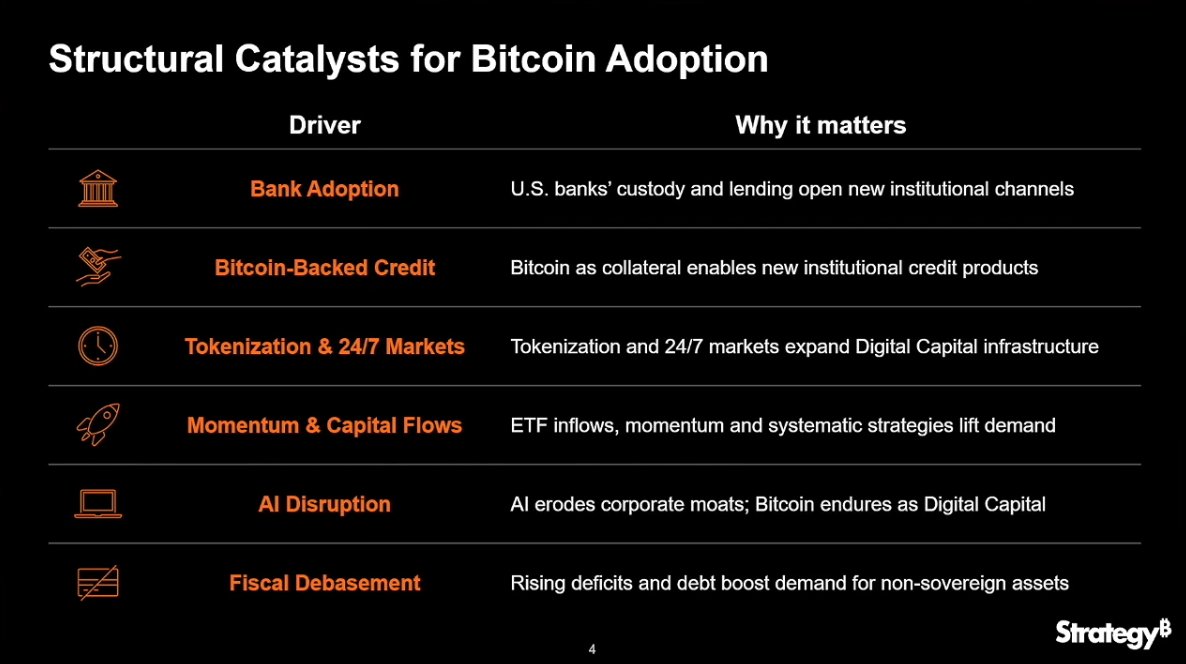
Each of these will profoundly impact Bitcoin’s price over the next decade.
These massive structural changes move slowly day to day, but remarkably fast over a few years.
Yet even when you understand their significance, short-term price movements can make it feel like nothing is happening simply because the price isn’t immediately reflecting the progress.
A good reminder not to let what changes every second drown out what’s developing over years.
Docusign $DOCU has a $14.9 Billion market cap.
98% of their revenue ($3.1 Billion) comes from SaaS and subscription fees.
DOCU currently has annual net income of $440M.
A 15% decline in gross SaaS revenue would deplete 100% of TTM net income.
Their flagship product is now available for $0, open sourced…
Technical moats are evaporating overnight.
Risk is mispriced.
@PunterJeff 1) Competitors will attack margins.
and,
2) Consumers will always choose more value.
then,
3) Prices will fall to the marginal cost of production in a truly free market.
In a filing late this afternoon, Tudor Investment (Paul Tudor Jones) reported owning 1,363,567 shares of IBIT as of September 30, valued at $64.5 million.
That's an increase from 688,529 shares reported for the previous quarter.
Today's filing also disclosed an IBIT call position valued at $40.6 million as of September 30, which is an increase from $4.9 million for the previous quarter.
See the last line of the previous post in August.
Filing:
https://t.co/gRBHFEaph9
👀 $NVDA wasn't just selling chips. It was the central bank of AI, with ~$500B in now questionable commitments. Its banker quit Thursday. $BTC, the canary in the weekend coal mine, is pricing a Lehman moment amidst AI anxiety, @binance, @Microsoft , a nationwide FAA ground stop, and a Fed hiking into tight liquidity.
The choice of metrics here is interesting in itself. Potential clues to how Strategy reads market conditions and how that might shape their capital allocation decisions.
When you want to understand what’s happening with Bitcoin, start with the data. Strategy’s Bitcoin dashboard brings the key metrics into focus. https://t.co/rXyEcWbRTF
Growth equities under attack from every direction.
AI-driven disruption. Eroding competitive moats. Rising capital intensity. Government intervention and regulatory overreach.
I think this will be one of the most powerful secular tailwinds for Bitcoin over the next decade.
Jeff’s point is simple, but important.
AI companies are entering into massive, multi-year, often non-cancellable commitments for compute, data centers, and chips. These are long-duration financial obligations, increasingly supported by elevated equity valuations and access to credit that depends, at least in part, on continued confidence in those valuations.
This creates a potentially significant asset-liability mismatch: relatively fixed contractual obligations supported by uncertain future cash flows, equity valuations, and financing conditions.
An IPO becomes a critical test of that structure. Strong pricing and a sustained public-market valuation reinforce confidence, preserve access to capital, and allow companies to continue financing their commitments on favorable terms.
But reflexivity works in both directions.
A disappointing IPO, particularly one followed by sustained weakness in the secondary market, could undermine confidence in the equity supporting the broader financing structure. As valuations compress, the cost of capital rises, lenders and counterparties become more cautious, and companies may be forced to issue additional equity at increasingly unfavorable prices simply to meet existing obligations.
That dilution puts further pressure on valuations, potentially creating a self-reinforcing cycle of deteriorating equity prices and tightening credit conditions.
We may already be seeing early signs of these pressures with Anthropic (as Jeff has recently pointed out).
These structures can remain viable for years as long as confidence, liquidity, and access to capital persist. But when financing conditions deteriorate, the mismatch between contractual obligations and available capital becomes increasingly difficult to sustain. The eventual adjustment can take the form of forced dilution, restructuring, credit withdrawal, or, in more extreme cases, liquidation.
This is where Jeff’s argument for Bitcoin becomes particularly interesting.
Bitcoin has no maturity date, no refinancing requirements, no issuer-dependent cash flows, and a supply schedule that cannot be expanded in response to financial stress.
I believe this could become the next major Bitcoin narrative.
AI presents two distinct but reinforcing challenges to traditional capital allocation: the potential financial unsustainability of its enormous infrastructure buildout, and the erosion of established corporate moats as increasingly capable intelligence makes previously scarce products, services, and capabilities abundant.
Both developments could accelerate the search for assets whose value does not depend on maintaining a competitive operating moat or continuously accessing external capital.
Capital currently concentrated in AI-related equities could increasingly rotate toward Bitcoin, seeking long-term growth and protection from both the financial vulnerabilities of the AI buildout itself and the broader economic disruption that AI is creating.
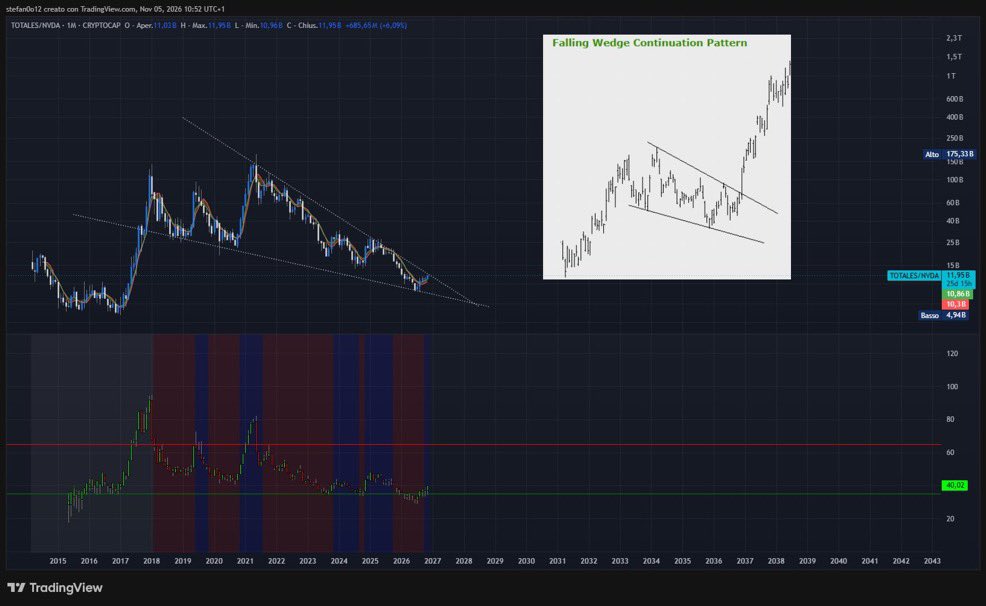
Finally, an interesting chart I came across today from @uci0o12:
The total cryptocurrency market capitalization priced in NVDA.
Would you look at that…
It’s hard to believe this right now but all this AI wealth creation is very bullish for BTC because whenever the asset liability mismatch breaks (they always do) and capital flees, the infinite duration asset that is Bitcoin will be waiting coiled in a generational indifference
ATM window open 👀
STRC crossed $100 at 12:38 PM ET. First time above threshold since May 14, nearly six months of sub-par trading.
9k shares tracked so far, ~4 BTC estimated.
https://t.co/OBanJeUmPp
The world is increasingly complex & dysfunctional, but I believe the optimal investments for the most common needs will become increasingly simple & clear:
Income: Digital Credit
Savings: Bitcoin
Growth: Amplified Bitcoin
$ASST $SATA solana:DSgjVUFC6NA59YuxiEDSxgs6zP4jjwSuoYJ3uS7WboeH $BTC
AI is eroding business moats and increasing operational risk?
If only there were a perfectly scarce asset with no business model to disrupt, no margins to compress, no management team to rely on, and a supply that no amount of intelligence or innovation could ever increase…
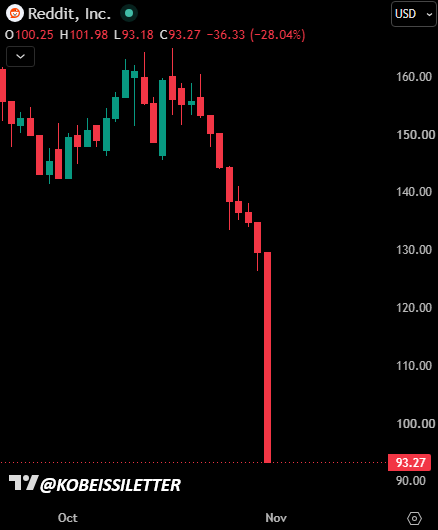
Yesterday's earnings call with Reddit's CEO will be referenced for years to come.
Reddit, $RDDT, is now down -42% in 8 trading days.
AI has disrupted search, and the internet more broadly, forever.
Our thoughts on this are included below.
₿itcoin is roughly 21% above its power law floor, and the floor is rising about 2.5% a month.
Put that in your pipe and smoke it. Or you could secure permanent, unsecured funding with zero refinancing risk and make interest-only payments with no amortization of principal. But that wouldn't be easy.
@Werkman, @PunterJeff, @ColeMacro, @GrainofSaltSF, @BritishHodl, @jameslavish
Bitcoin has a moat: absolute scarcity. Strategy has built a uniquely self-reinforcing moat on top.
Other entities accumulate BTC → BTC price rises → Strategy’s credit quality improves → Preferreds become more attractive → Greater capacity to buy BTC.
We’ve never seen a company like Strategy because we’ve never had an asset quite like Bitcoin.