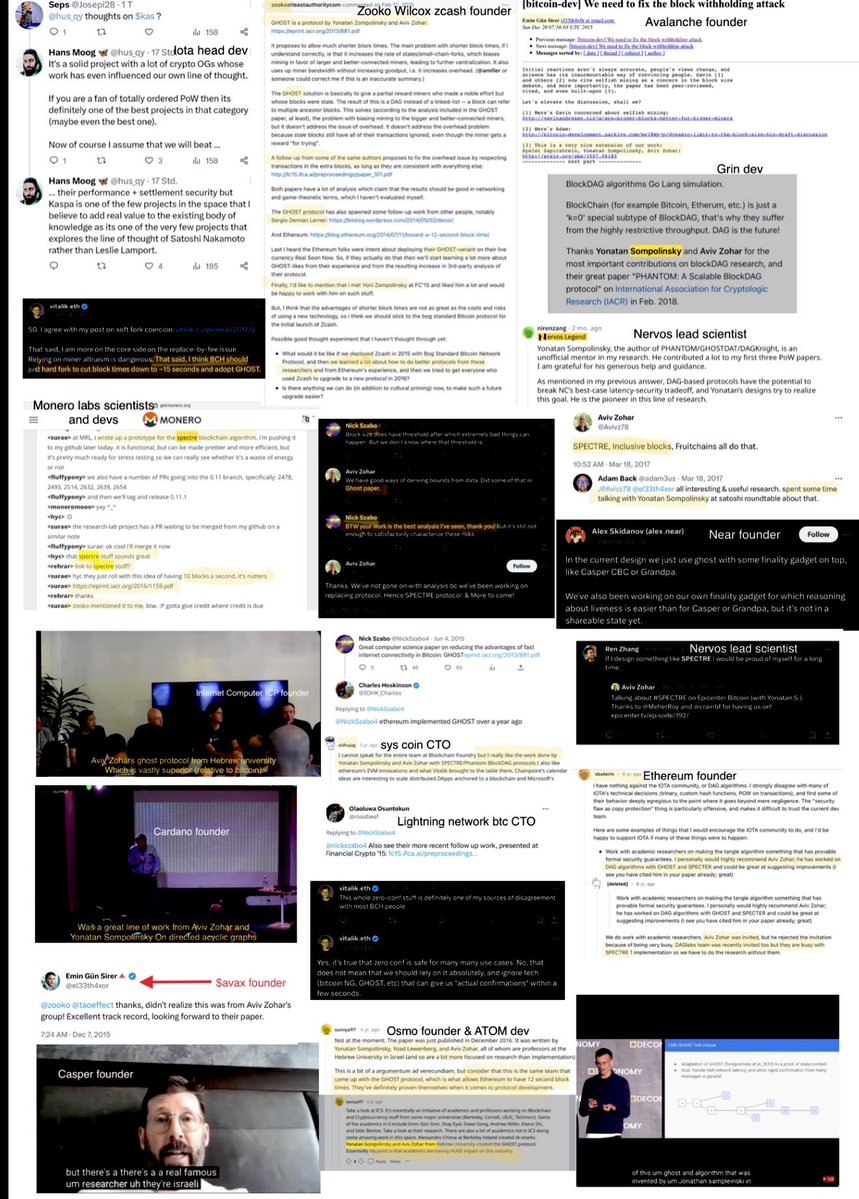
For some reason, there are very few posts about DagKnight, people just don't understand that a hardware - and softwware-realtime-adapted protocol with error correction simply rewrites the rules of the game. DagKnight is literally a penis for any size vagina :)
Dead would imply that the community stopped believing, the devs stopped innovating and shipping and the network stopped working.
Charts only show you one metric: price. And the only thing you can do with that is decide if its time to buy or sell. You dont base your evaluation of an assets capabilities, fundamentals and potential on a chart.
Kaspa is working flawlessly. Pushing the boundaries of what is even possible in crypto. And its community is only getting louder.
So you tell me.
Kaspa is beginning to occupy a category that is difficult to compare directly with traditional blockchains because the pieces being assembled operate at different layers of the stack.
Covenants give Kaspa native, enforceable state transitions at the L1. Instead of a UTXO merely answering “who can spend this?”, a covenant can constrain how that spend transforms into the next state. That creates the foundation for vaults, escrow, programmable assets, decentralized exchanges, smart wallets and complex financial primitives without abandoning Kaspa’s UTXO architecture.
Argent pushes this concept upward. It provides an actor-based programming model where applications can be expressed as collections of stateful covenant actors that consume and create one another atomically. Argent compiles these higher-level application definitions into auditable SilverScript, turning what would otherwise require intricate hand-written covenant logic into something much closer to application development. The significance is not simply “smart contracts on Kaspa.” It is the emergence of a native programming stack for composing UTXO state machines.
Then comes DAGKnight. Its importance is fundamentally different. Covenants and Argent expand what Kaspa can compute and enforce; DAGKnight advances how quickly and robustly the underlying consensus can coordinate that activity. Its design targets extremely low block intervals while strengthening resilience under adverse network conditions, pushing proof-of-work consensus toward a regime where high-frequency decentralized settlement becomes increasingly practical.
Put these layers together and the picture changes: Kaspa is not merely adding programmability to a fast PoW network. It is building a vertically integrated architecture where high-throughput consensus, native programmable state, developer tooling, and eventually proof-driven execution can reinforce one another.
That combination is what could place Kaspa in its own category: not another L1 competing for the same smart-contract narrative, but a programmable, high-throughput proof-of-work settlement network designed around parallelism from the protocol upward.
> A reorg can happen perfectly normally in a PoW network.
Of course, and the fact that a 10-minute reorg can happen naturally is exactly what increases confirmation time and reduces the security of the network.
> The blockDAG/GHOSTDAG design relies on parameters such as 'k', network propagation assumptions
It's true that GHOSTDAG assumes some upper bound for the network delay, but so does Bitcoin and BSV (this is reflected by the choice of 10 minute block time).
DAGKNIGHT (what we're currently implementing) actually solves that and doesn't require consensus to assume any network delay bound. This is actually an improvement over Bitcoin, which would become insecure if due to some catastrophic event network delay becomes close to 10 minutes.
> creating potential attack surfaces around DAG manipulation, block withholding, eclipse/partition attacks, selfish mining and pruning.
I would like to hear about such an attack that doesn't apply to Bitcoin as well.
> Increasing BPS progressively increases the computational, bandwidth and consensus complexity of the DAG
In practice, any modern laptop can run a 10 BPS network, and header processing overhead is not significant.
> Eventually, physical network propagation and node-resource constraints become the limiting factors.
If the only limitation to scale is your physical resources, this is actually a good thing.
> P.S. 100BPS (50-60K TPS @ 100BPS is not scale, not even close) — Sorry.
BSV Teranode experiments used high grade servers, while Kaspa works well on any modern laptop. Of course we could attain much more TPS if we would increase hardware requirements to require 30k$ machines, but for now we chose to optimize for personal computers. This can be easily changed when adoption increases.
Kaspa was already wrongly evaluated based on its pre-Toccata state, but the eval gap has significantly increased since then. It will change mainly through action, by building significant things. It will take some time but early signs will show up soon. It requires evangelism to the right audience, and that process needs to slowly expand outward, starting from those who understand the nuances now
@KaspaSilver@IzioDev@Kaspanero Over-collaterized decentralized stable coins do exist on ETH. They have their own pros and cons, but one main pro is that they don't require a central company to back them.
This is now enabled by Toccata.
so they're saying like similar to bitcoin in its security and decentralization.
but you have the speed of solana in the scalability of solana right, so it's perfect.
study kaspa:native
@Vladcostea@michaelsuttonil Mr. Sutton is ready to unpack everything hiding beneath the phrase “doing covenants the right way”, especially what they could unlock when built on a high-frequency proof-of-work network like Kaspa.👀🎙️
Let’s make it happen🙏
$kas #kaspa
a lot is hiding underneath the simple sentence “doing covenants in the right way”
reading around lately, i still feel like many might not fully grasp the potential of covenants done right on a high frequency network
i’d be happy to discuss the details and the possible strategic meanings in depth on the pod sometime
I appreciate the ambition of early bitcoiners, and I think nowadays bitcoiners are too conservative regarding the block size, but still, increasing the block size comes with its own tradeoffs.
For example, BSV recorded 18 reorg events over the course of 9 months (see https://t.co/TGvmKHopzE) and some BSV pools even have >1% orphan rate on the same pool (see 1.82% orphan rate here https://t.co/iRdbnsQfhu).
Note that this is all solved by DAGKNIGHT/GHOSTDAG.
Hey @Gemini, while you’re talking about Zcash, here’s Zcash founder Zooko Wilcox talking about the groundbreaking research of Kaspa founder Yonatan Sompolinsky.
FOLLOW THE RESEARCH. IT LEADS TO KASPA.🤝
$kas #kaspa
@Gemini@KaspaSilver@Kaspa_HypeMan I think these guys need a bit of help understanding Kaspa
This video actually paints a real-life picture of normal people trying to understand the complexity of Kaspa.
The main take from this video for me is: can it be explained in simpler terms ?
@Gemini talked about Kaspa #Kaspa kaspa:native for 20+ minutes their livestream (around 1:29:00 or the 52:25 remaining in the video) 👍
They want to learn more, and bring somebody on to explain it in laymen’s terms! They want people to repost and tag who they should bring on.
@hashdag@michaelsuttonil are probably the most knowledgeable.
But, I think the best connector with newbies would be @KaspaSilver
Make your voice be heard!
And obviously, I’d like to make an appearance on the show as well :)
We’ve been spending some time exploring covenants for .kas.
With a Covenant Domain, the name is the UTXO. Its rules live in the script, and consensus enforces them on every spend.
This opens up new possibilities for how a domain can work and what can be built around it.
More to come…
Hey $KAS little update of what is planned this week.
4.0 officially out on play store and app stores.
Expect many betas to keep getting pushed out as things get fully cleaned up for official release.
The desktop build will be under maintenance still and is not planned to be released until after 4.0 is officially completed and desktop can be guaranteed to work in production setting.
Thanks for all the support!
life is interesting @ kaspa core r&d
one day i find myself prepping a deep dive + roadmap for DK
the next i help review and final-edit three KCCs
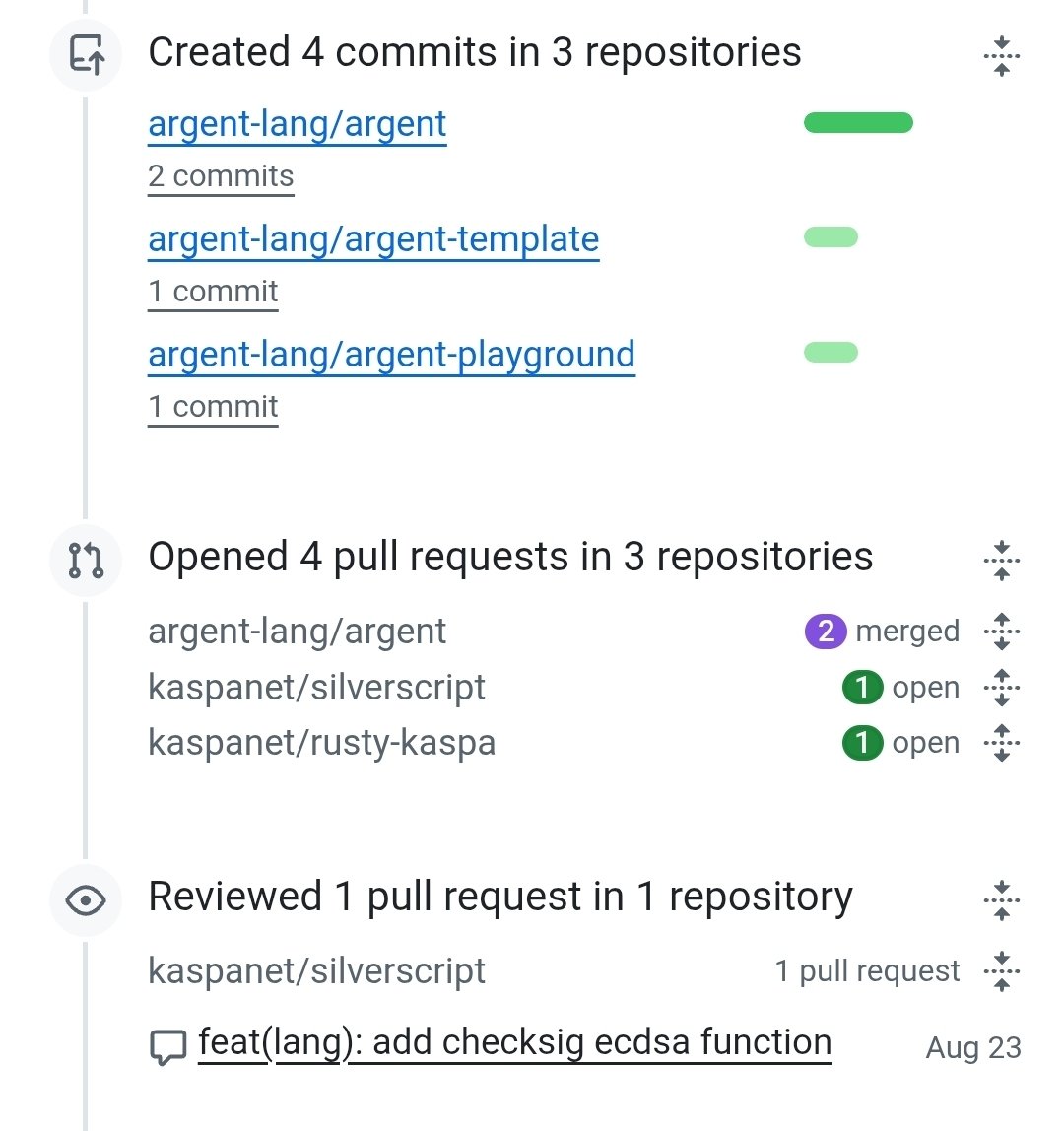
and on the third i do this (help harden silverscript + sync argent):