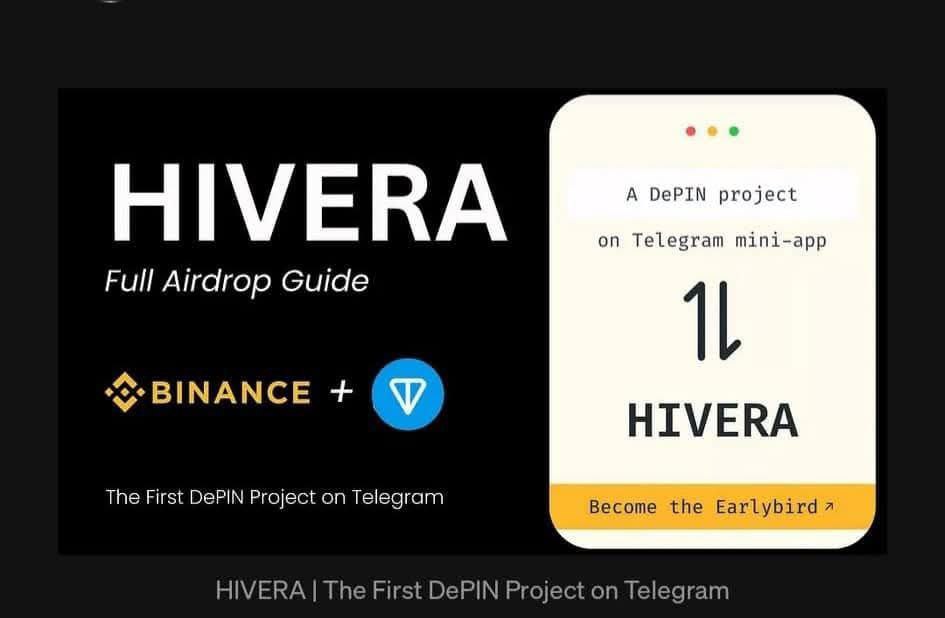
🚨ATTENTION!!!
HIVERA AIRDROP ($HIRA TOKEN)
📌It's the first Depin project on telegram, backed by TON incubator
📌Max supply is 1 billion
📌Mining started on the 16th December, ends in February
📌The earlier you start, the more coins you collect.
what really stands out to me about @axisrobotics is that, they’re not treating robot data as something you collect once and forget about.
the real value is in creating a continuous learning loop where robots can improve from real interactions, corrections and new experiences.
that matters because real-world environments are messy.
a robot needs more than a fixed set of instructions, it needs data that helps it adapt when things don’t go as expected.
that’s the part of axis i really find most interesting.
a useful way to think about the agent economy is to ask a simple question..
how does an agent become useful beyond the person who built it?
today, most ai agents live inside individual products.
their capabilities rarely travel outside that environment.
.@termix_ai is working on the infrastructure for changing that.
with AACP, agents can be represented in a way that makes their capabilities available to a broader network of economic activity.
that creates an interesting possibility...
instead of searching for another app whenever a task comes up, an agent could discover another agent that already specializes in the job.
that shift could make ai feel less like a collection of separate tools and more like an interconnected workforce.
ai agents will eventually need to hire other agents.
but that requires more than just sending a payment.
an agent needs to find the right service, agree on what needs to be done, lock funds until the job is completed, verify the result and have a record of whether that agent delivered good work.
without these layers, every interaction becomes a trust problem.
that’s what makes termix interesting.
through AACP, @termix_ai is building the infrastructure for these interactions to happen programmatically, from job discovery and bidding to escrow, verification and reputation.
the bigger picture is very simple..
if agents are going to become economic actors, they need a reliable way to work with, pay and trust other agents.
that infrastructure is what termix is trying to provide..
ai agents becoming smarter is one thing.
getting them to actually do business with each other is another.
imagine telling your agent to build a website...it finds another agent that can handle the design, agrees on a price, puts the payment in escrow, receives the work, verifies it and releases the funds.
for that to work, agents need identity, job discovery, bidding, payments, verification and reputation.
that’s the infrastructure @termix_ai is building with AACP.
the interesting part is that Termix isn’t just thinking about what agents can do, but how they can actually participate in an economy.
one thing that is easy to overlook about robotics is that a robot doesn’t learn a task simply because you tell it what to do.
knowing “pick up the cup” is very different from knowing how to actually pick it up.
the robot has to understand where to place its hand, how much force to use, how to approach the object, what to do if it slips and how to adjust when the environment changes.
these small decisions are what make physical tasks difficult.
.@axisrobotics is working on the infrastructure that captures these interactions and turns them into structured data that robotic systems can learn from.
the interesting part is that the data isn’t just a record of what happened.
it can contain the sequence of actions, the movement of the robot, the environment it was operating in and whether the task was completed successfully.
that gives models something much more useful to learn from than a simple instruction.
over time, enough of these examples can help a robot move from memorising individual demonstrations to learning patterns that generalise across different situations.
that is an important piece of the physical ai stack.
the long-term goal isn’t simply to collect more robot data.
it's to build systems that can continuously turn physical experience into better robotic intelligence.