Bringing you all the News & Analysis on Everything Energy—from the Rigs & Mines to the Blades, Panels & Batteries, and all the way to the Trading Floor.
US Oil inventories🔻16MM barrels
Cushing 6th consecutive week🔻 to 22.4MM, near operational minimum of ~20MM
Exports surged to ~6MM bopd, +50% vs. a year ago
US crude production steady at 13.7MM bopd, little changed since Iran war, despite significantly higher prices. @EIAgov
Key takeaways from the latest EIA inventory report:
• Combined US commercial crude and SPR inventories have now fallen by around 90 million barrels from their recent peak, including a 16 million barrel decline over the past week.
• Despite increases across all major fuel categories, total petroleum inventories (excluding the SPR) fell by 2.6 million barrels to their lowest level since May 2025.
• Cushing inventories declined for a sixth consecutive week to 22.4 million barrels, edging closer to the operational minimum, widely estimated at around 20 million barrels.
• The latest crude draw was driven in part by a surge in exports to nearly 6 million barrels per day, well above the 3.9 million barrels per day average recorded during the 12 months prior to the conflict.
• US crude production held steady at 13.7 million barrels per day, down 120,000 barrels per day year-to-date and little changed since the conflict began despite significantly higher prices.
• Gasoline and distillate inventories both increased, preventing diesel stocks from dropping below 100 million barrels for the first time since 2003.
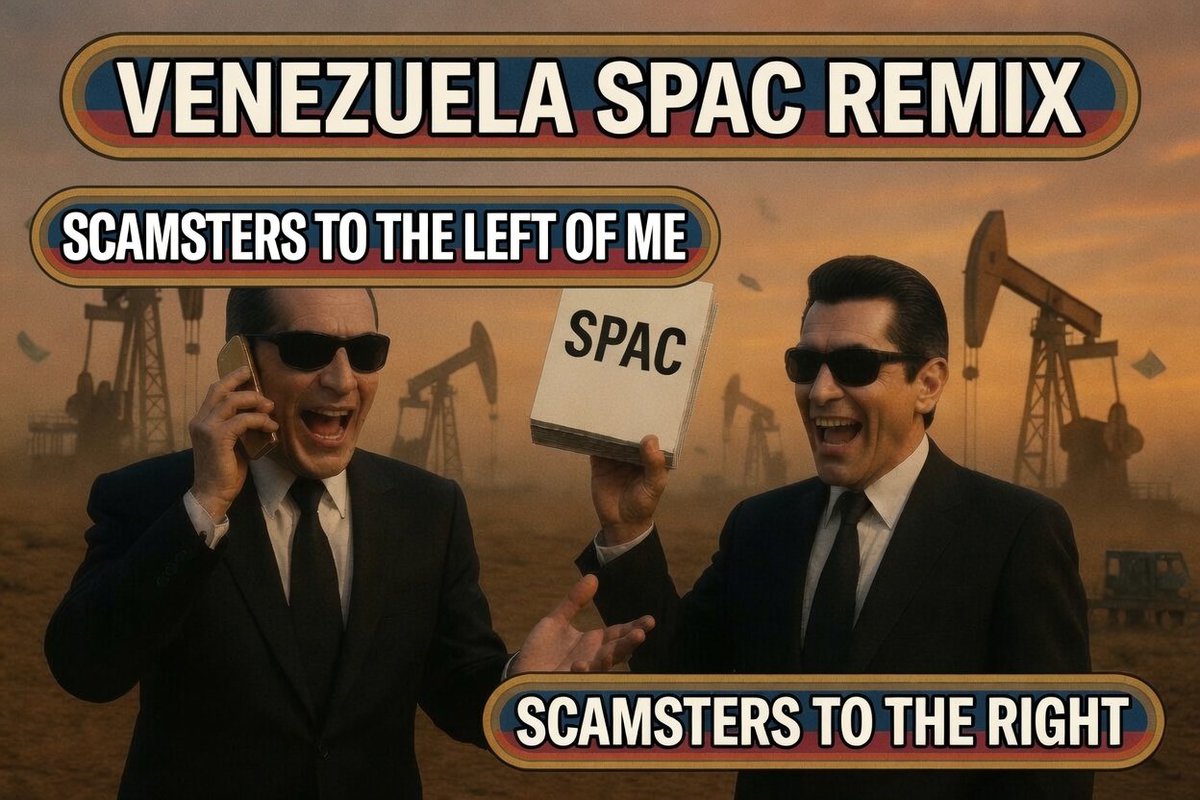
🤐Lionheart Capital SPAC in Talks to Buy Oil Fields in Venezuela
Lionheart Capital is lining up as much as $2.25 billion to invest in the Venezuelan energy industry through a special purpose acquisition vehicle, according to people familiar with the matter.
Clear Street LLC, a Wall Street brokerage, has agreed to provide $1.5 billion for the acquisitions and subsequent capital expenses to rehabilitate the fields, the people said, with the remainder coming from Lionheart’s own funds and bank financing. (Bloomberg)
@Scotian82@business In a Deplorable state. 15 years without proper maintenance and replacement of damaged installations.
Inspections? 🤣🤣 Inspections only come—if ever—after an explosion, leak, etc.
The problem remains getting paid.
Jeff, we know you’re just getting started to @X, but you gotta take your foot off the AI-accelerator 😅
And although most would’ve gotten it, you should also probably mention you’re a director of BORR 😉
You cannot print molecules. You cannot print the rigs $BORR that lift them either.
In a gold rush, the money isn't in the gold. It's in the picks and shovels.
Shale is likely finished as a source of growth. The remaining short-cycle barrels now sit in shallow water — and the Middle East has spent fifteen years drilling its way offshore as its onshore fields deplete. Saudi, the UAE, Qatar: all the growth is offshore now.
That barrel needs one thing above all else: a jack-up fleet. However, there are zero new orders and zero new-yard slots for years. Unsurprisingly the global fleet only shrinks — a third of the rigs on the water are over thirty years old and aging out. At $BORR they average seven. A newbuild theoretically costs $300m, and the dayrates haven’t come close to justifying one — rates must double, and lengthen, before a single rig gets ordered.
Now layer the demand. The buyers are National Oil Companies (NOCs) in countries GDP is heavily exposed to the barrel — the most inelastic clients in any market. The fleet was already above 90% utilized and rising before the war. After the fighting stops: pent-up Gulf tenders, field declines to offset, shut wells to bring back. And the order book already tells you where this goes — energy-security pushing work in Vietnam, Malaysia, Suriname, Gabon.
The security premium is no longer theoretical. It’s in the contracts. Either Hormuz reopens and pent-up demand from Saudi Arabia and the UAE skyrockets, or oil pushes into uncharted territory and the international NOCs pick up the tab.
Few other energy assets are this exposed to both tails. Low-breakeven shallow-water barrels are the supply the world needs to meet the coming crunch. And pick-and-shovel maker gets paid whether or not the miner strikes.
Now the part the market is missing. The whole enterprise trades at roughly forty cents on the cost of replacing its own steel. Enterprise value is about $4bn, split almost evenly — half debt, half equity. The debt is fixed. It does not re-rate. So every dollar the fleet gains as it runs toward newbuild parity falls straight through to the equity.
That is the engine. The debt does not move; the steel does. Re-rate the fleet to what it would cost to rebuild, and the equity does not double — it quadruples. The equity does not track the steel. It multiplies it. The 4x leverage is not the risk in this trade. In the upcycle, the 4x is the trade.
You can buy an irreplaceable strategic asset at less than half its replacement cost — with the leverage thrown in for free. The market is selling the quarter. We're buying the decade.
$BORR is down 14% today on a delayed rig start-up and a one-time receivable provision — operational noise, not structural damage. Utilization held at 97%. Full-year coverage rose to 71%, and the back half of the year jumped from 48% to 65% booked. Nothing in the supply, the demand, or the steel has changed.
The one thing that did move — the Middle East conflict — barely touched the financials and made the multi-year case stronger. Every affected rig is back at work. Tenders keep progressing. Management is more confident on 2027 and 2028, not less.
The market is selling the noise and ignoring the signal. The dislocation is the entry.
Get long. Buckle In. HALO.
.@USTreasury is issuing a temporary 30-day general license to provide the most vulnerable nations with the ability to temporarily access Russian oil currently stranded at sea.
This extension will provide additional flexibility, and we will work with these nations to provide specific licenses as needed. This general license will help stabilize the physical crude market and ensure oil reaches the most energy-vulnerable countries.
It will also help reroute existing supply to countries most in need by reducing China’s ability to stockpile discounted oil.
Reuters News
- IMF: WE ARE AWARE OF VENEZUELA'S ANNOUNCEMENT INITIATING EXTERNAL DEBT RESTRUCTURING, BUT HAVE SO FAR NOT BEEN INVOLVED IN THE PROCESS
- IMF SAYS VENEZUELAN AUTHORITIES HAVE NOT REQUESTED FINANCING FROM THE IMF.
Shell is eyeing Venezuelan gas and routing it through Trinidad.
Shell CEO Wael Sawan confirmed the company is in active talks with Venezuela's government to advance offshore gas projects.
The plan: produce Venezuelan offshore gas and channel it through Trinidad and Tobago's Atlantic LNG facility for export.
The logic is straightforward.
Atlantic LNG already exists.
The infrastructure, the offtake contracts, the export terminal all in place.
Venezuelan offshore gas fields sit close enough to Trinidad to make a pipeline connection viable without building a greenfield LNG facility from scratch.
Shell avoids the capital cost.
Venezuela monetises stranded resources it has no way to develop alone. Trinidad gets throughput to keep its underutilised facility running.
But the risk is real.
Any Shell involvement would require either specific OFAC licences or a broader sanctions relief framework.
Sawan flagging it publicly on an earnings call suggests Shell believes the political trajectory is moving in the right direction.
Watch Washington's posture on Venezuela sanctions over the coming months.
That is the actual gating factor.
As expected, US renews the standstill protecting CITGO from creditor collateral execution for another 45 days until June 19, 2026.
OFAC General License 5W, Issuance of Venezuela-related General License and Amended Frequently Asked Question https://t.co/44nazxIVRp
Reality Bites: With Less than 40% of its generation capacity currently available, Venezuela's revival ain't gonna happen. Yet Power suppliers hesitate to come (back) without payment guarantees.
"They still have no clue on how we would get paid." https://t.co/Vi6G48BOB8
“Facing a larger and more powerful neighbour's designs on our territory has not only threatened our peace and security, it has held back our development.”
Venezuela’s “unlawful” claim applies to +70% of its territory, Guyana said at the World Court in The Hague.