“Generate UI” sounds cool.
Until you realize most outputs can’t survive iteration.
Fizzy is built for the second step.
Where things get edited, broken, and improved.
Design rarely happens in one prompt.
Ideas evolve.
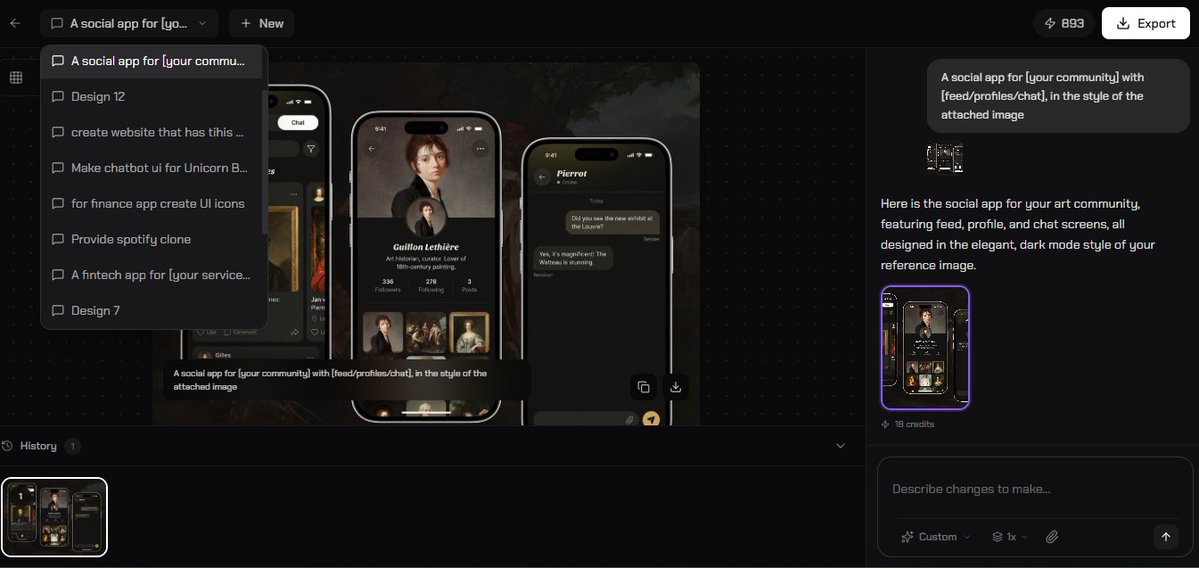
Fizzy keeps every attempt as a structured design workspace.
You can revisit, iterate, and branch ideas without restarting the process.
With AI replacing everyone’s jobs, one question that’s being asked by many people to me:
“which skills should I learn?”
The only suggestion I’ll give is: learn animation and design, and you’ll be the most secure person.
Design skills with animation skills is a very dangerous combo and will give you visibility + projects offer easily!
Design isn’t one artifact.
It’s a set of related ones.
UI
Icons
Illustrations
3D
Wireframes
Full interfaces
Fizzy generates the right layer from the same intent.
Introducing Fizzy : The Cursor for Design
design at the speed of thought.
an AI design platform that turns plain text into production-ready logos, websites, apps, posters, and illustrations in seconds. it understands design the way a senior designer does so you can ship professional work faster than hiring one.
$FIZZY presale now live on https://t.co/bRX3R4szNV
AI Capital Markets
"Design at the speed of thought"
@Fizzy_AI is launching on Capx today.
Raffle opens in 12 hours on https://t.co/hDpZjO49ig.
Here’s how it works:
1. Users enter by getting Raffle Tickets : each ticket requires committing 300 $CAPX.
2. A total of 6000 tickets will be available.
3. From these, 900 winners are selected randomly for allocation.
4. All non-winning participants receive a full refund of their committed $CAPX.
5. Allocation Winners: their committed 300 $CAPX is deposited, and each winner receives 0.1% of the total $FIZZY supply.
btw the last raffle had 6000 tickets sold in 57 mins so be quick ;)
AI Capital Markets.
everything you need to know about fizzy
what it actually is
fizzy is a text-to-design platform. you describe what you want in plain language, it generates production-ready designs in seconds.
the model
we're built on gemini 3.
most ai design tools are repurposed image generators. they can make pretty pictures but they don't understand design. they don't know what a logo needs to do. they don't get information hierarchy in a landing page. they can't think about mobile app UX.
we trained specifically for design outputs. the model understands composition, typography relationships, whitespace, visual balance... all the stuff that separates "ai generated image" from "actual professional design."
what it generates
this is where we're different from basically everyone else. most tools pick a lane. we cover the full spectrum:
- logos and brand marks
- websites and landing pages
- mobile app interfaces
- illustrations
- posters and marketing materials
- social media graphics
one platform. one interface. every design category a founder or creator actually needs.
output quality
when we say production-ready, we mean it.
these aren't starting points you have to spend three hours fixing. the exports are clean. the files are properly structured. you can take them straight to dev, straight to print, straight to your website.
where fizzy fits in your stack
we're not trying to replace figma. figma is incredible for collaboration, iteration, design systems, handoff. that's a different job.
fizzy sits upstream.
the workflow looks like this: idea → fizzy → finished design OR idea → fizzy → figma for refinement → finished design
we accelerate the zero-to-one phase. you generate the first version in seconds instead of hours. then if you need to collaborate or iterate with your team, you take it into figma.
we're the spark. figma is the workshop.
speed architecture
our entire infrastructure is optimized for one thing: latency.
the whole point is that your imagination becomes the bottleneck, not the tool. the experience should feel immediate. describe it, see it, move on.
the data flywheel
every generation makes the system smarter.
as more users create with fizzy, the models learn what works. what design patterns people actually want. what prompts map to what outputs. the template library expands. the quality improves.
this is compounding. early users are training the system that later users benefit from. and the more categories we cover, the more indispensable the platform becomes.
launching today on @0xCapx
Design is the last creative frontier that hasn't been democratized. Development got no-code tools. Writing got AI assistants. But design? Still locked behind expensive software, steep learning curves, and the constant hunt for skilled designers.