Excited to share our @natgenet.nature.com study showing that epigenetically rewired transposable elements control AML leukemia stem cell properties and patient outcome.
Grateful to the team & collaborators. https://t.co/3XO9vlbLUT
Excited to share our Nature Genetics Research Briefing on how the repetitive genome helps shape leukemia stemness.
We found that transposable elements sustain stem-like states in AML and predict patient outcomes.
https://t.co/VneAltovj1
Excited to share our Nature Genetics Research Briefing on how the repetitive genome helps shape leukemia stemness.
We found that transposable elements sustain stem-like states in AML and predict patient outcomes.
https://t.co/VneAltovj1
Excited to share our @natgenet.nature.com study showing that epigenetically rewired transposable elements control AML leukemia stem cell properties and patient outcome.
Grateful to the team & collaborators. https://t.co/3XO9vlbLUT
Our new study found that ancient DNA sequences in our genome, called transposable elements, can act as control hubs for leukemia stem cells, fueling therapy resistance and relapse in AML.
Led by @MatLupien & John Dick @UHN@pmcancercentre.
@NatureGenetics: https://t.co/4UAlmJqIl1
New study introduces MOLEA, an AI platform that designs lipid nanoparticles for precision RNA delivery and therapeutic gene editing. @NatureBiotech#RNAtherapeutics
Read more: https://t.co/t58kcajqB0
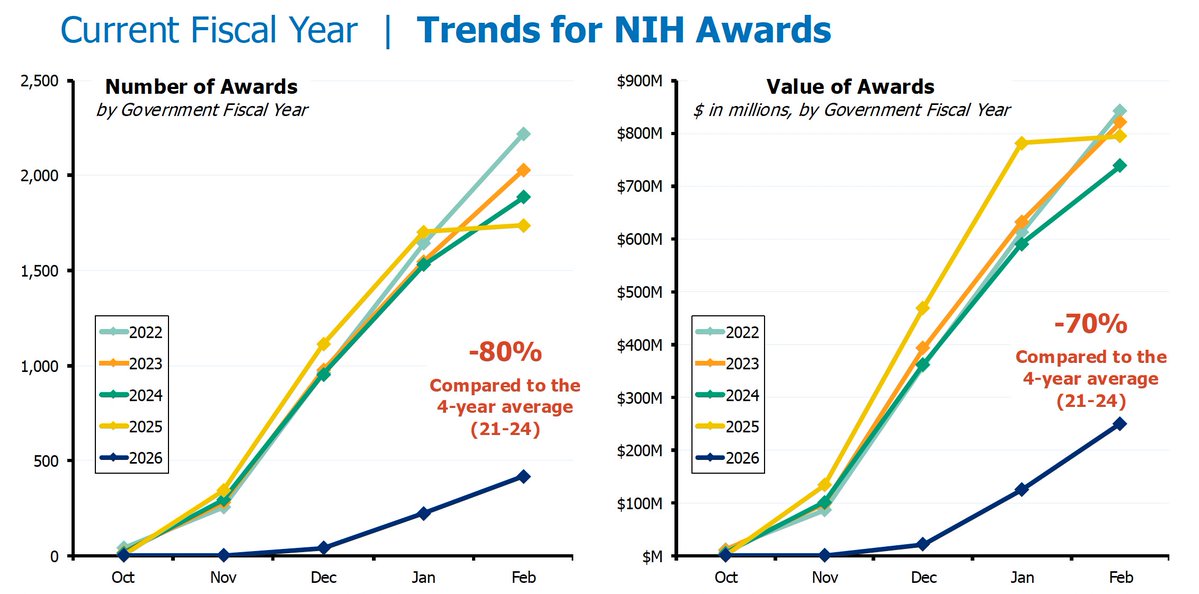
Federal funding for US biomedical research is moribund.
Since October 1 2025, NIH is -80% in new grants and -70% in values (total dollars).
Labs are closing down and researchers are leaving science.
To what end?
Pleased to share our new @NatureCancer paper: We harmonized cfMeDIP-seq across 11 cancer types, integrating methylation & fragmentation to boost detection. https://t.co/BK2TRUs8co
🌟New Resource article
Read about the pancancer landscape of cancer-specific cell-free DNA methylation and fragmentomic features from plasma samples from 1,294 patients
✒️Yong Zeng, @MatLupien, @PughLab, Housheng Hansen He & colleagues
https://t.co/niJ57sU9N2
Researchers @UHN@pmcancercentre analyzed 1,294 blood samples from 11 cancer types to build a comprehensive atlas of DNA methylation patterns, advancing pan-cancer detection and monitoring using liquid biopsy: https://t.co/Zyz50tJ5Ra
@UHN_Research@MatLupien@hansenhe7@PughLab
Massive team-science effort across @PMCancerCentre/@UHN, @UofT, @OICR and collaborators (incl. @TrevorPugh & Hansen He labs; lead author Yong Zeng). https://t.co/BK2TRUs8co
Pleased to share our new @NatureCancer paper: We harmonized cfMeDIP-seq across 11 cancer types, integrating methylation & fragmentation to boost detection. https://t.co/BK2TRUs8co
Our new study found that, when prostate cancer cells spread, they adopt an “inflammatory-like” state and mimic immune cells, suggesting new ways to control cancer progression.
Co-led by @MatLupien@UHN@pmcancercentre with @DKFZ:
https://t.co/uYGbTmkTu5
Our new study found that, when prostate cancer cells spread, they adopt an “inflammatory-like” state and mimic immune cells, suggesting new ways to control cancer progression.
Co-led by @MatLupien@UHN@pmcancercentre with @DKFZ:
https://t.co/lcHTyeCCHx
A jewel of a presentation on the history of chromatin. Always a pleasure to go back in time with those who helped shape it. I am grateful for the insights and stories shared by Drs. Ada and Donald Olins.
https://t.co/d92wjrljRs
Less than a month to go until the GRC on Hormone-Dependent Cancers! Looking forward to reconnecting with the community and sharing our latest on epigenomics of ecDNAs in tumor evolution. Hope to see you then. https://t.co/V70ymVsL7r