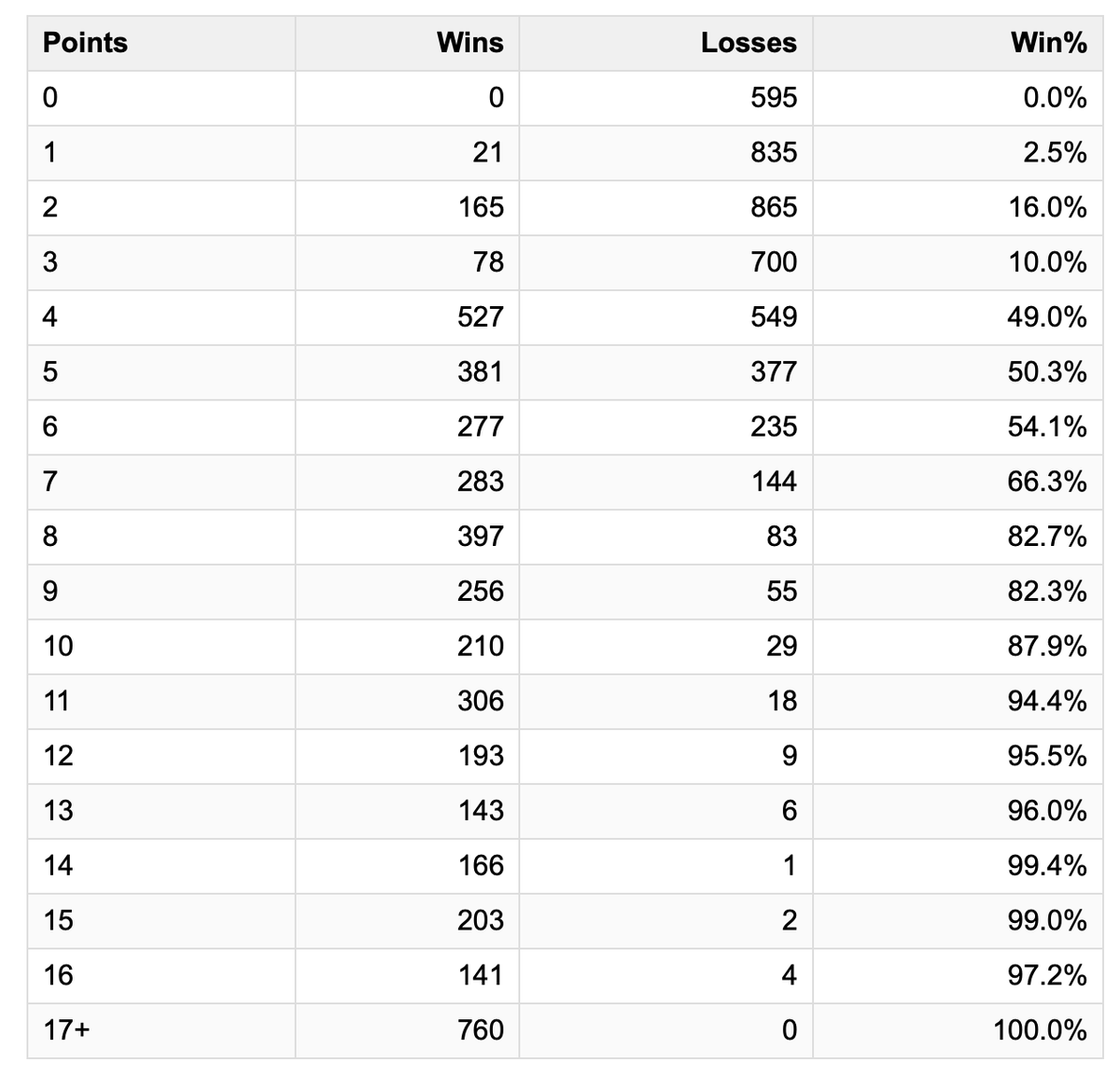
We teach our kids to score points and keep scoring points. The magic number used to be 7 to have a good chance at winning, but with the new scoring system you really need to be getting 8-10 to win the majority of your matches.
Unless you're AJ Ferrari bro. And you probably aren't.
This data is based on every D1 match wrestled so far this season.
@oldestgreatest@wrestlingbypir8 I was answering multiple questions at once, and had Jesse Mendez’ profile up, not Drake. So my example was Jesse.
As for Echemendia, spelling was never my strong suit.
40 years ago, baseball came up with the metric of WAR - Wins Above Replacement.
And it changed how we value players.
Wrestling has needed something like this for a long time.
But how do we compare Messenbring (165) to Mendez (141)? How do we value free agents? What weight classes does my team need to upgrade?
If baseball can compare the value of a 3rd basemen to a centerfielder, then we should be able to compare a 165 pounder to a 141-pounder.
That's why I created TPAR.
I think so? Like I told Pirate, I don’t really understand DII other than it does take into account SoS and margin of victory, so in that sense these metrics are similar.
There’s a lot of technical detail beyond the simple explanation, all in an effort to make this metric useful and predictive. I suspect there’s a lot to DII too.
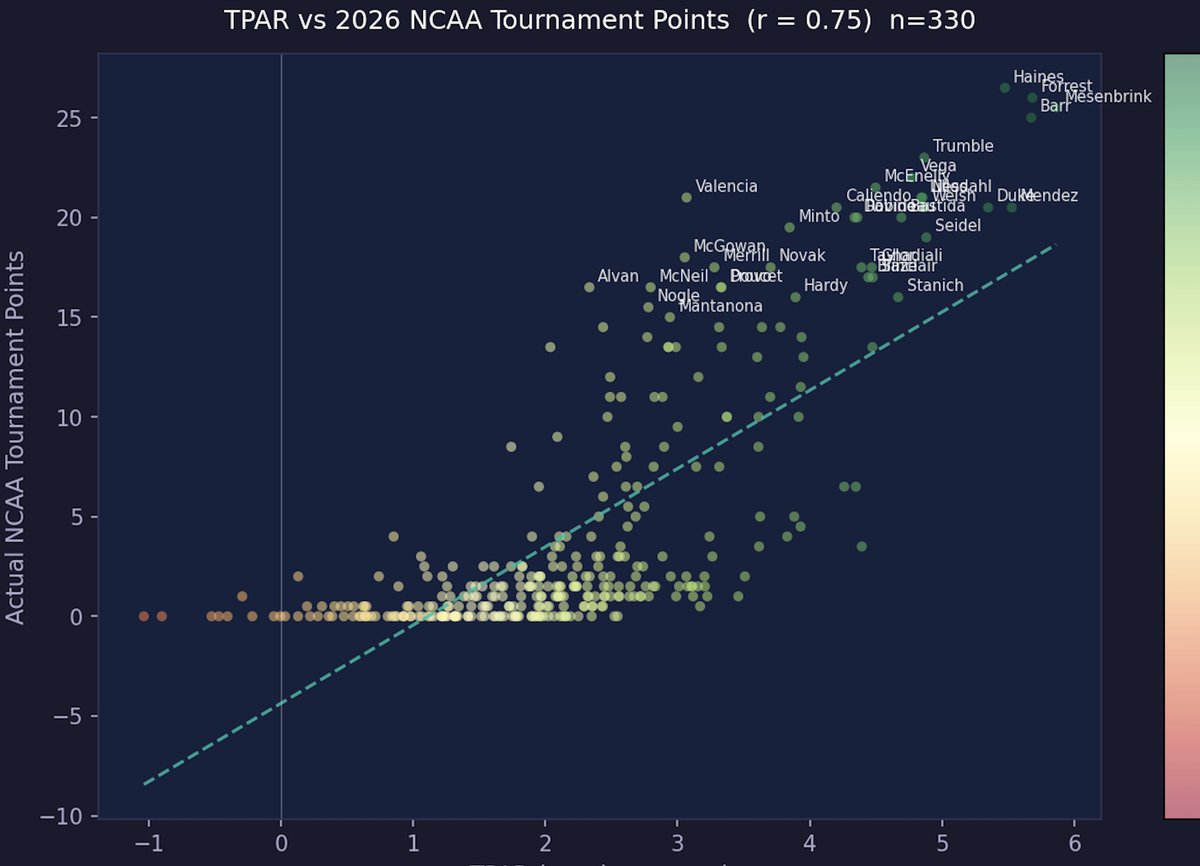
This is a quick visual of TPAR to NCAA tournament points. It needs to be analyzed in detail, and it's also the TPAR at the end of the season, so it's a little misleading in that it takes into account the tournament results.
But I think it shows trends in ranges:
TPAR < 0 -> Probably not making the tournament at all
0-1: Probably not scoring
1-2: Maybe a point or two.
2-3: Still expected to score minimal points, but there's finally an upside (Valencia being the ultimate goal)
3-4: These are the real AA contenders
4-5: At this point the expectation is AA
5-6: Champion or bust
High 5 to 6 is Hodge candidate.
This makes sense, as a 6 means you are expected to pin the average wrestler.
I'm aware of the Dual Impact Index as I've followed you for a while, but I don't honestly understand it. I just went back and read the description, and I still don't understand it.
For TPAR, if I look at heavyweight I see Isaac Trumble with +4.9. Taye is +4.5 and AJ is +3.9. So if I replace my team from AJ to Isaac, I can expect to score 1.0 points more per dual, on average (3.9 to 4.9). If I replaced AJ with Taye, I would only expect 0.6 points more, on average.
When I look at Dual Impact Index, what does it mean? I see that Taye and AJ are both above Isaac, with scores ranging from 154 to 160. But I can't honestly tell you what it means. It seems like it takes into account opponent quality, as well as margin of victory. So that's similar, but beyond that I'm not sure.
In the official stats, he's 7-0 with 6 bonus. His only non-bonus was still a win over All American Caleb Campos.
In actuality, he lost to Rocco. TPAR filters out teammate matches right now, because that's a standard practice. But I'm not sure if that's the right decision going forward.
Currently, the TPAR results on the website have a minimum of 3 matches. And I think to some extent it's OK because TPAR does a pretty good job of gauging value even with a low sample size. But there are limits to everything.
In the future I plan to make that a user setting, so users can filter out someone like Asher with only 7 matches at the end of the season. (It does show the # of matches in the far right column on the page)
That’s half the equation. The other half takes in to account the opponent.
For example, Drake Ayala’s 5-1 decision over #5 Eschemendia worked out to +5.8 TPAR, where as his tech of #51 AJ Rallo was +5.7 TPAR.
The old NCAA dominance measurement would value the Rallo tech significantly higher than the close win over Eschemendia. TPAR says the two results show similar value.
TPAR is live for every D1 wrestler across all 10 weight classes, with a match-by-match breakdown so you can see exactly where dominance was earned or lost.
This is the metric wrestling has always needed; we just didn't know it.
https://t.co/os7M0J8PIP
@SpeyWrestle@wrestling_info_ Yeah I get it. I think the problem isn’t that he should get special treatment, it’s that the non-special treatment ignores legitimate data.
But I’m not here to tell Flo how to do their rankings, I do appreciate consistency. 😉
Although I disagree with much of this list, I do wholeheartedly support putting Bo in tier 1, and not pretending like we’re not sure if he’s gonna be good until he proves it.
Unlike Flo’s treatment of PJ Duke last year.
I hate to rehash this but here we go…
PJ Duke was 6-0 with 5 falls and a dominating win over a guy who had just beat returning champ Antrell Taylor (although it ended in injury, he was about to tech him).
He also had just made the senior world team with two wins over Yianni. But I know that’s freestyle so it’s just a side point.
Flo still had him outside the top 10.
@CoachBeede If you are smart enough to get into Ivy’s, then you’ll be fine either way.
If you only got in because of athletics, you’d probably be better off taking the scholarship somewhere else and saving the money.