@DuxVul2 It’s funny to see woman girlbossing in their 20s completely shift gears when they have a kid. But usually the guy is completely unprepared and expects her to keep working the same
Where should AI actually sit in a Bank’s core?
@tuumplatform has a pretty clear answer:
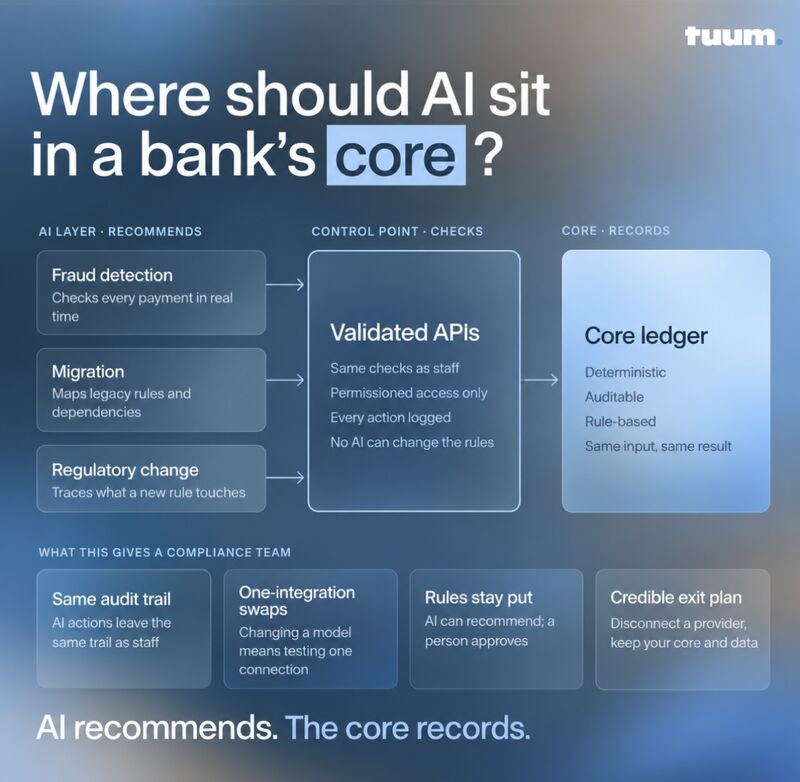
AI should recommend. The core should record.
The argument is simple.
AI models are probabilistic. Bank ledgers cannot be.
A transaction needs to post the same way every time, with rules that are deterministic, auditable and explainable.
So instead of putting AI inside the system of record, Tuum argues for an “around-the-core” architecture:
→ AI reads, analyzes and recommends
→ Validated APIs control access
→ Every action is logged
→ Humans approve material rule changes
→ The core ledger remains deterministic
→ AI providers can be swapped without touching the core
That last point could become increasingly important.
The best AI model today may not be the best one 12 months from now.
Banks that separate the AI layer from the core can change providers without having to re-engineer (or potentially re-validate) the system holding their customer records.
There is also a regulatory angle.
The EU AI Act, DORA and US model-risk guidance all increase the importance of explainability, audit trails, human oversight and credible exit plans.
Tuum CPTO Ove Kreison puts the principle neatly:
“AI reads, analyzes and recommends, while the core keeps the record, applies the rules and behaves the same way every time.”
The more AI enters banking infrastructure, the more important this architectural question becomes.
AI recommends. The core records.
I highly recommnend reading the complete article on this very interesting topic: https://t.co/OPGuB5TOiE
Do you think this becomes the standard architecture for AI-native banking?