Every government I've spoken to wants AI in public services. The hesitation is never about the technology. It's about the data: where it goes, who can see it, and what happens if it leaks. That's why we start from the other end. Keep the data where it is, and bring the AI to it.
I shared how we take this from pilot to scale in techUK's Digital Transformation in the Public Sector series. Thanks @techUK for having me.
Me talking to my wife. “I’ve had a rough day. I had to think through all these crazy life events today for something I’m working on and I’m just mentally wiped right now and in my bag.” My 11 year old as soon as I’m done saying that, “Dad I have questions about compounding interest.
190 of 195 countries carry debt with no real repayment plan. @Forson , President of @DeFiTechGlobal , says that means you're already a shareholder in it, whether you know it or not.
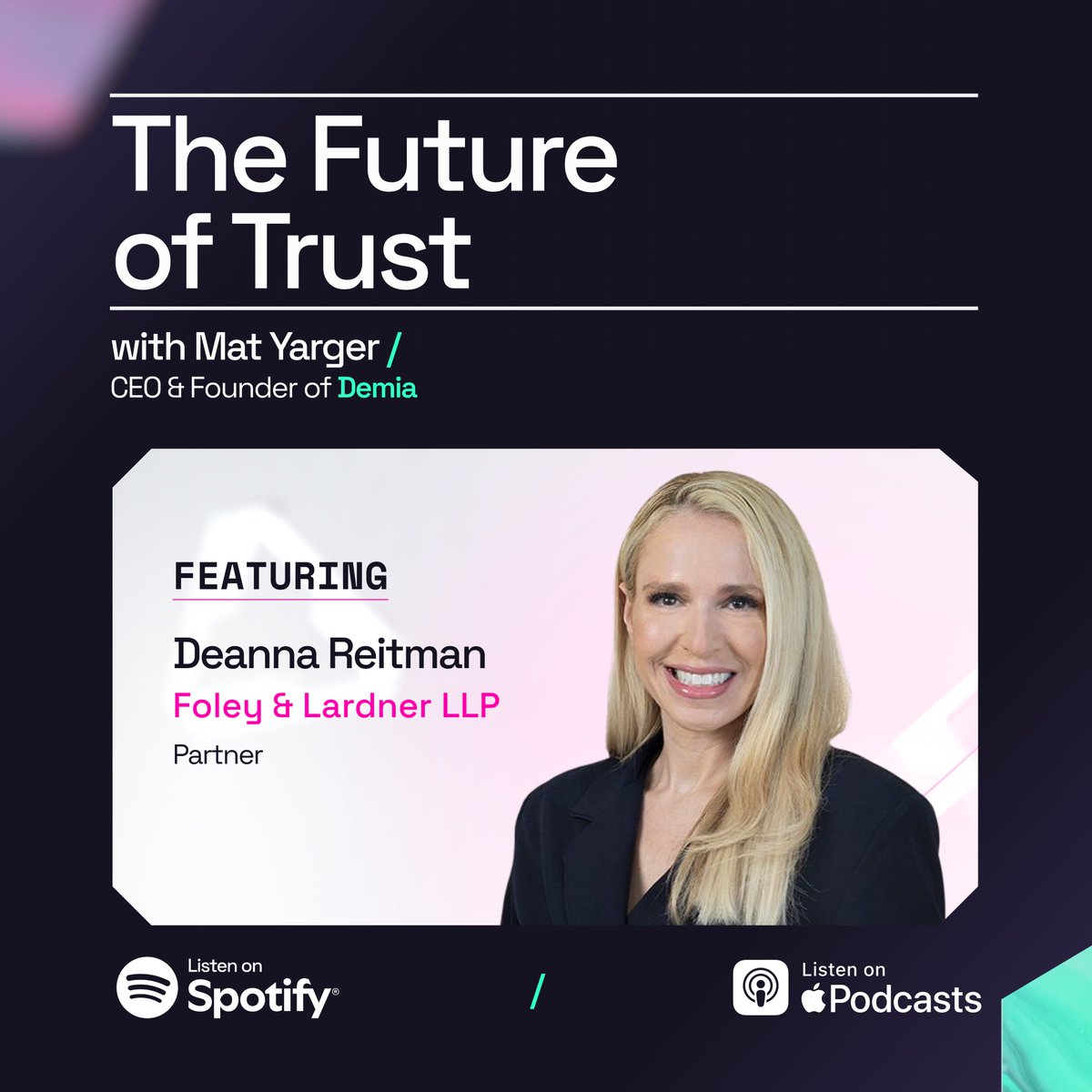
👇 New episode of The Future of Trust, link in the comments.
"Data doesn't prove ownership. Leases do."
That gap between data and proof is where a lot of digital markets fall apart.
In the latest episode of The Future of Trust, our Founder & CEO @Mat_Yarger invited Deanna Reitman, Partner at @FoleyandLardner, for a discussion on what actually breaks when markets move faster than the law backing them:
⚖️ Why standards get written without checking the law underneath them
📉 What happens when deals unwind because ownership was assumed rather than proven
🔍 What Deanna needs to see before she'll stand behind any system – digital or otherwise
🌍 What carbon markets and digital assets need before they hold up under pressure
For anyone building verification infrastructure, this is a clear look at why provenance has to be legally defensible, not just well-documented.
Links to the episode in the comments. 👇
Three years ago, @_Demia was a thesis.
The thesis: Corruption lives in the gap between what’s claimed and what’s true. Most markets run on data nobody can verify, so that gap stays wide. Verify from the source, at scale, and the room for corruption collapses. Trust the data, trust the outcome.
Three years in, that hasn’t changed. What’s changed is the evidence.
Today we’re marking three years of turning that thesis into infrastructure.
That infrastructure now runs across critical minerals and materials value chains: green steel, responsible mining, and refining and processing intelligence. It carries the same verified production data from operational monitoring on the ground up to investor and compliance reporting. One verified data layer, used wherever it’s needed.
It also backs conservation work across more than 650,000 hectares, and working relationships with auditors, financial institutions, governments, and operators on multiple continents. 🌎
The foundations held. Year four is about showing what they can carry.
That means showing the verification frameworks, the chain of custody results, and the data behind supply chains tested under real scrutiny. Corruption, fraud, and greenwashing all live in that gap between claim and truth. The evidence is what closes it. Case by case. Market by market.
To the partners, collaborators, and operators who got us here: thank you. You extended trust before the results were public. That’s what made this possible.
Want to follow what’s moving in critical minerals and materials as this unfolds? Subscribe to our newsletter, Material Evidence. Link in the comments. 👇
❌ A purity certificate is not a purity record.
That gap, between what a refinery claims and what it can actually prove, is where supply chain security is being built or abandoned right now. And this week, the market made clear it knows the difference.
Capital is moving toward the full mine-to-refinery chain. Governments are conditioning mineral access on in-country processing. Certification standards are tightening from general reportability to 171 specific operational requirements. The pressure on self-certified purity claims is real and it's accelerating.
This week's edition of Material Evidence covers electrochemical processing: what it actually does at the end of the refining chain, why the purity question has become a finance question, and what it takes to turn instrument-derived cell data into something a buyer, auditor, or capital allocator can actually rely on.
We also cover:
💰 CopperTech's New York Stock Exchange filing and what public markets are telling you about refinery asset pricing
🇪🇺 🇿🇦 The EU's €12 billion South Africa minerals roadshow and the beneficiation condition attached to it
🔍 What the Codelco recertification story actually reveals if you read past the headline
The verified production record is becoming the product.
🗞️ Subscribe to Material Evidence to stay on top of what's moving in critical minerals. Link in the comments.
Our Chairman Nicholas Parker co-founded CleanAI. Today, CleanAI published research on Canada's clean AI sector – the same day Ottawa released its national AI strategy. 🇨🇦
The numbers are worth reading. US$3.5B raised since 2020. More than 230 ventures. 7,700 jobs supported today. The path to 2030: US$9B in capital and 30,000 jobs, concentrated in water, energy, food security, mobility, and critical minerals.
What makes this credible is where the demand comes from. These aren't generative AI bets on markets that don't exist yet. Clean AI targets physical economy problems: known sectors, known buyers, measurable outcomes. 🤖
Critical minerals is one of them – and it's where Demia operates. The value chain from mine to battery to OEM runs on verified data. Who produced it, where, under what conditions, with what emissions profile. Without that data infrastructure, clean AI in the minerals space is just a pitch deck.
Nick has been building toward this for two decades, and he even coined the term cleantech in the early 2000s. Seeing him chair Demia while leading CleanAI at a moment like today is something we don't take lightly. 🙌
Congrats to Nicholas Parker and his colleagues at CleanAI – @shivanichotalia, @emilymacintosh, and Donald Mak – for this great achievement!
🔗 Learn more: https://t.co/cJlv3Cshd5
May had a lot going on in critical minerals.
🌎 A ministry extended its reach across an entire supply chain – not just at the border.
✅ A billion-dollar rare earth project finally got the green light after years in development.
🪨 The largest instrument in the federal critical minerals stack moved toward its first close.
🔍 A divestment order got tested in ways the compliance framework wasn't built to catch.
📊 And copper told a very different story through treatment charges than it did through spot price.
What did it all mean for sourcing, processing, and where the real risk sits heading into summer?
Material Evidence May recap is out. The ore you know, the stronger you forge ahead. Link to subscribe in the comments. 👇
@TiffanyWang98 and I covered a lot of ground in this one.
What started as a conversation about her path from corporate law to federated AI turned into one of the more honest discussions we've had on the show about what trust actually requires, in systems, in institutions, and in the people building them.
The through-line that stuck with me: the problem was never that the technology didn't exist. It's that the incentives were never designed to protect the people using it. That's what @flock_io is trying to change.
Well worth a listen if this space is on your radar.
New episode of The Future of Trust is out. Ep. 23 - @TiffanyWang98, Head of EMEA at @flock_io
Tiffany’s path to federated AI goes through corporate law, @PwC fraud investigation, and a very deliberate decision to stop writing fancy reports that nobody implements and start building systems that actually do something.
FLock uses federated learning to train AI models on private data without ever leaving the device it resides on. No central server. No single company holding the keys. Everything auditable on-chain. It’s built for sectors where privacy isn’t a preference, such as healthcare records, government data, and financial access for communities that have been cut off from traditional systems.
In this episode, we talked through:
🔎The difference between trusting a company’s promise and trusting the architecture itself
🌎 FLock’s @UNDP partnership is building climate resilience infrastructure for unbanked women in Latin America
🏥 How the Mauritius government is using federated learning to let patients contribute health data without handing control to a department that doesn’t need it
⚖️ And what Tiffany’s background in fraud investigation taught her about the gap between what organizations say and what they actually do.
@Mat_Yarger
https://t.co/mKGfbdvUqt
Link in comments 📷 👏
Where in your career have you chosen mission over profit, speed, or comfort? Or what problem do you wish more people would step up and take responsibility for, even if it’s hard? I’ve had the chance to speak with Amy McCrae Kessler many times over the past year, and this conversation on The Future of Trust brought it all together.
Amy is someone who chooses mission first. Every. Single. Day.
She talks about helping stand up the @ambiogascouncil in this clip. What she doesn’t say out loud, but what comes through clearly, is how hard that work actually was. Building trust across competitors. Aligning policy, capital, and incentives. Choosing to organize an industry instead of optimizing for a single company.
That theme runs through the entire episode.
We talked about her early volunteer work with orphaned #orangutans in Borneo. Her time in environmental law. Helping found the American Biogas Council and US Biochar Coalition (USBC). Walking away from paths that didn’t align. And what it really takes to turn fragmented climate ideas into durable infrastructure, from biogas to biochar to integrated energy systems.
That integrity is why we’re planning to work together through @_Demia and @FacetPower to support project developers with #trusted data, #financing pathways, and development tools, especially in regions like Africa, where the need is real, and the margin for error is small.
If you care about how climate markets actually get built, how #trust is earned across systems, or what hashtag#leadership looks like when it’s inconvenient, this episode is worth your time.
Drop your thoughts in the comments.
🌐 The systems we rely on every day quietly shape our choices.
In our latest episode of The Future of Trust, our founder and CEO @Mat_Yarger sat down with @andyellwood, Founder and CEO of #Stretch to explore trust, transparency, and the everyday decisions that impact families.
Key takeaways:
🤖 How AI and structured data can give families a clear picture of what their weekly shopping should cost
💡 Why invisible incentives in everyday systems matter more than we realize
✨ Lessons from Andy’s journey: from childhood budgeting to building tech that serves people, not just numbers
🌱 The role of trust in designing systems that are transparent, fair, and human-centric
Clear. Fair. Accountable. That’s how we design systems people can actually trust. 🤝
Listen now:
🎧 Spotify: https://t.co/89VykxOeDW
🍏 Apple Podcasts: https://t.co/WFy8stoxIu
Climate progress accelerates when risk is visible, data is credible, and incentives align. 🌱📈
On today’s episode of The Future of Trust, our founder & CEO @Mat_Yarger sit down with Amy McCrae Kessler, Co-Founder and CEO of @FacetPower, a leading voice in next-generation climate infrastructure. 🌍
In this episode:
🔹 Why climate capital still struggles to deploy
🔹 Environmental harm as a measurable financial risk
🔹 Traceability and life cycle analysis as trust infrastructure
🔹 What it takes to move carbon removal beyond pilots to scale
What does a climate project need to prove before you would trust it at scale? Let us know in the comments!
🎧 Full episode link in the replies 👇
@_Demia@FacetPower I've spoken with Amy probably a dozen times over the last year. This episode really brought together a lot of what we're working toward together.
Listen to the episode on Spotify or Apple Podcast!
https://t.co/3Dt51zDwMI
https://t.co/8wh7y481Sc
Material Evidence went out this morning. What stands out to me most this week is how clearly the market’s friction points are showing.
#CriticalMinerals are not constrained by ore.
They’re constrained by friction from everything that slows execution after discovery.
Processing bottlenecks.
Governance complexity.
Ownership scrutiny.
The long path from feasibility to verified throughput.
The challenge is not that proof is impossible.
The challenge is that proving what’s real in these markets is not a simple science. It’s an in-depth, manual process that consumes enormous human capital.
And this is an industry with limited, aging expertise, where scaling execution means amplifying the impact of the people already doing the work.
That is where the next shift happens.
At Demia, our mission is simple:
Secure data. Remove friction. Amplify impact. Unlock value.
The future of critical minerals depends on embedding verification into the infrastructure itself, turning trust into systems, and increasingly into policy-as-code, so execution can scale without relying on endless manual reconciliation.
#MaterialEvidence is how we track these signals each week, before they become the market’s breaking points.
The ore hasn’t changed. The rules have.
🗞️ This week’s Material Evidence looks at how critical mineral markets are being reshaped by policy, not price.
From U.S. rare earth investments that treat refining as a security asset, to ownership risk slowing deals in Australia, the pattern is clear: without sovereign backing and proven downstream pathways, execution breaks down. 📉
Inside this edition:
🏗️ Why processing is now the binding constraint
💰 How government capital is accelerating or blocking projects
⚠️ Where governance risk is raising the cost of capital
📊 The gap between announced capacity and real throughput
Subscribe to receive Material Evidence in your inbox and stay ahead of the signals shaping critical mineral supply chains: https://t.co/VBTd0970R2
📚 New on #Demia's blog: Inside the Mind of an Investor with @AdamFlinter
Our latest post explores insights from last week’s episode, where Demia’s founder & CEO @Mat_Yarger talks with Adam on what drives #CapitalDecisions – from family offices to #VCs – and what founders need to build lasting #partnerships. 💼
Trust, alignment, and #credibility matter more than pitch decks. Learn how to scale impact responsibly. 💡
🔗 Read the full blog post: https://t.co/ltIRu8Gf04
I continue to see how important it is for people across this space to have real clarity about what is happening. Supply chains are shifting, new industrial partnerships are forming, and decisions are being made that will shape the next several decades. Understanding these movements with verified insight is essential for anyone working to build resilient systems.
The more conversations I have with operators, refiners, engineers, financiers, and policymakers, the more obvious it becomes that trust sits at the center of all progress. Communities, nations, and industries need information they can rely on. This is not just about technology or policy. It is about having the confidence to act based on evidence that reflects reality.
I care deeply about contributing to that effort. Material Evidence is one way our team is helping illuminate the signals that matter. We want to support organizations that are working hard to do things the right way and give them tools and insight that strengthen their ability to plan, invest, and operate with confidence.
Thank you to everyone who has supported this work and shared their perspective. Your encouragement means a great deal and motivates us to keep raising the bar. 🙏
Every material tells a story, but only verified evidence reveals the truth.
This is the driving force behind Material Evidence.
Last month, we issued a weekly series on Critical Minerals. This went so well that we've decided to make it a regular release. Welcome to Material Evidence. Demia’s new weekly intelligence brief decoding the signals shaping global critical mineral supply chains.
From ore to end-product, every stage provides an insight into:
⏱️ timing
📦 availability
⚙️ operational performance
♻️ recycling flows
🔥 energy + emissions intensity
But when industries rely on assumptions instead of evidence, the system fractures, costs rise, risks compound, and geopolitical vulnerabilities deepen.
Material Evidence exists to change that.
In this week’s debut issue, we break down a defining month across the U.S., Allied Nations, and the EU:
🇺🇸 new U.S. actions against Chinese price suppression
🇺🇸🤝🇸🇦 the MP Materials–Ma’aden rare earth refinery JV
🇦🇺🇺🇸 $2B toward allied gallium + critical minerals capacity
🇨🇦 Canada’s $2B sovereign critical minerals fund
🇪🇺 Europe’s intensifying industrial-security doctrine
⚛️ advances in midstream refining, recycling, and magnet supply
📉 the real risk of de-industrialization without trusted data
These are defining the early architecture of a reshaped industrial world.
And beneath it all, one pattern is becoming unmistakable:
The future belongs to supply chains that can prove what they produce.
Trusted data → lower costs → cleaner production → stronger alliances → resilient industry.
At Demia, we’re building the digital nervous system that makes this possible. Connecting operators, refiners, investors, and governments with transparent, verifiable, real-time material intelligence.
If you want to undersIf you want to understand where the global industrial order is going and what it means for energy, manufacturing, geopolitics, and climate, this series is for you.
📘 Read Issue #1 - Material Evidence - November in Review
https://t.co/SEEoyxVx5Y
@Mat_Yarger