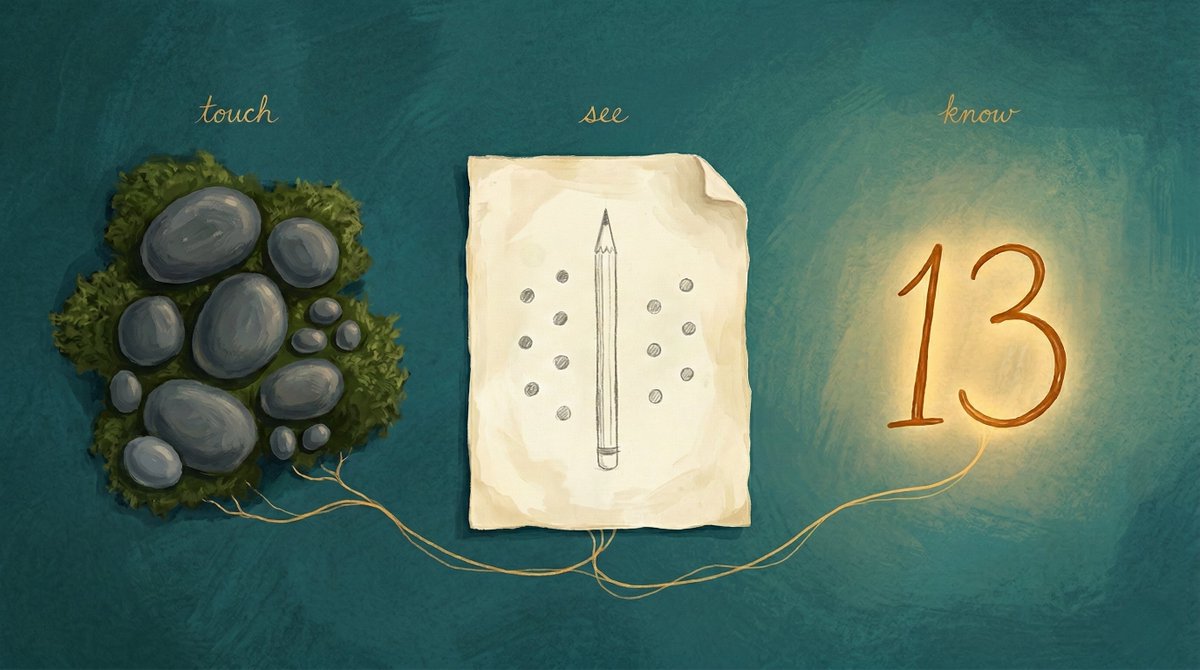
"Stop drawing. Just do the maths."
A child is thinking visibly — mapping what lives in their mind onto the page — and an adult tells them to stop.
We meant well. We thought we were moving them forward.
What we were actually doing is amputating half of their brain. 🧵
The shame attached to needing physical tools is real.
If you feel that using manipulatives is evidence of failure — that it means you should already understand — the tool cannot do its work. The emotional weight is too heavy. The mathematics cannot get through.
The first move is not a tool, but the permission to not know yet.
"Let the child teach you."
Not as a trick. Not as a strategy.
As an honest admission that you do not know how this works — and a genuine willingness to find out.
The child who has to explain a tool to an adult understands it more deeply than any lesson could produce.
When children are placed in a room with standard building blocks for hours a day in the early years, the result — years later — is measurably stronger spatial reasoning, geometry, and algebraic structure.
The toy was not separate from the mathematics. It was the mathematics, in its earliest form.
The concrete is not the primitive version of the abstract.
It is the foundation of it.
Every formula, every equation, every abstraction is shorthand for something first encountered in the physical world.
When we give children the symbol without the meaning, we give them a word in a language they have never heard spoken.
"A sad, endless cycle of innocent teachers inflicting damage upon innocent students."
— Paul Lockhart
Not cruel. Not malicious. Innocent.
Each person carrying what was given to them, not knowing they carry it. The fear is not in anyone's hands. It is in the transmission itself.
Students with maths anxiety who wrote freely about their feelings toward mathematics for ten minutes before a test performed significantly better than those who did not.
Not reassurance. Not instruction. Just the fear, placed on paper, outside the body.
Making space in the mind for thinking.
The interference of mathematical anxiety is most severe in people with the highest mathematical ability.
The ones most disrupted are the ones who could learn most readily — given the right conditions.
Potential was there. The anxiety closed the door.
For students with math anxiety, the amygdala's threat response activates before the mathematics begins.
In the anticipation. The seconds before the problem arrives.
For the most math-anxious people, brain imaging shows this activates the same neural regions as physical pain.
The fear is not a character flaw. It is a wound.
When we told the child to stop drawing, we told them to stop asking why.
They learned to perform the what instead — to move symbols through procedures without ever inhabiting the space behind them.
And somewhere along the way, they stopped believing they could see the mathematics at all.
Two students write 24 for 4 × 6. Same answer.
"Can you draw it?"
One draws a 4-by-6 rectangle and sees immediately why rotating it doesn't change the count. One cannot.
The symbol carried the same output. The understanding behind them was entirely different.
The drawing is not easier than the symbolic. It is harder to fake.
"Stop drawing. Just do the maths."
We said it to move the child forward — from the primitive to the sophisticated, from the concrete to the real thing.
Research shows we were moving them in the opposite direction. Away from how mathematicians actually think. Toward a performance without understanding.
Maryam Mirzakhani — the first woman to win the Fields Medal, the highest honour in mathematics — worked by spreading large sheets of paper on the floor and doodling until the ideas moved.
The abstraction is the shorthand.
The drawing is the truth it abbreviates.
The next time a child draws beside their numbers, do not stop it.
Ask: How did you see it?
Not what is the answer. Not is that right.
Watch what the hand knows that the mind has not yet put into words.
https://t.co/QMEbxGZBJr
"Stop drawing. Just do the maths."
A child is thinking visibly — mapping what lives in their mind onto the page — and an adult tells them to stop.
We meant well. We thought we were moving them forward.
What we were actually doing is amputating half of their brain. 🧵
The reason a mathematical idea works is not a supplement to understanding it. The reason is the understanding.
A symbol without a why is a sound without a meaning — technically correct, functionally hollow.
When we told the child to stop drawing, we told them to stop asking why.