The important question is not: How much faster can AI prove theorems?
It is: What happens to mathematics when theorem production becomes much faster than mathematicians can absorb it?
https://t.co/NzfF6Yprms
Even before the sun shone on us, even before there was air to breathe, the square of the hypotenuse was equal to the sum of the squares on the other two sides.
― Malba Tahan, The Man Who Counted: A Collection of Mathematical Adventures
Paul Erdős had no permanent home for much of his adult life. He traveled constantly, carrying most of his possessions in a suitcase and moving from university to university, conference to conference, and colleague to colleague.
When he arrived at a mathematician’s home, he was known to announce, “My brain is open.” He would then begin working with his host on mathematical problems, often producing new results and papers before moving on.
One of Erdős’s characteristic maxims captured this itinerant life perfectly:
“Another roof, another proof.”
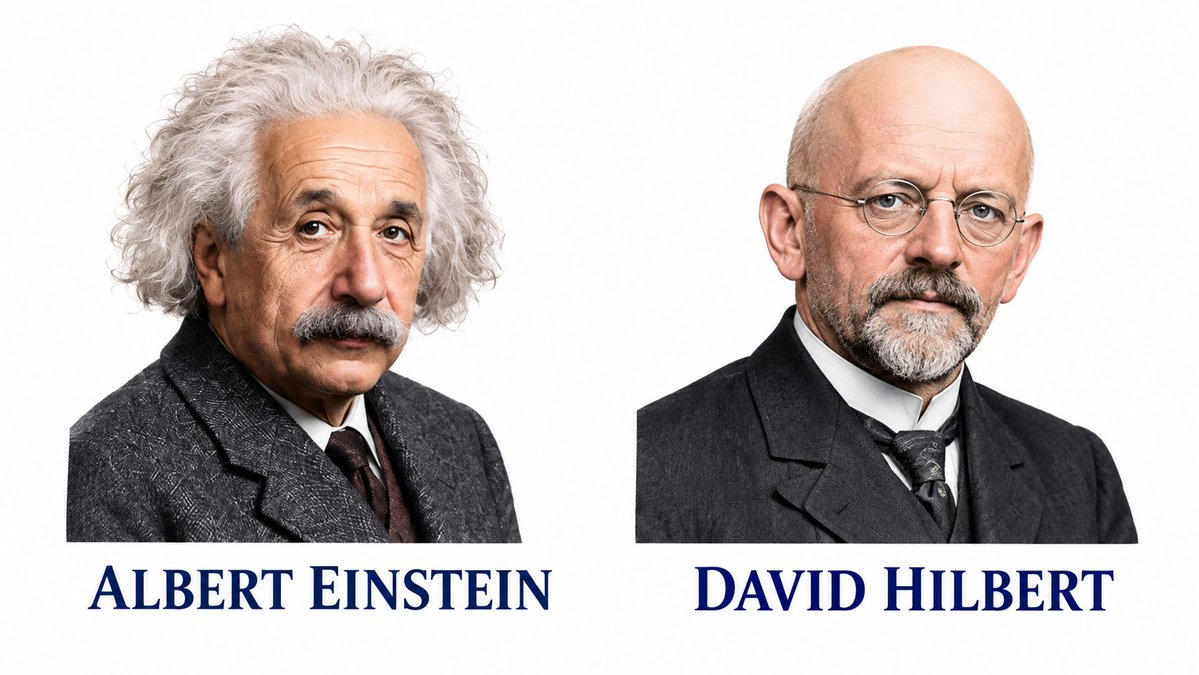
In 1915, Albert Einstein and David Hilbert were independently racing toward the mathematical formulation of general relativity.
Hilbert submitted his paper shortly before Einstein presented the final form of his field equations, leading to a famous priority dispute.
But the deeper story is not simply about who wrote the equations first. Einstein had the physical vision: gravity as the geometry of spacetime. Hilbert brought powerful mathematical tools to the problem.
A later remark attributed to Hilbert captures the distinction: “Every boy in the streets of Göttingen understands more about four-dimensional geometry than Einstein. Yet Einstein did the work and not the mathematicians.”
The history of general relativity is a reminder that mathematics and physics can meet in unexpected ways. Sometimes the crucial step is not inventing new mathematics, but knowing which mathematics describes nature.
Einstein had the physical question. Mathematics provided the language. General relativity emerged where the two met.
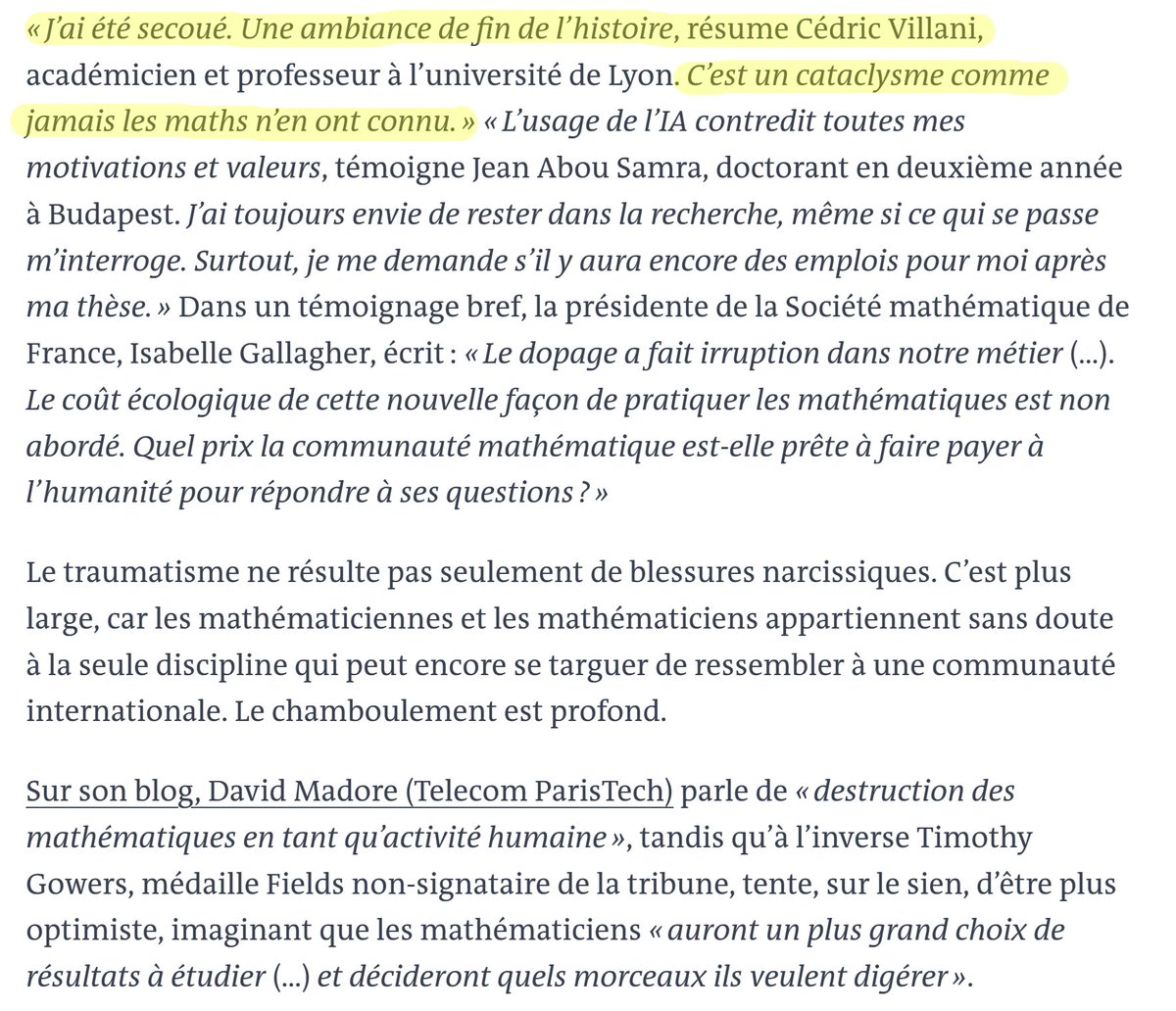
A mathematician who recently argued that large language models do not genuinely understand what they say now describes the moment as being “shaken” and even as a “cataclysm” for mathematics.
Cédric Villani après l'annonce de la solution d'OpenAI au problème du millénaire : « J’ai été secoué. Une ambiance de fin de l’histoire. C’est un cataclysme comme jamais les maths n’en ont connu. »
Mathematician Terence Tao:
"we have to slow down AI. the pace is insane, and there's no reason to be this fast — no reason at all"
It's amazing how willing we are to change everything without any idea what happens afterward
These are extremely nonlinear dynamics
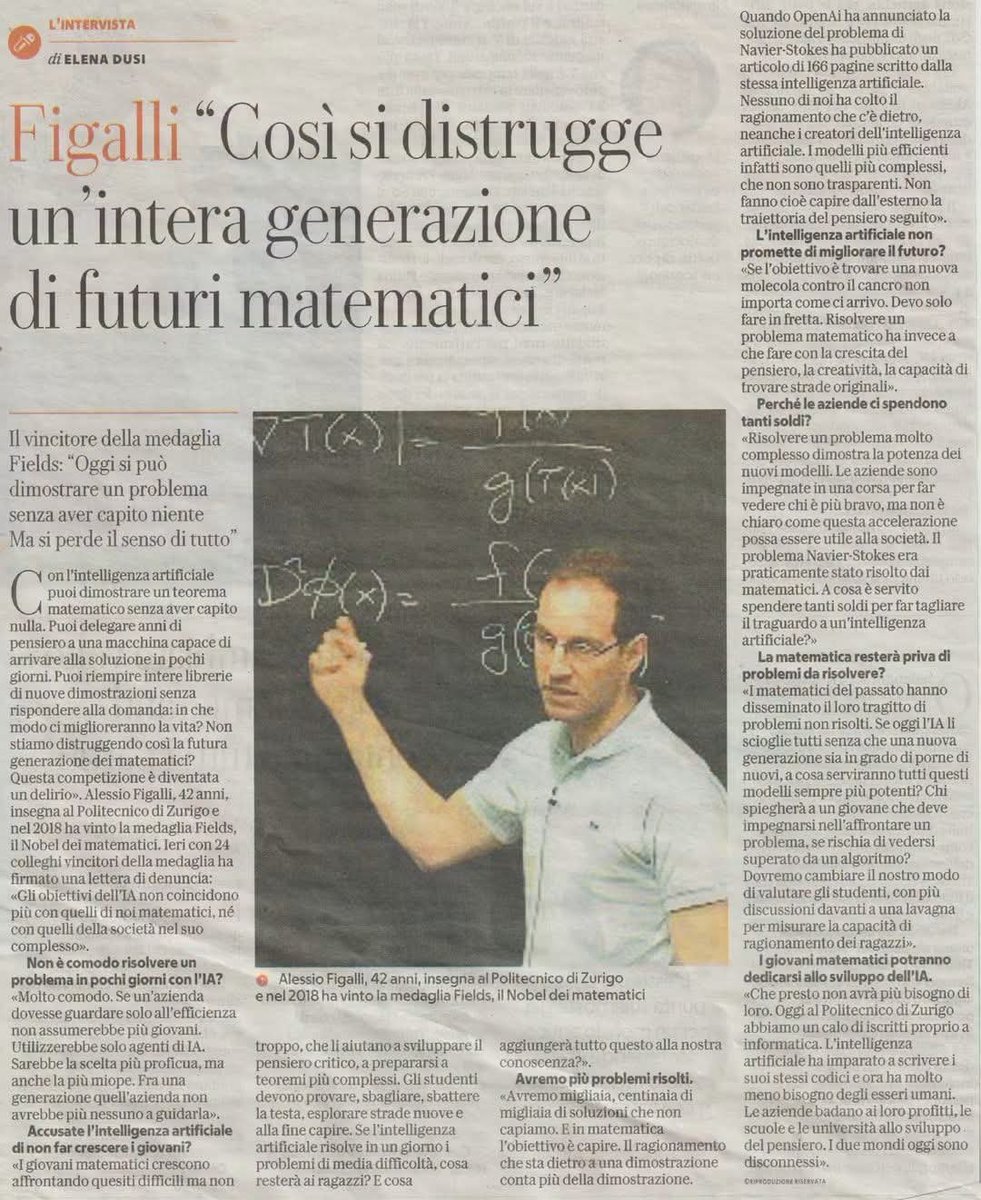
Figalli’s warning about AI
If AI generates proofs without explaining the reasoning, students may lose valuable opportunities to struggle, explore, and think creatively. Mathematics is not only about getting the right answer. It is also about understanding why it works. As AI prioritizes speed and efficiency, education may need to place greater emphasis on reasoning and independent problem-solving.
The Pythagoreans associated the number 5 with marriage, because it is the sum of what were to them the first even, female number, 2, and the first odd, male number, 3.
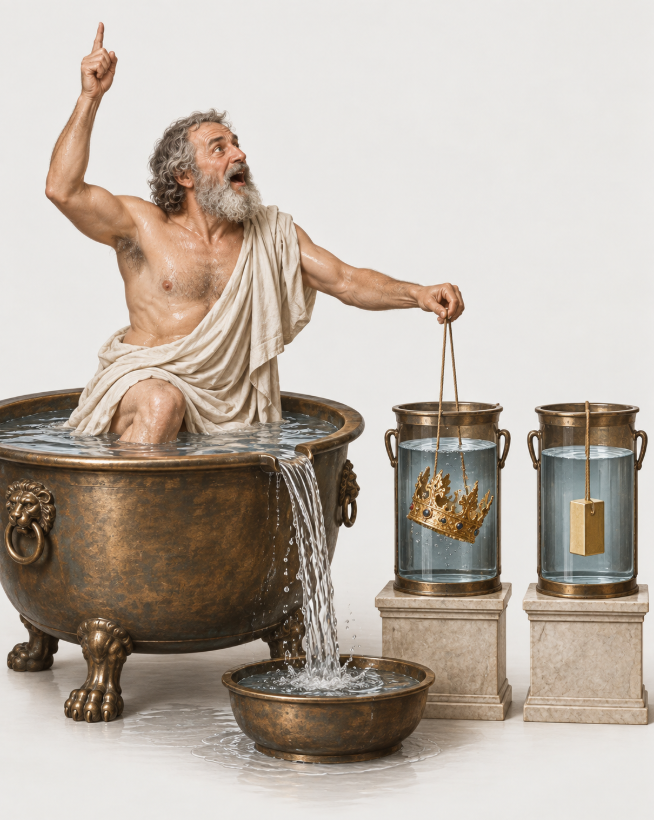
According to the Roman architect Vitruvius, King Hiero II of Syracuse commissioned a goldsmith to make a votive crown from a specified amount of gold. The finished crown had the same weight as the gold supplied, but Hiero suspected that the goldsmith had secretly substituted some silver for gold.
Hiero asked Archimedes to determine whether the crown had been adulterated without damaging it.
The traditional story says that Archimedes struggled with the problem because the crown's irregular shape made its volume difficult to determine. Then, while entering a bath, he noticed that immersing his body caused water to overflow. He realized that the amount of displaced water corresponded to the volume of the submerged part of his body.
According to Vitruvius, Archimedes then compared the crown with equal-weight samples of pure gold and silver by measuring the amount of water displaced. Because silver is less dense than gold, a gold-silver mixture of the same mass would occupy a greater volume and therefore displace more water than an equal mass of pure gold. The comparison reportedly revealed that silver had been mixed into the crown.
Vitruvius also says that Archimedes, overcome with excitement, ran home naked shouting “Eureka!”, Greek for “I have found it.”
The famous story is an ancient account rather than a directly documented eyewitness record. It is traditionally associated with Archimedes' work on buoyancy and fluid displacement, now expressed in what is known as Archimedes' principle.
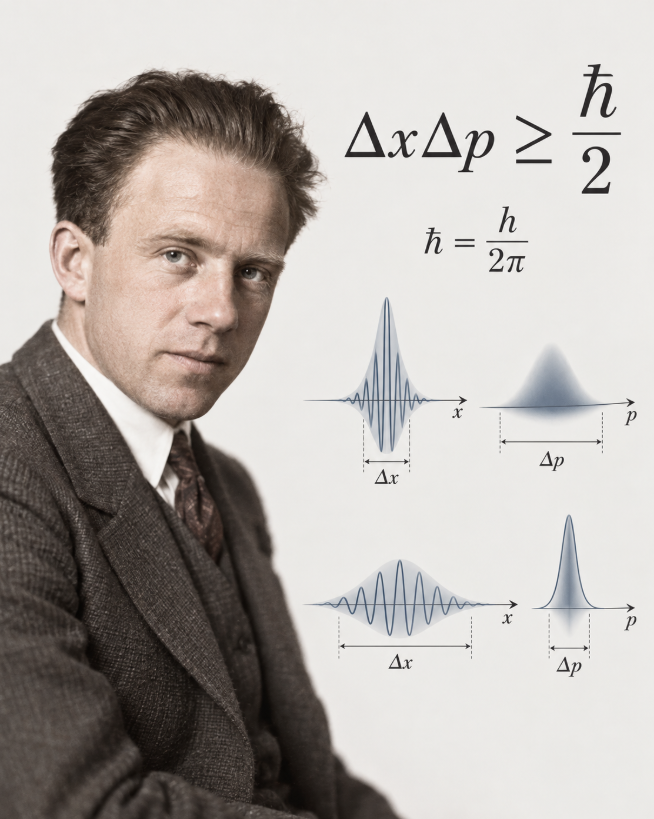
In quantum mechanics, the Heisenberg uncertainty principle states that the uncertainties in a particle’s position and momentum cannot both be made arbitrarily small.
If Δx is the standard deviation of position and Δp is the standard deviation of momentum, then Δx Δp ≥ ℏ/2, where ℏ = h/(2π) is the reduced Planck constant. Thus, π enters the uncertainty relation through the definition of ℏ.
In Chudnovsky π formula each term contributes about 14 correct decimal digits because of the series' exceptionally rapid convergence.
Developed by David and Gregory Chudnovsky in the late 1980s, this Ramanujan-type series has played a major role in high-precision computations of π, including record-setting calculations involving billions and eventually trillions of digits.
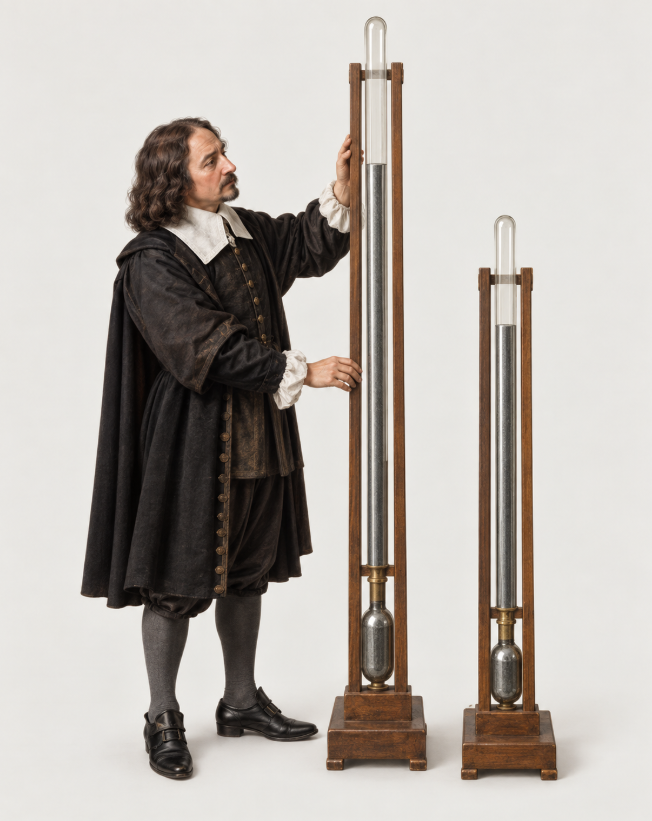
In 1648, Blaise Pascal proposed an experiment to test whether atmospheric pressure decreases with altitude. His brother-in-law, Florin Périer, carried a mercury barometer up the Puy-de-Dôme in France while another barometer was monitored at the base.
The mercury column fell significantly at higher elevation, providing strong experimental evidence that atmospheric pressure decreases with altitude and that the pressure is related to the weight of the atmosphere.
The experiment was an important confirmation of the Torricellian explanation of the barometer and helped undermine the traditional Aristotelian account of the vacuum, often expressed as horror vacui, or “nature abhors a vacuum.”
In 1977, theoretical physicist John Ellis lost a game of darts at a CERN pub after making a bet with student Melissa Franklin. The forfeit was unusual: he had to include the word “penguin” in his next scientific paper.
Ellis kept his promise. While working on the phenomenology of the b quark, he realized that some of the relevant loop diagrams could be drawn in a form resembling a penguin. The term “penguin” consequently appeared in the 1977 paper by John Ellis, Mary K. Gaillard, Dimitri Nanopoulos and Serge Rudaz, and the name eventually became standard in particle physics.
What makes the story interesting is that the physics came first and the name came almost accidentally. The diagrams represent loop-level contributions to certain particle processes, particularly flavour-changing weak decays. Their terminology began with a pub bet, but the name survived because it also happened to fit the visual appearance of the diagrams.
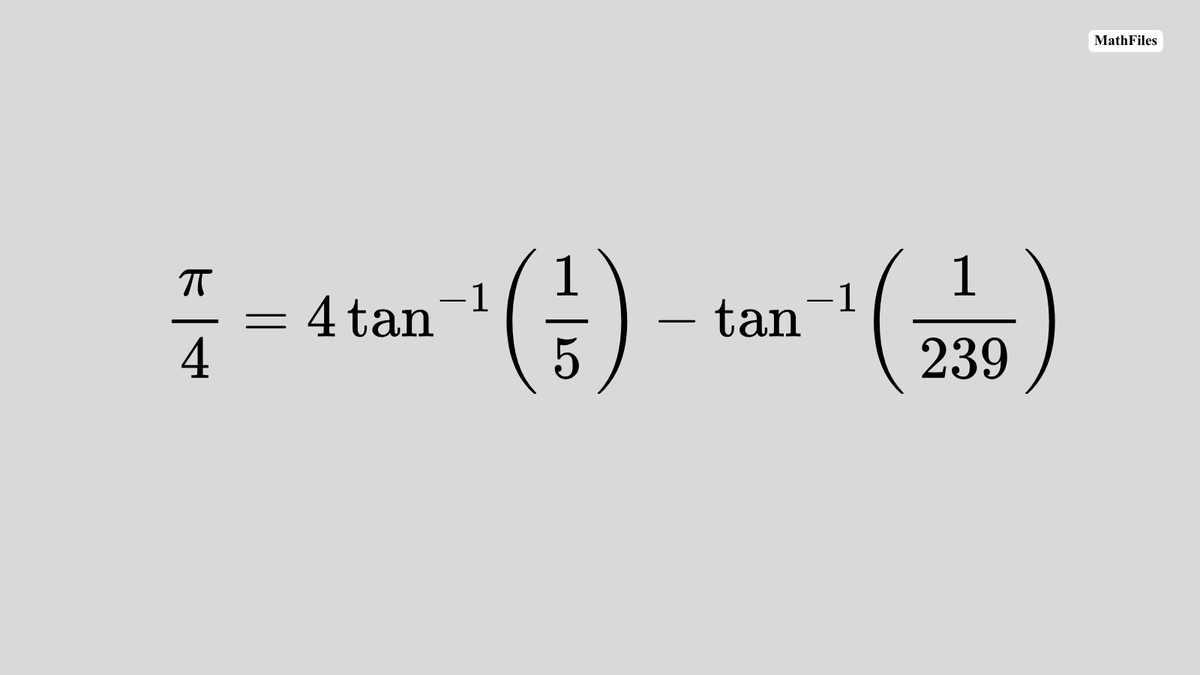
In 1706, John Machin introduced an ingenious formula for calculating π:
π/4 = 4 arctan(1/5) − arctan(1/239).
More than a century later, William Shanks used Machin’s formula to calculate π to 707 decimal places, publishing his result in 1873 after years of painstaking computation by hand. The achievement was extraordinary for its time, but there was a hidden flaw: only the first 527 decimal places were correct. The remaining 180 digits were wrong, and the error was not discovered until the 1940s.
To me, Shanks’s calculation illustrates both the power and the limitation of human computation. A mathematical method can be perfectly sound, yet a single unnoticed arithmetic error can undermine hundreds of subsequent digits. Modern computers transformed this aspect of mathematics, not by replacing mathematical ideas, but by making large-scale numerical verification extraordinarily faster and more reliable.
In 1931, Hundert Autoren gegen Einstein (One Hundred Authors Against Einstein) was published, bringing together criticisms of Einstein’s theory of relativity.
Einstein is widely reported to have responded:
“If I were wrong, one would have been enough.”
What I find interesting is the underlying idea: scientific theories are not strengthened by the number of people defending or criticizing them. A single valid argument or decisive piece of evidence can be enough to expose an error. In science, the strength of an idea ultimately rests on the evidence and reasoning behind it, not on the number of its supporters or opponents.
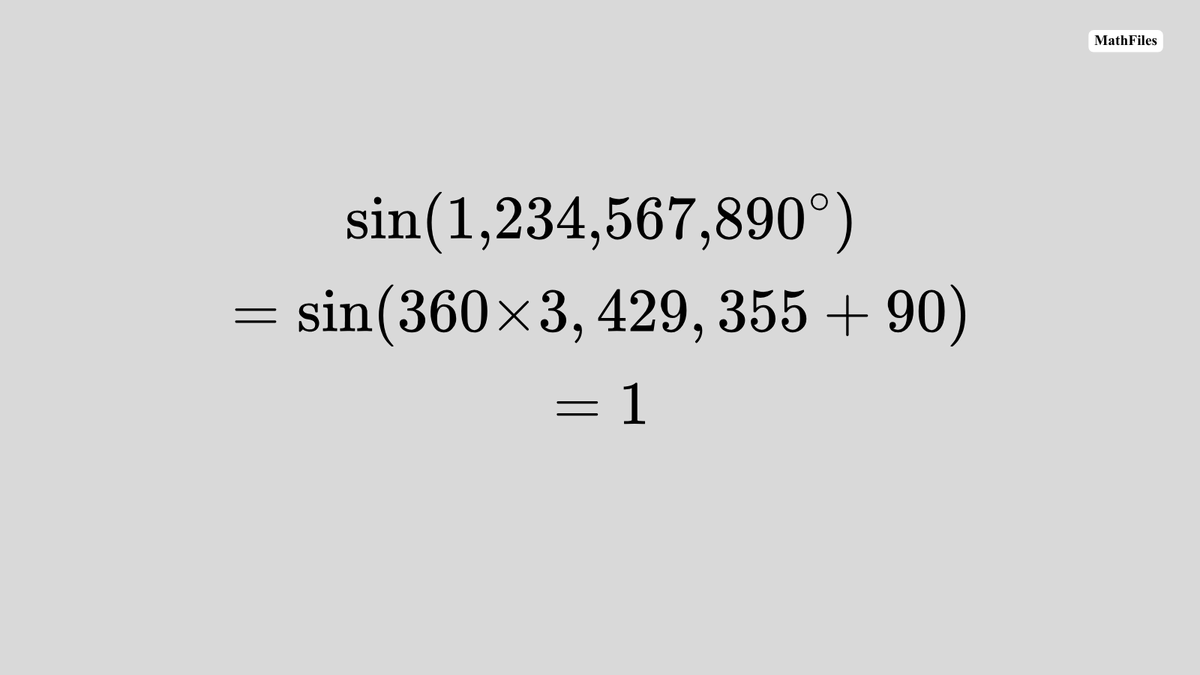
A huge trigonometric angle can look intimidating, but periodicity makes it surprisingly simple. Since the sine function has period 360°, and
1,234,567,890° = 3,429,355 × 360° + 90°.
Therefore, sin(1,234,567,890°) = sin(90°) = 1.
The calculation does not require evaluating an enormous angle directly. We only need to reduce it modulo 360°.