@Philip1891dif@ChangFrick Nej. Men skulle inte förvåna mig om hon pratade svenska sen tidigare. Man kan inte lära sig ett språk så fort och helt utan brytning, dessutom med dialekt
Iranian missiles may not be the greatest threat to the ships stranded in the Persian Gulf
Unchecked barnacle growth can reduce speed / increase fuel consumption by 40-80% in extreme cases (IMO, EU CLEANSHIP)
Barnacles can even eventually...sink a ship or cause a total loss
I’m sorry!!! But did I hear this right???
Did Jameis Winston just compare Jaxson Dart being at a Trump Rally to Democrats in the KKK blowing up a church in Alabama in the 60’s???
Mearsheimer: War is the predictable consequence when one great power establishes itself on the border of another great power. What was previously common sense has now become controversial...
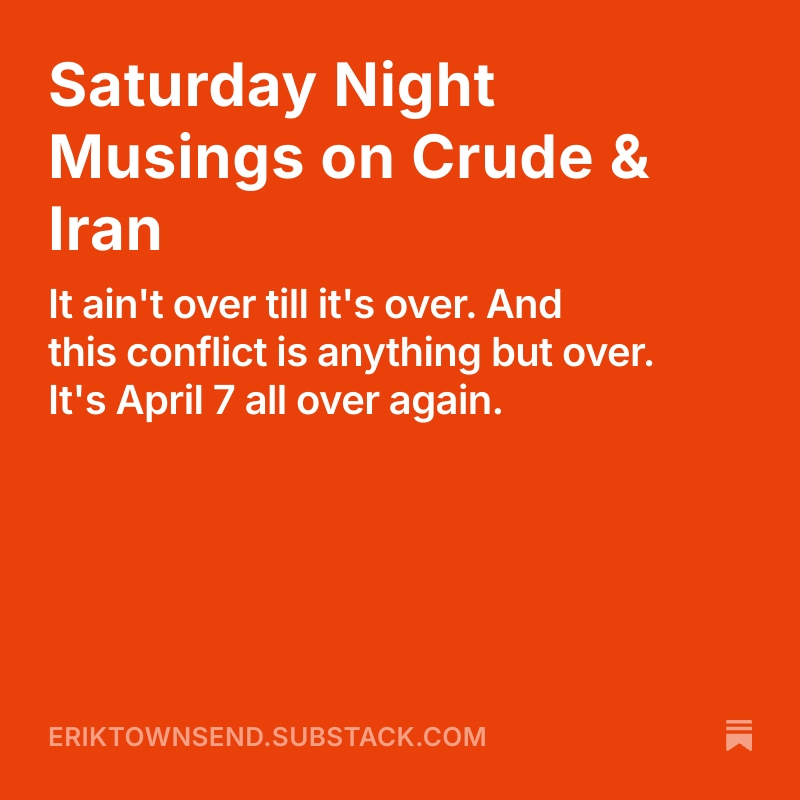
Full post on substack; summary bullets below:
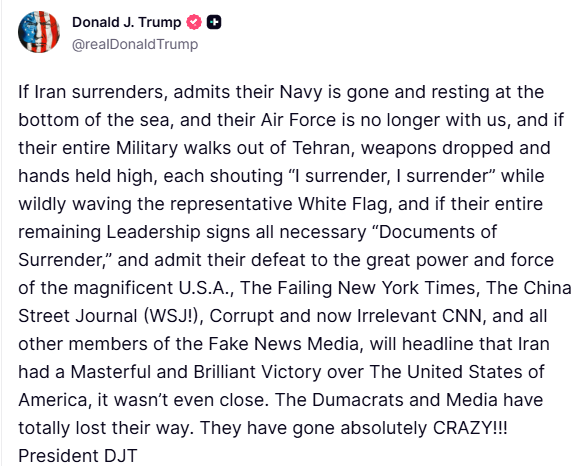
➡️Trump announced a “peace deal” on Truth Social Saturday afternoon. The post says an agreement is “largely negotiated,” invokes a “Memorandum of Understanding pertaining to PEACE,” and declares that the Strait of Hormuz “will be opened.” It reads like the war is ending. It is not. Not even close.
➡️Expect a gap-down in Brent and WTI at Sunday’s 6:00pm ET futures open — unless someone with a louder megaphone than mine debunks the “it’s over” narrative before then. I think that gap-down, if it happens, will be selling into a misunderstanding.
➡️This is April 7, Round 2. The substance — the part that would actually end the war — has again been deferred. What’s genuinely new here is a nuclear negotiation and-Strait reopening framework, not a nuclear deal.
➡️The reported MOU is one page, 14 points: declare the war over, gradually reopen Hormuz, lift the US naval blockade of Iranian ports, unfreeze some Iranian assets, and kick the hard nuclear questions neither side has been willing to budge on to a 30-to-60-day follow-on negotiation that has not yet started.
➡️The single issue that determines whether this war ends — possession of Iran’s ~440.9 kg of 60%-enriched uranium — was explicitly left out of the text. Iran’s Foreign Ministry wasted no time going on the record to emphasize this key omission the same day Trump announced the “Peace” deal.
➡️Trump insists Iran must surrender that material. Iran says it never will. Iran’s Supreme Leader reportedly issued a directive on May 21 that the stockpile “should not leave the country.” Secretary Rubio, the same weekend, repeated that any deal must include “turning over enriched uranium.” Neither side has moved a millimeter. Everything else is noise until that one core disagreement is resolved.
➡️The “is Iran weeks from a bomb, or has it had no weapons program for 20+ years?” contradiction is fake. Both statements are essentially true. Reconciling them requires understanding nuclear hedging — a concept the mainstream media has been derelict in failing to explain. This post explains it thoroughly.
➡️Enrichment is not a linear process. Getting from 60% to 90% weapons-grade enrichment requires roughly 1% of the effort it took to get to 60%. By stockpiling 60% material, Iran has already done about 99% of the separative work needed for a bomb’s worth of fuel.
➡️That stockpile is confirmed fact — not allegation, not propaganda, not suspicion. It was audited and verified by IAEA inspectors. Nobody on either side disputes it exists.
➡️Stories of a US or Israeli special-forces raid to “go in and grab the uranium” are not credible. Absent Iranian cooperation, every named expert who has spoken on the record calls such an operation somewhere between “unlike any mission the US military has tried before” and “rather fantastical.” That material leaves Iran only with Tehran’s consent — or behind a full ground occupation.
➡️For the crude market, the question that matters is not “is there a deal?” It’s “how much oil actually moves through the Strait of Hormuz?” Watch tanker traffic, not headlines.
➡️The durable takeaway: this can drag on for months. A global economic event tied to energy is, in my view, already a near-certainty at some severity. How much oil flows through Hormuz over the next several weeks will determine whether that event is merely painful or genuinely catastrophic. If the Strait remains substantially closed for just a few more weeks, a catastrophic outcome will become certain. We only have a few weeks left to sort this out, and if the strait remains substantially closed for the full 60 day negotiation period prescribed in today’s 14-point MOU, the global economic impact will be catastrophic and irreversible.
If that summary is enough for you, you can stop here. If you want the full argument, read the post on substack.