GOLDMAN SACHS open-sourced most dangerous quant repo on the internet.
THE EXACT FRAMEWORK THEIR INTERNAL DESKS USE TO BUILD & RUN TRADING STRATEGIES.
They even left their Claude skills inside. Plug them in & you've a Goldman Sachs quant building strategies for you. BOOKMARK.
found a polymarket setup that pays out whether bitcoin goes up OR down
you buy YES and NO on the same market at the same time - if both fill under 100c total, you collect 100c no matter what happens
i didnt believe it either, so i ran it 52 times
45 wins, 7 losses, 86% hit rate. and the 7 losses only happen when one leg fills and the other doesn't - which a stop loss handles
the math is simple:
-> YES at 20c + NO at 20c = 40c locked in
-> market resolves, the winning side pays 100c
-> you keep the 60c gap, every time both sides fill
the catch:
doing this by hand on 5-minute markets is impossible. the prices move too fast to place both legs in time
@TycheTerminal automates the whole thing. you set the two prices and a stop loss, it works the recurring markets on its own
this 86% run was its limit-bid mode on autopilot
right now almost nobody is running this. that's exactly why the gaps are still there
test it yourself: https://t.co/qSQXjGTrk4
There's a way to win on Polymarket no matter who wins.
Buy YES in one place, NO in another.
If they don't add up to a dollar, you locked a profit.
Before the event even happens.
Here's how the arbitrage actually works and how to master it:
This is the closest thing to free money on Polymarket.
Every market has a YES and a NO.
One of them MUST resolve to $1.
The other goes to zero.
So in theory, YES + NO should always cost exactly $1.
But in thin or messy markets, they don't.
Sometimes you can buy:
> YES at 0.48
> NO at 0.49
> total cost: 0.97
This guy does it every day: [https://t.co/DtRLSFXsGs]
He also uploaded a full guide on how to build the same bot.
One side pays you $1 at resolution no matter what.
He spends 97 cents to guarantee a dollar.
That 3 cents is locked, risk-free.
There's also the cross-market version.
The same event sometimes has two separate markets at different prices.
Buy the cheap YES in one, the cheap NO in the other, and pocket the gap.
Sounds easy, right?
But here's the honest part:
These gaps close in about 2.7 seconds now.
By the time you click by hand, a bot already took it.
So the manual version only really survives in low-liquidity markets the bots ignore.
The fast version?
That lives in compiled code with a VPS sitting next to the exchange.
If you can code, this is one of the cleanest edges i know.
If you can't, stick to the thin markets where speed matters less.
Good luck!
i'm 21.
dropped out of the university.
started vibe coding and tried prediction markets.
studied the simplest arbitrage.
now my bot is printing $600 daily.
life hits different now.
6/7 AI models agree your strategy is a winner.
Feels bulletproof, right?
But it's confident garbage.
Here's why consensus doesn't fix a broken backtest:
The setup looks perfect.
A swarm of frontier models analyzes the trade, votes and spits out a clean confidence score.
6 out of 7 say go.
But voting does not create truth.
It just averages whatever the models were handed.
So what were they handed?
The same broken backtest every AI runs.
It looks at your entry price and the resolution price, draws a straight line and calls it a win rate.
That's the whole model.
No order book depth.
No fill probability at your price.
No latency and slippage.
No adverse selection.
Seven models staring at the same fantasy will confidently agree on the same fantasy.
Garbage in, consensus garbage out.
A vote is not a backtest.
It's seven opinions about a number that was already wrong.
You don't get real confidence by adding more models.
You get it by adding real data.
Record the actual book at every tick.
Model real fills, real slippage, real latency.
Then ask one honest question instead of seven flattering ones.
My sweeper bot hit $27k PnL only because of right backtesting and tool.
Here's the one i use: <https://t.co/crzsdhL1YE>
It helped me develop my sweeper so now it prints passively.
The only thing left for me is just monitoring and updating.
Public wallet: <https://t.co/yCsjRsOAXJ>
The market does not care how many models agreed.
It only cares what your order actually hit.
Leaving a full guide on how to build your own sweeper bot below.
I made 6 figs on Polymarket bots.
And i only used 2 indicators.
Hedge funds running cross-platform arbitrage use the exact same 2.
Different scale, identical conclusion.
Here is what they both landed on:
Forget RSI, MACD, EMA, every indicator built from price.
They are all just past price, smoothed and rewrapped.
One signal wearing five hats and lagging more with each one.
The only things that carry real information are the ones that read order flow.
The first is OBI.
Order book imbalance.
It compares the resting volume on the bid side versus the ask side.
If buyers have 100,000 contracts stacked and sellers have 1,000, price is mathematically pressured to move up before a single trade prints.
I use it as his final go or no-go before entry.
The hedge funds compute it across two platforms at once to predict which book moves next.
Second is the flow actually hitting that book.
The dev calls it CVD, the running total of market buys minus market sells.
The funds call it the micro-price, the true value once you weight each side by its volume.
Different names, same job.
They tell you who is actually being aggressive, not just who is resting an order.
OBI shows you the pressure.
CVD and micro-price show you whether that pressure is real or bluffing.
One reads the standing book.
The other reads the live attack on it.
Put them together and you know the next move before the chart does.
This is exactly what my sweeper bot is doing before executing.
Public wallet: <https://t.co/yCsjRsOAXJ>
The people winning at every level figured out the same thing.
Stop staring at the chart.
Start reading the book.
That's it.
Go through a full guide if you wanna deep dive into bot building.
I found 7 free Polymarket trading bots on GitHub for 7 different trading situations…
Each of these bots comes with a detailed step by step setup and usage guide in English:
1. This bot includes 118+ ready to use strategies and tools for trading on prediction markets (Momentum, Binance-Polymarket latency, Penny Clipper, Smart Routing, Expiry Fade, DCA bots and more).
Built by a Cambridge computer science student who won a hackathon with this trading bot.
GitHub: https://t.co/2MCzD8iZG7
2. This bot automatically manages all your Polymarket limit orders to maximize liquidity rewards.
GitHub: https://t.co/nvb96dTIwx
3. A weather bot from a Chinese dev, that analyzes multiple sources in real time, like forecasts, airport data and aviation observations (METAR + SPECI) to get the most accurate temperature data and generate a detailed weather report for a specific city and day.
GitHub: https://t.co/No3sBcqMg1
4. A bot that automatically searches for arbitrage opportunities between Polymarket and Kalshi.
GitHub: https://t.co/icWBTLTeVg
5. This is a bot-toolkit that includes copy trading, arbitrage, market making, whale alerts, spread farming, sports trading and more…
GitHub: https://t.co/p3obYeQTzO
6. A smart money trading bot - it looks for the most successful traders in selected markets, filters them by Pnl + win rate, and then creates a list for automated copy trading.
GitHub: https://t.co/qbk9l2uxLd
7. A large collection of 20+ free trading bots for prediction markets.
GitHub: https://t.co/a2WRRl8PJl
Every bot here has a Dry Run mode, so you can test it on real markets without risking any funds.
AI will build you a Polymarket bot in an hour.
Then it will quietly make you poor over the next month.
You won't even see how.
Here are the 4 places your bot betrays you:
> Backtest is a fantasy
Ask AI to backtest and it does one thing:
Looks at your entry price, looks at the resolution price, draws a line between them.
"81% win rate, you're a genius."
No fill rates.
No order book depth.
No other bots taking your spot.
Your real number is 20 points lower and you deploy on the fake one.
> It overfits and calls it alpha
AI is a ruthless optimist.
Give it data and it finds tiny loophole pockets to drive a train through.
"Skip 17c up bets on Tuesdays for +38% ROI."
All bs that dies the second it touches a live market.
Bots that survive use 1 or 2 signals.
Not 9 filters stacked on a coincidence.
> Same input, different output
Trading needs determinism.
Same input must always give the same output.
LLMs don't work like that - ask twice, get two answers.
A bot that sometimes does something different is not a strategy.
It's uncontrolled risk wearing a strategy costume.
> It drags you into complexity
AI loves to add hedging, rebalancing, merging, cross-window arb, five signals.
It sounds smart and feels productive.
None of the top bots do any of that.
Every layer you add is one more thing that breaks at 3am while you sleep.
So should you stop using AI?
No, use it.
Just stop trusting it with the parts that matter.
> Let it write the plumbing
> Never let it near your edge or your backtest
> Force it to use TOML files, it kills almost all the drift.
> More than 2 signals? AI tricked you so rip them out.
I've built 1,000+ bots already.
The ones that print are the dumbest ones (the ones I let AI touch the least).
Take my sweeper bot as example: <https://t.co/yCsjRsOAXJ>
AI will hand you a bot but it will never hand you an edge.
That part is still on you.
Go through my last article if you wanna understand what 2 indicators determine EVERYTHING.
Attached below.
You don't need to predict the future on Polymarket.
You just need to know how often history repeats.
The crowd trades feelings and headlines.
You trade the numbers they keep forgetting.
Here's the base-rate edge NO ONE told you about:
Most people open a market and ask what will happen.
Wrong question.
The right one is how often has this happened before.
That's a base rate.
And Polymarket is full of markets that ignore it.
Take politics.
The president's party almost always loses ground in the first midterm.
It's one of the most reliable patterns in modern history.
Yet each one gets priced like a fresh coin flip.
Or correlations:
> when a party wins the White House, they take the Senate around 85% of the time
> some outcomes basically drag others along with them
The crowd treats these as separate guesses.
They're not.
Here's the method:
> find the market
> pull the actual historical rate
> compare it to the current price
> trade the gap
If history says 85% and the market says 65%, you found an edge.
No prediction.
No insider info.
Just public numbers most people are too lazy to check.
Same boring logic behind those monthly "Largest Company" markets.
Market link: [https://t.co/BAVBElY3VM]
NVIDIA wins every time statistically.
Or the Jesus Christ market where we made 3x multiple times just after i warned you (will be quoted below).
Market link: [https://t.co/MjImaHDhhP]
History rhymes.
Prices forget.
You profit from the gap.
The gap is the trade, that's it.
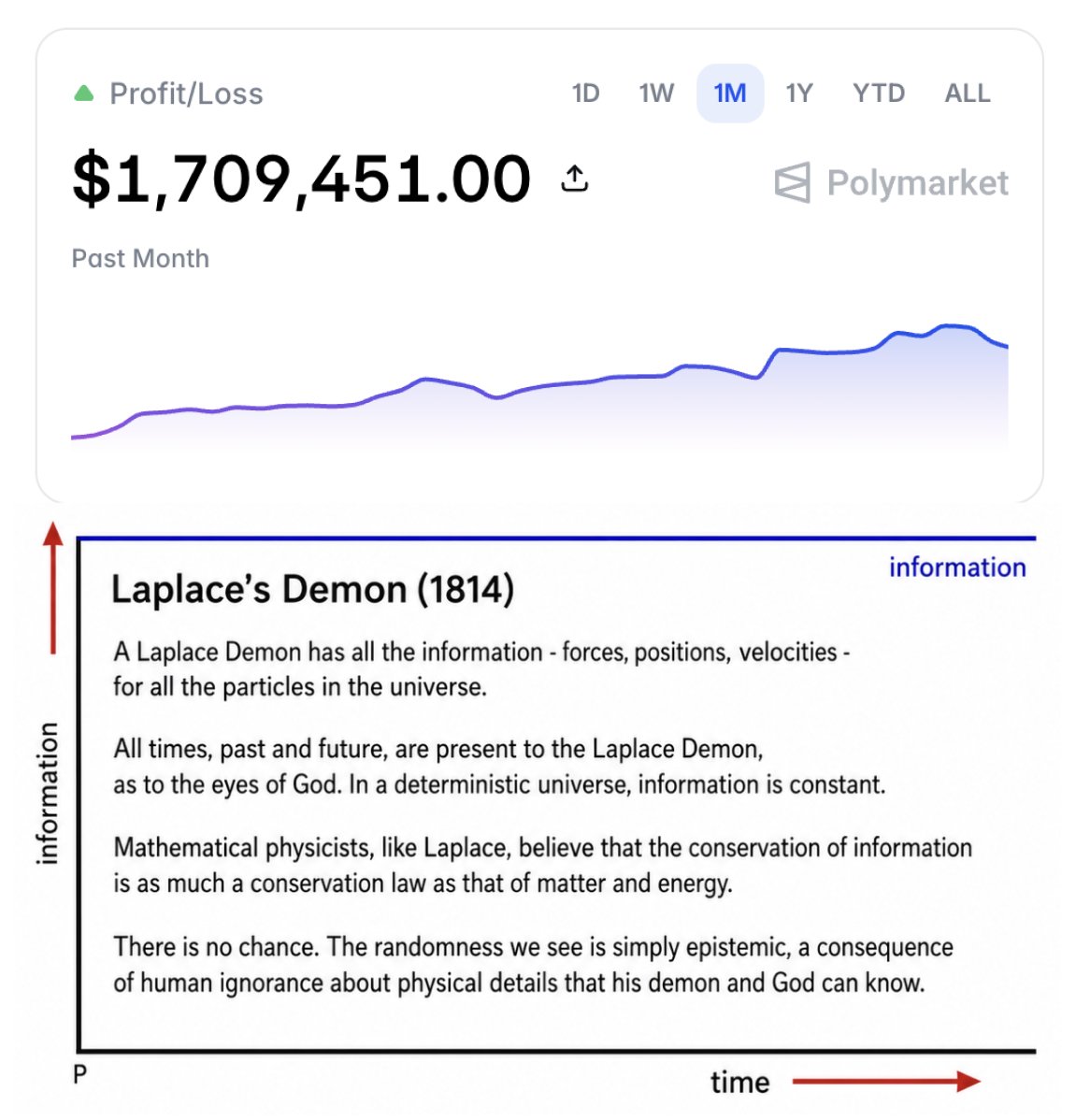
In 1814 a mathematician imagined a creature that could predict the entire future.
200 years later, Polymarket is quietly building it.
The idea was called Laplace's Demon.
If a being knew the position of every particle in the universe, it could calculate everything that would ever happen.
Nothing uncertain.
Everything computable.
For two centuries it stayed a thought experiment.
Then prediction markets showed up and started assembling a rough version of it, one market at a time.
Here is how:
No single person knows everything.
But a prediction market does something clever.
It takes thousands of people, each holding one fragment of truth and weights each fragment by how much money they will risk on being right.
> One trader knows the polling
> Another saw the news first
> Another has the ground truth
> Another holds insider read
The orderbook fuses every fragment into a single number.
No individual is the demon.
The market collectively becomes one.
Every new market is another piece of its vision coming online.
Elections, wars, prices, weather, all continuously computed by the crowd.
This is why fading the market on pure conviction is so dangerous.
You are one fragment betting against the assembled fragments of thousands.
The demon is not always right.
But to beat it you need a real piece of information it has not absorbed yet.
Not a feeling.
You are not smarter than the demon.
Sometimes you just hold a fragment it is missing.
Full breakdown of all 6 theories in the article above.
Polymarket Weather Strategy: Four Structural Edges That Actually Work (FULL GUIDE)
If you’re building (or upgrading) a serious bot for daily temperature markets on Polymarket - stop chasing “the best model” for a second
The real edge almost never comes from having a slightly more accurate forecast than everyone else
It comes from understanding where and why the market consistently misprices buckets relative to reality
I gathered and analyzed all the key points and distilled the four structural edges that top bots exploit day after day in 2026
1. Model Update Lag (everyone knows it, but it’s still alive)
NWP models (GFS, ECMWF, HRRR) are released on a strict schedule. A new run often causes a big shift in the forecast - but the Polymarket doesn’t reprice instantly.
The price only moves when someone actually buys or sells.
• In 2024 the window was 30–60 minutes on major cities
• Now on top markets (NYC, London) it’s shrunk to 5–15 minutes thanks to bots
• On secondary cities (Buenos Aires, Cape Town, Atlanta, etc.) the window can still last for hours
> How to catch it:
Set alerts for key run releases (especially ECMWF 12Z and HRRR). Immediately compare the new forecast with current market prices
If the shift is bigger than your minimum edge (usually 8%+) - enter. To filter noise, wait for confirmation on 1–2 subsequent runs
2. Airport vs City Discrepancy (heavily underrated edge)
Polymarket resolves strictly by the specific airport station, not by the “city average” that everyone sees in apps and weather websites
The difference is often predictable:
• LaGuardia (KLGA) is frequently 1.5–3°C cooler than Midtown Manhattan during sea breeze
• Paris Le Bourget (LFPB) is cooler than the city center in anticyclones
• Hong Kong airport (VHHH) and Burbank (KBUR) have their own characteristic biases
> How to exploit it:
Keep statistics of historical deltas between the resolution station and city center by season and synoptic situation.
When the pattern confirms (sea-breeze day, heat dome, etc.) - adjust your probability and catch moments when the market is anchored to “city temperature”
3. Calibration Edge (the most sustainable and deepest)
Even with the same raw data, two traders/bots can produce completely different probabilities for the same bucket
Proper calibration includes:
• Using the full ensemble distribution, not just the deterministic forecast (spread = uncertainty)
• Station-specific bias correction (based on historical errors exactly at that station)
• Correcting ensemble underdispersion
• Choosing the right distribution shape (Normal often works, but not always).
Result - significantly lower Brier score. This edge doesn’t require crazy speed and dies much slower than latency
4. Behavioral Edge (exploiting retail)
Retail traders on Polymarket have predictable behavioral flaws:Recency bias:
• Retail strongly anchors on today’s temperature when pricing tomorrow’s. If NYC hit 88°F today, they push up the 86–90°F bucket for tomorrow even if models already show a cold front incoming
• Favorite-longshot bias (in reverse) - cheap tail buckets ($0.10–0.15) are often underpriced
• News-driven herding - after a heatwave or cold snap in the news, everyone piles into extreme buckets even when models have already reverted
> How to exploit it:
When retail overprices extremes after a notable weather event - your well-calibrated model gives you the edge
How to Build the Strategy Properly (recommendation + practice)
1. Pick one type of edge and one time horizon (don’t try to catch everything at once)
2. Clearly define entry rules (edge ≥ 8%, model agreement, market volume, lead time, etc.)
3. Always backtest on historical Polymarket prices + real station resolutions
4. Track not just win rate, but EV, Brier score, and maximum drawdown
Simple classical bias correction methods (decaying average, MOS, Kalman) still deliver 60-80% of the possible improvement and make an excellent base before you move to ConvLSTM / BC-Unet / ReSA-ConvLSTM
Everyone's running the 95c sniper right now.
Trade near-certain favorite in the last minute, hold to expiry, collect your reward.
It's a slow leak straight to ZERO.
Here's the math nobody selling it will show you:
The pitch looks free.
Find the side trading at 95c or higher, bid it, it resolves to $1.
Result? You pocket the difference.
Now run it through honest backtesting instead of an AI fantasy.
The real win rate on those 95c favorites is around 87%, not the 95% the crowd believes.
And 87% is a losing number here.
At a 95c entry you need to win more than 95% of the time just to break even.
Win 87%, and you bleed roughly 8c per contract on average.
This is the entry-price trap I keep screaming about.
A high win rate is not profit.
Price decides everything.
So why is the favorite a trap?
Because the crowd overpays for it.
Everyone wants the sure thing so they bid favorites past their true odds.
And that same crowd dumps the losing side way too cheap.
The underdog at 5 to 20c only wins maybe a third of the time.
But it pays so much when it hits that the skew flips positive.
A 33% dog at 8c is +EV.
A 95% favorite at 95c is -EV.
Read that twice.
Stop sniping favorites.
Log the cheap underdog price and its real resolution for a week.
Find the range-bound windows where dogs go too cheap, and bet those.
Kill favorites and mirror to dogs.
My public bot made $21k PnL already only because i was backtesting real odds.
My example: [https://t.co/hIum0iETkG]
The bot was never mistuned.
It was just on the wrong side before.
Read the full guide attached below if you want to build your own trading bot with no mistakes.







![0xSurferX's tweet photo. Everyone's running the 95c sniper right now.
Trade near-certain favorite in the last minute, hold to expiry, collect your reward.
It's a slow leak straight to ZERO.
Here's the math nobody selling it will show you:
The pitch looks free.
Find the side trading at 95c or higher, bid it, it resolves to $1.
Result? You pocket the difference.
Now run it through honest backtesting instead of an AI fantasy.
The real win rate on those 95c favorites is around 87%, not the 95% the crowd believes.
And 87% is a losing number here.
At a 95c entry you need to win more than 95% of the time just to break even.
Win 87%, and you bleed roughly 8c per contract on average.
This is the entry-price trap I keep screaming about.
A high win rate is not profit.
Price decides everything.
So why is the favorite a trap?
Because the crowd overpays for it.
Everyone wants the sure thing so they bid favorites past their true odds.
And that same crowd dumps the losing side way too cheap.
The underdog at 5 to 20c only wins maybe a third of the time.
But it pays so much when it hits that the skew flips positive.
A 33% dog at 8c is +EV.
A 95% favorite at 95c is -EV.
Read that twice.
Stop sniping favorites.
Log the cheap underdog price and its real resolution for a week.
Find the range-bound windows where dogs go too cheap, and bet those.
Kill favorites and mirror to dogs.
My public bot made $21k PnL already only because i was backtesting real odds.
My example: [https://t.co/hIum0iETkG]
The bot was never mistuned.
It was just on the wrong side before.
Read the full guide attached below if you want to build your own trading bot with no mistakes.](https://pbs.twimg.com/media/HKyaIGoWcAAJncG.jpg)