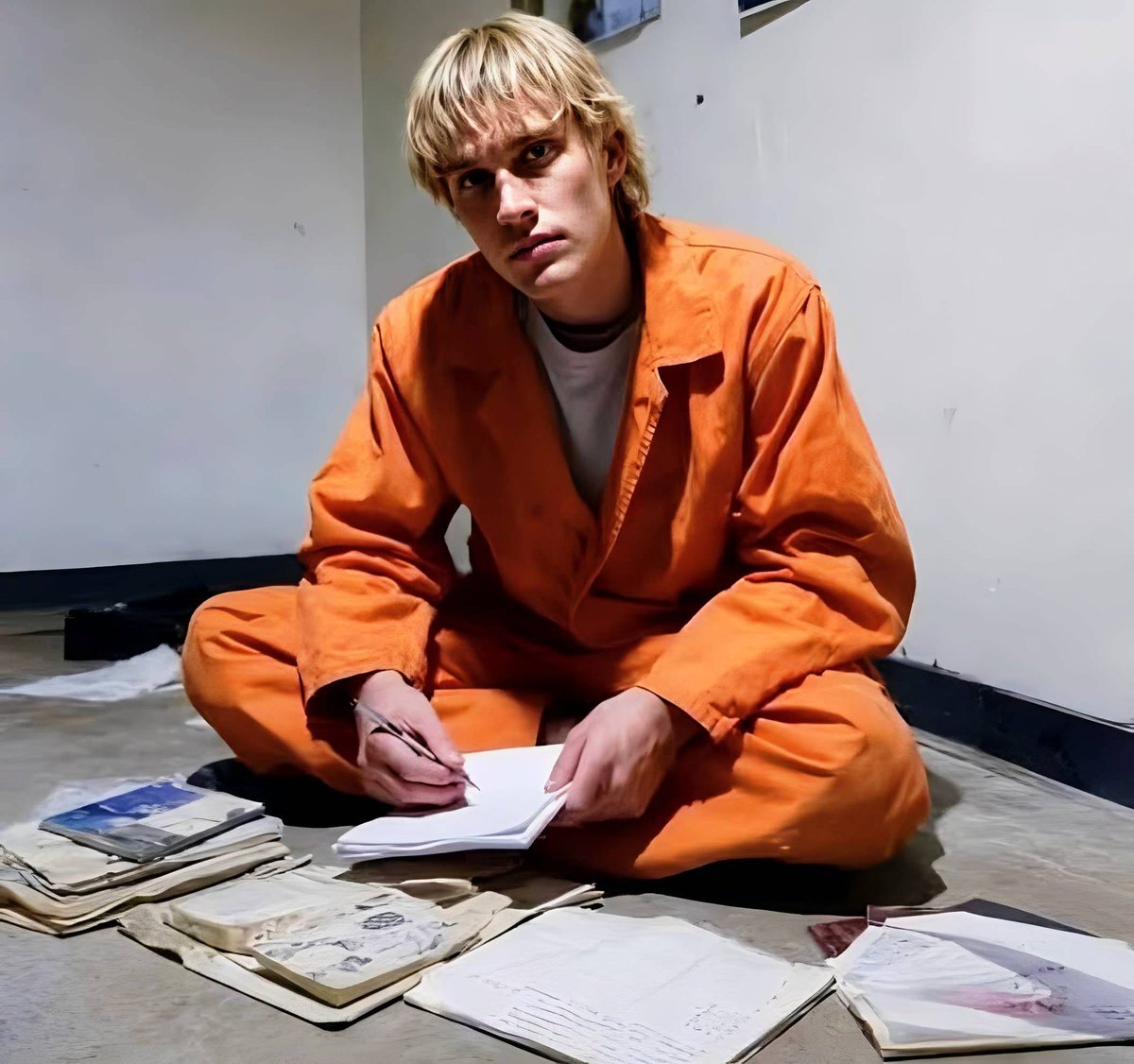
He was serving a 25-year prison sentence for m*rder when a forgotten mathematics textbook changed the direction of his life.
Christopher Havens entered a maximum-security prison in Washington State with a past shaped by dr**gs, violence and poor decisions. By 2011, at just 31 years old, he believed his future had already been decided.
Then, almost by accident, he picked up a mathematics textbook that a cellmate had left behind.
At first, it was simply something to do. Havens had struggled at school and left without a clear direction. But inside his prison cell, with time on his hands and few distractions, he began working through the problems.
And something clicked.
Mathematics offered a world governed by logic. Every problem had rules. Every step required patience. Answers could be tested and proved. In a life that had often been chaotic, he discovered something that gave him focus and purpose.
He began asking the prison education programme for more books. He worked through algebra, moved on to calculus and gradually tackled increasingly advanced subjects.
Before long, he was studying mathematics far beyond the level of ordinary schoolwork.
But eventually, he reached a point where books alone were not enough. He needed someone who could challenge his thinking and guide him through difficult concepts.
So he began writing letters to mathematicians around the world.
One of them replied: Umberto Cerruti, a mathematician at the University of Turin in Italy.
Rather than dismissing Havens because of his criminal past or lack of formal education, Cerruti took his questions seriously. He sent him material on number theory and set him challenging problems.
Havens responded with pages of handwritten calculations and proofs.
Working with little more than books, paper and pencils, he began exploring continued fractions and quadratic irrationals — mathematical subjects with roots stretching back thousands of years.
His work eventually developed into original research.
With Cerruti’s guidance, Havens produced mathematical results that were examined and checked by others. In 2020, their research was published in the peer-reviewed journal Research in Number Theory.
Think about that for a moment: a man serving a lengthy prison sentence, without a university degree or access to the resources available to professional academics, had contributed original research to a recognised mathematical journal.
But Havens did not stop with his own education.
He went on to co-found the Prison Mathematics Project, helping other incarcerated people study mathematics, connect with mentors and discover abilities they may never have known they possessed.
His work became about more than solving equations. It became about giving others access to knowledge, encouragement and a sense of possibility.
Havens remains incarcerated, and his story does not erase the seriousness of the crime that brought him there. Education does not undo harm, and personal growth does not remove accountability.
But his journey raises an important question: what could happen if more people in prison were given meaningful opportunities to learn?
Christopher Havens found mathematics in a forgotten textbook. He found purpose in the hours he once had nothing to fill. And he turned what he learned into an opportunity for others.
His story is a reminder that a person’s past does not have to define every part of their future — and that the potential to learn can exist in places where society least expects to find it.
@eupietraaaaaa Se estar horrível é estar assim, imagina se tivesse bonita. Horrível estou eu que fui inventar de cortar cabelo em casa e raspei tudo, pois estava o samba do crioulo doido. Kkkk