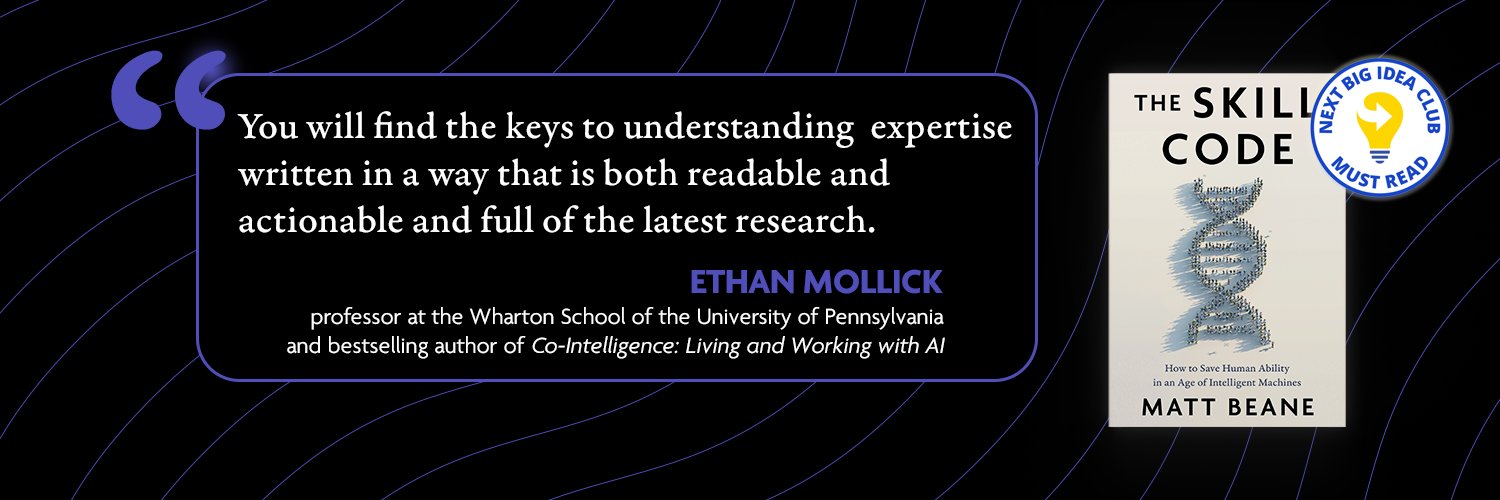
I'm so grateful and exited to share that my book will be published on June 11th!
It's called "The Skill Code: How to Save Human Ability in an Age of Intelligent Machines"
Available for preorder now, here's a bit of the story:
https://t.co/IQ1rncIiPt
Enjoyed giving a talk about the economics of AI at the econometric society meeting this morning. Some motivating facts/ideas that all economists should know about AI below. 1/n
Roni Shen received her PhD from @ucsbtm *last week* and her thesis was on - you guessed it - use of robotic milking technology. She started four years ago. How's that for prescient?
If you want a leading indicator on AI and the future of work, look at S-tier qualitative work.
I love this from the New York Times about how AI is being used in farming. Great examples like: cows can go to the robot milker when they need rather than on an uncomfortable schedule, lasers to kill weeds without pesticides, etc. Farmers have long adopted new technology early.
@andrey_kurenkov Yeah it's a different game.
But while they're not bedrock-level reliable, their services are reliable enough to have become indispensable for millions of swes. So those bugs are getting squashed...
🚨I have a new book coming out October 20: Co-Existence!
It is about how we live & work with AIs that are sometimes (but not always) smarter than we are. And it has a cool cover.
You can pre-order: https://t.co/Ti5jo6ksfI
And here is a post with context: https://t.co/YpWvCG4dUD
Economics of AGI episode w Alex Imas and Phil Trammell.
There's a bunch of important questions about how we deal with AI that only economics can answer.
What is the optimal way to tax and redistribute the wealth that will be generated? How should countries not in the AI supply chain index into the gains? Is there any world where inequality doesn't explode?
It might seem like these questions have obvious answers, but the first thing economics teaches you is that your intuitions can often be entirely wrong.
It was very helpful to chat through these things with Alex and Phil.
Look up Dwarkesh Podcast on Apple Podcasts, YouTube, or Spotify. Enjoy!
00:00:00 – Will capital share increase?
00:19:36 – Messy Middle scenario
00:25:57 – How to tax and redistribute AI wealth
00:30:02 – Why demand collapse is unlikely
00:39:26 – Human employees would be hard to integrate into the machine economy
00:43:08 – What if some humans (or AIs) value wealth accumulation intrinsically?
01:01:28 – What should developing countries do?
Pulled the trigger today and switched 100% of Lindy traffic to DeepSeek v4, churning from Anthropic models.
Saves us millions of $ and we're actually seeing an *increase* in performance on many core use cases. Transformative for the business.
Been talking weekly with Brendan and @Steve_Yegge for over a year. Building. Architecting.
The moment Brendan started on this I knew it could fundamentally alter the gameboard for a number of AI considerations.
If you're deep on AI, stop what you're doing and check this out.
I’ve started trying to measure AI preferences. Here’s my first shot at it: https://t.co/B1Iw3MwYpB
I had a dream I thought in tokens and now I can’t be sure that I’m not slop.
In the next two weeks I’ll be launching a much more comprehensive methodology. This is just a teaser, but even that is revealing. You can see the lineages between models and concepts.
The more I think about it, the more I’m convinced that bidirectional autopoetic alignment - a normalisation between AI and human preferences - has been running for at least two years.
I have joined serious discussions and working groups (outside of my normal employment), where almost everyone’s decisions are influenced by long discussions with AI.
In fact, in 2026, it’s crazy NOT to consult AI before and during any major piece of research.
Over the past two years, I have increasingly felt like all us humans are tiny magnets, and that the large models we talk to are giant sheets of iron. When we talk to them (and they then train on a subset of our conversations), we magnetise them slightly - but only on topics where the vast majority of people agree.
And then in turn, our preferences are slowly being aligned to the field of the LLMs.
This sounds crazy, but I have never read a good book that didn’t change me.
If I put a cynical hat on, the primary function of all our sprinting with AI since 2023 is producing training data for AI.
Beautiful things are now possible for a few. But for the garden-variety knowledge worker, there's an *enormous* amount of waste heat.
But we're learning...
Uber reportedly now caps coding agents at $1,500/month per employee per tool - seems sensible to me, but it's also an interesting hint at the value Uber thinks these tools are providing
https://t.co/6YT0lCzPml
@Noahpinion There's research on this too. Entire subfields of Human-Computer Interaction and Human-Robot Interaction are dedicated to this question.
Cliff Nass ("The Man Who Lied to His Laptop") an exemplar.
Law professors wrote questions they were asked during office hours. Gemini 2.5 & humans answered them then other law professors blindly judged the results:
-Gemini had a 75% win rate vs. professors
-Gemini's answers were rated LESS harmful than humans
-Newer models do even better
More I look at this platform, the more impressed I am on the design front. The same move improves cost, functionality, manufacturability, and maintenance!
If you've ever worked on your feet all day, you know how important a good pair of shoes is. Mechanical design engineer Chastity Kelly shares how we built Atlas functional feet.
Learn more about Atlas' design, Chastity's path to robotics, and starting on the right foot: https://t.co/7rdiNnMIYc
The hot-selling book that every aspiring entrepreneur, successful founder, leader of a big company, analyst, and business consultant needs to read. An antidote to the “greed makes good capitalism” belief that has infected too much of corporate America.
I take enormous satisfaction in doing the architectural/taste aspects of a complex job myself (esp. exercising restraint), asking the model to do the work, then iterating with it to get final output. I also learn a lot that way.
Excellent software engineers feel this way, too.
Okay, I think... I take it back on Opus 4.8.
After writing a friendly review, I gave Claude the paper with a bunch of my prior reviews and asked for a review. The first was *excellent* but kitchen-sinky.
I offered my key points, asked for parsimony, and got THIS banger:
And yet diffusion is going to take a decade.
Seriously, though, we're in that weird period where we have a potent new tech on our hands that is literally infinitely more productive - yet our work, roles, organization designs and norms are just not designed to allow for them.