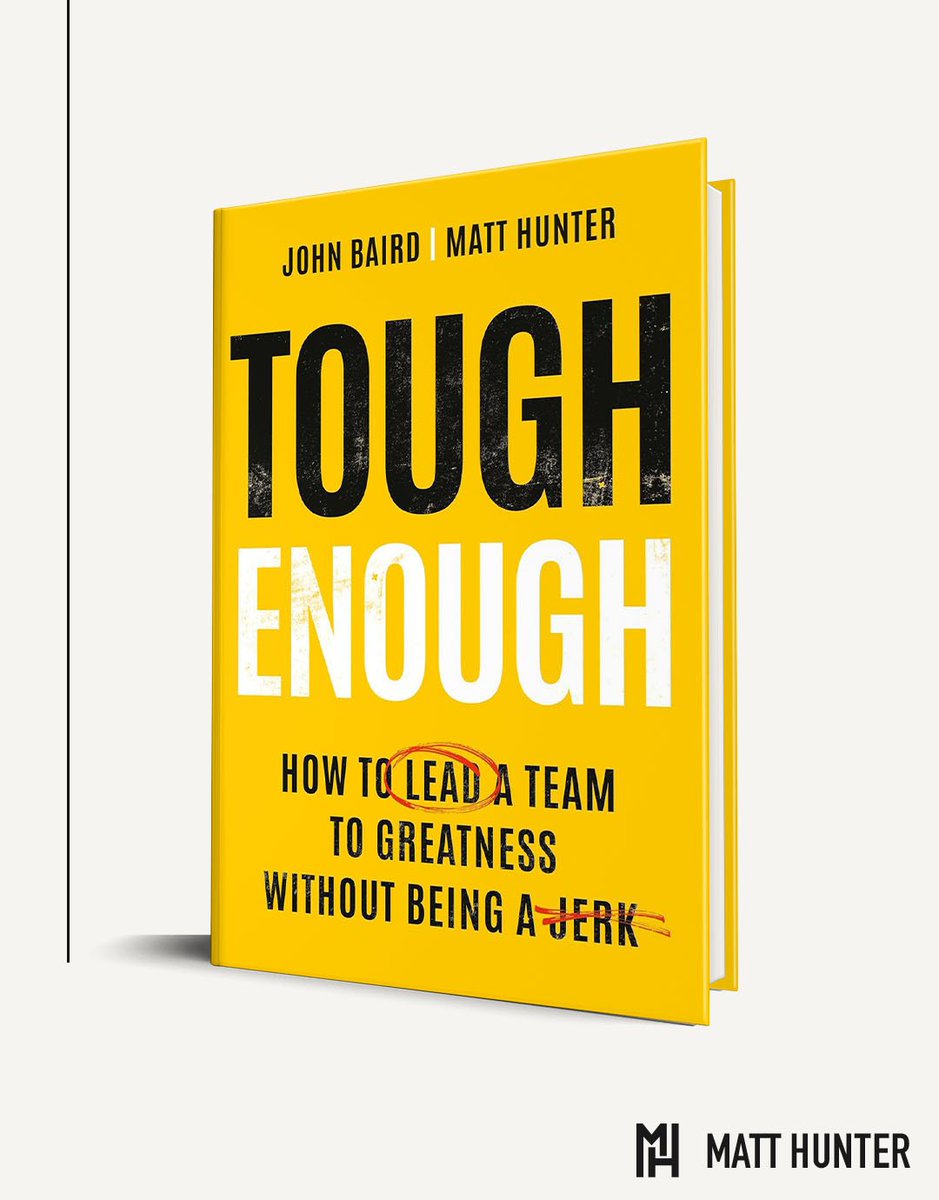
Today I am so excited to publicly announce my new book, Tough Enough: How to Lead a Team to Greatness Without Being a Jerk, which @BasicVenture at @HachetteUS will publish on September 29, 2026. It’s the practical playbook for building the next generation of great companies.
As an ex-founder turned executive coach, I’ve partnered with John Baird, one of Silicon Valley’s most respected executive coaches (Apple, Nike, DoorDash, MasterClass) as co-author to pay forward our hard-earned experiences in this book.
At the core of Tough Enough is a question that we’ve come back to repeatedly in our work:
How can leaders strike a balance between firm and humanizing?
It sounds simple, but actual leadership in practice tends to fall into either end on The Toughness Spectrum. And yet that middle operating mode is what is required to build great teams and lead companies to success without being a jerk.
We call that mode “Tough Enough”—a way of leading that is demanding, fast, and performance-oriented, while still being respectful. We break this down into seven timeless habits that can be taught and applied.
Tough Enough is for ambitious leaders who are too tough and need to keep their edge while reducing harm and those who are not tough enough and need to raise standards, embrace difficult conversations, and hold the line.
You can learn more about Tough Enough and start reading it right away here:
https://t.co/syJCmvLUPY
Thank you for your support to develop Tough Enough leaders to guide teams and their companies to greatness.
“Keep emotions out of business” is terrible advice.
Great leaders use emotion, they don’t suppress it.
When something isn’t good enough, they don’t stay neutral. They show it through frustration, disappointment, and urgency.
And the team feels it.
Emotion is how humans prioritize what matters.
The mistake isn’t expressing emotion. The mistake is losing control of it or making it personal.
There’s a difference between saying, “This isn’t acceptable,” and “You aren’t acceptable.”
Used well, emotion creates movement, sharpens standards, and forces clarity.
Used poorly, it destroys trust.
You’re not a robot. You don’t have to be emotionless.
Your job is to be intentional with what you express and why you express it.
We’ve built a generation of leaders who are afraid to lead.
Over the past decade, the workplace shifted hard toward comfort through better perks, more flexibility, more emphasis on psychological safety, and more sensitivity to how everything might be perceived.
Some of that was necessary and corrected real imbalances.
But it also created something I see constantly in my coaching work: what I call the mirage of compassion.
On the surface, it looks like care. Leaders are nice, avoid conflict, and try to keep everyone happy.
Underneath, it’s often fear.
Fear of being called out.
Fear of losing talent.
Fear of saying the wrong thing.
So what happens?
Standards drop, feedback softens, accountability disappears, and the mission quietly takes a backseat to making sure no one feels uncomfortable.
But happiness doesn’t drive performance. Clarity does.
Standards do.
Accountability does.
Great teams aren’t built on comfort. They’re built on shared commitment to a goal that actually matters.
And that requires tension.
It requires saying, “This isn’t good enough.”
It requires holding the line when it would be easier to let it slide.
It requires leaders who are willing to be misunderstood in the short term to get the right outcome in the long term.
The answer isn’t to swing back to harsh, old-school leadership.
It’s integrating the old school with the new.
Care about your people, and tell them the truth.
Create psychological safety, and demand high performance.
Be kind, and be clear.
Because real compassion is about helping people rise to what they’re capable of.
The best recruiting tool has nothing to do with compensation.
It’s purpose.
People will work incredibly hard, make sacrifices, and stay committed when they believe they’re part of something that matters.
That’s why great leaders sell a vision.
In my most recent newsletter, I explore why the strongest companies are built around a clear manifesto, and why vision, mission, values, and standards are essential for attracting top talent and building high-performance cultures.
If you’re going to ask a lot from people, you need to give them something worth believing in.
👉 Read it here → https://t.co/lc0bl0InM9
Most startup problems are connection problems.
The number one issue I see is leaders who can’t have hard conversations or deliver clear feedback.
So things get avoided, smoothed over, and deferred.
Then they compound.
Small issues turn into culture problems.
Culture problems turn into performance problems.
And eventually, everything slows down.
If your team can’t give and receive honest feedback, it’s not a functional team.
If that’s the case for your team, turning on direct, clear conversations will fix more than almost anything else.
It creates accountability, surfaces issues early, and keeps standards high.
Yes, it’s uncomfortable.
But avoiding this approach will break your organization.
Most leaders have been taught the wrong lesson about emotions.
They think professionalism means neutrality: keep a straight face, stay calm, and don’t let people see how you really feel.
But if you study high-performing teams, that’s not what’s happening.
The best leaders use emotion as a tool.
When something is off, they don’t hide it. They express frustration, disappointment, and urgency. Not to intimidate, but to signal that something matters.
And people respond.
Why? Because we’re wired that way.
Emotion is how humans prioritize information. When something is delivered with intensity, it cuts through the noise and demands attention.
That’s why a well-timed emotional moment can shift a team faster than a perfectly crafted, calm explanation.
But here’s where most leaders get it wrong:
They confuse emotional expression with emotional reactivity.
Losing control, lashing out, and making it personal is dysfunction.
The proper move is controlled intensity.
Call out the problem clearly. Let people feel the gap between where they are and where they need to be.
Then hold the tension.
But keep it about the work, not the person.
I think of this as delivering a “thunderbolt.”
Used sparingly, it resets standards and creates movement.
Used constantly, it loses power and destroys morale.
So the question isn’t whether emotion belongs in leadership.
Of course it does.
The question is whether you can access it without being ruled by it.
Feel it, use it, and then return to clarity.
That’s how you lead with both power and precision.
If you’re having a hard conversation over Slack, you’re already failing.
Founders and leaders are frequently guilty of this.
Something sensitive comes up. Instead of addressing it directly, they draft a long message. Or fire off a quick one.
Either way, it creates confusion, tension, and unnecessary conflict.
Remember this: the more important the conversation, the more human the medium needs to be.
Text is for logistics.
Calls are for alignment.
And face-to-face is for anything that actually matters.
Why?
Because most communication isn’t words. It’s tone, body language, timing, and presence.
If you skip that, you’re guessing and usually getting it wrong.
Next time something feels even slightly tense, don’t reply.
Escalate the conversation to be face-to-face or as close as possible.
There’s a line every founder needs to understand, and most cross it without realizing.
You are allowed to be wildly optimistic about the future.
You are not allowed to be loose with the truth about the present or past.
That distinction really matters.
When you’re talking about vision, go big. Push it, stretch it, and say the thing that makes people lean in and think, “If this works, it changes everything.”
That’s part of the job.
Investors, partners, and teammates aren’t buying your current state. They’re buying the possibility. And they want that possibility to be big.
But the moment the conversation shifts to realities like revenue, burn, headcount, and product capability, you need to snap to precision.
Give exact numbers, direct answers, and no qualifiers before the fact.
This is where founders often get into trouble.
They start blending vision with reality. They round up, they reframe, and they “contextualize” instead of answering.
And just like that, trust is gone.
I’ve seen it happen in real time. It only takes one vague answer or one avoided number for the investor to leave.
Because if you’re not clean on the facts, nothing else you say matters.
We’ve seen how this ends at scale.
Theranos.
WeWork.
FTX.
Not failures of vision, but failures of integrity.
Here’s the simple rule: be expansive about where you’re going, and be exact about where you are.
No spin.
No storytelling.
No hiding.
Because in the early days, your company is built on belief.
And belief is built on trust.
Once that’s gone, the rest collapses fast.
Is your map of yourself accurate?
You’re making decisions, setting goals, and trying to grow… based on your own perspective. But is it accurate?
The truth is, your perspective of yourself is limited.
The fastest way to fix this is through positive triangulation.
Bring in a small group of people you trust to tell you the truth about how you actually show up.
Because awareness drives everything.
If your map is off, your results will be too.
The key with who solicit feedback from is credibility. You want people who are honest, perceptive, and actually have your best interests at heart, not people who will just validate you.
Most people avoid this because it’s uncomfortable.
But the leaders who lean into it get better faster.
Stop guessing.
Collect better data.
If your team isn’t meeting your standards, there’s a good chance the problem is you haven’t defined them clearly.
I see this all the time.
Leaders get frustrated because the work isn’t good enough. Expectations feel “obvious” in their head but completely unclear to everyone else.
Then they do one of two things. They either lower the bar or they come down hard.
Both are mistakes.
The fix is simpler, but harder.
Align on what success actually looks like with your team.
Have the conversation, let your team weigh in, get specific, and get agreement.
Then give them ownership.
Once someone owns the outcome, it’s on them to deliver.
Your job shifts from doing the work to holding the standard.
Clarity creates ownership.
Ownership creates performance.
Everything else is noise.
There are two ditches that people fall into when it comes to anger: being afraid of it and being ruled by it.
What I see far more often is the first: people who pride themselves on being calm, composed, and “above it.”
They don’t get angry.
Except they do… they just don’t admit it.
So what happens?
The anger gets buried. And instead of coming out cleanly, it leaks.
It shows up as weak boundaries, passive aggression, quiet resentment, burnout, and even physical symptoms over time.
Here’s the necessary reframe: anger isn’t the enemy; it’s data.
It’s your internal signal that something is off.
A line’s been crossed.
A standard’s been missed.
A value’s been violated.
And if you ignore that signal, you lose access to a massive source of clarity and energy.
And there’s the other ditch leaders fall into. They express anger without control, lash out, and make it about the person instead of the problem.
That’s immature.
The cure is to get more skillful. Feel the anger fully. Understand what it’s pointing to.
And then express it in a way that’s clean, direct, and respectful.
When you do this well, a few things happen. Your boundaries get stronger, your communication gets clearer, and your presence gets more powerful.
Because people can feel when something actually matters to you.
Anger, used skillfully, is fuel.
It drives action, sharpens standards, and forces change.
So don’t suppress it.
Don’t let it run you.
Instead, learn how to use it.
That’s where a good portion of your untapped power is.
The feedback sandwich is killing your team’s performance.
You think you’re being kind, but you’re actually being unclear.
We’re told to say something nice, slip in the real issue, and end with another compliment.
But now no one knows what actually matters.
Did they do well? Did they mess up? Should they change something?
This is what happens when you prioritize comfort over clarity.
Great leaders say the hard thing directly.
Not harshly or disrespectfully. Just clearly.
Additionally, you need to share the impact.
“This missed the mark,” is weak.
“This created confusion and concern for me,” lands.
Clarity drives change.
If you soften the message, you weaken the outcome.
If you want to accelerate your growth, stop trying to figure yourself out alone.
It won’t work.
I frequently see founders and leaders relying too heavily on their own self-assessment. They journal, reflect, and maybe even work with a coach, but they’re still operating inside a closed loop.
And that loop is flawed. You are rarely an objective narrator of your own life.
That’s where positive triangulation comes in.
The idea is simple: bring in multiple credible perspectives to help you see what you can’t see on your own.
This could look like a formal 360 review, or something much simpler.
Asking your team how you’re actually doing as a leader.
Getting honest feedback from your spouse.
Inviting someone you trust to observe you in action.
The goal is accuracy.
Because growth doesn’t come purely from having good intentions. It comes from awareness.
And most of us are a lot more off than we think.
Here’s what I’ve seen again and again:
Someone thinks they’re great at giving feedback. Then you watch them in a meeting, and they aren’t.
Someone thinks they’re showing up as a strong leader while their team experiences them as unclear and inconsistent.
These gaps are everywhere.
And you don’t close them by thinking harder. You close them by getting real data from real people.
Yes, it can sting.
Good feedback usually does. It hits you in the gut before it sets you free.
But if you can stay with it without defensiveness or spinning, you unlock a completely different level of growth.
Better awareness.
Better decisions.
Better leadership.
If you want a shortcut, this is it.
Stop guessing who you are, and let people show you.
“Praise publicly, criticize privately” is good advice for most companies.
It’s just not good advice if you want elite performance.
“Praise publicly, criticize privately” help you operate from the Comfort Zone, protecting feelings, avoiding tension, and keeping feedback behind closed doors.
And it works to a point.
But high-performing teams operate differently.
They’re willing to bring feedback into the open.
Not to shame or embarrass, but to raise the standard for everyone.
Because when feedback is public, a few things happen:
Accountability becomes visible.
The whole team learns.
And there’s nowhere to hide.
The key is how you do it.
Share clear observations, honest impact, and use a respectful tone.
No theatrics. No ego.
Private feedback protects people’s feelings.
Public feedback, done right, elevates the team.
If you’re still using the feedback sandwich, you’re prioritizing your comfort over your team’s growth.
And it’s costing you.
The idea sounds nice in theory. Open with praise, deliver the hard truth, close with encouragement.
But in practice, it creates confusion and dilutes the message. The person walks away unsure what actually matters.
And when there’s no clarity, there’s no change.
At the highest levels of performance, leaders don’t hide the hard thing. They say it directly, clearly, and without dressing it up.
That doesn’t mean being a jerk.
It means being honest and still respectful.
There’s a big difference.
The real lever here is to share the impact. When someone’s work misses the mark, your job isn’t just to point it out. It’s to communicate what it caused: frustration, concern, missed targets, and loss of trust.
When people feel the impact, they pay attention. That’s what actually drives behavior change.
Most leaders avoid this because it’s uncomfortable. But discomfort is part of the job.
If you still want a sandwich of sorts, keep two things:
Re-anchor to the goal or mission and end with belief in their ability to improve.
Everything in the middle? Say it straight.
No fluff, padding, or performance.
Just truth, delivered with respect.
If you want better work, stop softening the message.
If your feedback isn’t backed by consequences, it’s just noise.
I see this constantly.
Leaders say the hard thing…then stop short of enacting consequences when the teammate doesn’t follow through.
And over time, the team learns a simple lesson: Nothing actually happens if I don’t change.
That’s how standards erode.
Consequences signal that expectations matter, that commitments mean something, and that performance has weight.
Feedback is step one, and consequences are step two.
Without step two, step one loses power.
And here’s the uncomfortable truth: if you avoid consequences, you’re being unclear, not kind.
Great leaders don’t rush to consequences.
But when it’s time, they enact them.
And that builds accountability.
Every team needs a worthy opponent.
Not to obsess over or hate, but to focus the mission.
A well-chosen rival sharpens execution, raises the standard, and gives people something concrete to chase.
I’ve seen this work over and over.
When the goal is abstract, energy drifts.
When there’s a clear opponent, intensity rises.
But here’s where most leaders get it wrong:
They make it personal.
They make it toxic.
Or they lose the plot.
The best version is simple: pick a rival bigger than you that makes you better, channel the competition into better work, and keep the focus on winning through execution.
No trash talk.
Use competition, not as your identity, but as your fuel.
That’s how you build momentum without losing control.
In business, a well-chosen rival can be incredibly powerful.
Used correctly, they sharpen focus, raise standards, and inject urgency into the system.
But there’s a line a lot of leaders cross: On one end, you have healthy competition in a clear rival, an aspirational chase, and a unifying story that says, “This is who we’re up against, and this is who we’re becoming.”
It’s energizing. It’s productive. It drives better execution.
On the other end, you get obsession.
Early Microsoft is the extreme case. Bill Gates didn’t just want to win, he wanted to eliminate competitors.
It became personal, emotional, and all-consuming.
While it worked in terms of outcomes, it came with intensity that most teams can’t and shouldn’t try to replicate.
The sweet spot is somewhere in the middle.
Nike nailed this. They positioned themselves as the underdog chasing Adidas.
That identity shaped everything from how they built products and how they recruited athletes to how they showed up in the market.
It created clarity and internal cohesion without tipping into dysfunction.
Komatsu did the same thing with Caterpillar. Not “destroy them,” but encircle them. That subtle shift matters. It turned strategy into something people could rally around.
The bottom line is the ego loves a fight. Your job as a leader is to give it one that actually serves the mission.
Pick the right rival, set clear guardrails, and keep it about performance, not personal vendettas.
Use the tension to elevate your team without consuming it.
That’s how you turn competition into a strategic advantage instead of a cultural liability.
Big growth rarely starts big.
It starts with one small, winnable sandbox.
One campus. One neighborhood. One niche community.
That’s how Tinder built early traction… creating dense pockets of attention that triggered network effects city by city.
In my most recent newsletter, I break down:
- Why concentrated momentum beats broad exposure
- The guerrilla tactics Tinder and Bumble used to dominate campuses
- Where the line is between bold marketing and reckless growth
Because breakout growth doesn’t come from being everywhere.
It comes from owning somewhere first.
👉 Read it here → https://t.co/7wbQ7xpDeO
Being bad at praise is astoundingly common, especially for leaders.
They either avoid praise altogether or water it down to a vague, “good job.”
Then they wonder why performance stalls.
Most of the time, it’s that they fear praise will create complacency.
The irony is that genuine praise doesn’t, but the vague praise they resort to does.
When you get specific, praise becomes a performance tool.
Call out the exact behavior.
Explain why it mattered.
And tie it to how it impacted you personally as well as the business.
“Great presentation” does nothing.
“Your breakdown of the data made a complex decision easy for the team, which moved the project forward. I felt relieved and grateful.” That could change everything. Now they know what winning looks like.
The goal isn’t to be nice but to reinforce what works.
Too much criticism burns people out. Too much empty praise makes them complacent and feeling not seen.
If you want better performance, stop being generic and start being exact.
Precision is what makes the difference.
Drama in your organization isn’t harmless. It’s a leadership failure.
Gossip, side conversations, and back-channeling aren’t just annoying; they’re signals your culture is off.
Poor communication.
Avoided conflict.
Unclear standards.
Comfortable leaders tolerate each of these. Strong leaders shut them down immediately.
Here’s the rule: if the person isn’t in the room, the conversation shouldn’t be happening.
The move is simply to redirect the conversation. Something like, “Have you talked to them about this directly?”
If not, that’s the next step. Always.
No Slack debates or long email threads. Real conversations that happen face to face.
When you allow drama, you drain focus, erode trust, and model bad behavior.
When you go direct, you build accountability, clarity, and respect.
If you want a high-performing team, stop managing around problems.
Step into them.