One government department claims it has saved millions and delivered a better system by moving away from Palantir and building in-house. Interesting
https://t.co/qPNbZrM6Xa
@ednewtonrex@Rahll Or maybe they were never going to train models here, and the lack of a change in copyright law was a good reason to pull back on investments that were non-essential to running their business in the UK. And also reduce the cash burn at the same time.
Maybe.
For comparison, in recent years, he has seen 1 or a few IPs doing 10,000+ requests, but this week we're seeing 100,0000+ IPs in a coordinated to scrape, each IP doing a few requests.
#FOSS4G
@AndrewOrlowski@jason_kint He may yet still!
He's an MMA fighting, AGI investing , don't give a monkeys, visionary.
Just look at the way he's using Meta chat bot conversations to fine tune targeted ad impressions.
Morality isn't a concept he needs to care about anymore. He is a man of the future.
@jason_kint "But more conversations have followed, including dialogues with other high-ranking Russian officials past 2022 and into this year. One of the officials was Sergei Kiriyenko, Putin’s first deputy chief of staff, two of the officials said. What the two talked about isn’t clear."
'Britain can achieve more than simply becoming the UK branch of US tech'
Protecting British creatives with responsible AI would boost UK growth – not prevent it
✍️ @JamesFrith
https://t.co/wN6uHNjpZk
“We’re a new front organisation sponsored by billionaire lunatics and our agenda is to give American tech monopolies everything they ask for.
“We use words like industry and economic sovereignty and stick a Union Jack on our posts. But we are lobbying hard to strip British businesses of their property right, to please our American sponsors. This is what we do”
“We’re globalists with no shame about deceiving people - and we are here to gaslight you”
Several misleading claims by @peterkyle on The Rest Is Politics today to justify his proposed gutting of UK copyright law.
1. “All of the data has already been scraped and used by AI companies because not one of them is domiciled in the UK... so unless you have international copyright attached to your work which is respected in California, then your data has already been subsumed into the AI system”
While it's true that many of the big AI companies are based in the US, many people think scraping copyrighted work for commercial gen AI training is illegal under US law, which is why there are 30+ lawsuits in the US on the topic. None are resolved yet. What's more, British creators *do* have 'international copyright', because 180+ countries have signed international agreements on this (including the UK & US), such as the Berne Convention.
2. “The copyright laws are 300 years old”
The *first* copyright laws are 300 years old (the 'Statute of Anne'), but they have been updated many times since then, including with the addition of international laws. This is like saying "the murder laws are hundreds of years old, so they're clearly not fit for purpose".
3. “When it comes to China, they have no regard for any copyright anywhere in the world”
They do.
4. “What I’m being asked to do is choose between [AI and the creative industries]”
He is not. The creative industries simply say AI companies should be required to pay for their training data, just as they pay for engineers and GPUs. There is no indication that only one 'side' can win here.
Super disappointing to see the debate framed this way by the person in charge of the UK's consultation on AI & copyright. It's hardly surprising the UK's creators are so angry with the government on this.
Suggest giving it a listen: https://t.co/WaWRPQdXxD
(Starts at ~57 mins)
A couple of misleading things in this policy paper from the Tony Blair Institute:
1. They suggest the US doesn’t have strict copyright laws. But US copyright laws are strong, and are pretty fair to creators - the ‘fair use’ exception is nuanced, and many people (myself included) don’t believe for a moment that it permits all commercial gen AI training (hence the many US lawsuits).
2. They claim there are better ways to protect artists than strong copyright laws. This is not what artists say.
These are becoming mantras of the school of thought that wants to weaken copyright law to favour AI companies. But repeating them doesn’t make them true.
In general, I think it is odd for institutes with strong links to tech companies and zero links to artists to tell artists what they do or don’t need from copyright law. They would do better to listen to what artists are actually saying.
Alphafold wasn't built with the beach boys, or the contents of BBC iPlayer, it was made using the protein data bank. An asset funded by billions of dollars in public funding, curated by many thousands of human beings. Discoveries like this are not about broad copyright exceptions
3/ AI is built on three fundamental inputs: compute, algorithms, and data.
Restricting access to data means UK firms building AI for drug discovery, small business automation, or advanced manufacturing will be left behind.
AI models won’t be built or adopted here but they will continue to be trained abroad. The best talent and startups will relocate. The best products—faster cancer treatments, cheaper logistics, smarter energy grids—won’t launch in the UK.
Alphafold is UK based. Other UK startups like Basecamp research are building on that success.
“Not only is the dataset better quality, but it's actually sourced correctly with the right permissions around it so that it can be commercialised."
https://t.co/VUSxGfDJsk
3/ AI is built on three fundamental inputs: compute, algorithms, and data.
Restricting access to data means UK firms building AI for drug discovery, small business automation, or advanced manufacturing will be left behind.
AI models won’t be built or adopted here but they will continue to be trained abroad. The best talent and startups will relocate. The best products—faster cancer treatments, cheaper logistics, smarter energy grids—won’t launch in the UK.
We really really REALLY need a map of all the tech cash coming into trade bodies and think tanks advocating to take the doors off on copyright.
And MPs, Lords and select committees need to ask for that data before they take meetings with them or take their evidence
#MakeItFair
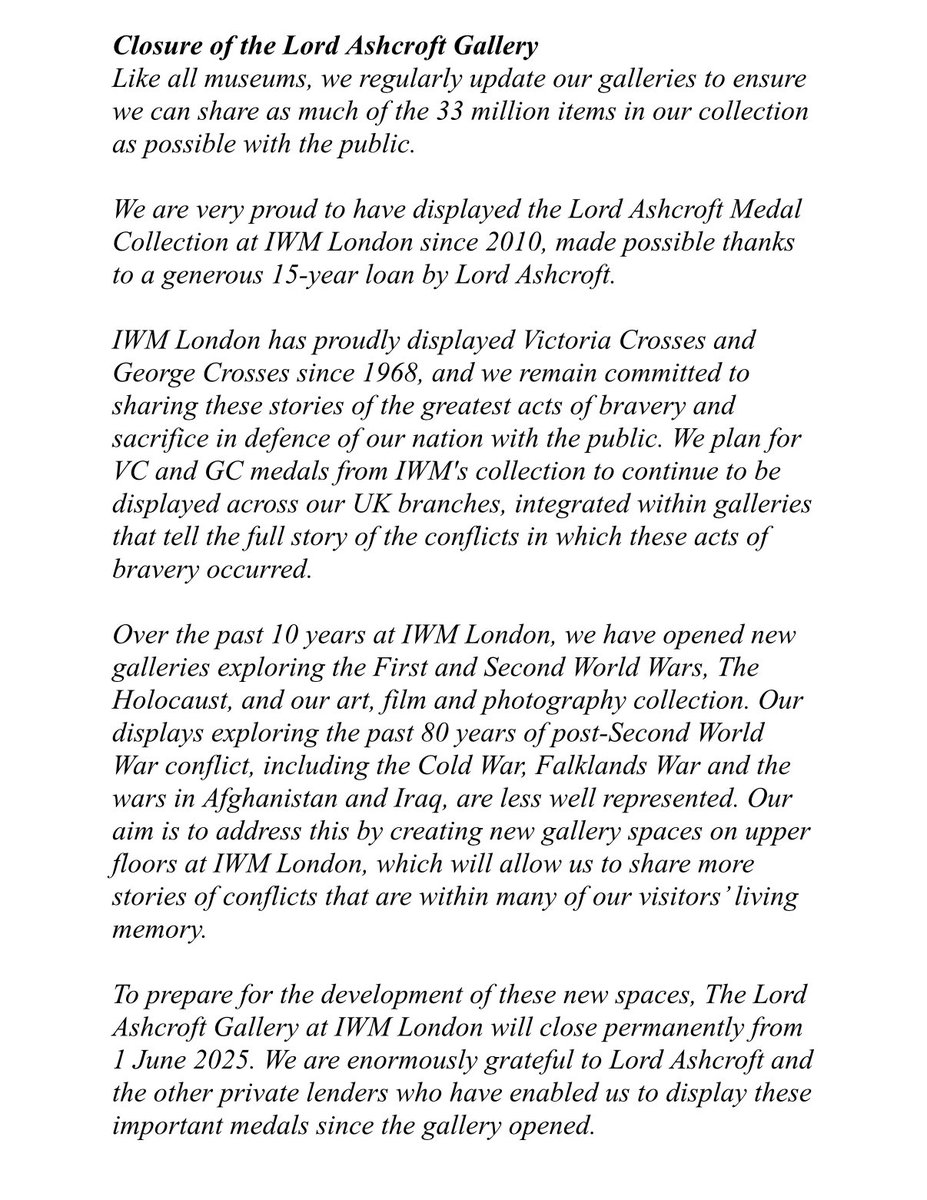
Sad for me. I’ve got this from the Imperial War Museums closing the Lord Ashcroft Gallery displaying around 200 VC’s representing the finest deeds of servicemen in UK’s history. Sadly into storage for the time being and my £5m cost to open lost. Please visit before closing…
Rubbish.
1. The Thomson Reuters case involved AI use that was not transformative, making it a poor precedent for most AI systems that generate outputs meaningfully distinct from their training data. It does not suggest the US is moving toward an opt-in or opt-out regime for AI training.
2. This ruling came from a Delaware court. If a copyright claim against AI reaches the Supreme Court, it is highly likely to rule that the vast majority of AI products fall under fair use.
3. Even if points 1 and 2 were wrong, this still wouldn’t matter because China does not care about Western copyright laws. Chinese companies will continue training models on publicly available data, whether or not US firms are restricted.
4. Given this, do you really think Trump—or any US administration—will allow AI development in the US to be hamstrung while China charges ahead unrestricted?
This is quite the simplistic read on the global copyright situation vis AI training.
For a little reality check, check out the Thomson Reuters (TR) v Ross AI case, which TR won.
https://t.co/kdeb5jNGD3
And a tracker of the over 30 AI cases to come https://t.co/CtwPr74QqO
wow. Upon Court order, incriminating exhibits were unsealed at 3:30am in an AI lawsuit against Meta. Once past a 'fake privilege,' it appears Zuckerberg approved the use of a highly controversial, pirated dataset.
Note OpenAI, too? AI companies with no ethics or guardrails. /1











![ednewtonrex's tweet photo. Several misleading claims by @peterkyle on The Rest Is Politics today to justify his proposed gutting of UK copyright law.
1. “All of the data has already been scraped and used by AI companies because not one of them is domiciled in the UK... so unless you have international copyright attached to your work which is respected in California, then your data has already been subsumed into the AI system”
While it's true that many of the big AI companies are based in the US, many people think scraping copyrighted work for commercial gen AI training is illegal under US law, which is why there are 30+ lawsuits in the US on the topic. None are resolved yet. What's more, British creators *do* have 'international copyright', because 180+ countries have signed international agreements on this (including the UK & US), such as the Berne Convention.
2. “The copyright laws are 300 years old”
The *first* copyright laws are 300 years old (the 'Statute of Anne'), but they have been updated many times since then, including with the addition of international laws. This is like saying "the murder laws are hundreds of years old, so they're clearly not fit for purpose".
3. “When it comes to China, they have no regard for any copyright anywhere in the world”
They do.
4. “What I’m being asked to do is choose between [AI and the creative industries]”
He is not. The creative industries simply say AI companies should be required to pay for their training data, just as they pay for engineers and GPUs. There is no indication that only one 'side' can win here.
Super disappointing to see the debate framed this way by the person in charge of the UK's consultation on AI & copyright. It's hardly surprising the UK's creators are so angry with the government on this.
Suggest giving it a listen: https://t.co/WaWRPQdXxD
(Starts at ~57 mins)](https://pbs.twimg.com/media/GmQUExJaAAA45sy.png)