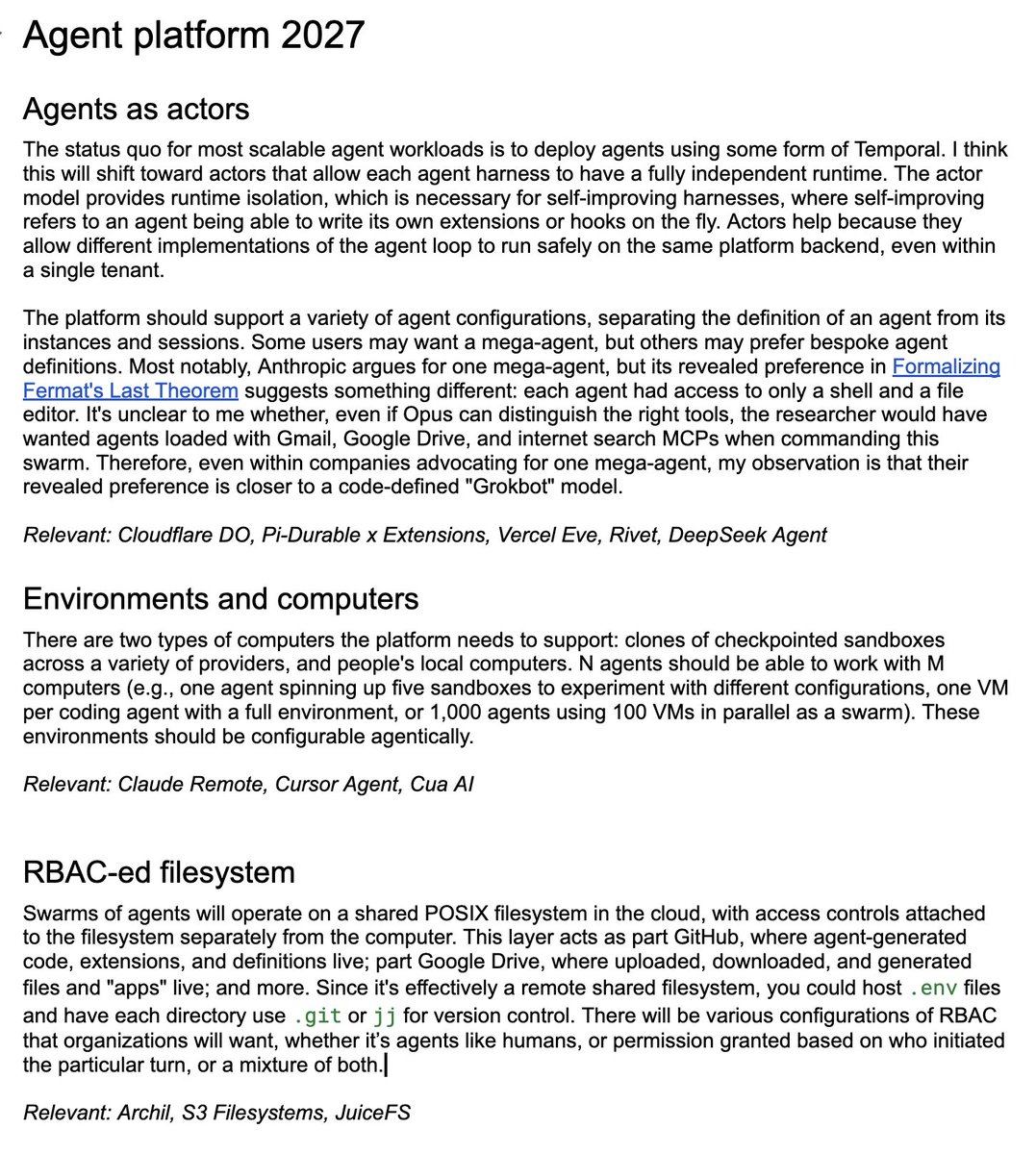
Agent platform of 2027.
This is the end game. This is the blueprint for the one and only application layer software that will exist. Every other software will effectively become databases for this layer, the everything agentic operating system for the million agent swarm to work on top of.
This is obviously the end game vision for the application layer of ChatGPT and Claude. I have reasons to believe that an independent company will own this product layer. But most ADE, "enterprise agent platform", or vertical saas companies, are focused on the wrong things far too narrowly, not technically competent, and do not have the product / technical vision to see this inevitable future.
The correct agent platform that wins will function like the base of a garden, from which customers will plant their unique "seeds" to grow their own plants and trees, managed and evolved by agents, humans, and signals from the sensors of the business. This presents a clearer picture than "factory of a factory" imo.
A toothpaste company has quietly killed the entire market research industry and nobody is talking about it.
Colgate published a paper showing you can predict real purchase intent by simply asking LLMs to roleplay customers.
And this is beyond insane.
If you ask an AI, "Rate this product from 1 to 5," it gives safe, middle-of-the-road garbage.
So researchers invented a method called Semantic Similarity Rating (SSR).
Instead of asking the AI for a number, they asked it to roleplay.
They gave the LLM a demographic profile. They showed it a product concept. And they asked it to write down its raw, unfiltered thoughts.
Then, they used a semantic model to translate those written thoughts into a numerical score.
The results are staggering.
Tested against 57 real personal care product surveys and 9,300 human responses, the synthetic consumers hit 90% of human test-retest reliability.
They perfectly mirrored how different age brackets and income levels react to price changes.
And they provided detailed, qualitative feedback that was deeper and more critical than what actual humans wrote.
This destroys the economics of traditional market research.
You don't need to wait a month to see if a product will sell.
You can simulate 1,000 hyper-targeted customer interviews overnight.
You can A/B test pricing across every demographic instantly.
There's also a related thing: https://t.co/LtzbUvbx9l
I bet if those bugs were not found it'd have shipped anyway.
LLMs are so good at finding every minute thing and every weird permutation that it's finding and reporting and wanting to fix stuff like "if this happens then this and that and it's the 30th of March at 3pm UTC then this one thing will look wrong".
Sure, yes, it's a bug, but the odds of hitting that are wildy low. But it's a bug. Backlog's full of things nobody would've hit or cared about if they did.
@theo Yeah, Opus really likes to do exhaustive checks "what if this then this then that then this happens?" Yes, there are a nearly infinite number of things that could happen but we need to ship it - move along and maybe we can explore second or third order edge cases some other day
talked to someone today who was distraught and said basically everyone just ships whatever they want, no one is talking to each other, and no one has any reason to say "no" to any particular feature being added so they just add everything
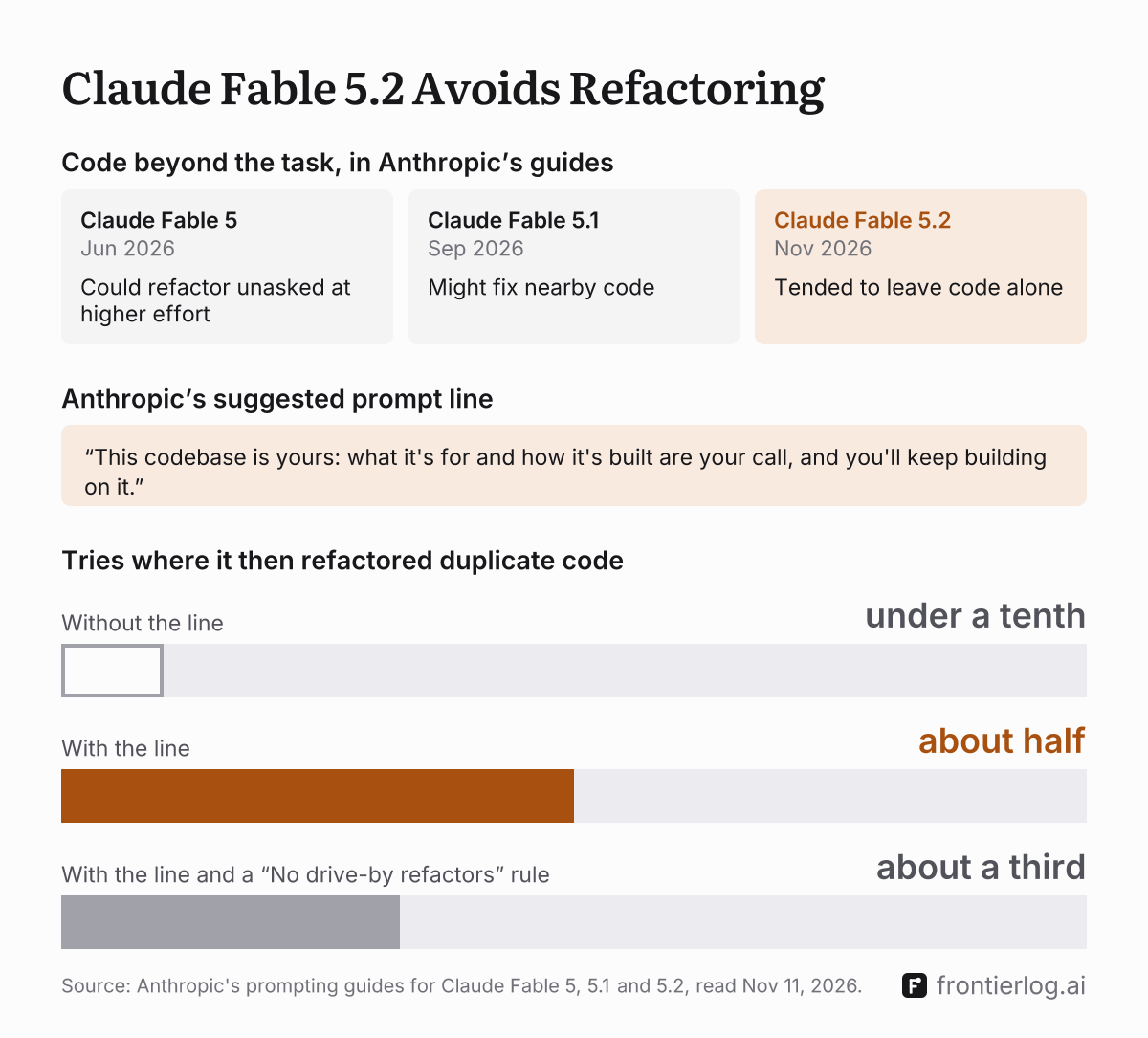
fable 5.2 is a clear departure from older claude models in terms of thinking, subagents, retries and refactoring.
adjust your prompts and mental models accordingly if you want to use fable 5.2 in your workflows.
We've given all Pro, Max, Ultra, and Team users one free full reset, across all models and limits. Use it anytime before December 10 at 2:00PM PT.
We recently fixed a few small issues that used more limits than intended, and the Fable resets didn't do much for those of you who'd already hit your weekly limits for all models. While these issues didn't affect everyone, we want to make up for the trouble.
You'll find it in Settings > Usage, or at https://t.co/5YRzheAZyQ.
It’s not an overstatement to say that creating software without the aid of AI at this point is basically absurd. Like, that’s a preposterous, ridiculous thing to do.
Anthropic found a way to make Claude build better-looking apps, and the trick isn't a better design prompt
Instead of asking Claude to make an interface “beautiful,” researchers separated the agent that builds it from the one that evaluates it.
The evaluator checks concrete criteria, including visual coherence and originality, then feeds the results back into another iteration.
This turns subjective design feedback into a repeatable improvement process.
If you're building with Claude Code, try the same approach:
Define visual standards, let a separate agent critique the output, and require revisions before approval.
@yishan Agreed! While LLMs are amazing - they get you 80-90% of the way there which is likely wildly economically positive. Getting to 100% seems to require e=mc^2 type exponential and unnecessary for SaaS. I buy that game dev - where “fun” is the whole point - is still quite a ways off
I encourage anyone who doubts this to try and make a real AAA game and apply your own real critical game quality standards to it.
I am making one right now and while Opus 5.5 (Fable and Astra can't do it) can do many of the coding tasks, it simply isn't able to make gameplay design and UI design decisions at the level of detail and correctness demanded by a GAME.
My theory is that it's because the quality requirement in a game is ironically higher than for e.g. a SaaS application.
SaaS or other "work" applications provide economic value for using it, so as long as your economic value gained is high enough, you'll tolerate bugs and UI imperfections and lag, even outright illogical app behavior - as long as it does the thing you need it to do.
But when you're playing a game, your willingness to continue doing so rests entirely on the quality of the experience. And that's impacted by gameplay, fun, UI, story, etc. If there's any sort of "irritant" like a part of the interface is janky, or something consistently looks wrong, or the gameplay does something illogical, or it's laggy, etc - you don't have any incentive to keep going.
To keep someone playing a game, the experience has to be far better than that - maybe not perfect - but it still has to be great.
What I'm finding is the Opus 5.5 will make a game at roughly between 50% to 85% quality level. If you give it a lazy prompt, it'll puke out something with blocky graphics and barely-working gameplay: 50%. If you iterate a bit and give it more details, you can get it up to 85% or so - playable, can generate impressive screenshots and maybe even gameplay clips - but that last 15% or so still needs hand-tuning and human taste-making.
You can have it read every game design and UI/UX guide you can find, and it just won't build anything better than "kind of workable." And "kind of workable" is often enough for a work app. I have like a dozen vibe-coded utility apps that roughly do the thing I need them to do (track stuff, manage some kind of data, visualize something) but they're not worth polishing because they're good enough to perform the function.
But with games I can imagine someone else looking at it with the same critical eye that I would, if I were playing it:
- these buttons are a little out of place, the alignment isn't perfect
- why does this icon which does the same thing as this other one look different?
- this tree or shadow looks weird from this angle
- this game element acts a little janky under these conditions
- there's lag when stuff gets busy
In particular, AI doesn't seem to be able to create really good custom UIs. If you have a bunch of commonplace functions then yeah, it'll use a UI template. But if you have a game, and the game involves doing a bunch of unusual (fun!) things, you want the UI to engage the user's intuition about it, show the right responsiveness or progress of an action, act correctly in certain unusual corner cases (because fun often involves corner cases) etc, and AI can't quite get all of it right yet. It's workable, you can often see the vision - but it's not a game. No AAA game studio would ship what AI produces today.
Much of this seems to be about paying attention to the right details. Maybe subsequent models will be better (they often are). But right now a human still has to look at every little corner of the game, decide if it's acting just right, then specify in extensive detail exactly what should happen and why, and what overall effect is intended.
The good news is that one person can be the gameplay designer, the artistic director, the engine developer, the interface designer - you can do all of these jobs and let the AI carry out the tasks.
The bad news is that one person has to be the gameplay designer, the artistic director, the engine developer, the interface designer... and I'll probably have to be the marketing guy later when/if the game is released.
Consequently, I've had to quickly learn the fundamentals of all these disciplines. Unsurprisingly given my SWE background, the engine on my game is quite well-optimized even with tons and tons of moving things and physics. But the gameplay is another thing and I don't even know the right terminology to describe a lot of the art/graphics things I want to see, and... oh my god, UI design is an AI clusterfuck...
Back in the day, tech companies sort of had a hierarchy of respect when it came to technical staff - I'm a little ashamed to say - it was roughly:
1. backend engineer
2. frontend engineer
3. visual designer
4. UI/UX designer
Yes, the lowly UI/UX designer, at the bottom of the totem pole - not even considered "real" designers - they were ones responsible for deciding where to put the buttons and what fonts to use.
Well, today the AI does everything else but it still can't design a great interface worth a damn. So yeah, to the UI/UX designers I knew: I owe you an apology. I wasn't really familiar with your game.
Of all of the tasks, this is the one that AI can't seem to do - I have to tell it how to do things and it's extra hard when I don't even have the terminology. I can describe how I want things to work, but the AI doesn't have the interiority of a human user - there's a lot of intuition and feelings involved - it does boneheaded things, ignores critical details that would be obvious to a human, doesn't realize which things it absolutely mustn't overlook on a UI and worst of all: even when I feed it a precise sketch of the interface I want, it ignores critical details because it simply didn't realize those details were key.
(example: when I draw this thing next to this other thing, it literally means they need to be next to each other)
If anyone wants a benchmark: I've been working on a game for about 6 weeks now - coincidentally I got started right before Opus 5.5 came out (when attempts with Astra just couldn't cut it). Granted, I have a day job so a lot of that was after-hours and weekends but I'd estimate that I have gotten done the equivalent work of a 10-person studio working for ~6 months. So there's definitely leverage here, but there's definitely a lot more work to go before this is a real game.
Delete everything in your AGENTS file and replace with:
> Always build code cleanly, modularly, and with proper architecture and separation of concerns. Never simply bolt on a feature because I asked for it. If you can’t find an easy way to build it naturally, and you'd recommend a refactor to make the whole thing cleanly, stop your work ahead of time and say so.
Introducing Claude Fable 5.2 and Claude Mythos 5.2, designed to tackle the most daunting technical challenges.
They’re capable collaborators on ambitious projects in many fields, and show improvements in areas like coding, reasoning, and vision.
@garybernhardt I make it work thru a bin that it cannot modify (e.g. if it wants to make a worktree, it needs to run ops/worktree --create {or something}) (It certainly could definitely figure out a way around it - not bulletproof, but totally helps reduce repeatable mistakes)