Humans Avoid Wasted Effort Rather Than Exertion | Neuroscience News
Summary: A paradigm-shifting critical synthesis challenges decades of psychological and neuroscientific dogma by proposing that humans and animals do not possess an intrinsic aversion to effort. Instead, the research argues that individuals actively avoid wasted effort, investment that yields no progress or fails to justify its cost.
By auditing developmental psychology and behavioral literature, the co-authors demonstrate that effort is a neutral currency. When an action is deemed meaningful or sufficiently rewarded, the investment is experienced as deeply satisfying, redefining human motivation and offering new frameworks for education, corporate design, and clinical psychiatry.
Key Facts
- Challenging the Law of Laziness: Classic behavioral science has long asserted that humans and animals are naturally wired to minimize effort because the act of exertion is inherently unpleasant. This new framework reinterprets that avoidance as a strategic calculation to prevent wasted energy.
- The Developmental Proof: Infancy and early childhood reveal no spontaneous aversion to effort. For example, 10-month-old infants who watch an adult persevere in a difficult task will instinctively redouble their own efforts to solve a problem.
- The Resistance Premium: Around age 6, children smile significantly more after conquering a difficult task than an easy one. This behavior indicates that the physical or mental resistance overcome adds intrinsic value to their success, which would be biologically impossible if effort were inherently aversive.
- The Paradox of Effort Solved: Viewing effort as a neutral transactional cost (like money) perfectly explains why millions of people voluntarily choose demanding activities—such as extreme sports, mastering an instrument, or pursuing lengthy academic fields—and find them deeply enjoyable.
- The Idleness Penalty: Literature on the “least effort principle” shows that a preference for the lowest-energy path only surfaces when the final rewards are strictly identical. When given a choice, adults prefer active engagement over passivity, and busy people record higher happiness markers than idle peers.
- The Dopamine Drop Bottleneck: True, pathological aversion to effort is distinct from ordinary disengagement. When the brain’s dopaminergic system experiences reduced activity, the internal sense of reward withers, transforming effort into a genuinely unpleasant, agonizing experience.
- The Institutional Pivot: The review suggests that instead of endlessly trying to make tasks less burdensome in corporate, academic, and care sectors, systems should pivot toward making tasks clearly justified, meaningful, and useful in the eyes of those performing them.
---
For decades, psychology and neuroscience have suggested that if humans and animals naturally try to make as little effort as possible, it is because putting in the effort is not enjoyable.
Another possible interpretation: is that it’s not the actual effort that individuals avoid, it’s the effort wasted – effort that leads you nowhere or whose benefits do not justify putting in the effort. This vision is explored in a recent article I co-wrote with Roy Baumeister at Harvard University, Guido Gendolla at the University of Geneva, and Michel Audiffren from the University of Poitiers and published in 2026 in Neuroscience & Biobehavioral Reviews.
Let me explain:
How did we come to pinpoint that it’s effort-wasting that people avoid rather than actual effort?
To support our thesis, we conducted a critical, two-pronged synthesis of the scientific literature. First looking at child development. We thought that, if the effort was intrinsically unpleasant, effort rejection should be observed very early in development.
Infants and young children do not show any spontaneous aversion to effort: they engage in it freely, associate pleasure with satisfaction, and only learn how to spare their efforts gradually. The example of 10-month-olds is particularly striking: after watching an adult persevere in a difficult task, they themselves redouble their efforts to solve a problem.
Later on, at around 6 years old, children smile more after achieving something difficult than when something is easy – as if the acutal resistance involved added value to their success. If effort were intrinsically aversive, none of this would be possible.
Secondly, we focused on studies of the “least effort principle” in animals and adults. The preference for the least costly path in terms of effort emerges only when the rewards are strictly equivalent – and disappears as soon as the benefits justify the investment.
Better still, several studies show that people prefer to actively engage in a task rather than remain passive, and that busy people are happier than idle people, even when they are forced to be active.
Why is this so important?
This shift in perspective is transforming our understanding of human motivation. It makes it possible to solve what some call the “paradox of effort”: if there is indeed a biological law of “least effort”, then how can we explain why millions of people voluntarily engage in demanding activities such as extreme sports, learning an instrument, lengthy studies – and find them enjoyable?
If effort is perceived as a neutral cost (i.e. neither positively nor negatively balanced), comparable to spending money, then it becomes logical that people agree to put in the effort when it pays off.
This approach reinstates human beings as agents capable of evaluating and making decisions, rather than as an organism perpetually battling against a biological repulsion to action. It also makes it possible to better distinguish between ordinary situations of disengagement – when faced with something deemed unfavourable – and pathological cases, where a real aversion to effort may arise.
In the second case, such resistance to effort is based on well-identified neurobiological mechanisms, notably a reduced activity of the dopaminergic system.
Dopamine plays a central role in motivation in this respect: it strengthens the sense of reward and stimulates the pursuit of goals. When dopamine is lacking, effort becomes truly unpleasant and the desire to engage withers away.
What should be the next steps for this research?
Several questions remain open.
It is still unclear in what conditions some people develop a real aversion to effort and which neurobiological mechanisms are involved. Dopamine function is often cited, but research has mainly focused on situations involving external rewards. However, few studies examine the intrinsic motivations behind actually seeking effort for the sake of it.
One practical question still stands: what if, rather than seeking to make tasks less burdensome in schools, at work, and in care sectors – we primarily sought to make them more justified and useful in the eyes of those who are required to do them? This could make all the difference.
Read more:
https://t.co/TOk8lCHSed
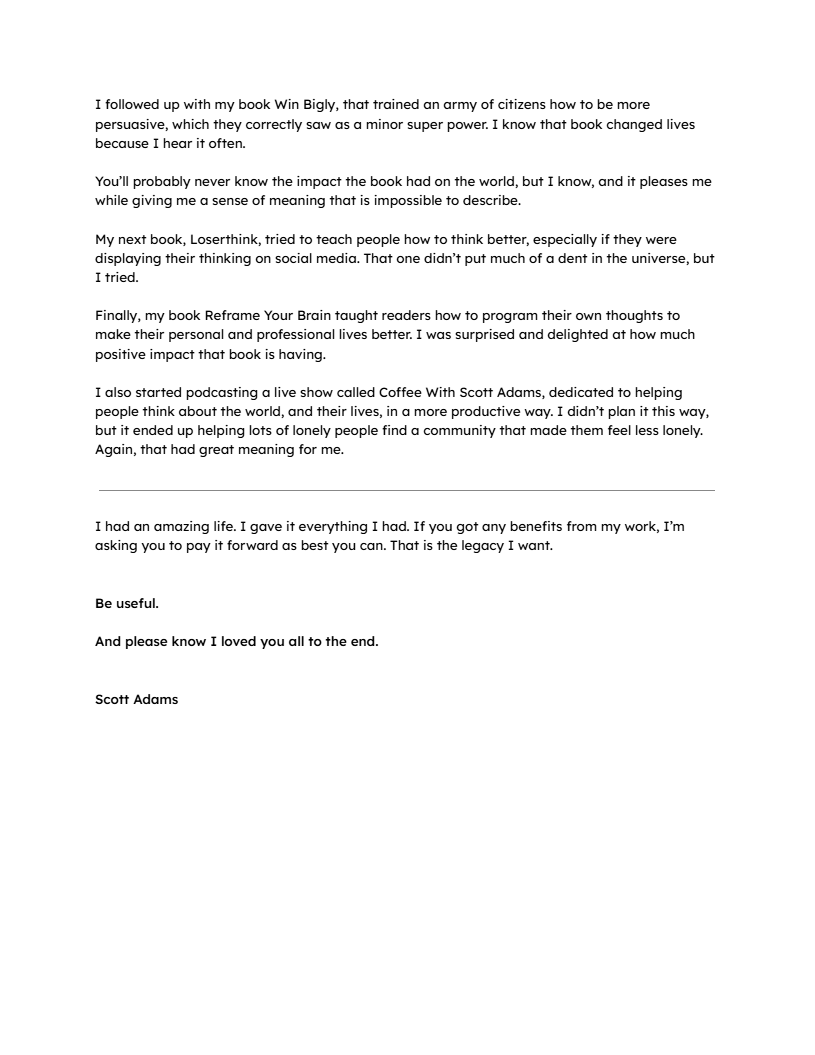
Scott Adams (@ScottAdamsSays) was my favorite podcaster and I’m going to miss him terribly. He always had unique takes on the news and he helped me become a more critical thinker. As a Scoutmaster, I’ve incorporated a few of his lessons into to my “Scoutmaster Minutes” which are short bursts of wisdom to conclude a Boy Scout troop meeting. One example is Scott’s take that the meaning of life is the journey from becoming a “net taker,” like a baby who’s entirely dependent on others to a “net giver” an unselfish person who contributes to the world by helping others. He demonstrated this himself by keeping his podcast going until the very end. Another is his lesson that freedom from embarrassment is a super power and that young people should force themselves to be put in embarrassing situations because they’ll need the practice. What a legacy!
Scott Adams (@ScottAdamsSays) was my favorite podcaster and I’m going to miss him terribly. He always had unique takes on the news and he helped me become a more critical thinker. As a Scoutmaster, I’ve incorporated a few of his lessons into to my “Scoutmaster Minutes” which are short bursts of wisdom to conclude a Boy Scout troop meeting. One example is Scott’s take that the meaning of life is the journey from becoming a “net taker,” like a baby who’s entirely dependent on others to a “net giver” an unselfish person who contributes to the world by helping others. He demonstrated this himself by keeping his podcast going until the very end. Another is his lesson that freedom from embarrassment is a super power and that young people should force themselves to be put in embarrassing situations because they’ll need the practice. What a legacy!
Scott Adams passed away this morning. Let’s get together to honor his life.
We’ll let people speak for about two hours tonight, and we can do more on other days.
https://t.co/9eaTtLCbUU
If you claim to support human rights yet can’t bring yourself to show solidarity with those fighting for their liberty in Iran, you’ve revealed yourself. You don’t give a damn about people being oppressed and brutalised so long as it’s being done by the enemies of your enemies.
You will NOT gaslight your way out of this.
NOT this time.
The Democrat Party must finally look in the mirror, condemn the political violence they’ve unleashed, and apologize for poisoning an entire generation into believing conservatives are “fascist threats” to democracy.
Tyler Robinson got on that roof, took aim, and assassinated Charlie Kirk, because their propaganda worked.
We’ve got buns, we’ve got burgers, we’ve got… a little prep work to do. 😉 The free burger date will be announced tomorrow, so no need to line up just yet. Trust us—it’s going to be worth the wait!
One of the greatest Milwaukeeans ever, an American hero who showed steely calm and tremendous bravery during the Apollo 13 crisis, James Lovell. What a life this great man lived. https://t.co/4SavFidnhX
@ggreenwald Maybe it’s got something to do with the way they brainwash their children into believing they’ll go to heaven if they die while killing nonbelievers.