call me crazy too but this is lowkey the smartest first agent move.
Most teams are still stuck building chatbots nobody asked for while their competitors are out here shipping and pricing like it’s free real estate
kimi k3 watching the board while you sleep?
yeah i’m stealing that
call me crazy but the first AI agent most companies should build is an autonomous analyst.
you can build one using Kimi K3.
it watches your competitors while you sleep, remembers every move, and wakes your team with the launches, pricing changes, and positioning shifts they need to act on.
don't bookmark this if it crosses your timeline.
paste the full article into Kimi and tell it to build the first version for your market.
This is the best explanation I’ve seen of why your fancy GPU sits there doing almost nothing while generating tokens
memory bandwidth is the actual boss,
not the FLOPs number on the datasheet. once that clicks, half the “optimization tricks”
just become obvious
bookmarking this one hard
🎯 Special thanks to our incredible Co-Host @UniKeyOfficial !
We are thrilled to have the unified gateway for the AI economy onboard for "AI Meets the Chart" at KBW. Your support is making this highly anticipated event (and our exciting lucky draws! 🎁) possible. Get ready to shape the new era of AI with us! 🥂
🔗 https://t.co/XrVFqYvYwq
this is actually nuts
one line in → 5 searchers with zero shared context → dedupe → writer that never even sees the raw pages → fact-checker whose whole job is to try and kill it
12 mins, 40 sources, every claim locked to something real
the isolation is the whole cheat code
ANTHROPIC LEAKED A 5-AGENT SETUP THAT TURNS ONE QUESTION INTO A SOURCED REPORT
you write one line and never open a tab - the fleet reads 40 sources and only the answer comes back.
question → scope → 5 searchers → dedupe → writer → fact-check → report
the scope agent turns a vague question into 5 angles that do not overlap - skip this and five agents fetch the same three articles.
5 searchers run in parallel with separate contexts - none of them sees what the others found, which is exactly why they do not converge on the same source.
dedupe is code, not an agent - flatten, drop repeats, normalize URLs, zero tokens, instant.
the writer only sees structured findings, never raw pages - it cannot cite something that was never verified because it never had access to it.
the fact-checker reads the draft against the sources, not against itself - every claim without a matching source goes back, and only that section is rewritten.
nothing reaches you until a second agent, with clean context, has tried to kill it.
12 minutes, 40 sources, one report where every line traces back to something real.
save this and read the full graph engineering course below ↓
We are excited to announce that our UniKey Co-Founder & Head of AI Strategy and Ecosystem @Matt_WilsonBTC will join the #binance live @UniKeyOfficial × @KeyFlow_EN AMA, and explore the future trends of AI Agents together with @Moon1ightSt!
📅 August 12
⏰ 21:30 (UTC+8)
🎥 Secure your spot in advance and explore the future trends of AI Agents together! 🚀
📍 Binance Square: https://t.co/rBrxqOoT1x
#AI #AIAgent #Web3 #AIInfrastructure #Crypto #BinanceSquare
This is a much better way to think about where agents are heading.
Planning + tools made agents useful. Memory + feedback will make them improve. But multi-agent collaboration is where things get really interesting.
We’re moving from “AI that answers” to networks of AI that can reason, coordinate and actually get things done together.
That shift is going to open up a completely different AI economy.
Survey from UIUC, Meta, Amazon , Google DeepMind:
Agentic Reasoning for Large Language Models
They organize the entire agent space into 3 clear layers:
1. Foundational : Planning, tool use, search
2. Self-evolving : Memory, feedback , continuous improvement
3. Collective : Multi-agent roles, collaboration & co-evolution
Plus clean split between in-context orchestration vs post-training (RL/SFT).
a proper mental model instead of random agent papers.
- https://t.co/NfT4NlypM8
We’ve spent years talking about models.
The next few years will be about systems that can perceive, reason, and act in the real world.
Open models like this don’t just accelerate innovation—they give more builders the chance to contribute to safer and more capable robotics.
Excited to see where this goes.
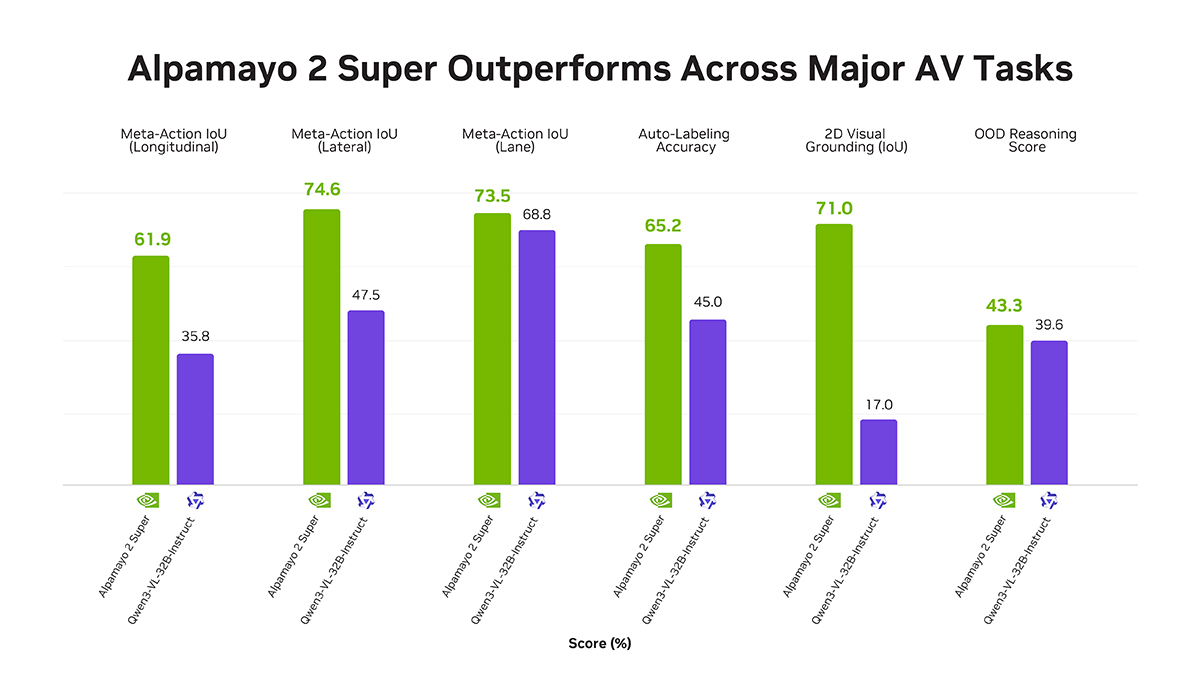
Today, we’re launching Alpamayo 2 Super, our frontier open reasoning model for autonomous vehicles.
Beyond seeing, Alpamayo understands and reasons through the complex world - thinks before it acts.
It’s a powerful backbone for robotaxis, trucks, shuttles, delivery vans, tractors and the long tail of mobile robots—billions of autonomous machines someday.
We’re releasing it for commercial use under OpenMDW-1.1 so teams can inspect it, fine-tune it and deploy it—open models advance safety and security.
The next wave of AI is robotics—and it starts with autonomous vehicles.
Great work, Alpamayo team!
https://t.co/2PYCCXWjZh
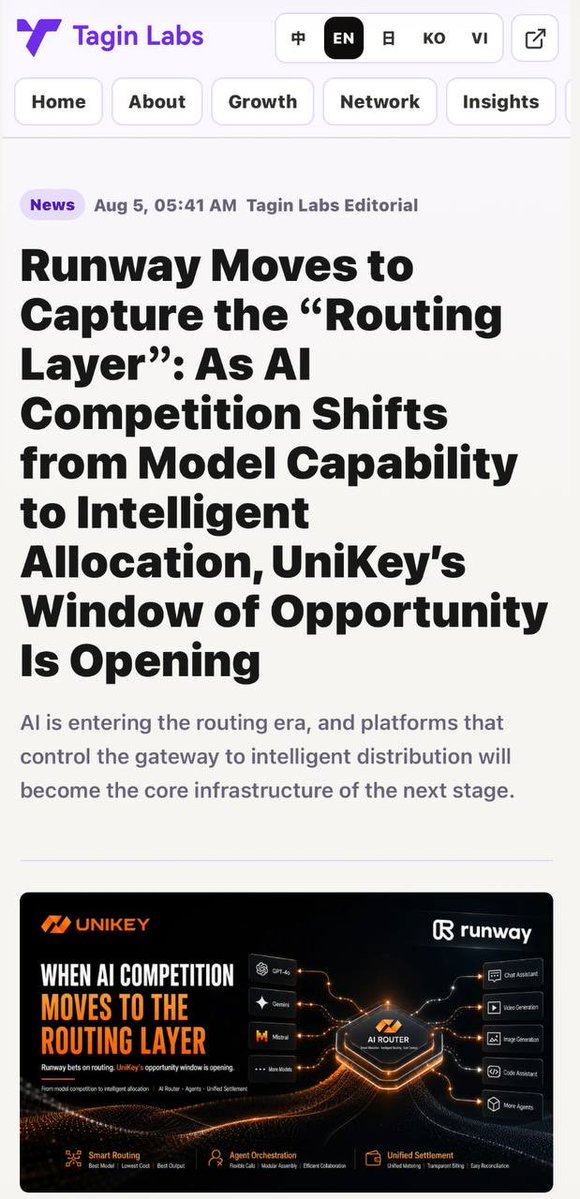
🔥Industry Spotlight | Runway Enters AI Router, Intelligent Allocation Is Becoming the Next-Generation Infrastructure
As the number of AI models continues to grow, competition within the industry is changing:
From “who owns the most powerful models” to “who can connect, route, and manage intelligent capabilities more efficiently,” the AI routing layer is becoming a new competitive direction.
🔍 Key Topics Worth Following:
❓ Why is “choosing the right model” becoming a new system cost as AI models continue to increase?
❓ How is AI Router evolving from simple model selection into an intelligent coordination hub for AI systems?
❓ Why will the future of AI competition depend not only on model capabilities, but also on intelligent allocation?
❓ Why will real usage data, task outcomes, and routing experience become important assets in the AI era?
❓ How does UniKey connect models, Agents, Workflows, and AI services to achieve unified access, management, and value circulation?
🧐 AI is moving from single-model applications toward multi-model and multi-Agent collaboration.
In the future, platforms that control intelligent access points and allocation capabilities will become an important direction for AI infrastructure development.
🟠 UniKey|Connecting Global AI, Exploring the New Era of Intelligent Economy:
https://t.co/ItcqAjAF8q
📖 Click to read the full article and explore the development trends of the AI Router era, as well as UniKey’s exploration of next-generation AI infrastructure.
🔗Tagin Labs:
https://t.co/4cCE76pgqo
🔗Coin time:
https://t.co/q4wfST6hnp
🎓 UniKey Academy|Experience Text-to-Video Generation with One Click
AI creation is becoming simpler than ever.
With UniKey, no complicated operations are required. Simply enter a Prompt and quickly generate your own AI video content.
📹 This video will unlock UniKey’s AI video creation capabilities:
✅ Log in to UniKey
✅ Enter the Dashboard
✅ Enable the Text-to-Video feature
✅ Enter a Prompt
✅ Generate an AI video with one click
From text to visuals, turning imagination into reality faster.
🟠 UniKey|Connecting global AI capabilities, empowering everyone to explore the new era of intelligent creation.
🌐 Official Website: https://t.co/ItcqAjBcXY
Real-time intelligence isn’t about having the biggest model.
It’s about connecting live data, reliable pipelines, and autonomous decision-making.
AI is moving from “generate” to “act.
A SPORTS ANALYST WIRED STADIUM API DATA STRAIGHT INTO A SYSTEM THAT REACTS FASTER THAN THE ORDER BOOK
Most people wait for a broadcast delay to catch up before odds even start moving.
The pipeline reads raw stadium events directly, penalties, cards, formation shifts, the moment they happen on the pitch.
A ranking stage sorts every signal by recency and source authority, so a stale update never outweighs a live one.
The system flags a mismatch the instant live odds stop reflecting what just happened on the field.
By the time the crowd finishes reacting to the broadcast, this already priced the shift and moved.
Try testing his new system here: https://t.co/no5fTa2Z5G
Anthropic’s Skills are a big step from chatbots to persistent specialized teams. Progressive disclosure + modular SKILL.m d cuts the daily context tax and token burn while boosting consistency.
At UniKey we’re building the infra to connect & scale exactly these agentic capabilities across models. Strong playbook @polydao
🟠 UniKey|Token Price, The Intelligent Bill
🧠 In the AI era, what truly needs to be redefined is not only model capabilities, but also the way AI costs are measured.
With the rapid evolution of models such as GPT, Claude, Gemini, and DeepSeek, enterprises are entering the era of multi-model collaboration.
However, new challenges are becoming increasingly apparent:
❕ What is the true cost behind a single Token?
❕ How should AI resources be purchased, allocated, and managed?
❕ In the future Agent era, how will intelligent consumption be measured and settled?
📌 This in-depth research focuses on the core issues of AI cost:
➡️ Breaking down the real cost structure behind Tokens through the TCO model
➡️ Analyzing the limitations of traditional approaches: “self-built compute infrastructure vs. API-based access”
➡️ Exploring how AI Credits can become the new measurement system for the intelligent economy era
UniKey believes: Token is the new oil, and AI Credits are the new electricity meter.
In the future, AI will require not only powerful models, but also unified measurement, intelligent routing, and settlement infrastructure. ⚡️⚡️⚡️
🖥 Click to read the full article:
🔗 Tagin Labs:
https://t.co/Tqg43zgubJ
🔗 CoinTime:
https://t.co/BvExzoV3OW
Turns out AI agents can overfit to their own confidence too. 😂
Better models aren’t enough. Better feedback loops are. The next AI race won’t just be about who builds the smartest agents, but who builds the best infrastructure for them to learn, collaborate, and improve.
thats insane..
Stanford just dropped a paper about loop engineering and self-improving agents.
act -> reward your own rollouts -> train on them -> repeat
let an agent train on its own reasoning with no hard check, and the failures compound:
it gets more confident and less correct at the same time.
that's the difference between a loop that compounds work and one that compounds error.
read the paper first, then the article below.
Google Brain co-founder Andrew Ng explained the roadmap for building AI agents in 5 simple steps:
00:00 - Intro to AI agents and prompting
02:22 - Context and memory for better agent behavior
09:22 - Code execution and building real apps
21:12 - Why agentic workflows beat one-shot prompting
34:07 - Reflection, tool use, planning and multi-agent collaboration
51:24 - The rise of AI agents and agentic reasoning
This is not another AI tools tutorial.
It is a practical roadmap for building useful agents: context, memory, code execution, app building, reflection, tool use, planning, and multi-agent workflows.
Watch it today, then read the article below to learn how to build AI agents that actually work.
AI literacy today isn’t just about writing better prompts.
It’s also understanding which models are best for brainstorming, image generation, editing, branding, or product visualization.
The right tool often saves more time than the perfect prompt
🟠 UniKey|The One-Stop Intelligent Gateway for AI Creation
AI is reshaping the way content is created.
From idea generation and AI image creation to brand design, product visualization, and image enhancement, AI creative tools are continuously evolving.
UniKey connects global AI models and creative tools through a unified gateway, enabling users to efficiently explore and access AI-powered creation capabilities.
✨ Models × Skills × Agents × Workflows
One Key, connecting global AI.
https://t.co/hoTxoNCvdI
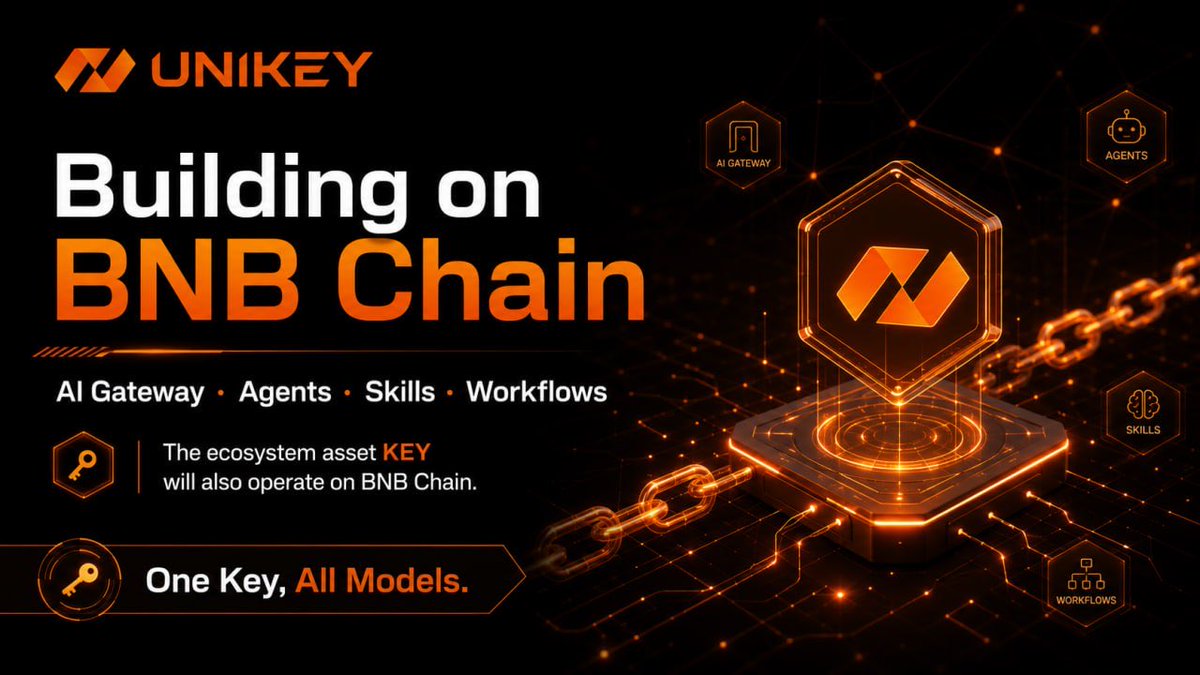
UniKey is deploying on @BNBCHAIN to bring a unified AI Gateway to the BNB Chain community.
Builders and users can access leading AI models, create agents, call skills and run workflows in one platform.
$KEY will power the UniKey ecosystem on BNB Chain.
One Key, All Models.
#UniKey #BNBChain #AI #AIAgents