I think the market may be valuing $XPEV completely wrong.
Everyone still looks at XPeng as a Chinese EV manufacturer.
But the Unitree IPO might expose why that framework is becoming outdated.
Unitree has reportedly attracted extraordinary demand, with its IPO valuing the robotics company at roughly $9B despite only generating around $250M of revenue in 2025.
Meanwhile, the entirety of XPeng trades around a similar order of magnitude in market value.
Except XPeng isn’t just cars.
It is building:
• Humanoid robotics through IRON
• Robotaxis
• Autonomous driving
• Proprietary AI chips
• Its VLA physical-AI model
• Flying vehicles
• And an already scaled EV manufacturing platform
The important part is that these aren’t completely separate bets.
XPeng is building toward one physical-AI ecosystem.
Its cars collect real-world data → that improves its VLA/autonomy stack → the same underlying intelligence can extend into Robotaxis and humanoid robots → all while XPeng already possesses manufacturing, supply-chain and hardware expertise.
That’s what I think the market is overlooking.
Unitree is being valued as a robotics/AI company.
XPeng is still largely being valued as an automaker.
Of course there is a reason for the discount. XPeng still needs to prove that IRON and Robotaxi can become meaningful commercial businesses rather than impressive technology demonstrations.
But that’s also where the asymmetry comes from.
If humanoid robotics continues receiving AI-like valuations, you don’t need XPeng to beat Unitree at robotics.
You simply need investors to begin assigning some meaningful value to XPeng’s robotics, autonomy and physical-AI businesses separately from its cars.
At that point the question changes from:
“How many cars will XPeng sell?”
to:
“What is the EV business + autonomy + Robotaxi + humanoid robotics + physical-AI IP actually worth?”
Unitree’s IPO doesn’t prove $XPEV is undervalued.
But it may give the market the comparable it needed to realise XPeng is becoming much more than an EV company.
That’s the part I’m watching.
Oliver Curtis just recently tried to IPO Firmus at A$44B.
The float collapsed within days
I’ve been comparing the numbers with $IREN and some of them are pretty hard to ignore.
Firmus was seeking a valuation of roughly US$31B.
It had around 42MW operational and more than 900MW of contracted customer capacity.
Meanwhile, IREN was worth roughly US$14B at Friday’s close.
IREN has a 5GW+ global data centre pipeline, $4B of contracted annualised revenue for its 2026 capacity and around $1B already operating.
So we’re talking about a company that tried to list at more than twice IREN’s market cap, while IREN has a development pipeline several times larger.
Now, those MW figures aren’t directly comparable. Firmus has major contracts of its own with OpenAI and Meta, and IREN’s full 5GW isn’t built or earning revenue either.
And obviously Firmus didn’t actually achieve that valuation. Investors rejected it.
But that’s kinda the point.
Everyone wants to build AI data centres right now. Actually getting power connected, building the facilities and securing customers is a much harder problem.
IREN has spent years doing that work, and it’s already turning some of that infrastructure into revenue.
I’m not saying IREN should be worth A$44B just because Firmus tried to be.
I am starting to wonder how much value the market is assigning to IREN’s existing power position versus the AI cloud business being built on top of it.
Because those are two different sources of value, and I don’t think they should be analysed as one.
$IREN reportedly just landed Anthropic as a cloud customer. Stock up ~8% overnight.
What’s interesting is that IREN already disclosed a multiyear deal with an unnamed frontier AI lab back in August. Anthropic was one of the names people suspected.
So this most likely a confirmation of an existing deal rather than some massive new contract.
Still, look at how quickly IREN’s customer base has changed.
Microsoft is already signed. Now The Information is reporting Anthropic too.
Two of the biggest names in AI potentially relying on infrastructure built by a company that was mining Bitcoin a few years ago.
And I reckon the power side of this is getting overlooked.
You can buy GPUs. Securing enough electricity, grid connections and infrastructure to actually run them is a completely different problem.
IREN spent years building that position before AI demand got to where it is today.
We still don’t know the value of the reported Anthropic contract, so there’s no point throwing out random revenue estimates.
But if this relationship is confirmed, it’s another pretty significant customer validation for IREN’s cloud business.
Been coming back to my $OUST valuation thesis and I think the NVIDIA relationship is becoming one of the more interesting pieces of it.
Another piece got added today.
Stereolabs now supports NVIDIA’s JetPack 7.2 across its ZED X cameras, including systems built around Jetson Orin + Thor.
Not a huge announcement on its own
But look at the direction:
Rev8 -> NVIDIA DRIVE Hyperion
ZED cameras -> Jetson Orin + Thor
Ouster software -> NVIDIA Metropolis
AI compute -> Jetson
This is where the Stereolabs acquisition gets interesting
Ouster doesn’t need to build the brain
NVIDIA is already building the compute platform Physical AI runs on.
Ouster can focus on giving those machines the ability to actually understand what’s around them.
Lidar. Cameras. Depth. Sensor fusion. Perception.
Still a long way from proving Ouster captures meaningful economics from that stack, and obviously NVIDIA isn’t exclusive to them.
But if I’m going to be right about the valuation case below, moving beyond just selling lidar sensors is probably one of the things that has to happen.
Today’s news is another small step in that direction.
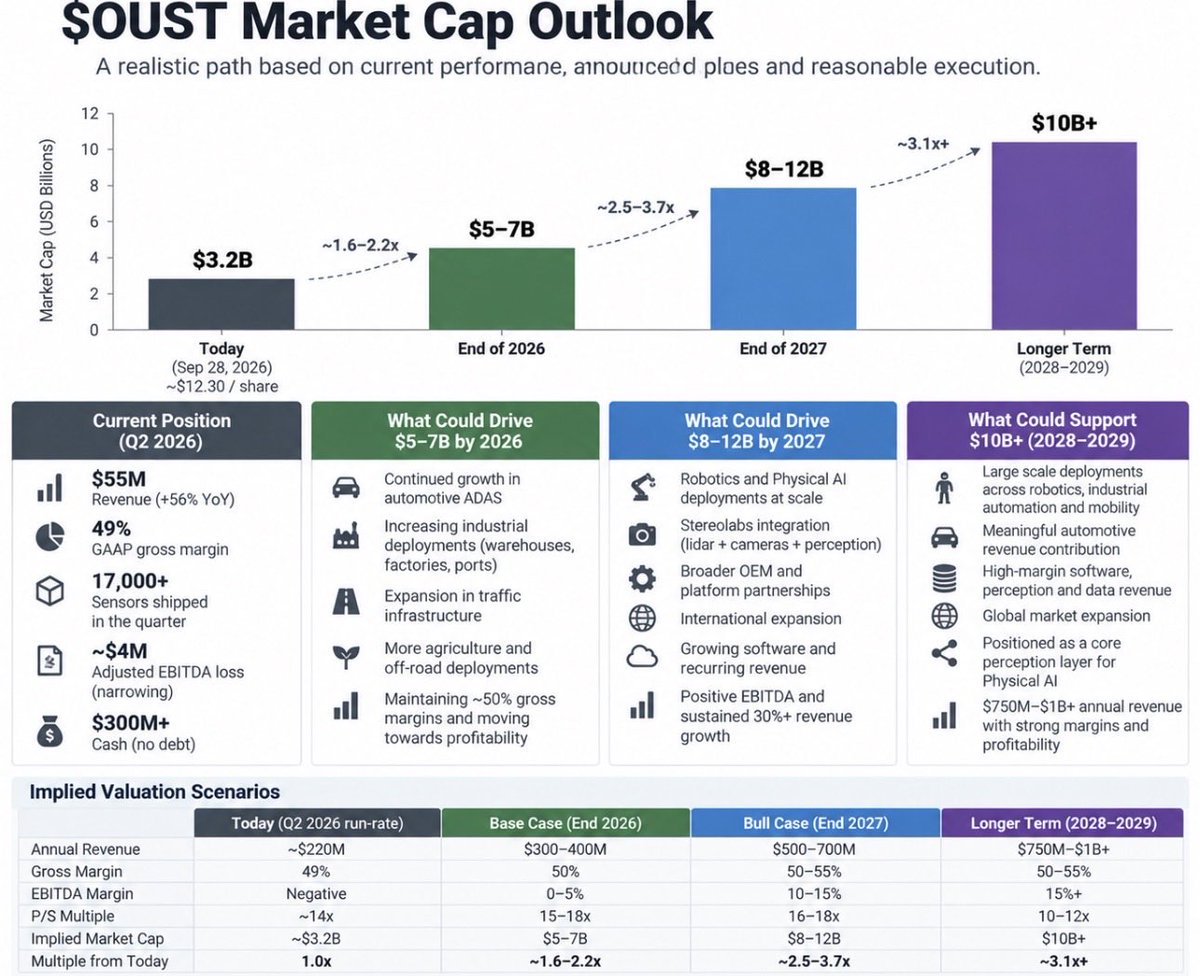
I think $OUST can realistically become a $ 10B+ company
That’s roughly 3x today’s ~$3.2B market cap.
But at this valuation, “Physical AI will be huge” isn’t enough.
The numbers actually have to work.
Right now Ouster is doing ~$55M of quarterly revenue.
That’s +56% YoY.
Gross margin is already 49%.
And adjusted EBITDA loss is down to just ~$4M.
So here’s roughly what I need to see:
2026 -> ~$3-4B
Keep revenue growing 30%+.
Maintain ~50% gross margins.
Get to / very close to positive adjusted EBITDA.
2027-28 -> ~$5-7B
This is where the Physical AI thesis needs to start showing up in volume.
Not just pilots.
Thousands more sensors going into warehouses, traffic systems, agriculture, drones + robots.
And Stereolabs needs to prove the acquisition gave Ouster something bigger than lidar:
Lidar + cameras + perception.
Then ~$10B+ becomes interesting.
To justify that, I’d want Ouster approaching roughly $ 750M-$1B annual revenue with strong growth and actual profitability.
At $1B revenue, a $10B valuation is 10x sales.
Expensive.
But not insane if Ouster has become one of the core perception layers underneath Physical AI with ~50%+ gross margins and 30%+ growth.
That’s really my thesis here.
I’m not betting that lidar suddenly becomes incredibly valuable.
I’m betting that millions of machines are eventually going to need to understand the physical world around them.
Cars.
Robots.
Drones.
Factories.
Warehouses.
Cities.
Farms.
And somebody has to give those machines eyes.
If Ouster becomes one of those companies, I don’t think $3B is where this story ends.
Been reading into how all these GPUs are actually getting financed and there’s one number I can’t get past.
Banks are apparently underwriting them over ~3-4 years
NVIDIA thinks they can keep earning for potentially a decade
That’s a pretty massive gap
Especially when you look at how much capital is starting to get involved here. NVIDIA + Wall Street are talking about >$500B of third-party compute financing, and NVIDIA itself has investments/backstops across parts of the ecosystem buying its chips.
I’m still bullish on the buildout, but I think this is a legit risk.
If an H100/B200 is still economically useful years after the next few generations arrive, fine. The debt has an asset underneath it that keeps earning.
But if newer GPUs crush the economics of older ones way faster than expected, I wanna know who ends up holding that risk.
Starting to think GPU depreciation might matter almost as much as GPU demand.
@memely Exactly. That “other” bucket is probably the most interesting part of $XPEV to me rn.
Especially if licensing + software + eventually robotics keep making it higher margin.
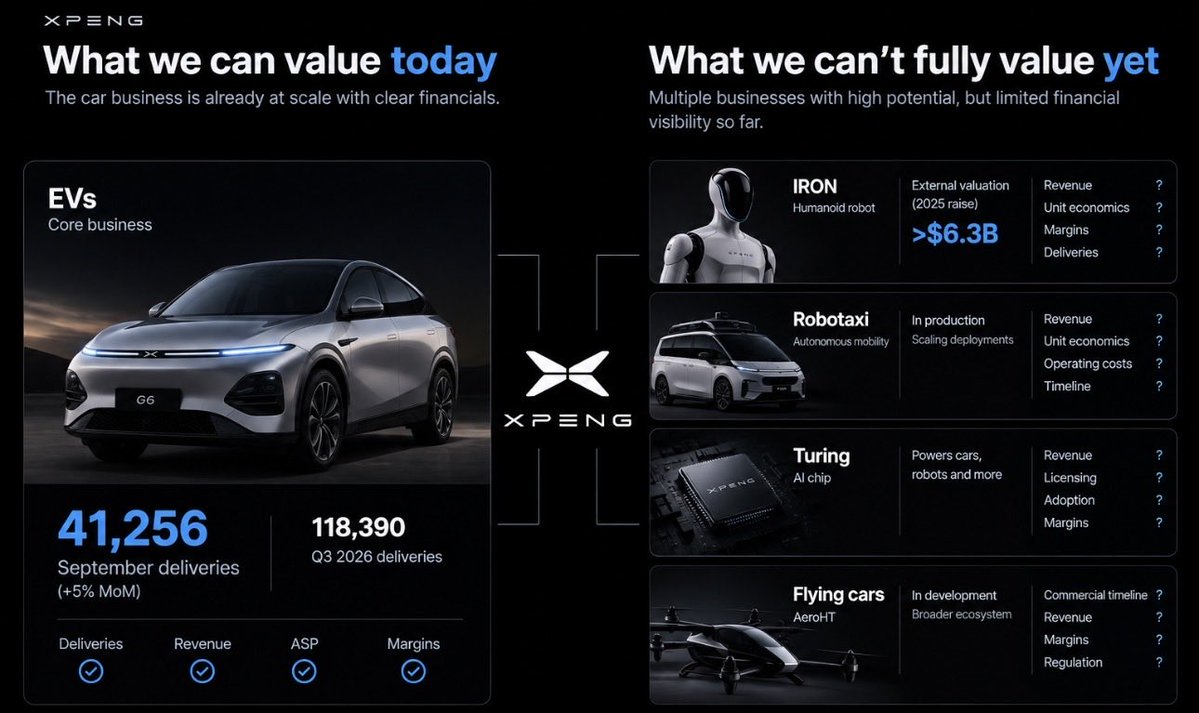
$XPEV delivered 41,256 cars in September.
Weirdly, that’s becoming one of the least interesting numbers in the company to me.
Don’t get me wrong, the car business still has to work. It’s what funds everything else.
But I’m starting to think there’s a growing problem with how we actually value XPeng.
Cars are easy
We get monthly deliveries, ASPs, vehicle margins, revenue etc.
Now try doing the same thing with the rest of the company.
IRON now has an external valuation through the robotics raise.
Robotaxi has entered production.
The same Turing AI chips are moving across cars + robots.
VLA 2.0 is becoming a shared intelligence layer.
Then you’ve got technology licensing and the flying car business sitting around all of that.
And most of those businesses are still at the stage where it’s genuinely hard to put a sensible number on them.
That’s why I’m probably watching XPeng’s disclosures more closely than its monthly delivery number now.
I want separate robotics revenue
Robot pricing + margins
Robotaxi economics
Licensing revenue
Eventually software/AI recurring revenue
41,256 cars tells me how the business XPeng already has is doing.
Those other numbers will tell us what kind of company it’s actually becoming.
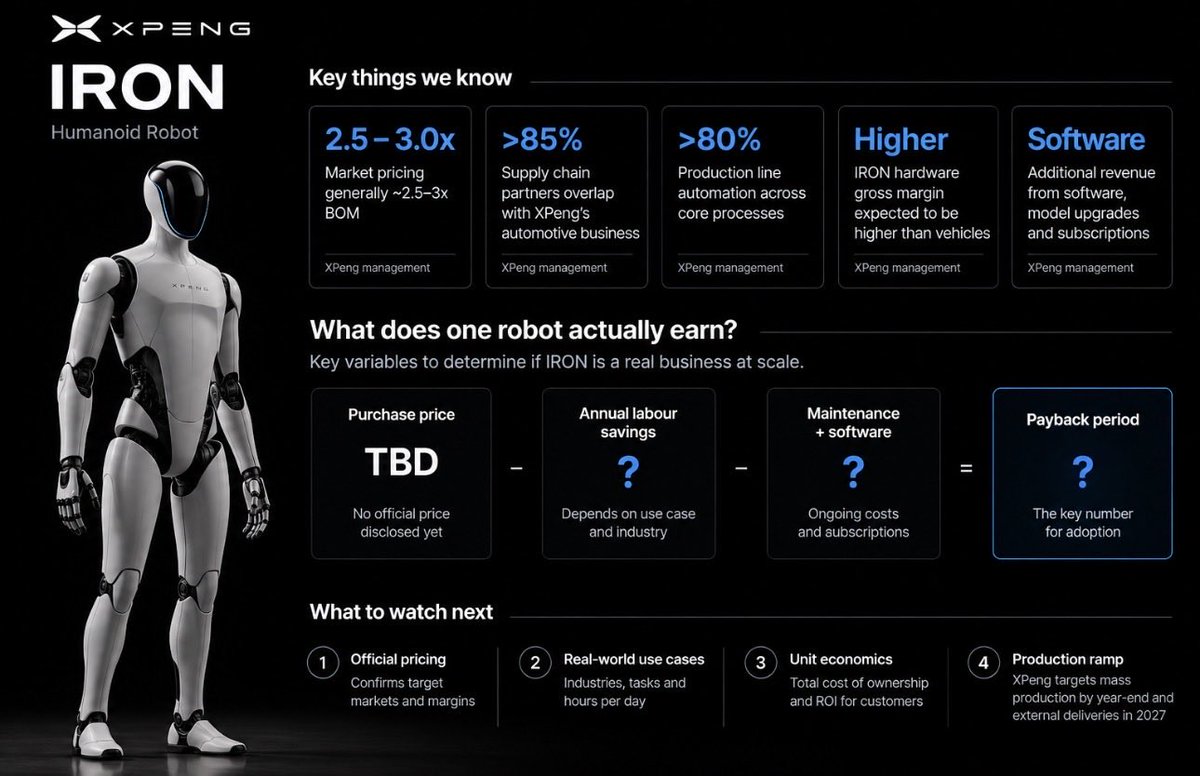
I’m way less interested in how human $XPEV’s IRON looks than I am in what one robot can actually earn.
And XPeng gave a few clues that I think are being overlooked.
They still haven’t given us an official selling price.
But management says robots in the market generally price around 2.5-3x their bill of materials, and they expect IRON’s hardware gross margin to be higher than their cars.
Then there’s software/model upgrades + subscriptions on top.
That’s where this gets interesting to me.
A car gets sold and XPeng hopes to make a margin on it.
A robot is potentially a productive asset for whoever buys it AND a recurring revenue stream for XPeng after the hardware leaves the factory.
So eventually I think the number that matters isn’t robots delivered.
It’s payback period.
If a business can buy an IRON and recover the cost through labour/productivity savings in 2 years, buying robot #2 becomes a pretty easy conversation.
If the payback is 6-8 years, suddenly all the humanoid hype matters a lot less.
XPeng already has >85% overlap between its robot + automotive supply chains and says it can ramp monthly robot production into the thousands during 2027 if demand is there.
That’s a serious manufacturing advantage.
But now I want to see the other side of the equation.
Price
Useful working hours
Labour actually replaced
Maintenance
Software revenue
Payback period
That’s when IRON stops being an impressive robot demo and starts becoming something I can actually model.
I own AI infrastructure stocks and space stocks.
Didn’t expect those two theses to literally merge.
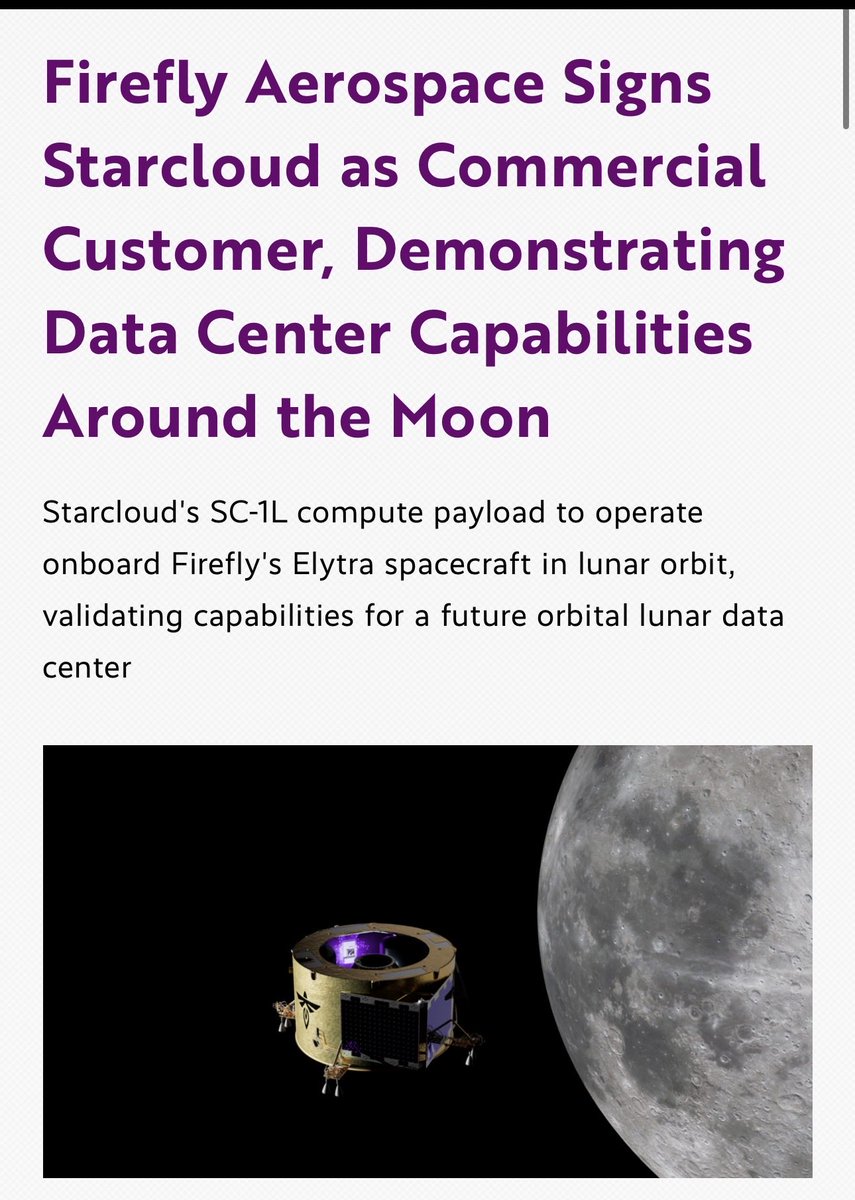
$FLY just signed Starcloud to put an AI compute payload aboard Elytra and send it into lunar orbit in 2029.
The goal is to test technology for something that sounds ridiculous at first:
Data centers around the Moon.
But the more I thought about it, the more sense it made.
If we actually end up with satellites, rovers, landers and eventually people constantly generating data around the Moon, sending every raw piece of information 384,000km back to Earth just to process it isn’t necessarily the best architecture.
Put compute closer to where the data is created.
Process it there.
Send back what actually matters.
Obviously we’re a LONG way from lunar data centers becoming a meaningful business. I’m not adding some huge number to my $FLY valuation because of this.
I just find it interesting that Elytra is starting to look like more than a spacecraft that moves payloads around.
Hosting compute, communications and other infrastructure in orbit could eventually become a business of its own.
AI infrastructure on Earth is already becoming a power + compute problem.
Apparently the Moon might eventually need its own version too lol.
I think AI agents could make the current data center buildout look conservative.
The Codex usage changes are a pretty interesting example of why.
OpenAI is moving from 20x usage to a new 50x tier, while the effective weekly allowance heavy users were getting on 20x has been cut.
At first that just looks like a pricing change.
But people are actually burning through these limits.
I found one recent Codex example where 8 visible user turns turned into 266 model responses and ~96M input tokens once the agent started working through tools on its own.
That’s a completely different demand model from ChatGPT.
One human isn’t necessarily creating one workload anymore.
You can kick off Codex, leave it working, start another agent on something else, then another. Eventually I don’t see why companies stop at one coding agent either.
That’s where this gets interesting for AI infrastructure.
We spend a lot of time estimating future compute demand from how many people will use AI.
I’m starting to think the more important number might eventually be how many agents each person has working for them.
$IREN already has ~$4B of contracted ARR against roughly ~$1B operating at the last update.
If we’re moving toward a world where one employee can continuously generate multiple autonomous workloads, I’m not convinced the current data center buildout is as crazy as it looks.
AMD just spent $8.2B buying a company that doesn’t make chips.
I think that’s probably more important than it looks.
World Labs is trying to teach AI how to understand 3D space and the physical world. Basically the stuff you need if AI is going to move beyond a screen and actually operate robots, machines, vehicles etc.
And AMD wants that research sitting inside the company helping decide what its future hardware should look like.
That’s the part I keep coming back to.
We’ve spent the last few years building chips around the needs of LLMs.
What happens when the next major workload isn’t predicting the next word, but constantly processing cameras, depth, movement, physics and interactions with the real world?
The hardware requirements could end up looking pretty different.
World Labs was valued at ~$5B only seven months ago. AMD is now paying $8.2B.
Maybe they overpaid. Definitely possible.
But I find it pretty hard to look at AMD spending that much on spatial intelligence while NVIDIA keeps pushing deeper into robotics and conclude Physical AI is still some distant side project.
The chip companies seem to be positioning for it already.
Good question. I wouldn’t value a potential $10B 2030 outcome at $10B today.
Discount that back 4 years at ~15-20% for time + execution risk and you get roughly $ 4.8-5.7B today.
Against ~$3B currently, I still find that attractive, but it’s definitely not an absurd discount.
The bigger upside requires $1B revenue to be a waypoint rather than the end state IMO.
I think $OUST can realistically become a $ 10B+ company
That’s roughly 3x today’s ~$3.2B market cap.
But at this valuation, “Physical AI will be huge” isn’t enough.
The numbers actually have to work.
Right now Ouster is doing ~$55M of quarterly revenue.
That’s +56% YoY.
Gross margin is already 49%.
And adjusted EBITDA loss is down to just ~$4M.
So here’s roughly what I need to see:
2026 -> ~$3-4B
Keep revenue growing 30%+.
Maintain ~50% gross margins.
Get to / very close to positive adjusted EBITDA.
2027-28 -> ~$5-7B
This is where the Physical AI thesis needs to start showing up in volume.
Not just pilots.
Thousands more sensors going into warehouses, traffic systems, agriculture, drones + robots.
And Stereolabs needs to prove the acquisition gave Ouster something bigger than lidar:
Lidar + cameras + perception.
Then ~$10B+ becomes interesting.
To justify that, I’d want Ouster approaching roughly $ 750M-$1B annual revenue with strong growth and actual profitability.
At $1B revenue, a $10B valuation is 10x sales.
Expensive.
But not insane if Ouster has become one of the core perception layers underneath Physical AI with ~50%+ gross margins and 30%+ growth.
That’s really my thesis here.
I’m not betting that lidar suddenly becomes incredibly valuable.
I’m betting that millions of machines are eventually going to need to understand the physical world around them.
Cars.
Robots.
Drones.
Factories.
Warehouses.
Cities.
Farms.
And somebody has to give those machines eyes.
If Ouster becomes one of those companies, I don’t think $3B is where this story ends.
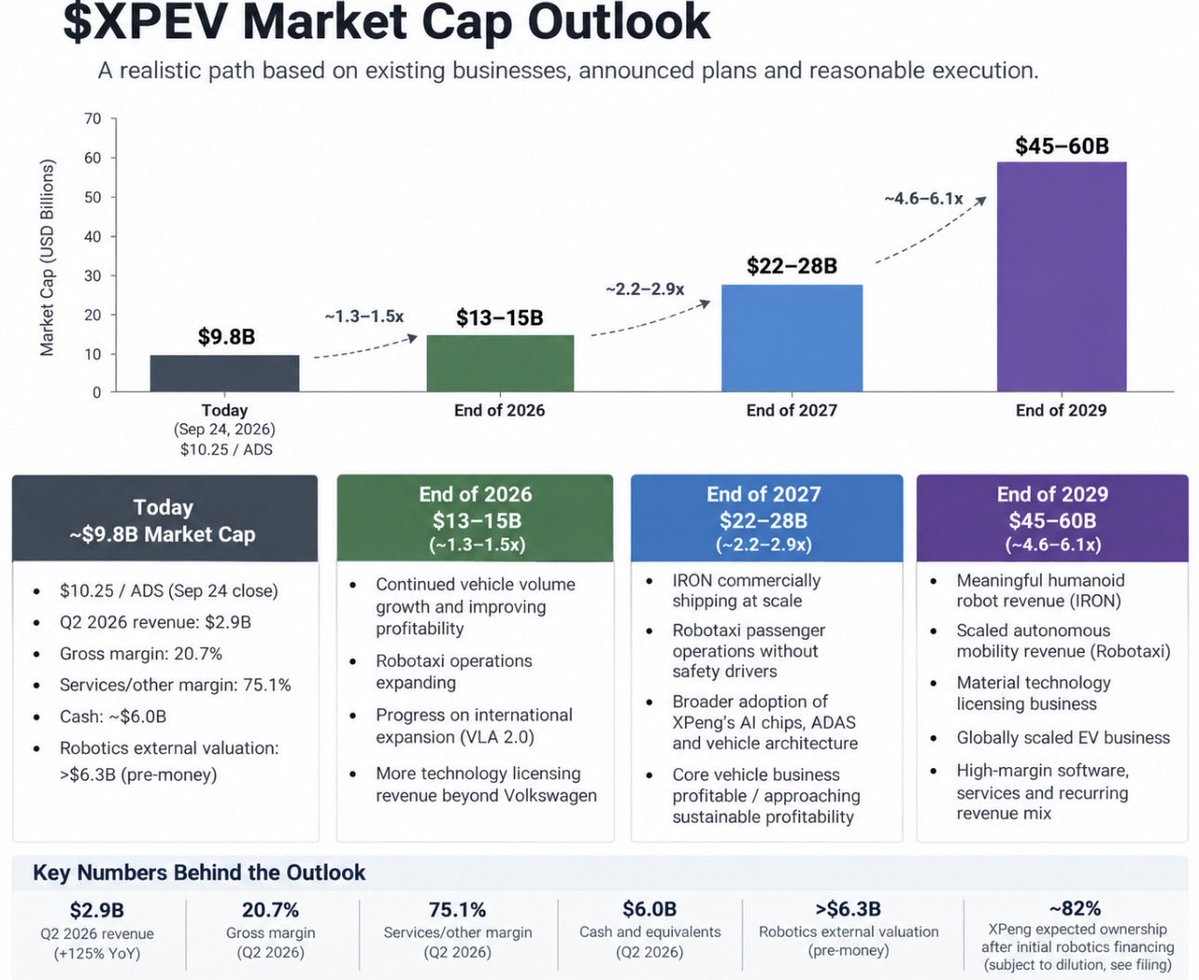
I think $XPEV can realistically become a $ 45-60B company within ~3 years.
That’s roughly 4.5-6x today’s ~$9.8B market cap.
Not because “robots are the future.”
Here’s how I’m actually getting there.
EOY 2026 -> $ 13-15B
I don’t expect the market to suddenly give XPeng a crazy multiple in 3 months.
The car business still needs to prove consistent profitability.
But Q2 revenue was already $2.9B, gross margin reached 20.7%, they’ve got ~$6B cash and robotics now has an external valuation above $ 6.3B.
At ~$9.8B for the whole company today, that’s hard for me to ignore.
EOY 2027 -> $ 22-28B
This is where I think the story either starts working or breaks.
By then I want to see:
IRON commercially shipping at scale.
Robotaxis carrying passengers without safety drivers.
VLA 2.0 expanding internationally.
More technology customers beyond Volkswagen.
And the core vehicle business profitable / approaching sustainable profitability.
The interesting part is the margin mix.
XPeng’s vehicle margin was only 12.1% in Q2.
Services + other was 75.1%.
If licensing becomes meaningful, every $1 of new revenue isn’t equal.
EOY 2029 -> $ 45-60B
This is where the Physical AI thesis actually has to be real.
Not demos.
Real robot revenue.
Real autonomous mobility revenue.
Real licensing revenue.
A globally scaled EV business underneath it.
The robotics piece is especially interesting.
Outside investors just valued it at >$6.3B.
XPeng is expected to retain ~82% after the initial financing transaction.
So before IRON has even started external commercial deliveries, XPeng’s stake has an implied value of roughly $ 5B.
Compare that with a ~$9.8B valuation for ALL of XPeng today.
That’s why I think the upside can get asymmetric.
My rough framework from today’s market cap:
2026: $ 13-15B -> ~1.3-1.5x
2027: $ 22-28B -> ~2.2-2.9x
2029: $ 45-60B -> ~4.6-6.1x
Obviously none of those numbers are guaranteed.
If robotics doesn’t commercialise, licensing stays small and the EV business keeps burning cash, this falls apart quickly.
But I don’t need XPeng to become the next Tesla for the current valuation to look too low.
I just need several businesses the market currently gives limited value to become real.
Days like today are where I think growth investors make the most mistakes.
A stock being down 8% doesn’t mean it’s 8% more attractive.
And it doesn’t mean your thesis is 8% more wrong either.
Most of the stuff I’m watching today is getting hit while Treasury yields are ripping higher.
That’s a valuation problem.
Not automatically a business problem.
So I’m going through every position asking one thing:
What actually changed?
Did expected revenue change?
Did the competitive position change?
Did a customer disappear?
Did execution slip?
Or did the market just decide future cash flows are worth less at a 5%+ 10-year?
Those are VERY different reasons for a stock to fall.
I’m not blindly buying everything that’s red.
But if I can buy the exact same business, with the exact same thesis, materially cheaper because the discount rate moved…
that’s when sell-offs start getting interesting.
I think the $IREN thesis has quietly changed.
A year ago I was asking:
Can they actually find enough AI customers to fill all this capacity?
I’m not really worried about that anymore.
2026 capacity is largely sold out.
$4B of ARR is already contracted.
Only ~$1B of that is actually operating today.
That’s a pretty insane gap.
And it completely changes what I’m watching.
I don’t need another massive contract announcement.
I need to see Horizon 2 turn on.
Then 3.
Then 4.
Then Sweetwater.
Because at this point I think the biggest risk to $IREN isn’t demand.
It’s execution.
There’s roughly $3B of contracted ARR sitting between what IREN has operating today and what it’s supposed to have running.
If they close that gap, the financials start looking very different.
If they can’t, the contracts don’t mean nearly as much.
For me, the next leg of this thesis gets won on the construction site.
I think the next AI trade might look a lot less like tech than people expect.
NVIDIA just qualified Tesla, LG + Hitachi for battery systems inside AI data centres.
Yesterday I was looking into supercapacitors for GPU power spikes.
Now this.
And I’m starting to think I’ve been looking at the AI power trade too narrowly.
It isn’t just:
“AI needs more electricity.”
These clusters need an entire new layer of hardware just to USE that electricity properly.
Batteries for longer interruptions.
Supercapacitors for millisecond power swings.
Liquid cooling.
Transformers.
Switchgear.
Backup generation.
Suddenly the data centre starts looking less like a building full of GPUs…
and more like its own miniature power grid.
Everyone is trying to figure out who sells the next million GPUs.
I’m starting to wonder who sells all the boring stuff those GPUs literally can’t run without.
That’s probably where I’m digging next.
Coming back to my original $XPEV thesis.
The stock is down.
The thesis is stronger.
And that’s a pretty interesting combination.
Since I wrote this:
Their first mass-produced Robotaxi rolled off the line.
IRON moved onto an actual production line with >80% automation across core processes.
The robotics business raised $900M+ at a $6.3B+ valuation.
And now XPeng is talking about selling its AI chips, ADAS + vehicle architecture to automakers beyond Volkswagen.
None of that guarantees the thesis works.
But here’s what I find interesting:
The market cap has compressed while more of the businesses I originally thought were being valued at basically zero are becoming real enough to value separately.
Robotics literally just got an external valuation.
Tech licensing is generating high-margin revenue.
Robotaxi is moving from development into production.
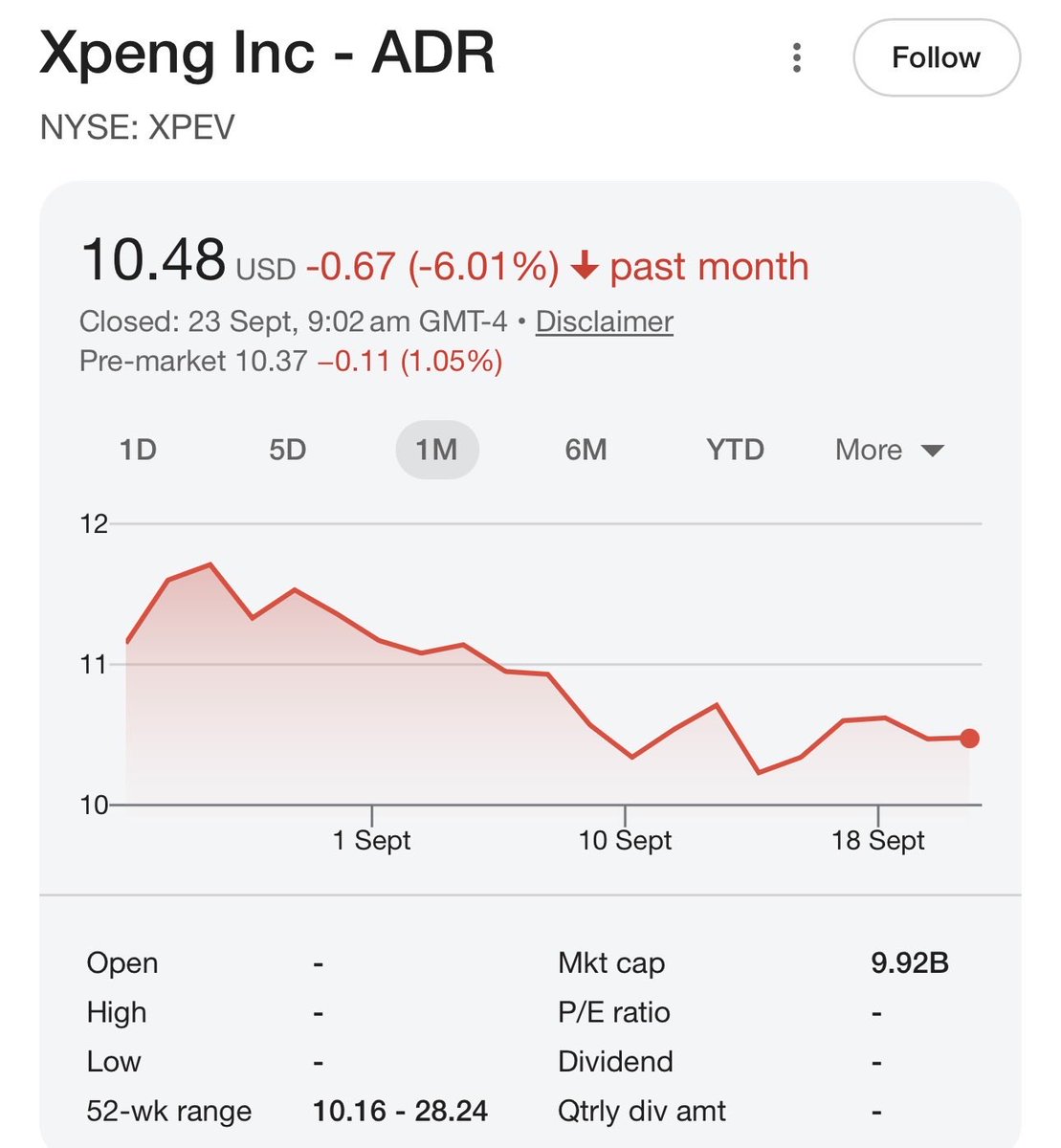
So I’m actually more interested in $XPEV at ~$10 than I was when I wrote the original post.
Not because it’s cheaper.
Because there’s more evidence underneath the same price.
I think the market may be valuing $XPEV completely wrong.
Everyone still looks at XPeng as a Chinese EV manufacturer.
But the Unitree IPO might expose why that framework is becoming outdated.
Unitree has reportedly attracted extraordinary demand, with its IPO valuing the robotics company at roughly $9B despite only generating around $250M of revenue in 2025.
Meanwhile, the entirety of XPeng trades around a similar order of magnitude in market value.
Except XPeng isn’t just cars.
It is building:
• Humanoid robotics through IRON
• Robotaxis
• Autonomous driving
• Proprietary AI chips
• Its VLA physical-AI model
• Flying vehicles
• And an already scaled EV manufacturing platform
The important part is that these aren’t completely separate bets.
XPeng is building toward one physical-AI ecosystem.
Its cars collect real-world data → that improves its VLA/autonomy stack → the same underlying intelligence can extend into Robotaxis and humanoid robots → all while XPeng already possesses manufacturing, supply-chain and hardware expertise.
That’s what I think the market is overlooking.
Unitree is being valued as a robotics/AI company.
XPeng is still largely being valued as an automaker.
Of course there is a reason for the discount. XPeng still needs to prove that IRON and Robotaxi can become meaningful commercial businesses rather than impressive technology demonstrations.
But that’s also where the asymmetry comes from.
If humanoid robotics continues receiving AI-like valuations, you don’t need XPeng to beat Unitree at robotics.
You simply need investors to begin assigning some meaningful value to XPeng’s robotics, autonomy and physical-AI businesses separately from its cars.
At that point the question changes from:
“How many cars will XPeng sell?”
to:
“What is the EV business + autonomy + Robotaxi + humanoid robotics + physical-AI IP actually worth?”
Unitree’s IPO doesn’t prove $XPEV is undervalued.
But it may give the market the comparable it needed to realise XPeng is becoming much more than an EV company.
That’s the part I’m watching.
Found another part of the AI trade I genuinely hadn’t thought about before today.
Supercapacitors.
And weirdly, the reason has nothing to do with how MUCH electricity AI uses.
It’s how FAST that demand changes.
When thousands of GPUs work on the same workload, they can ramp power up and down together in milliseconds.
The grid isn’t really built for that.
Batteries help, but constantly cycling them for tiny bursts of power isn’t exactly what they’re best at.
Supercapacitors are.
They can dump power almost instantly, recharge almost instantly and do it over and over again without degrading like a normal battery.
Basically:
Grid supplies the power.
Supercapacitor absorbs the violent spikes.
Battery / generator handles longer interruptions.
IDTechEx now thinks supercapacitors in data centres could become a >$950M market by 2037.
Not enormous yet.
But this is exactly the kind of second-order AI trade I find interesting.
Everyone knows AI needs more electricity.
Far fewer people are thinking about all the weird hardware you need just to make that electricity usable by hundreds of thousands of GPUs.
Going to dig into this one more.