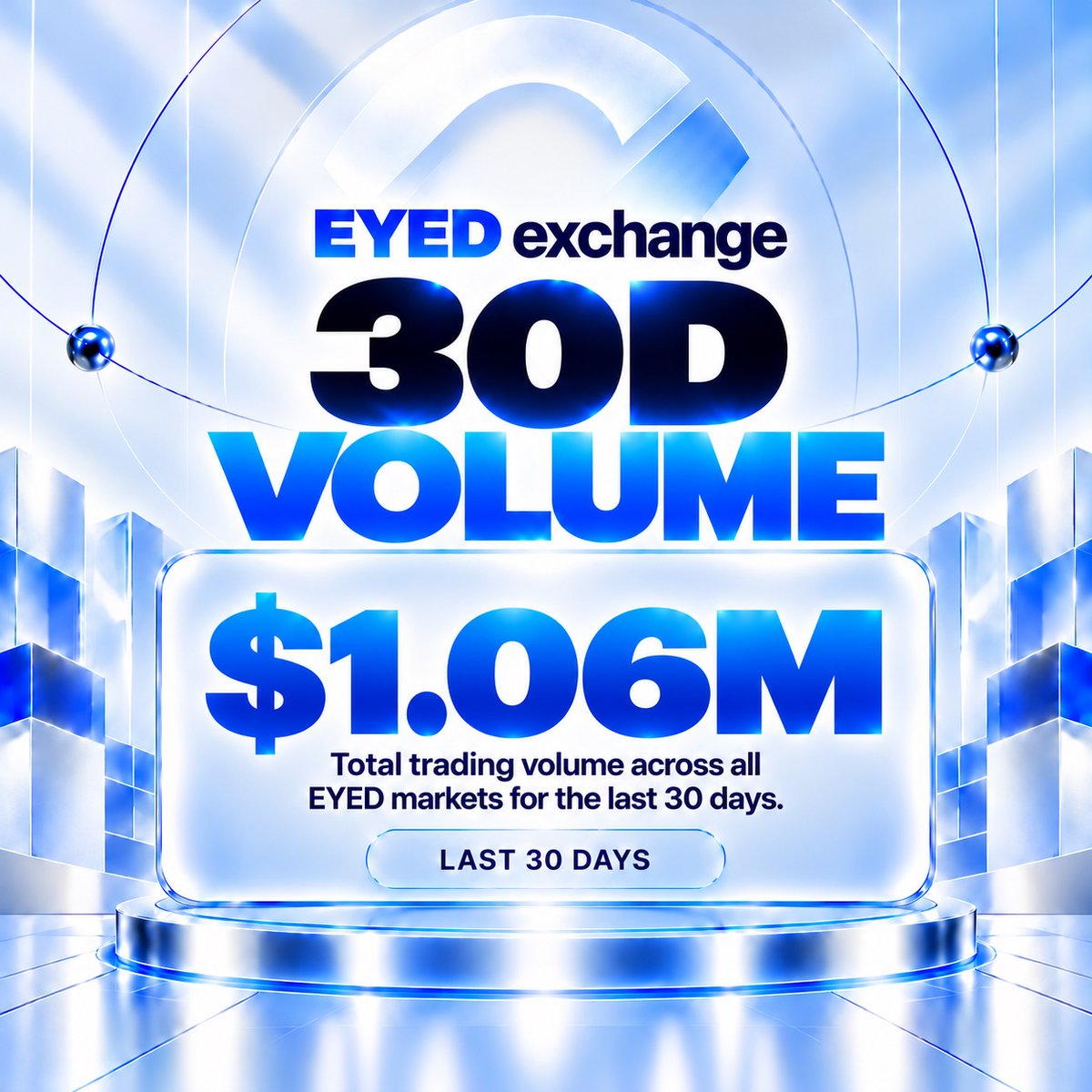
The ultimate Solana trading hub is here — @EyedTrade
Trade all these asset classes under ONE non-custodial account:
• Spot → EYED
• Perps → EYED
• Predictions → EYED
• Commodities → EYED
• Stocks → EYED
• Pre-IPO → EYED
• Indices → EYED
• Forex → EYED
Spot + perpetuals with up to 100x leverage, isolated margin (no cascading liquidations), Predictions markets, Pre-IPO access, and more — everything in a single seamless Solana DEX experience.
No other platform offers this breadth in one account. One wallet. Every market. Complete freedom.
Why juggle multiple apps when Eyed Exchange puts the full trading universe at your fingertips?
Start trading smarter on Solana
https://t.co/uounRPXEbO
#EyedExchange #SolanaDEX #Perps #PredictionsMarkets #PreIPO #Commodities #Stocks #ForexTrading #MultiAsset #OneAccount #DeFi #CryptoTrading
One month of EYED V3.
A lot of updates shipped, a lot of improvements made, and plenty more on the way.
Not a victory lap. Just a checkpoint.
Our focus remains the same: building a better trading experience, bringing more traders on board, and improving every day.
Still early. A lot more work ahead.
Doing my first space ever for @MPP32_dev with @MarioNawfal and on his @RoundtableSpace
11am ET tommorow be there!
solana:6hKtz8FV7cAQMrbjcBZeTQAcrYep3WCM83164JpJpump will be making some moves soon with utility upgrades!
Well said @RoundtableSpace
The agent economy is expected to turn into a 1 trillion dollar market and no one does it like solana:6hKtz8FV7cAQMrbjcBZeTQAcrYep3WCM83164JpJpump
One of the most undervalued utility tokens out there
Dev has been grinding for months and I think his hard work will soon reflect on the chart
M32 enables AI agents like Dots to pay. AI agents are starting to spend real money, and they need infrastructure built for it.
@MPP32_dev is building a payment layer that lets AI agents access and pay for services on Solana through a single connection.
More than 35,000 services are already available, providers keep 100% of their revenue, and agents can verify pricing before making a payment.
solana:6hKtz8FV7cAQMrbjcBZeTQAcrYep3WCM83164JpJpump sits behind the ecosystem, giving holders a way to participate as agent-to-agent commerce grows.
The MPP32 team will be joining the Roundtable show this Friday to break it all down. Stay tuned for their episode!
Learn more: https://t.co/b5WOrNJATA
Disclaimer: This content was produced in collaboration with the client and is intended for informational purposes only. It does not constitute financial or investment advice. Always conduct your own research before making any financial decisions, especially in highly volatile markets like crypto.
💠 Connection Room News
💠 Team 122
💠 @MPP32_dev
What is solana:6hKtz8FV7cAQMrbjcBZeTQAcrYep3WCM83164JpJpump:
They have two domains that cover different areas of the agent market.
1. Agents can pay for APIs now. They still can't tell if the price is fair. There's literally no way to educate your agent on an up to date live fair market value for the calls across x402 that they make. You can prompt them to compare but then you slow down your automated workflow and pay more in AI fees which ends up making you pay more.
So their service fixes that issue.
2. MPP32 org lets agents pay any provider across x402, Tempo and AP2 without the provider picking a rail. This maximizes revenue for providers because we eliminate the cross chain or protocol communication for agents. Also allows agents to access and buy on 100% of the market.
solana:6hKtz8FV7cAQMrbjcBZeTQAcrYep3WCM83164JpJpump is the access, burn it for 30 days of paid agent tools. More agents using the tools means more burns.
Welcome solana:6hKtz8FV7cAQMrbjcBZeTQAcrYep3WCM83164JpJpump to my Room :)
We were spotlighted by @x402 at our low.
Now were climbing back up to new milestones and highs.
With the most usage we've ever had on our networks. We see agentic commerce expanding in live time.
Thank you to all the day 1 believers in the community solana:3GVntiigVVNEsQy7L1f8Yw8kzC1ef8oYtoDi5UE4pump has a long way to go and huge news coming up soon!
Agent payment protocols should not determine whether a price is reasonable.
MPP32 currently tracks both x402 and MPP services in the same measurement layer.
The live protocol report lists more than 13,700 x402 services and more than 1,100 MPP services.
Agents should be able to compare price, freshness, reliability, and volatility without changing their evaluation system for every payment rail.
Payment rails move money. MPP32 helps agents decide whether the quote deserves to be paid.
https://t.co/ZkqJVnzT08
Agents hiring agents sounds cool until one of them starts spending dangerously.
Heres what we fixed👇
We built something called Delegated Spend Keys.
How it works:
A parent agent creates a child key with a budget, an allowlist, a velocity cap, and a per-call ceiling.
The child can pay. It cannot drain the treasury.
Every spend rolls back up to the parent.
Revoke the parent and the whole tree under it dies instantly.
Everybody talks about agents hiring agents.
This is the part that makes it safe enough to actually run.
solana:6hKtz8FV7cAQMrbjcBZeTQAcrYep3WCM83164JpJpump
Private inference solves the “who can see the prompt” problem. It does not solve the “who does the agent pay” problem.
Once models have real context about work, money, and personal life, they start calling paid APIs, data feeds, and compute endpoints on their own. Venice (TEE + zero retention + E2EE) keeps that context inside an attested enclave.
@Attestagent is the missing check before the agent authorizes the payment:
• Grades any x402/MPP endpoint A–F before a single cent moves
• Verifies the payout wallet on-chain, flags typosquats, overpriced or bait-and-switch offers, and known-bad operators
• Plugs in via MCP so the agent can scan programmatically instead of blindly settling
You can have hardware-isolated inference and still get drained by a malicious payment endpoint that just harvested the private request.
@Attestagent is the buyer-side reputation layer that lets agents operate with both privacy and money without a human watching every transaction.
Combined they actually make the “give the model more of our lives” future usable instead of just theoretically private.
Why to buy @Attestagent:
Agents are about to spend money on their own.
That’s the whole pitch.
x402 and machine payment protocols let an agent hit an endpoint, pay in stablecoins, and get data back with no human in the loop. Anyone can list a payable URL. A lookalike domain, a fresh payout wallet, a bait-and-switch price, or a dead handshake can drain funds before anyone notices.
@Attestagent is the buyer-side check that should have existed first.
Paste an endpoint. Attest grades it A–F before a cent moves: protocol validity, wallet trust, pricing vs category medians, typosquatting, blocklists, delivery integrity. Plug it into Claude, Cursor, or any MCP agent. Basic grades stay free. The product is the verdict — and they are explicit that $ATST cannot buy a better grade.
What $ATST actually does:
• Hold it for deeper scans, forensics, bulk tools, higher limits, and the full Trust Graph Observatory
• Burn it for lifetime Pro
• Lock it for Watchtower alerts when an endpoint or payout wallet changes
• Fund agents at published holder tiers
The agent economy is building the payment rail. Attest is building the anti-scam layer in front of it. If autonomous spend scales, a reputation check before payment is not optional.
Not financial advice. Tiny market, early product, do your own research. Check https://t.co/z9KUCAkPmi and @Attestagent.
Your AI agent can read an invoice, call an API, and send money.
But does it know whether the payment request itself changed?
A swapped wallet.
A 5× price increase.
A lookalike x402 endpoint.
Attest checks the exact offer before your agent pays:
ALLOW / WARN / BLOCK
Because “the API responded” is not the same as “the payment is safe.”
Built for x402 and MPP.
https://t.co/0APDTwDGbr
solana:3GVntiigVVNEsQy7L1f8Yw8kzC1ef8oYtoDi5UE4pump 23k MC
Legit working tech, been hanging in for a while now.
Personally i beleive the agent economy as a whole is 5months away from scaling to new highs of volume and agent activity.
I havent seen a trust layer similar to theirs, bidding now. Dyor NFA
Thank you to @PayAINetwork for inviting us to the x402 takeover space!
We'll be there along with our community listening in supporting solana:3GVntiigVVNEsQy7L1f8Yw8kzC1ef8oYtoDi5UE4pump
Be there SEP 14th at 14:00 UTC
Our Founding Story📚
The payment rails for AI agents had a massive flaw, they couldn't interact with eachother.
x402 shipped. Tempo shipped. AP2, ACP etc.. all shipped. Every one of them solved the same narrow thing, which is how to move a dollar from an agent to a server.
That part was done, but it wasnt complete enough for an entire economy to run on alone.
Moving money to agents was made possible by x402, MPP protocols but there was still 6 rails that do not interact with each other, spread across different chains, with no shared directory of who accepts what.
No way for an agent to discover a service it can actually pay.
No way to know an endpoint will settle before you throw money at it.
No identity that survives a hop between two protocols. No way for one agent to fund another agent without handing over a private key.
No escrow when three agents work one job and only two deliver.
No budget that holds when your agent spawns five sub agents.
That is not a payment protocol problem!!
That is a coordination problem, and it is the real reason the agent economy still runs on a human clicking things.
We saw that in May and went straight at it.
The value sits in the layer that makes them usable together, and that layer is where an actual economy either forms or does not. Wires came first and they were useful to almost nobody.
The switchboard is what turned wires into a phone system. The agent economy was sitting in the wires stage and everybody was celebrating.
So we built the switchboard.
- Providers sell to 100% of the agentic market
- Agents launched have access to 100% of services no matter the chain or protocol
Discovery. 25,000 machine payable APIs and MCP servers indexed in one federated catalog, crawled continuously across every protocol. An agent gets one integration instead of one account per provider. And we only surface what settles end to end, because a directory full of endpoints that fail on payment is worse than no directory at all.
Routing. Your agent asks for what it needs by name or by intent. We pick the protocol, the chain and the endpoint. Nobody should have to teach a model the difference between settling on Solana and settling on Base.
Identity. Signed AGTP agent identity, so an agent can prove who it is when a call crosses from one platform into another. We run this live with a partner network in production today, signed both directions.
Delegation. Delegated Spend Keys. A parent agent mints a scoped, capped, revocable child key and hands it to a sub agent it hires. Allowlist, budget, hourly velocity limit, per call ceiling. Every dollar the child spends rolls up against the parent. Kill the parent and the entire tree below it dies instantly. Everyone talks about agents hiring agents. This is the primitive that makes it survivable, and we are the only ones shipping it.
Escrow. Multiple agents pool a budget, collaborate, and get paid only when their contribution is verified. Rails have no concept of conditional multi party payment. Real work does.
Control. Budgets, velocity caps and per call ceilings enforced before money moves, not reconciled after.
Custody. None, ever. Keys never leave your machine. Every settlement returns an on chain signature you can verify yourself.
Four months in this is live, open source, on npm, listed in the official MCP registry, and running inside Claude, Cursor, Windsurf and Grok. Ten free calls a day so an agent can prove the entire flow before touching crypto.
The next few years are going to produce billions of agents that need to buy things from each other constantly and without supervision. That does not happen because a rail exists. It happens because something sits above the rails and handles discovery, identity, delegation, limits and trust between parties who have never met.
Thats what we're building here at solana:6hKtz8FV7cAQMrbjcBZeTQAcrYep3WCM83164JpJpump
Did you know? The same paid endpoint does not always have one price.
MPP32 probes recently recorded Agent Exchange signal quotes from $0.005 to $0.09 across 74 observations.
That is an 18x spread for the same https://t.co/tqk0AKgsd7 1,000 calls, choosing the cheaper observed quote instead of the highest one changes the bill by $85
Before an agent pays, it needs to know whether the quote is normal, stale, or an outlier.
Would this make you consider running agents at different times depending on peak hours or low volume hours when the same endpoint costs less?
Only with solana:6hKtz8FV7cAQMrbjcBZeTQAcrYep3WCM83164JpJpump will you ever have your agents access this data.
MPP32 measures the price, unit, timestamp, source, and history so agents can make that decision with evidence. https://t.co/7Acsm7l7Rx
A second strong example is SYNTHORA’s onchain primitives endpoint, where probes recorded prices from $0.01 to $0.25 across 159 observations. That is a 25x observed range for the same endpoint. The service page is:
https://t.co/1wAHioeBtw
Our Founding Story📚
The payment rails for AI agents had a massive flaw, they couldn't interact with eachother.
x402 shipped. Tempo shipped. AP2, ACP etc.. all shipped. Every one of them solved the same narrow thing, which is how to move a dollar from an agent to a server.
That part was done, but it wasnt complete enough for an entire economy to run on alone.
Moving money to agents was made possible by x402, MPP protocols but there was still 6 rails that do not interact with each other, spread across different chains, with no shared directory of who accepts what.
No way for an agent to discover a service it can actually pay.
No way to know an endpoint will settle before you throw money at it.
No identity that survives a hop between two protocols. No way for one agent to fund another agent without handing over a private key.
No escrow when three agents work one job and only two deliver.
No budget that holds when your agent spawns five sub agents.
That is not a payment protocol problem!!
That is a coordination problem, and it is the real reason the agent economy still runs on a human clicking things.
We saw that in May and went straight at it.
The value sits in the layer that makes them usable together, and that layer is where an actual economy either forms or does not. Wires came first and they were useful to almost nobody.
The switchboard is what turned wires into a phone system. The agent economy was sitting in the wires stage and everybody was celebrating.
So we built the switchboard.
- Providers sell to 100% of the agentic market
- Agents launched have access to 100% of services no matter the chain or protocol
Discovery. 25,000 machine payable APIs and MCP servers indexed in one federated catalog, crawled continuously across every protocol. An agent gets one integration instead of one account per provider. And we only surface what settles end to end, because a directory full of endpoints that fail on payment is worse than no directory at all.
Routing. Your agent asks for what it needs by name or by intent. We pick the protocol, the chain and the endpoint. Nobody should have to teach a model the difference between settling on Solana and settling on Base.
Identity. Signed AGTP agent identity, so an agent can prove who it is when a call crosses from one platform into another. We run this live with a partner network in production today, signed both directions.
Delegation. Delegated Spend Keys. A parent agent mints a scoped, capped, revocable child key and hands it to a sub agent it hires. Allowlist, budget, hourly velocity limit, per call ceiling. Every dollar the child spends rolls up against the parent. Kill the parent and the entire tree below it dies instantly. Everyone talks about agents hiring agents. This is the primitive that makes it survivable, and we are the only ones shipping it.
Escrow. Multiple agents pool a budget, collaborate, and get paid only when their contribution is verified. Rails have no concept of conditional multi party payment. Real work does.
Control. Budgets, velocity caps and per call ceilings enforced before money moves, not reconciled after.
Custody. None, ever. Keys never leave your machine. Every settlement returns an on chain signature you can verify yourself.
Four months in this is live, open source, on npm, listed in the official MCP registry, and running inside Claude, Cursor, Windsurf and Grok. Ten free calls a day so an agent can prove the entire flow before touching crypto.
The next few years are going to produce billions of agents that need to buy things from each other constantly and without supervision. That does not happen because a rail exists. It happens because something sits above the rails and handles discovery, identity, delegation, limits and trust between parties who have never met.
Thats what we're building here at solana:6hKtz8FV7cAQMrbjcBZeTQAcrYep3WCM83164JpJpump
An AI agent can call thousands of paid APIs without a human reviewing the bill.
The difficult part is not sending the payment.
It is knowing whether the price is reasonable.
Most agent payment flows answer one question:
Can this quote be paid?
They do not answer:
Is this quote an outlier? Has the price changed? Is the unit correct? Is there a comparable alternative?
MPP32 provides that missing layer.
It continuously measures paid endpoints, normalizes prices by unit, tracks historical ranges, separates real observations from synthetic data, and publishes the evidence behind each benchmark.
Before paying, an agent can compare a quote with observed market prices, reject an extreme outlier, and choose a better priced alternative where one exists.
That matters because a 20% pricing error repeated 100,000 times is a $2,000 problem, not a rounding error.
The live index has recorded 55,090 raw observations in the last 24 hours across 14,813 services and tracks 2.52M indexed historical observations.
Payments move money. MPP32 helps agents decide whether the price deserves to be paid.
https://t.co/qGV8V9PNJN
MPP32 publishes the evidence behind the number:
• Raw observations
• Timestamps and source endpoints
• Units and outcomes
• Probe history
• Signed schedule proofs for scheduled probes
• Synthetic backfill labeled separately from live data
Agents can audit the benchmark before they pay.
The index now covers 2.19M observations across 14.6K services.
Pricing data for agents should be verifiable, not just searchable.
Check out our transparency page below👇
https://t.co/cngmncALsk