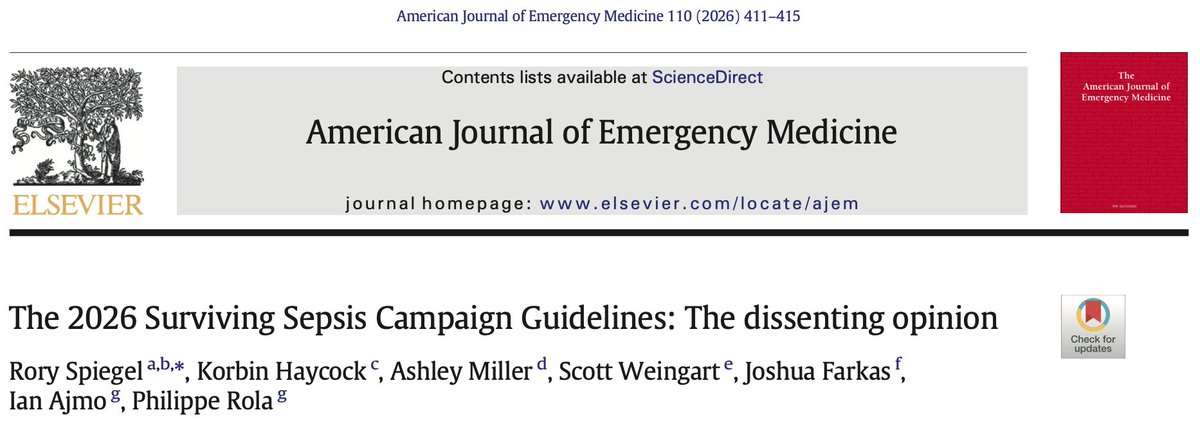
The Surviving Sepsis Campaign has shaped sepsis care for decades. But do some of its core recommendations now lag behind the physiology and the evidence?
Rory Spiegel @TheEMNerd led this new dissenting opinion, which I was very pleased to contribute to.
We challenge:
• fixed 30 mL/kg fluid loading
• chasing lactate with fluid
• fluid responsiveness as a sufficient reason to give fluid
• pressure-centric resuscitation
• the omission of POCUS from modern haemodynamic assessment
• rigid bundle-driven care
The argument is not for less treatment. It is for more individualised, physiology-driven treatment of shock.
https://t.co/ImJeVAsbi1
The 2026 Surviving Sepsis Campaign Guidelines: The dissenting opinion
Spiegel et al. AJEM, just published.
Fresh IBCC chapter on intubation in critical illness 😁
Contains some basic stuff & some cutting-edge stuff (see the section on Ultra Rapid Sequence Esophageal Intubation 🔥)
This is aimed at occasional intubators (e.g., Pulm/CC), especially trainees. It outlines a safe approach that is easy to learn. If you already have an established practice pattern that works great for you, there's no need to change that.
Link in next post #1/2
Technique for hyperangulated videolaryngoscopy.
From the Guidelines for providing a foundation for airway management
Download high resolution images at https://t.co/goZDDng9Bd
Full free text of guideline in @Anaes_Journal at https://t.co/LqzCV3Etqx
in response to this blog, lots of folks commented that hyperangulated videolaryngoscopy is great at visualizing the cords but makes tube passage difficult
my team hasn't encountered this problem. why??
I think it's because we use sniffing position +/- laryngeal manipulation
Fresh Blog: Why I think hyperangulated videolarygnoscopy should be the mainstay of ICU intubations:
📹 People actually use the tool correctly
📹 Master one technique for easy & hard airways
📹 Compatible with steep bed angulation
📹 The fresh COVALENT RCT 😁
(#1/2)
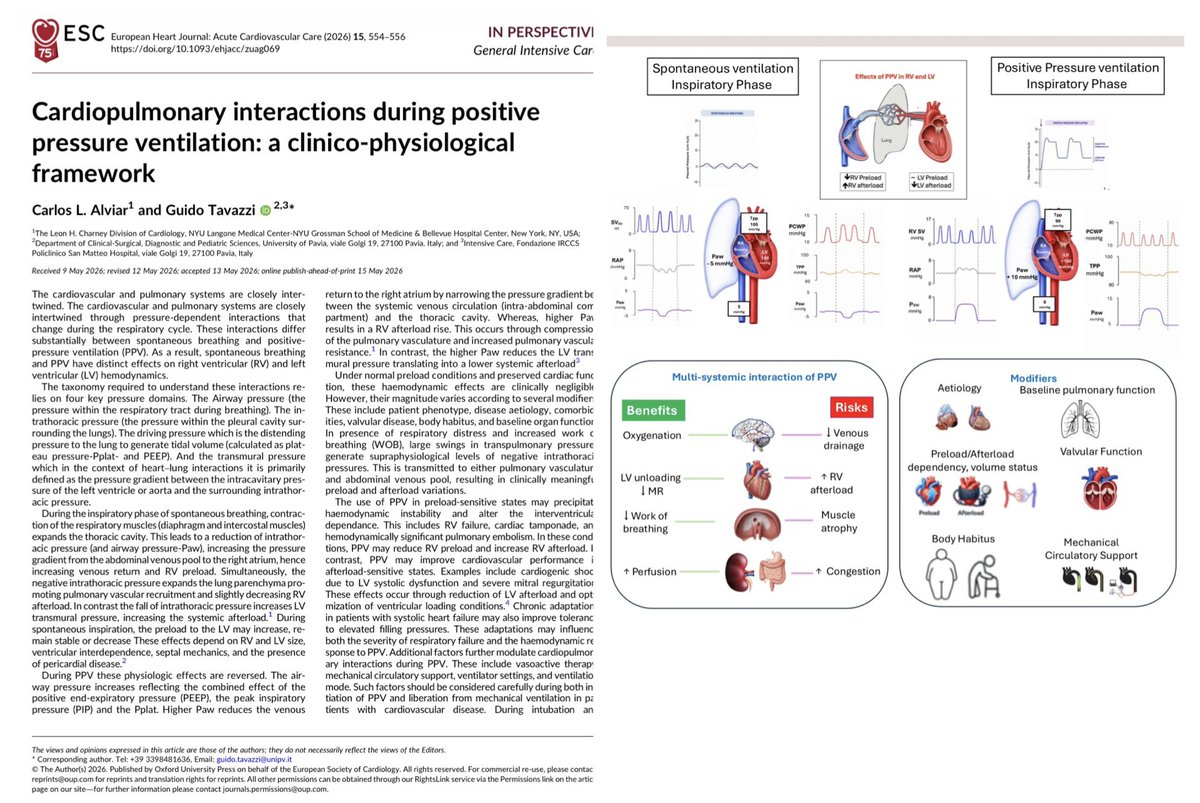
Interacción cardiopulmonar
Durante la inspiración espontánea:
✅Disminuye la presión intratorácica.
✅Aumenta el gradiente de retorno venoso.
✅Incrementa la precarga del ventrículo derecho.
✅Disminuye discretamente la poscarga del VD por reclutamiento vascular pulmonar.
✅Aumenta la presión transmural del VI, incrementando su poscarga.
Ventilación con presión positiva
Durante la inspiración con VPP ocurre el fenómeno opuesto:
Sobre el ventrículo derecho
✅Disminuye el retorno venoso.
✅Disminuye la precarga.
✅Aumenta la resistencia vascular pulmonar.
✅Incrementa la poscarga del VD.
Sobre el ventrículo izquierdo
✅Disminuye la presión transmural.
✅Disminuye la poscarga sistémica.
✅Facilita la eyección ventricular.
Situaciones donde la VPP puede ser perjudicial
La VPP puede precipitar inestabilidad hemodinámica en pacientes dependientes de precarga, como:
❌Falla ventricular derecha.
❌Taponamiento cardíaco.
❌Tromboembolia pulmonar masiva.
En estas condiciones reduce aún más la precarga del VD y aumenta su poscarga, favoreciendo el deterioro del gasto cardíaco.
Situaciones donde la VPP es beneficiosa
En pacientes dependientes de poscarga, la VPP mejora el desempeño cardiovascular:
✅Choque cardiogénico por disfunción sistólica del VI.
✅Insuficiencia mitral grave.
✅Edema agudo pulmonar cardiogénico
An easy way to get unstuck is to get up and take a walk.
We generate more creative ideas during and after walking outdoors—and even on a treadmill facing a blank wall.
Divergent thinking rarely happens when we're tethered to a desk. Moving our bodies frees our minds.
We're excited to welcome @cliffreid as one of our keynote speakers at #SASNoosa2026. Join us at the Elysium Noosa Resort Fri 28th Aug (& don't forget the Airway SIG meeting on Thu 27th).
Workshops, panel discussions, guideline launches & more.
Details: https://t.co/0fYRRnFaT6
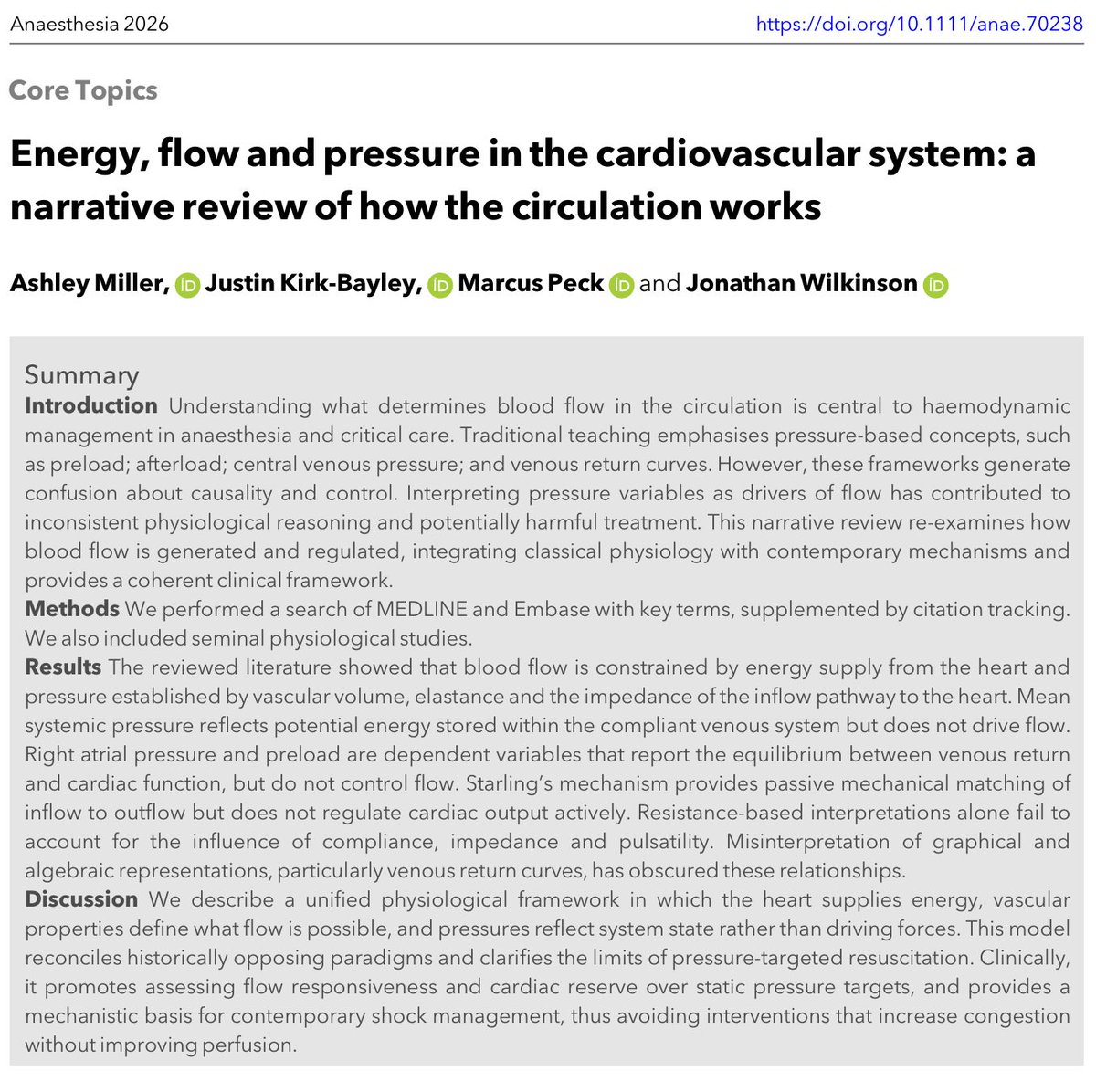
Haemodynamic equations are useful. But they also mislead.
Take:
CO = HR × SV
CO ≈ (MAP − RAP) / SVR
Both are mathematically true. But they can make the variables they contain look like the controllers of output.
Often they are not.
In the intact circulation, these equations describe the resolved state of the system. They do not, by themselves, tell you what is supplying energy, what is constraining flow, or what is actually limiting output.
That is one of the central themes of our review:
Energy, flow and pressure in the cardiovascular system: a narrative review of how the circulation works.
https://t.co/L19bsDCzr6
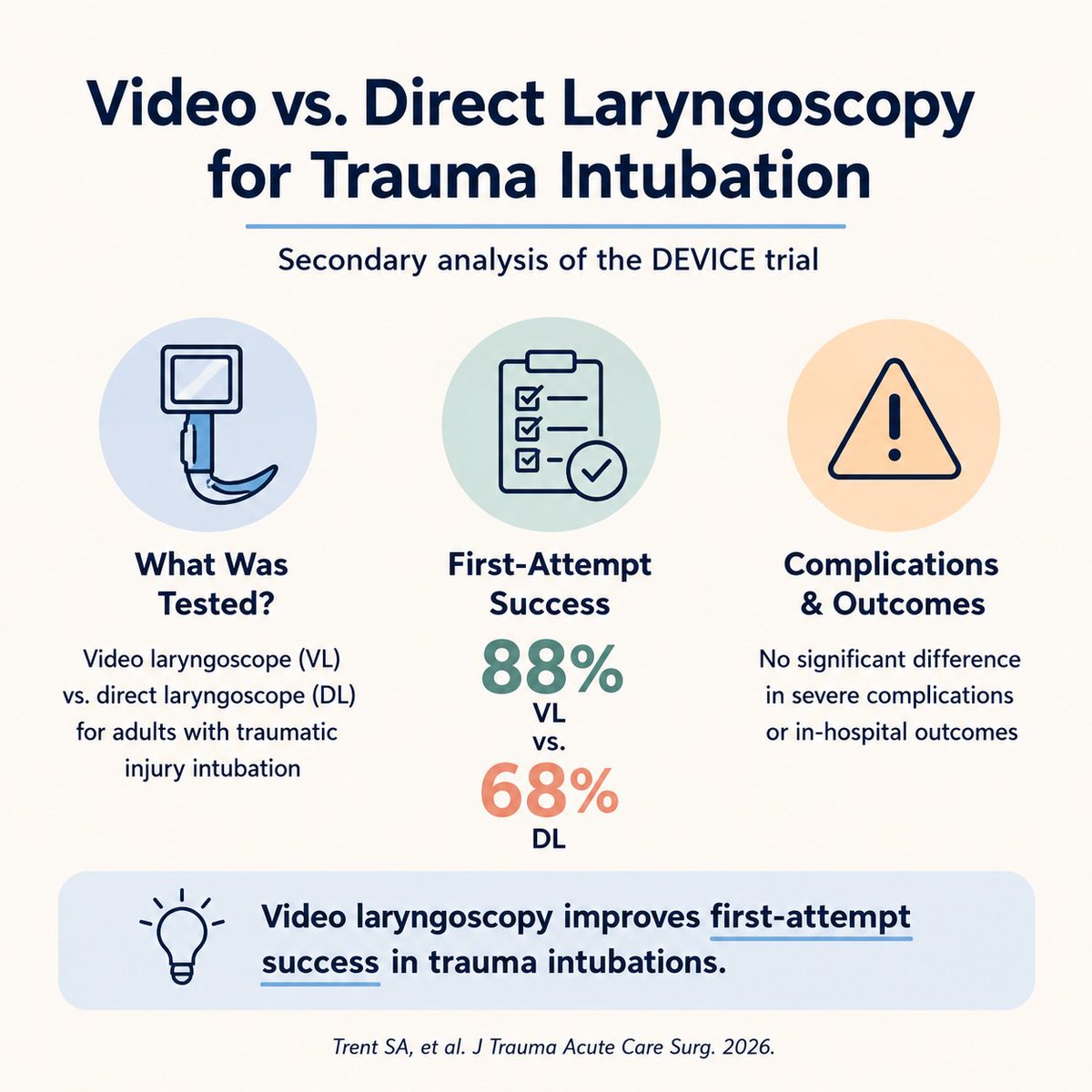
Our secondary analysis of patients intubated for traumatic indications from the DEVICE study is out now. Unsurprisingly, VL out performed DL with an NNT of 5.
https://t.co/aeuE3I2njH
DM me for the full paper.
#emergency#icu#airway#trauma#science#medx#medtwitter
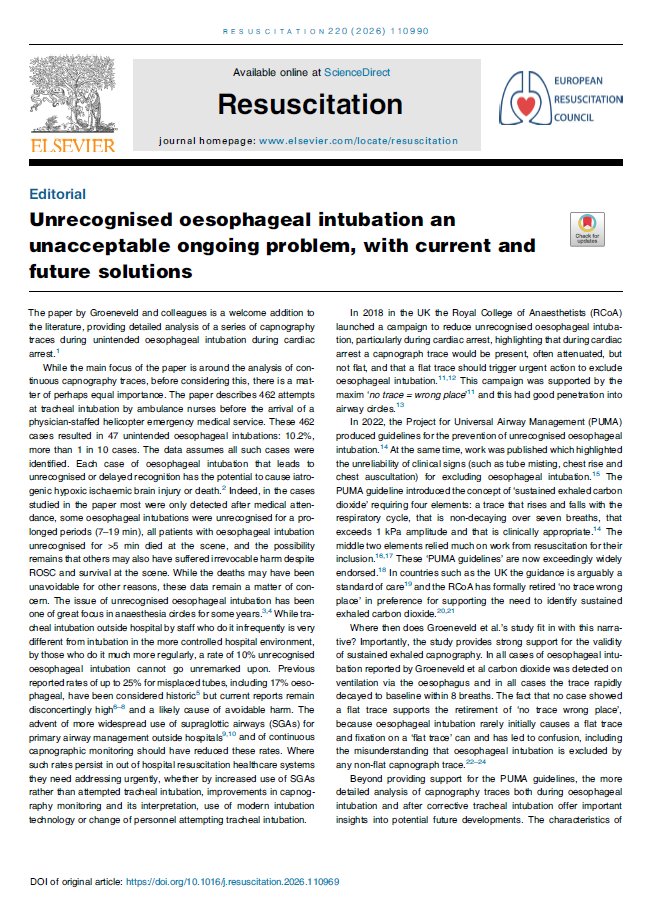
Delighted to see this editorial published in Resuscitation
Described as hard hitting it addresses
- the ongoing and unacceptable high rates of unrecognised oesophageal intubation in some out of hospital settings
- current methods to reduce this
- future opportunities to make this even more failsafe
https://t.co/IgnYxHvPqE
20 years ago today, 3 years before he was slain by depression, David Foster Wallace delivered his unforgettable meditation on the meaning of life – perhaps the greatest commencement address of all time https://t.co/SqaJx9Covr
Does it really matter which IO site you choose?
Well, it depends on how important flow rates are for what you are looking to infuse.
Here's some IV flow rates for comparison:
14g = 330 ml/min
16g = 193 ml/min
18g = 95 ml/min
20g = 61 ml/min
With a pressure bag, here's what you can expect from IO by type and site:
EZ-IO in tibia = 69-165 ml/min
EZ=IO in humerus = 60-153 ml/min
FAST1 in sternum = 112 ml/min (does anyone actually use these now?)
So, back to the original question... for the vast majority of indications, it does not matter which site you choose. We frequently do not resuscitate through 14g IV's, thus, both commonly used IO sites will provide you nearly similar flow rates on pressure bag to the usual IV access catheters.
Clip from The Pitt on @streamonmax
https://t.co/RJuX9wDa6O
PMID: 27075364
#emergency #emergencymedicine #criticalcare #icu #airway #medic #science #data #research #army #armymedicine #armyemdoc #medic #prehospital #medx #medtwitter
Revisit a February 2024 review article on the concept of consciousness, how it is altered by anesthetics, the challenges for assessing consciousness, currently used technologies for assessing anesthesia levels, and future research directions: https://t.co/BZnAMHCZ9a
Exposure to nature doesn’t only make us happier. It makes us kinder too.
Data: Just recalling or seeing photos of forests, oceans, landscapes, or the stars is enough to evoke awe and motivate helping.
The outdoors strengthens our connection to something larger than ourselves.
Female physicians still face systemic barriers and internalised biases, limiting professional opportunities, undermining success and taking significant emotional and psychological tolls. #SexismInMedicine
https://t.co/JWGVsDqh09
Does digital intubation work?
There is no good data on this technique in adults.
There is decent data with efficacy in neonates, but their anatomy is different than adults, and more importantly, unlike adults, you can attempt this in neonates without paralysis. In adults, without paralysis, you risk losing your digits.
One mannequin study compared digital intubation with an ET tube alone, ET + stylet, and ET + bougie. The ET + stylet had the best success rate and fastest times.
A systematic review in neonates found a 94% first-pass success rate.
Anecdotally, when I've tried this in an elective setting, my fingers were almost never long enough. So maybe my colleagues who wear size 8+ gloves may have better success at reaching the landmarks.
In an era of VL and other reliable backup devices, such as SGAs, I'm not sure what role this has, if any. Maybe someone out there can tell me what role this should have, if any.
https://t.co/WKNenvaLOz
https://t.co/KWufY07V5O
PMID 30711420, 34265176
Clip from The Pitt at @StreamOnMax
#emergency #emergencymedicine #criticalcare #icu #airway #medic #science #data #research #army #armymedicine #armyemdoc #airway #medx #medtwitter