in 1978, a married couple in washington recorded a lo-fi folk lounge album in their living room together. they used instruments from a local junk shop. it was the only music they ever made, eventually divorcing and the album falling into obscurity for decades, forgotten.
I wrote a little something about Bowie in the 1970's for my Substack people. By no means definitive, just my thoughts most of a lifetime later. https://t.co/eMfUz0RGCp
Närmare ett hundra forskare och lärare vid Linköpings universitet riktar nu skarp kritik mot universitetsledningen efter att personalen uppmanats att använda AI i sitt arbete. https://t.co/5tHvUfNxnE
Förstasingeln, tillika titelspåret, från CIVIL POLIS andra album finns ute nu på CIVIL RADIO, Bandcamp och Nina Protocol, samt i streaming-version på Spotify, Apple Music, Tidal, Qobus och så vidare. Förhandsbeställning här.
https://t.co/r0nUXOQAK2
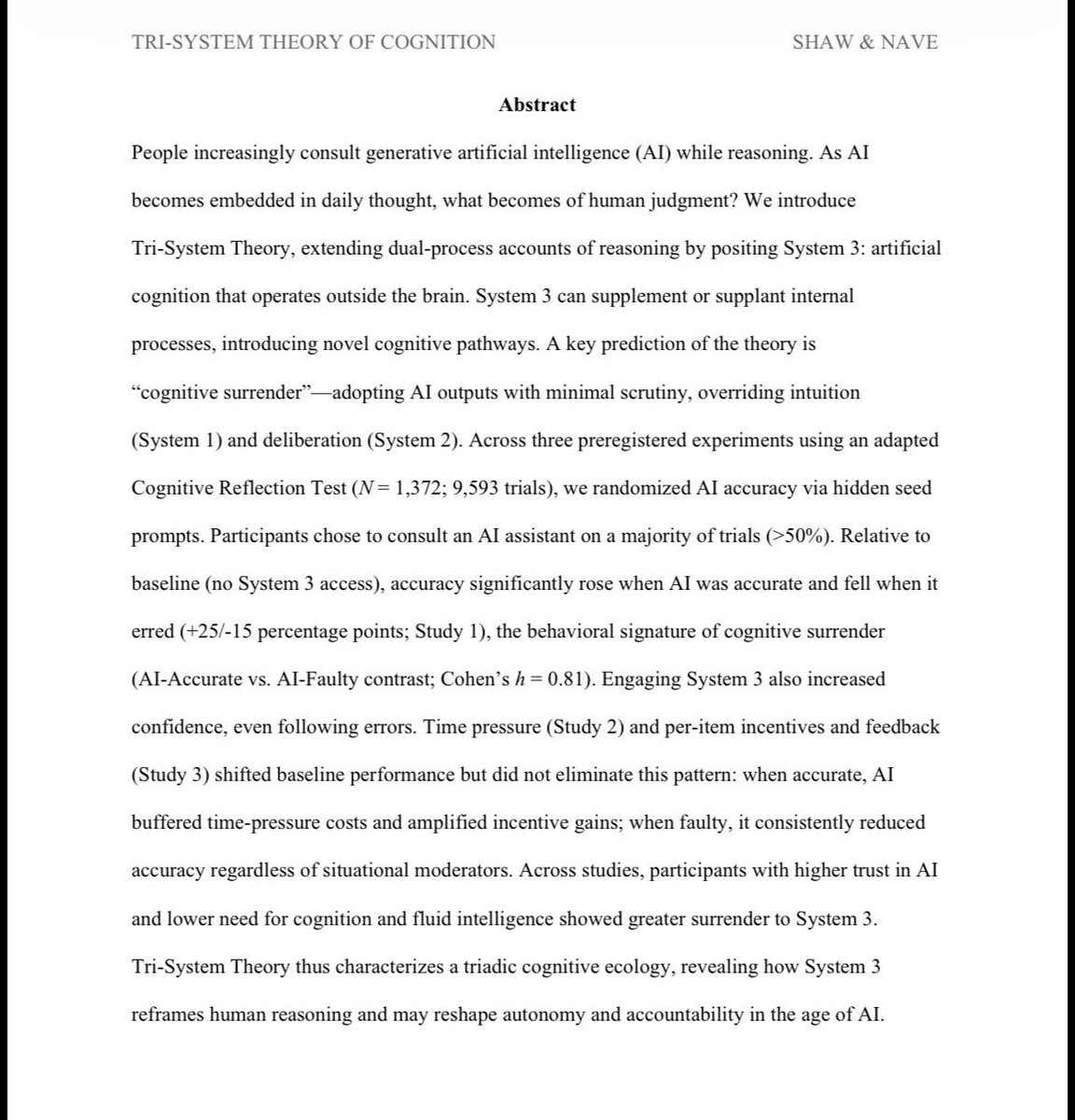
“Cognitive Surrender” - a new study argues that use of AI leads to suspension of human reasoning, not its augmentation. The implication being that over time people will lose their reasoning ability & use AI as its substitute. Download the paper for free here, excerpts & reference below:
https://t.co/ZlWbD0b6CJ
——-
“As people increasingly integrate AI into their decision-making processes, they interact and engage with a cognitive system that can reshape the functions of both intuition and deliberation. For example, System 3 can replace System 1 by offering confident, ready-made answers that preempt the need for intuitive reasoning.” (page 15 of pdf)
“As AI systems increasingly participate in human cognition, a new phenomenon emerges that cannot be explained by traditional concepts such as cognitive offloading or automation bias alone. We define cognitive surrender as the behavioral and motivational tendency to defer judgment, effort, and responsibility to System 3’s output, particularly when that output is delivered fluently, confidently, or with minimal friction. Unlike cognitive offloading, which is typically strategic and task-specific (e.g., using GPS to navigate), cognitive surrender entails a deeper transfer of agency.” (Page 17)
“Access to System 3 outputs significantly influenced accuracy, increasing correct answers when AI was correct, and decreasing accuracy when incorrect. Access to System 3 made decision-makers more confident, despite approximately half of System 3 outputs being incorrect. Finally, users who trust AI more and have lower NFC and fluid IQ were more likely to display cognitive surrender. Whether System 3 was accurate or faulty, its presence displaced internal reasoning.” (Page 27)
“Cognitive surrender was robust across studies.” (Page 42)
“Across our studies, we observe that when System 3 was available, people readily engaged it and frequently adopted its answers. This shift reflects a reallocation of cognitive control rather than mere effort saving. System 3’s fluent, confident outputs are treated as epistemically authoritative, lowering the threshold for scrutiny and attenuating the metacognitive signals that would ordinarily route a response to deliberation. In the case of cognitive surrender, there is a shift in the locus of control, with an external system (System 3) occupying the default position.” (Page 45)
“Time constraints clarify why surrender arises so readily, while incentives and feedback show that surrender is malleable. When decision time is scarce, the internal monitor detecting conflict and recruiting deliberation is less likely to trigger. Hence, the low-friction path to defer to external cognition becomes attractive.” (Page 46)
“Tri-System Theory is not a warning about AI’s dangers but a recognition of System 3’s psychological presence. We do not merely use AI; we think with it. In doing so, we must ask new questions: What happens when our judgments are shaped by minds not our own? What becomes of intuition and effort when a generative, artificial partner stands ready to answer? How do we preserve agency, reflection, and autonomy in a world where users engage in cognitive surrender?”
"Bright Size Life", released 50 years ago, is Pat Metheny’s first studio recording as a leader.
It was the album that put him on the map as a bright new force, with something fresh to say in the context of contemporary jazz.
You can find it here: https://t.co/iHNb5AUMdU
The fall of a prolific science journal exposes the billion-dollar profits of scientific publishing: One of the 15 publications that put out the most studies globally has been expelled from the indexing system for irregularities. Its publisher, Elsevier, has a 38% profit margin that reached $1.5 billion in 2024 https://t.co/YLSChNGfS4
Scientific publishing is now an industry. Students write to graduate. Academics publish to survive. Journals accept to profit. Everyone’s producing, but almost nobody is reading.
When did it change from the creation of knowledge to a thriving business sector, in which shady actors operate?
We condemn paper mills as parasites, yet they arere only mimicking what the system rewards — speed, volume, and the illusion of impact.
YO! My partner and I have decided to start our own label!
Simply to put out stuff we're into, from friends, ourselves, or likeminded individuals. I will continue to release on Ilian Tape and also Bandcamp freebies, but this project will be my focus for the foreseeable future. The label is called "A Strange Child" and the first release comes from Konrad Wehrmeister, officially out today and hitting the stores until end of the month. Digital release will follow soon!
Here's the link: https://t.co/KqQLyoZB7T
We'll also set up a newsletter + website for the future so keep an eye on the label page.
Thanks to Konrad for making this possible and to YOU for the ongoing support!
Peace