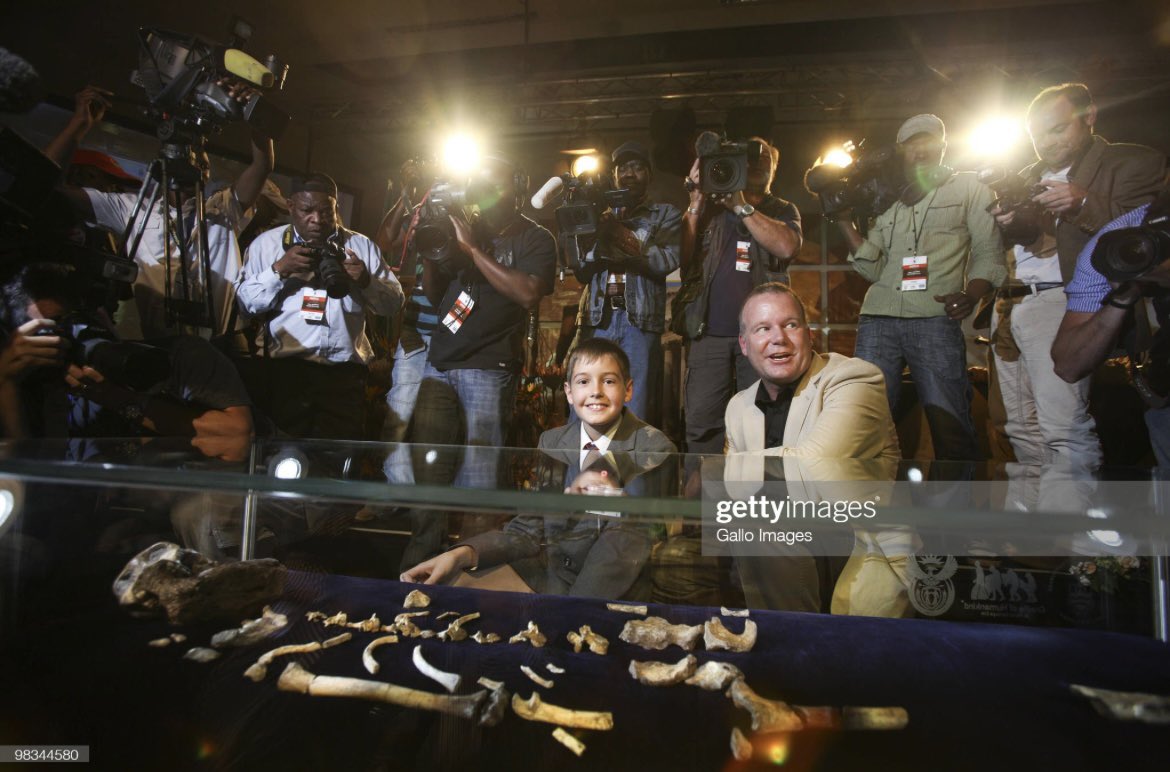
15 years ago today I discovered the first fossil of Australopithecus sediba 💀 This journey I have been involved in has changed my life! It has been a privilege to have played a little part in such a historical discovery 🇿🇦 Happy discovery day sediba #Woah#NeverStopExploring
Voting for the People's Choice Award is now open for the Fourth Edition of Gen:48. Watch all fifty finalist films and cast your votes by Wednesday at 9 AM ET.
Entered @runwayml Gen:48 AI short film competition with Kavin Kapoor and Ishan Modi and somehow made it through as one of 50 finalists out of 3000 teams who entered. Please vote for our silly little experiment of a film!
https://t.co/WkBFYHvyWa
My son Matthew Berger (the discoverer of #sediba and who now works as an executive editor in Hollywood), has had an Ai short film he and colleagues made called “How it’s Made” shortlisted for Runways Fourth Edition of its 48 hour competition Gen:488 Peoples Choice Awards. Its judged by online votes and you can watch it here https://t.co/eZw4qPGfqn - scroll down to see his work and vote for your favourite!
As I have been posting about new #sediba fossils quite a bit these days, it would be remiss of me not to remind the world that I did not discover #Australopithecus sediba @Matty_Berger98 discovered the first specimen in 2008. This is a picture taken moments later. He is now an editor in film in Hollywood working on television, online production and documentaries. Very proud!
SOUND ON. You’re hearing the first howl of a dire wolf in over 10,000 years. Meet Romulus and Remus—the world’s first de-extinct animals, born on October 1, 2024.
The dire wolf has been extinct for over 10,000 years. These two wolves were brought back from extinction using genetic edits derived from a complete dire wolf genome, meticulously reconstructed by Colossal from ancient DNA found in fossils dating back 11,500 and 72,000 years. This moment marks not only a milestone for us as a company but also a leap forward for science, conservation, and humanity. From the beginning, our goal has been clear: “To revolutionize history and be the first company to use CRISPR technology successfully in the de-extinction of previously lost species.” By achieving this, we continue to push forward our broader mission on—accepting humanity’s duty to restore Earth to a healthier state.
But this isn’t just our moment—it’s one for science, our planet, and humankind. All of which we love and are passionate about. Now, close your eyes and listen to that howl once more. Think about what this means for all of us.
For #FossilFriday I want to show you below a beautiful picture – this is a 2-million-year-old fossil humerus of Australopithecus sediba. It was finished being prepared only earlier today so you are among the first humans to view it fully out of the encasing rock – The fossil was prepared by @ZandileNdaba30 (affectionately called Ma Zandi by the team). She has been working with me for 24 years and is part of our full-time team of highly skilled preparators and field technicians. This is extraordinary, beautiful work on this child’s fossil arm and comes from a block containing a child’s skeleton that she has been working on since before covid. It can take thousands, even tens of thousands of hours to prepare some of these fossils and skeletons. Our technicians, like ma Zandi, have literally trained years to do this delicate and painstaking work and ma Zandi has trained many of our team herself. She and the other senior members of the team are terrific mentors and care deeply about their work. Every day they share knowledge and information with each other and scientists around the world. They love sharing their work with the world, particularly young people. Without people like her and our other team members, working in Africa, we wouldn’t have the rich knowledge of human origins that has been emerging over the past decade and a half from the caves of South Africa. The world owes preparators like Ma Zandi and the other members of our teams in the labs and field a great deal for revealing these treasures.