Estimating causal effects efficiently doesn’t have to mean discovering the entire causal graph! Now you can find the optimal adjustment from only local information using LOAD!
📜 Preprint: https://t.co/SskylMuEET
👾 Code: https://t.co/JhM91N5cJk
🧵 1/8
🏎️Drift in the right direction🏎️
Introducing kernel-gradient drifting models: a reformulation of drifting models where the kernel itself defines the direction of motion through its gradient.
📜Paper: https://t.co/1ILDAZj66Y
💾Notebook: https://t.co/9tzqaXAyz7
🌍Today we release Mosaic, a probabilistic weather model that shifts the Pareto frontier of ML weather forecasting.
It matches the skill of state-of-the-art models while generating a 24-member, 10-day global forecast in under 12 s on a single H100.
Thread!
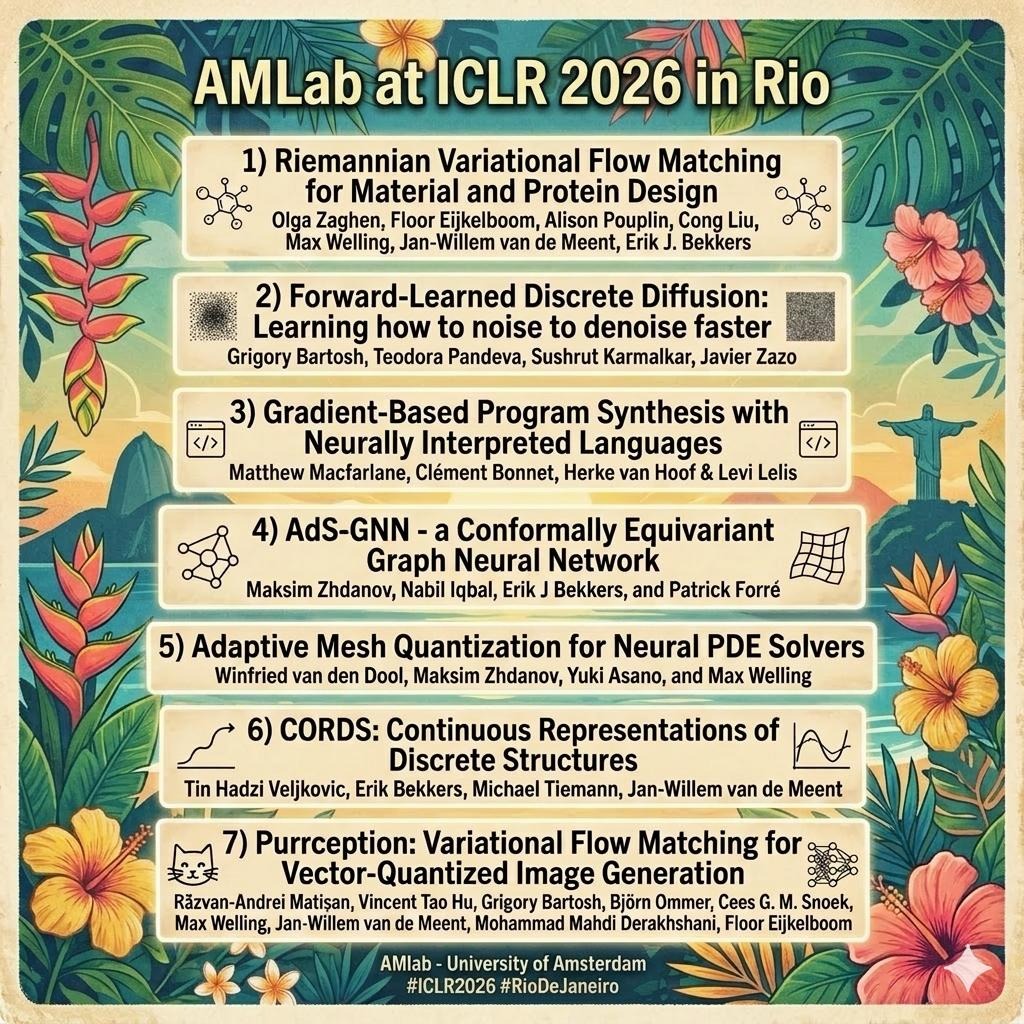
AMLab is excited to present 7 papers at ICLR 2026! See you all in Rio 🇧🇷
1. https://t.co/ObBZE5Ni1N
2. https://t.co/66ofl8ZuLG
3. https://t.co/9EtWxRRJPf
4. https://t.co/bGIGhR8kWH
5. https://t.co/01tuHJzkvd
6. https://t.co/Z53f0zpgIR
7. https://t.co/QTDHiujx2b
Excited to share that we're looking for a new colleague at @AMLab_UvA : Assistant Professor in AI for Science 🔬🤖
AMLab is a world-class ML research group embedded in Amsterdam's thriving AI ecosystem: leading research groups, an ELLIS unit, startups, and big tech — all within reach.
And Dutch academic labor conditions are genuinely among the best in Europe ❤️
Deadline: May 30 👉 https://t.co/PseZ3bsh2B
Cool news: our extended Riemannian Gaussian VFM paper is out! 🔮
We define and study a variational objective for probability flows 🌀 on manifolds with closed-form geodesics.
@FEijkelboom@a_ppln@CongLiu202212@wellingmax@jwvdm@erikjbekkers 🔥
📜 https://t.co/PE6I6YcoTn
LOAD is already my second work with the team of Tom Claassen and @saramagliacane 🥳 Check out the details of the paper at https://t.co/SskylMuEET and load optimal adjustment sets without effort using the publicly available code at https://t.co/JhM91N5cJk!
🏁/8
Estimating causal effects efficiently doesn’t have to mean discovering the entire causal graph! Now you can find the optimal adjustment from only local information using LOAD!
📜 Preprint: https://t.co/SskylMuEET
👾 Code: https://t.co/JhM91N5cJk
🧵 1/8
On both synthetic and realistic data LOAD
🏎️ is more computationally efficient than global methods, performing close to local methods,
💎 recovers high-quality, statistically efficient adjustment sets,
🔮 thus enables reliable causal effect estimation even at scale
7/8
Had a fun little ping pong tournament 🏓 at @AmlabUva some days ago - perfect mix of fun and team bonding! I feel so grateful for working with such amazing people ❤️
& kudos to our organizer, the one and only @maxxxzdn 🤹
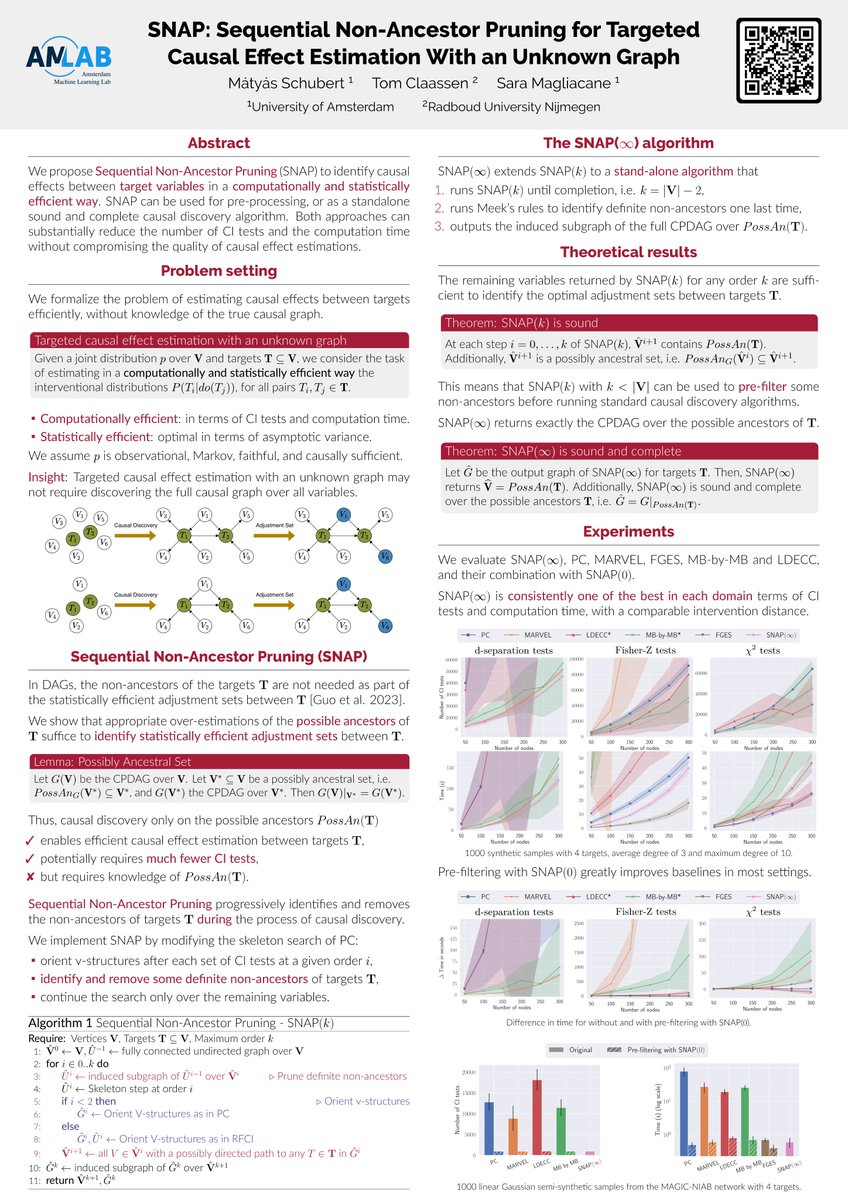
A little over a week ago, I had the chance to attend #AISTATS and present our poster on SNAP (https://t.co/YBMVMJsoaq)! Three days of brilliant invited talks and a stream of fascinating papers left me with a much longer reading list about ideas to explore.
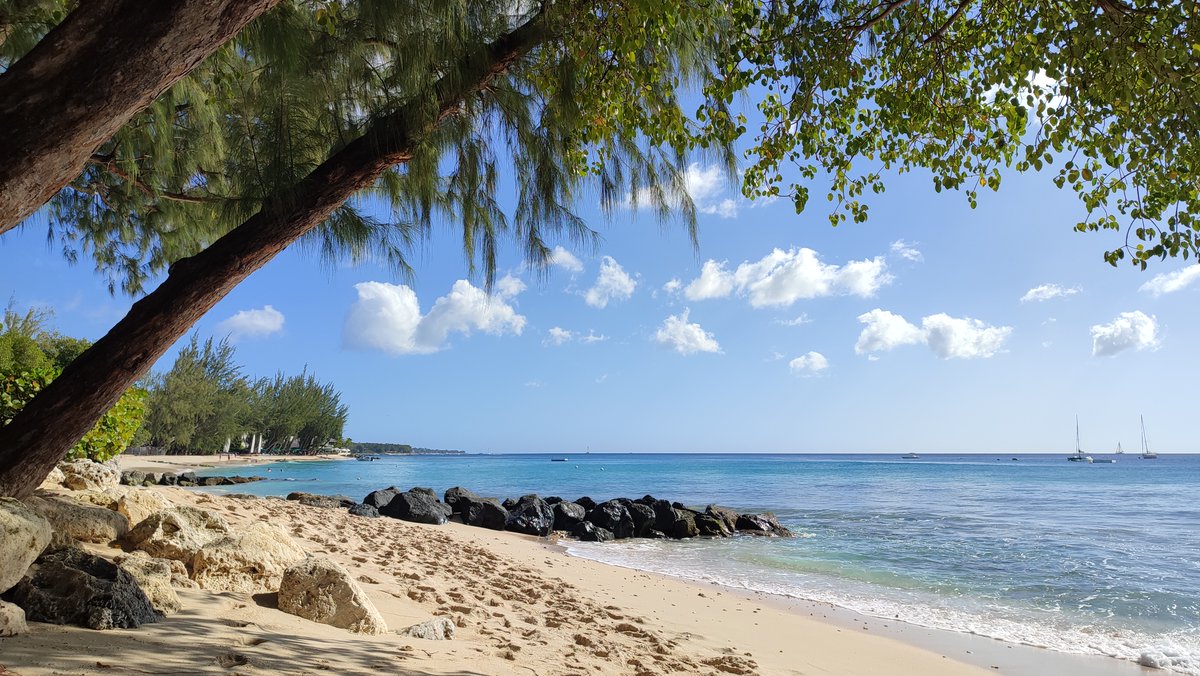
A few weeks ago, I presented SNAP at the wonderful #Bellairs Workshop on Causality in Barbados🐢
This Friday, I will get to present SNAP again at the kick-off of the newest season of #CausalClub 🤌 Check out this, and their other amazing upcoming talks at https://t.co/I58jCWYUEa
10/10 SNAP is joint work with a fantastic team of Tom Claassen and @saramagliacane. Visit our project page on https://t.co/UO7ChXBdbO, run SNAP using our publicly available code at https://t.co/fsEfehBNvz, and visit to our poster at #aistats2025! 🏖️
Do you want to estimate causal effects for a small set of target variables without knowing the causal graph, but discovering it takes too long? Now you can get adjustment sets in a SNAP🫰accepted at #aistats2025!
📜 https://t.co/ueAf6cRCqw
🧩 https://t.co/UO7ChXBdbO
🧵 1/10
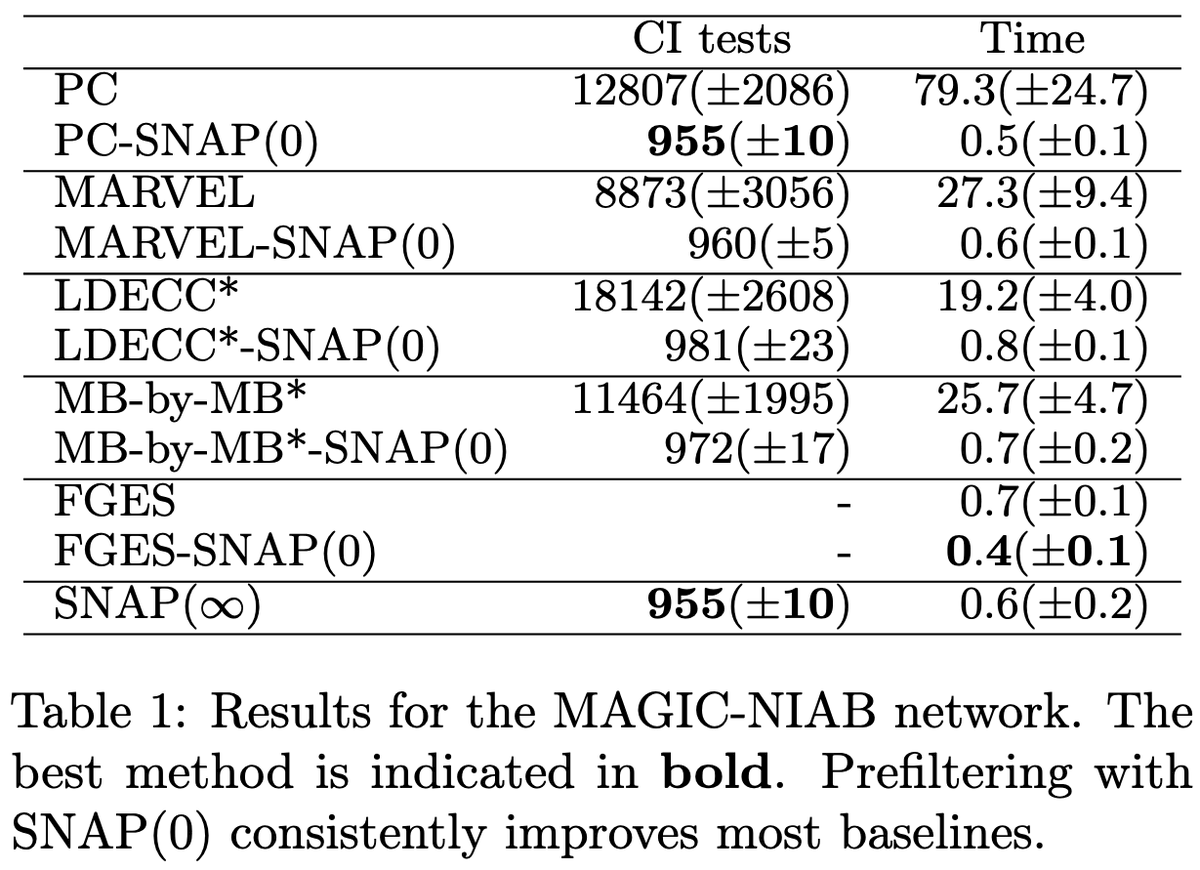
9/10 We also evaluate SNAP on semi-synthetic settings including data generated from the MAGIC-NIAB network, which captures genetic effects and phenotypic interactions 🧬 We see that SNAP greatly reduces the number of CI tests and execution time compared to most baselines.