The Fed’s $25B monthly QT cap lets it reinvest excess Treasury maturities.
A recent $34.8B in buys over 2 days raised eyebrows—if sustained, it could mean stealth QE.
Some call it a shift, others say it’s routine SOMA reinvestment.
The key is whether it continues.
Morgan Stanley sees AI infrastructure spend topping $3T by 2028. That includes $2.6T on data centers (chips + servers), $210–330B on new power generation, and likely hundreds of billions more for grid upgrades.
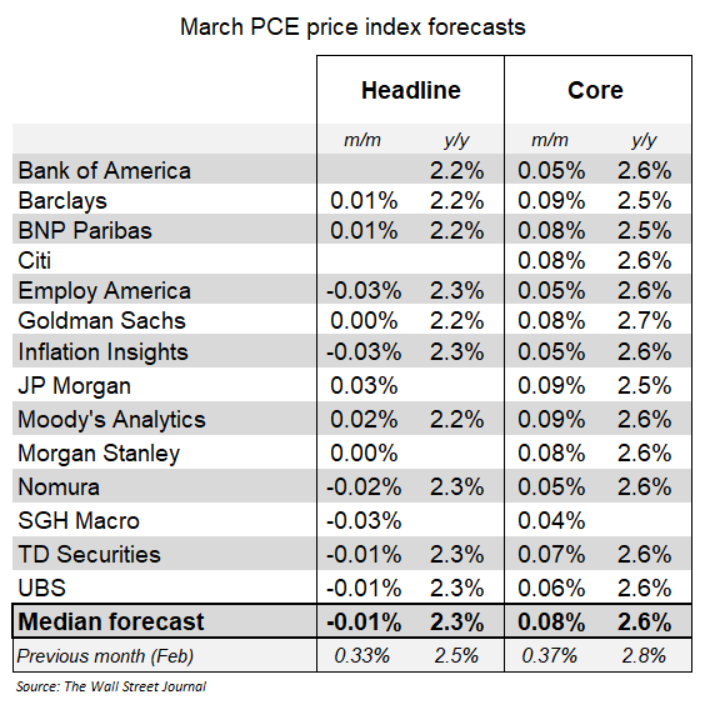
The PCE price index (due at 10 am on Wednesday) is expected to show core prices rose just 0.08% in March, according to forecasters who map the CPI, PPI and import prices into the PCE.
Headline prices are anticipated to have been flat (-0.01%) in March
Interpretation of the 245% Tariff on Chinese Goods – Seolhwa Choi, Meritz Securities
Today, the 245% tariff rate became a widely discussed topic in China.
This is because the White House statement released on April 15 (local U.S. time) listed the tariff rate on syringes and needles as 245%.
That figure is 100 percentage points higher than the previously familiar rate of 145%. While China has stated that it will not retaliate, it seems that such external pressure has only strengthened nationalistic sentiment among the Chinese public.
https://t.co/OOP2NA8jqB
Let's talk about Trump tariffs. They are up, it's a question of whether how much, to whom, which sector rather than whether.
I want to clarify a simple fact that needs to be nailed home - trade and investment go together. Tariffs are a friction to trade & if you just take the idea that tariffs are going up (we'll discuss soon the details) then INVESTMENT IS GOING TO BE RESHUFFLED.
Half of global FDI is US driven. Global investment will be reshuffled. Okay, let's talk about first w/ who is LEAST TARGETED & we got to who is MOST.
250325_Server TAM updates: Revising Down AI Training Server Outlook - Goldman Sachs
(1) Goldman Sachs revised down its forecast for rack-level AI server shipments (144-GPU Equivalent):
•2025: From 31K → 19K
•2026: From 61K → 57K
(2) This revision reflects compounded uncertainties on both demand and supply sides.
(3) Consequently, we have revisited our outlook on Taiwanese Server ODMs and cooling system-related value chains, lowering target prices (TP) for Quanta, Hon Hai, FII, Wistron, AVC, and Auras by approximately 7-21%.
(4) Specifically, Quanta has been downgraded from “Buy” to “Neutral.”
(5) 2Q25 is expected to be a strong quarter as rack-level AI servers ramp up significantly after a prolonged waiting period.
(6) However, annual shipment expectations remain somewhat conservative due to potential shipment pressures arising from product transitions in 3Q25.
(7) Meanwhile, the forecast for High-Power AI Servers (8PU Equivalent) remains relatively unchanged:
•2025: From 437K → 423K
•2026: From 424K → 423K
(8) The slight decline to flat forecast for High-Power AI Servers reflects customers’ continued preference for flexible baseboard solutions and indicates these servers will not be fully replaced by rack-level AI servers.
(9) Demand for AI inference servers and general-purpose (GP) servers remains strong, maintaining a positive outlook.
(10) Therefore, expanding AI-driven applications (AI inference) and the recovery of aging server replacement cycles (GP servers) will act as growth drivers.
(11) Customer CAPEX projections:
• US: 2025 YoY +41%, 2026 YoY +15%
• China: 2025 YoY +26%, 2026 YoY +4%
(12) AI Training Servers show continued growth momentum, but compounded factors including slower shipment growth and uncertainties from product transitioning are impacting both demand and supply.
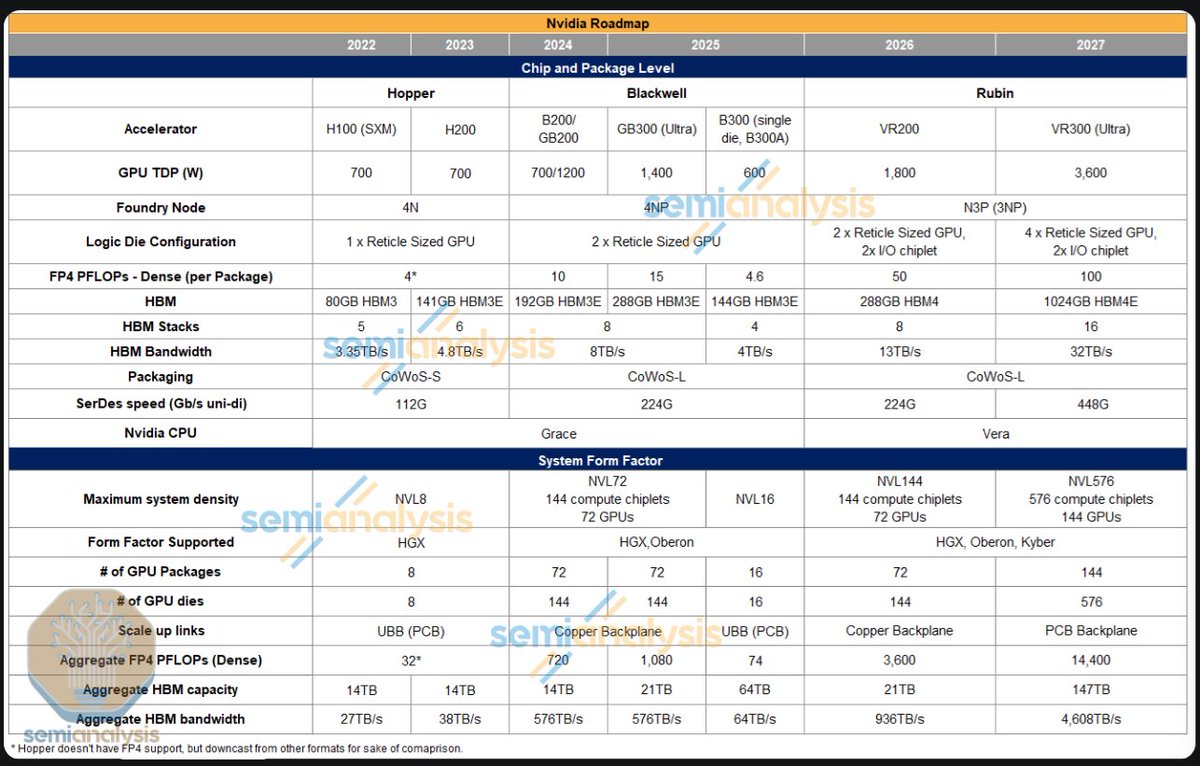
(13) In particular, shipment volumes may temporarily decline in 2H25 due to NVIDIA’s GPU platform transitioning to its next-generation model (Blackwell).
(14) Additionally, complexities in rack-level AI server production and assembly introduce uncertainties during production scaling, alongside ongoing debates about sustained training demand beyond DeepSeek.
(15) Tariff issues may also become significant variables.
(16) These dynamics necessitate geographic diversification in production lines for major Server ODMs, requiring additional time to stabilize yields in new regions.
(17) Ultimately, we forecast AI Training Server revenues to reach $160bn in 2025 (+30% YoY) and $260bn in 2026 (+63% YoY):
• 2025: Revised down from $179bn → $160bn
• 2026: Revised up from $248bn → $260bn
(18) Our market outlook revision reflects a 10.6% downward adjustment for 2025, but a 4.8% upward adjustment for 2026 compared to previous forecasts.
(19) AI Training Servers - Full Racks market forecast:
• 2025: Revised from $88bn → $54bn
• 2026: Revised from $182bn → $156bn
(20) AI Training Servers - High Power market forecast:
• 2025: Revised from $90bn → $106bn
• 2026: Revised from $66bn → $104bn
(21) Goldman Sachs significantly adjusted the 2026 forecast downward by 14.3% for the Full Racks market but substantially raised the High-Power forecast by 57.6% from $66bn to $104bn.
(22) AI Inference Server revenues are projected to grow YoY by +41% in 2025 and +39% in 2026, primarily driven by expanding AI applications.
(23) GP Servers are expected to see gradual recovery from aging replacement cycles, coupled with new CPU platform introductions, projecting modest YoY growth of +6% in 2025 and +4% in 2026.
250318_Bi-weekly AI Thematic: NVIDIA’s CPO Switch - Nomura
(1) Semi Vision recently reported that NVDA is likely to unveil its first CPO switch at GTC 2025.
(2) We expect that the CPO switch will receive increasing attention over the next few years because it plays a crucial role in reducing power consumption and enhancing cost efficiency in AI Data Centers. *Based on Meta’s 24k-GPU AI cluster, computing power (AI GPUs and servers) accounted for 68.2% of CAPEX in 2024, while networking/interconnection accounted for 23.9%.
(3) Although major global companies such as NVIDIA, Broadcom, and TSMC are taking proactive stances on the CPO technology roadmap, due to (1) still high prices and (2) deployment issues, it is unlikely that we will see significant high growth in 2025.
(4) The global network switch market is structurally growing due to LLM training and data center expansion, and the shipment volume of high-speed switches—such as 800G models—is expected to drive future growth.
(5) Regarding the penetration rate of CPO in the AI network market, LightCounting expects that initial shipments of 1.6T optical interconnects will be small, and that by around 2028–2029, 3.2T will dominate the market.
(6) We estimate that the revenue-based penetration rate of CPO switches in the AI Data Center switch market will reach 2% in 2025, 22% in 2026, and 32% in 2030.
(7) In 2023, Broadcom launched the Tomahawk 5 Bailly, a 51.2T Ethernet switch CPO product.
(8) In December 2024, TSMC, in collaboration with Broadcom, successfully completed pilot production (3nm) of one of the key CPO technologies, the MRM (Micro Ring Modulator).
(9) Meanwhile, Semi Vision reported that NVIDIA is expected to launch its first CPO switch, the Quantum 3400 X800—based on InfiniBand—at GTC 2025, with mass production likely to start from July 2025.
(10) It was also added that the Ethernet-based CPO switch, Spectrum 5 X800, is expected to enter mass production in December 2025.
(11) The key components of a CPO switch include:
1) lasers,
2) optical chips,
3) optical engines,
4) switch ASICs,
5) optical components (Fiber Array Units),
6) shuttle boxes, and
7) MPO (Multi-Fiber Push-On) connectors, among others.
(12) We are focusing on leading companies in the FAU market, such as Suzhou (300394 CH EQUITY), which we believe will be direct beneficiaries of the long-term CPO trend.
(13) In addition, T&S (300570 CH) is recognized as a major supplier of shuttle boxes and MPO connectors for CPO switches, and Unisplendour (000938 CH) as well as Accelink (002281 CH) are actively participating in CPO switch solutions—factors that are expected to benefit from the expansion of AI infrastructure investment in China.
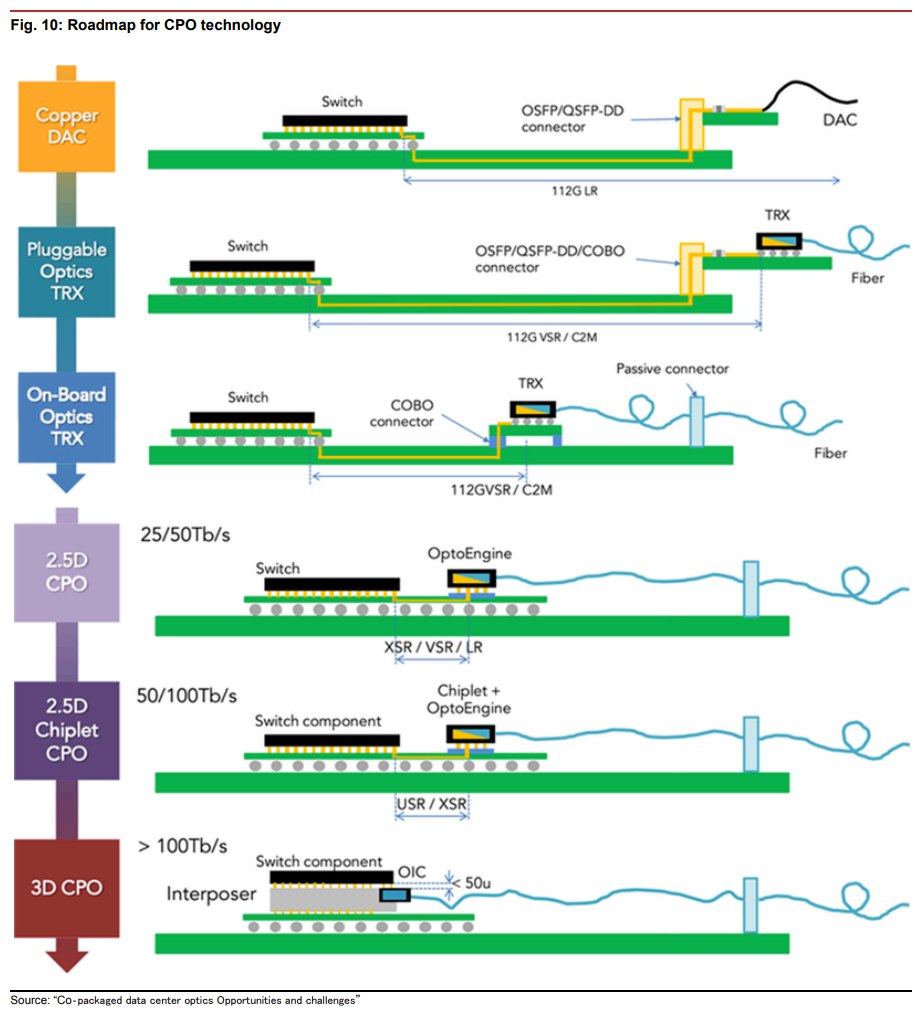
(14) Additionally, Broadcom’s CPO product roadmap is as follows:
(15) 1st Generation CPO: Tomahawk 4 “Humboldt”
■ In 2022, Broadcom, in collaboration with Tencent, launched the 1st generation CPO system, Tomahawk 4 “Humboldt”.
■ It was directly coupled (Co-Packaged) with four 3.2-Tbps Silicon Photonics Chiplet (SCIP) optical engines, with each optical engine containing approximately 250 optical components.
■ It is equipped with 32 transmit (Tx) and 32 receive (Rx) channels, supporting a signal rate of 100Gbps per channel.
(16) Latest CPO: Tomahawk 5 “Bailly”
■ Tomahawk 5 “Bailly” is a 51.2T Ethernet switch CPO product, competing in the same segment as Marvell’s Teralynx 10 (51.2T, supporting 64 ports at 800G).
■ It integrates eight 6.4-Tbps Silicon Photonics-based optical engines, coupled with the StrataXGS Tomahawk5 switch chip.
■ Compared to traditional plug-in optical transceivers, it reduces power consumption by 70% and improves silicon area efficiency by 8 times.
■ Each optical engine includes about 1,000 optical components (a 2× increase over Humboldt).
■ It integrates millions of transistors into a single optical engine on the same substrate as a complex logic chip, thereby minimizing the need for additional signal-conditioning circuitry.
$NVDA
Added a bit to my $AVGO and $CLS positions ahead of Broadcom's earnings. Think Marvell's issues are specific to its $AMZN relationship (namely, Alchip winning Trainium3 and Amazon's accelerator buys skewing towards $NVDA GPUs, because that's what most AWS customers want).