🚨 8 years ago, Tom DeLonge went on JRE & outlined a plan he made with military gatekeepers to "slow roll" UFO disclosure.
Looking at the steady stream of UAP news today, it feels exactly like this blueprint
Did a rockstar actually design the modern disclosure playbook?
America First UFC Fighter Sean Strickland Crashes UFC White House Press Conference after he was banned for criticizing Israel.
“Come ban me that f**kin’ pedophile.”
Bryce Mitchell reacts to Sean Strickland being banned from the UFC White House event:
"I'm not surprised at all. We ought to be able to criticize our own nation, let alone a foreign nation.
[Israel] is the only nation you're not allowed to criticize. Something's gonna change, because evil empires don't last forever."
(via @mmamania)
An unidentified Recon Marine, his face painted and bush hat decorated with grenade pins, pauses to rest after a patrol sweep near the U.S. Marine base at Khe Sanh. AP Wire photograph, 1968.
Taken during one of the most intense phases of the Vietnam War, this photograph shows a U.S. Marine reconnaissance trooper near Khe Sanh in 1968. His face paint, cigarette, and bush hat decorated with grenade pins have made the image one of the war’s most enduring visual records. Though his identity is unknown, his expression reflects a common reality among those who served: fatigue, constant alertness, and the pressure of operating in hostile terrain.
Khe Sanh, close to the Laos border, was the focus of a 77-day siege in early 1968. Throughout the battle, thousands of U.S. Marines and South Vietnamese forces held the combat base against sustained attacks from North Vietnamese troops. The engagement unfolded alongside the wider Tet Offensive and quickly became one of the most controversial battles of the war. U.S. commanders also feared it could turn into a modern-day Dien Bien Phu, echoing the decisive French defeat that had reshaped Indochina.
Reconnaissance Marines typically operated in small, isolated teams deep behind enemy lines. Their role involved gathering intelligence, tracking enemy movements, and coordinating artillery or air support. These missions were among the most hazardous of the conflict, with casualty rates often rivaling or exceeding those of regular infantry units.
During the siege itself, American air power delivered more than 100,000 tons of ordnance in support of the base. The surrounding region became one of the most heavily bombed areas in modern military history.
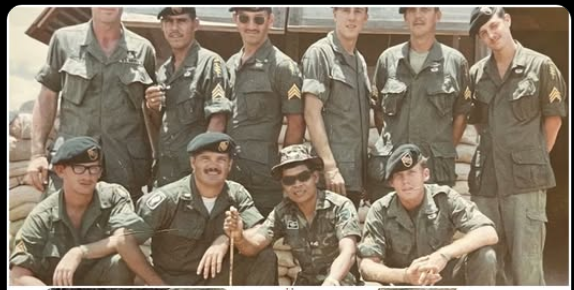
Five men are lying in the mud 3 ft from a North Vietnamese trail. It is after midnight. They have been motionless for 6 hours. Through the dark, they can hear boots, dozens of them, passing close enough that the lead NVA soldier's sandal brushes the toe of the point man's jungle boot. Nobody breathes. Nobody moves. The point man can smell NVA tobacco on the air, a specific acrid scent that American cigarettes don't produce. He can hear the quiet clink of an AK-47 sling against a canteen. He can feel the vibration of footsteps through the ground beneath his chest. The NVA column passes. 30 men, maybe 40. They never see the five Americans lying in the vegetation beside them. The Americans don't fire. They don't move. They wait until the sound fades, then the radio operator keys his handset twice, two clicks, no voice, and transmits the grid coordinates to a fire base 15 miles away. 30 minutes later, artillery erases the trail junction where the column was heading. That was the job. Five men, no armor, no reinforcements. Days behind enemy lines in jungle so dense that the man 10 ft ahead of you was invisible. Carrying weapons designed to kill in silence. Suppressed pistols, crossbows, fighting knives. Because the sound of a single gunshot meant the difference between completing the mission and being hunted by an army. They were called LRRPs. Long Range Reconnaissance Patrols, later Rangers. And inside the most classified program in the war, MACV-SOG, they crossed borders into countries the United States wasn't officially fighting in, ran missions that the White House denied existed, and suffered a casualty rate that no other unit in American military history has matched. One of them, a A sergeant named Jerry Shriver, became so effective at killing NVA officers in their own territory that Radio Hanoi put a $10,000 bounty on his head by name. His teammates called him Mad Dog. His last radio transmission during a firefight in Cambodia 1969 was seven words. I've got them right where I want them, surrounded from the inside. Nobody ever heard from him again. His body was never found. He is still listed as missing in action. To understand what kind of war produced men like Jerry Shriver and what it cost them, you need to understand the jungle they operated in and the weapons they carried into it. By 1966, conventional American infantry in Vietnam was getting destroyed by an enemy it couldn't see. The NVA and Viet Cong owned the jungle at night. They ambushed platoons on trails that looked safe at dawn and were killing grounds by dusk. American artillery and air power, the most destructive in the world, were useless against an enemy that melted into the canopy before the shells arrived. General Westmoreland issued the order in July '66. Create dedicated long-range patrol units that could operate in the enemy's own terrain, find his formations before they struck, and either call in fire or kill him in place. Every brigade and division would have a LRRP platoon. The men would be volunteers, all of them. Nobody was drafted into this work. The volunteers trained at the Recon School in Nha Trang, run by the 5th Special Forces Group.
The people have the power to change the world into something better than it is right now.
You will always have that power.
The illusion is that you are powerless.
OWN YOUR MORNINGS.
When you wake up, do this no negotiation:
1. Pray.
Hit your knees or stand tall.
Gratitude first. Strength next.
Center your spirit before the world speaks.
2. Walk.
Fasted. Purposeful. At dawn.
No phone. No excuses. Just movement and intent.
3. Stretch.
Wake the machine.
Hips. Back. Shoulders.
Get loose. Get strong.
4. Sunlight.
Face the sun. Eyes open. No shades.
10–15 minutes to prime mood, focus, and energy.
Do these four every morning.
The rest of the day bows to the man who already won at sunrise.
The best discovery of our road trip has been a musician called Ella Langley. We had never heard of her before, but after hearing her on pretty much every country radio station, we’ve become big fans. She’s basically the soundtrack of our trip.
Jimmy Dore on the uniparty, Charlie Kirk’s murder and why he came to believe in God.
0:00 Thomas Massie’s Loss and Life in a Corporate Hellscape
5:55 The Illusion of Democracy in the US
14:56 What Would Grab the Attention of Those in Charge?
19:04 What Really Happened to Seth Rich?
28:02 War Propaganda and Rachel Maddow
35:49 What Happened to Stephen Colbert?
38:00 What Happened to Bill Maher?
40:39 How Could Anyone Defend the Genocide in Gaza?
42:26 What Happened to Bernie Sanders?
47:00 Does AOC Have a Shot at the Nomination?
52:17 Is Gavin Newsom Different?
1:01:31 Big Pharma and the Corruption of the FBI
1:04:00 Chris Cuomo, Don Lemon, and CNN Coloring Joe Rogan’s Skin Green
1:06:42 Carl Jung and the Deification of Dr. Fauci
1:11:09 Dore’s Experience of God and His Past Addiction to Weed
1:17:37 The Dream That Changed Dore’s Life
1:24:46 The Mass Spiritual Awakening
1:29:24 The Collapse of the System
1:40:29 Dore’s Laptop Being Hacked
1:42:24 The Assassination of Charlie Kirk