Struggling with minibatch noise in Stochastic Gradient Bayesian Inference? Want your chains to naturally run on stochastic hardware?
Introducing — Stochastic Gradient Lattice Random Walk!
New work from @NormalComputing in collab with @zierhjmensch, @adnarim066, @wellingmax, and the dream team at normal computing, @Sam_Duffield, @MaxAifer and @ColesThermoAI.
Install ntn, the Notion CLI.
It brings the entire Notion API to your terminal, plus everything you need to build and deploy Workers. Built for humans and coding agents alike.
Install with: curl -fsSL https://t.co/2dJqE3YHvw | bash
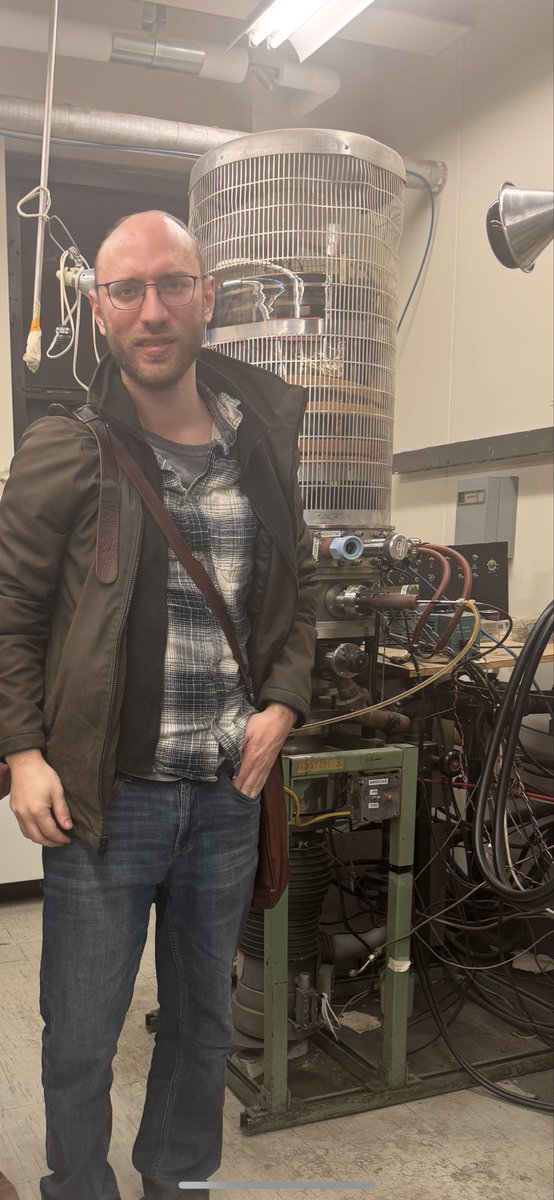
Great day visiting the magnet lab at mit! The contraption behind me is System 3, which my grandfather Robert Meservey used in his pioneering work on spin-polarized tunneling, leading to the development of spintronics.
Here is a simple intro to Gaussian Process regression (GPR) & implementation using Thermodynamic Linear Algebra (TLA) from @NormalComputing. GPR was a predicted use case of this cool idea. 1/2 https://t.co/k9Hp0PtX6I
What does it look like to build the product that changes how the world's most complex chips get designed?
In Chapter 02 of Inside Normal, Hanna Yip, Max Aifer, and Adam DeHovitz talk about building Normal EDA, our purpose-built AI platform for semiconductors: customer deployments, daily product work, and why EDA innovation is required to make entirely new chip architectures possible.
Normal Computing CEO @FarisSbahi says thermodynamic computing introduces a new tradeoff in chip design: noise.
“You have speed and energy—those are typically the trade-offs that you're making. We're introducing a new one, which is noise.”
“Let's say you're trying to run something like a diffusion model, which is super topical because OpenAI just winded down Sora this week. It was costing them like $15 million per day to run, $21 million cumulative revenue.”
“That's the kind of workload that's a really nice fit for this computing paradigm, because you're taking something that's noisy and approximate by definition and mapping it to hardware where the physics maps really nicely between those equations.”
“From our perspective, 2030 is a key date we talk about a lot internally, because there's a view that even by 2028 we're going to have a 49 gigawatt shortfall in terms of power.”
“Something has to change. It could be energy—it could be that we find new sources or create data centers in space, or one of these other directions—or that we'll have a real breakthrough when it comes to silicon, and that's what we're going after.”
Normal Computing has raised $50 million in strategic funding led by @SamsungCatalyst, bringing total funding to more than $85 million.
We build AI for the semiconductor industry and are developing a new class of computing hardware, using our software to design our own hardware IP.
We're partnered with more than half of the top ten semiconductor companies by revenue through Normal EDA, our purpose-built AI platform. In parallel, we completed the tape-out of CN101, the world's first thermodynamic computing chip, targeting up to 1000x gains in energy efficiency for AI workloads.
Investors include @GalvanizeLLC , @CelestaCapital , @drivecapital , Eric Schmidt's First Spark Ventures, Micron Ventures, Brevan Howard Macro Venture Fund, and @ArcternVC.
We're hiring: https://t.co/QYSxbRDxmi
Full announcement: https://t.co/9Cod1P0n4Q
my results on AI for autonomous progress:
we ran codex+claude for 43 days straight to build a System Verilog compiler/simulator
https://t.co/f0tT0cBtOM
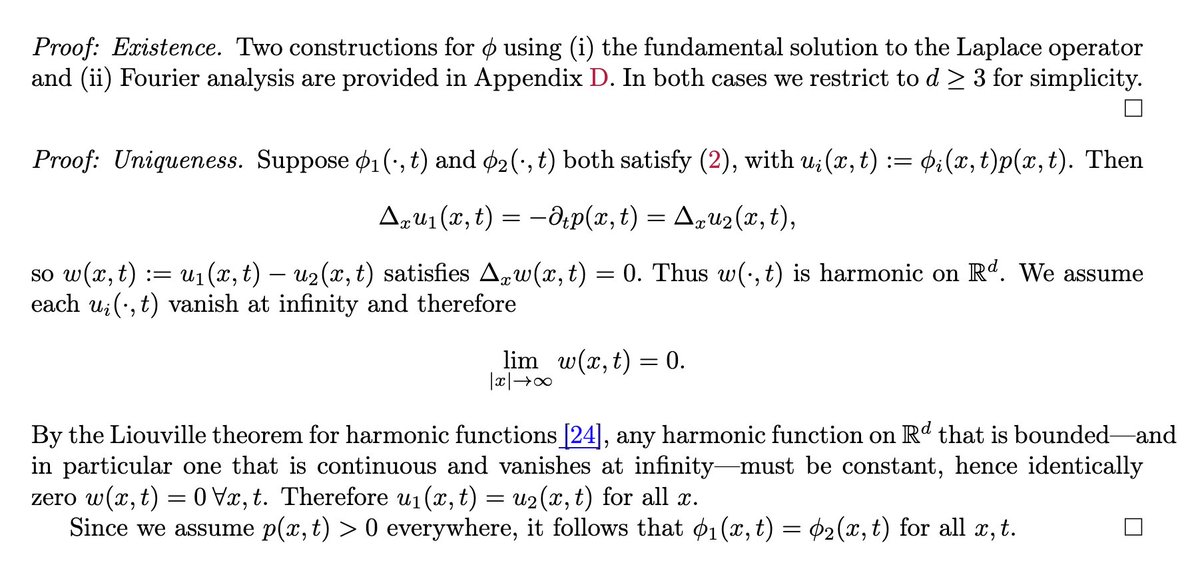
Very nice little preprint from @Sam_Duffield on the general solution to the inverse problem for the Fokker-Planck equation. I particularly enjoyed the use of Liouville's theorem!
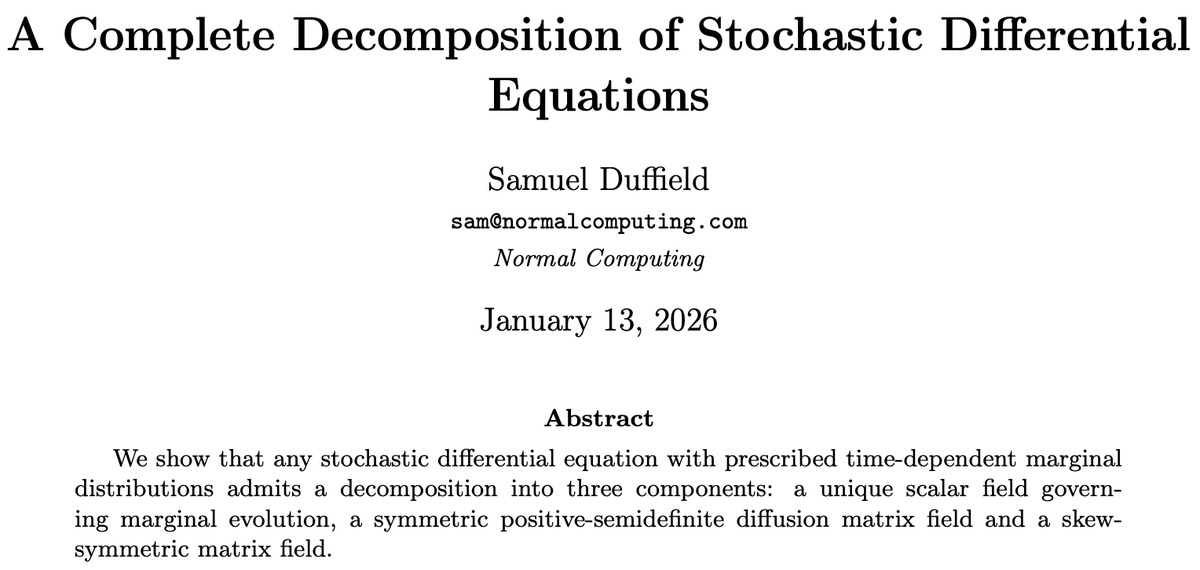
New preprint! A Complete Decomposition of Stochastic Differential Equations
I characterise all possible SDEs that satisfy given time-dependent marginals p(x,t)
New preprint! A Complete Decomposition of Stochastic Differential Equations
I characterise all possible SDEs that satisfy given time-dependent marginals p(x,t)
In June, we taped out CN101, the world’s first thermodynamic computing chip.
We’re now sharing early bring-up results from the first thermodynamic ASIC, showing how a physics-based approach can enable stochastic, stateful, and asynchronous computation directly in silicon.
Also on YouTube: https://t.co/Q9seOk8FyS
#ThermodynamicComputing #CustomSilicon #ASIC #CN101
From Scott Aaronson's slides:
“ 'No fast solution to NP complete problems' feels not that dissimilar to ‘no superluminal signaling or ‘no perpetual motion’”
I think this kind of maneuver has potential to lead to more useful and more precise formulations of second-law-like results in thermodynamics. It's also a compelling quantitative approach to formulating physics in terms of counterfactuals, a la constructor theory.
Interesting slides from Scott Aaronson on the interplay between computational complexity and physics. Anyone have a recording of the talk?
https://t.co/ANPFC1nVQe
Interesting slides from Scott Aaronson on the interplay between computational complexity and physics. Anyone have a recording of the talk?
https://t.co/ANPFC1nVQe
Thermodynamic computing in short: move below digital abstraction layer, turn physical tradeoffs of speed ↔ energy ↔ error into a tunable knob, take advantage of AI workload symmetries to optimize encoding for noise robustness.
Then crank the noise up.
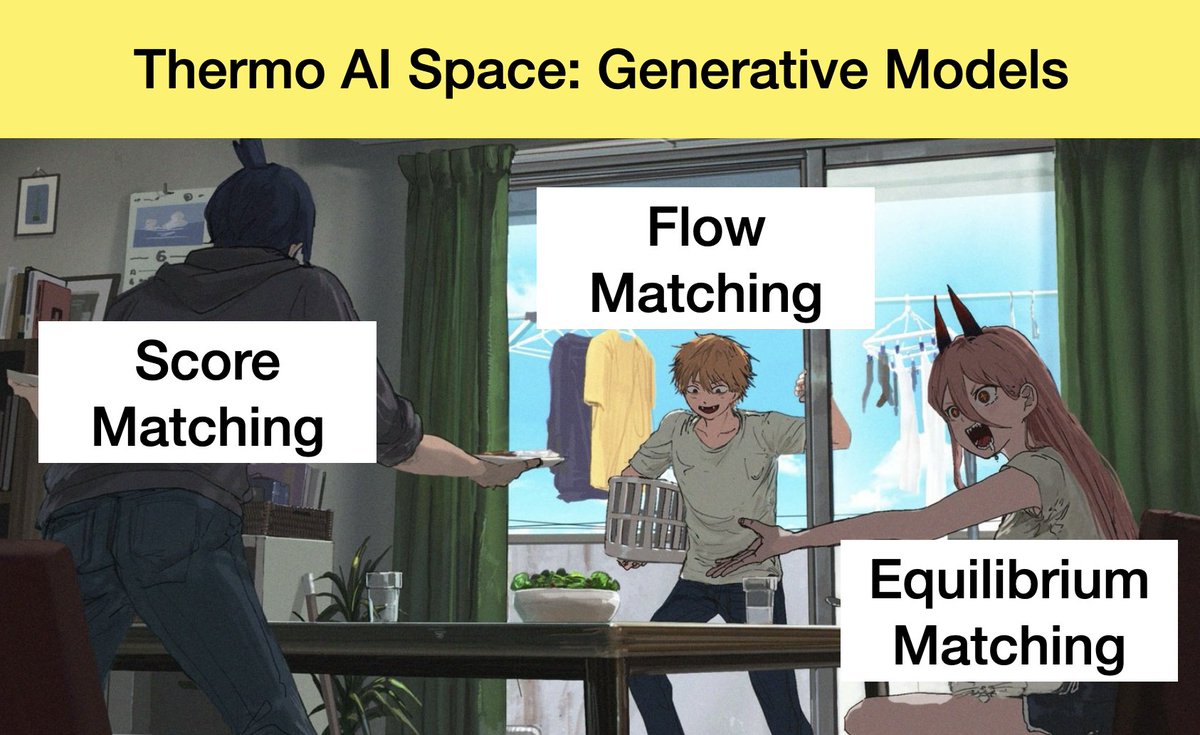
After a long hiatus the thermo AI discussion group space is back. Starting in 30 minutes to talk about recent advances in generative modeling
https://t.co/wcZ3HfUodr