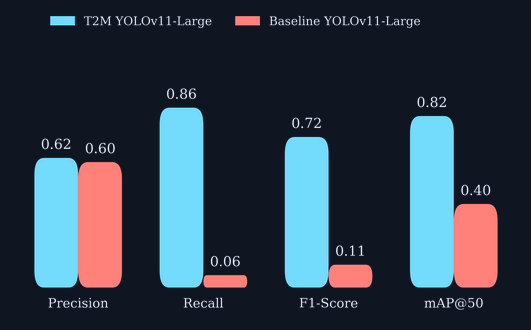
New research from the Yrikka team: Text-to-Model (T2M).
You can now create a custom object detection models with nothing more than a prompt and a few raw images.
No datasets. No labels. No annotation grind.
FLUX.1 Krea is out! I compared it to FLUX.1 Dev in the frequency domain using 50 real NYC photos and found Krea aligns closer to reality. Check it out:
https://t.co/eDRpX3hen4
@krea_ai We ran a frequency-based analysis on Krea vs Dev and found that Krea aligns more closely with real photographs. Check it out:
https://t.co/eDRpX3hen4
I fine-tuned FLUX Kontext LoRAs this week and image structure held up perfectly. That said, mask-guided inpainting was inconsistent (objects clipped or vanished). For reliable masked edits, it seems FLUX Fill is better
I’ve been exploring diffusion-based image editing and I’m impressed by the FLUX Kontext demos. They preserve object and scene consistency even when you make precise edits in scenarios where spatial alignment is difficult and normally trades off against image quality
One cool LoRA idea for Kontext could be teaching it to shift viewpoints so you can prompt to change perspective / view.
I’m curious to see how it compares with editing pipelines built on FLUX Dev and the FLUX control tools.
New way to boost image generation in diffusion models: HeadHunter pinpoints specific DiT attention heads (structure, style or texture) and SoftPAG offers a smooth knob for on-the-fly inference-time control without retraining, validated on SD3 and FLUX. https://t.co/nHNO4uVxtX
“Fine-Tuning Without Forgetting” shows YOLOv8 can be adapted to a narrow domain (6 fruits) by unfreezing mid-to-late layers to boost fruit mAP by ~10% without dropping COCO performance. I’m curious how this holds up on more diverse domains or sequential fine-tuning
Apple’s “Illusion of Thinking” shows LLMs “fail to develop generalizable reasoning beyond certain complexity thresholds”. This isn’t doom. It shows we need clean benchmarks and smarter training. In my agentic workflows, exposing intermediate thoughts improves multi-step decisions