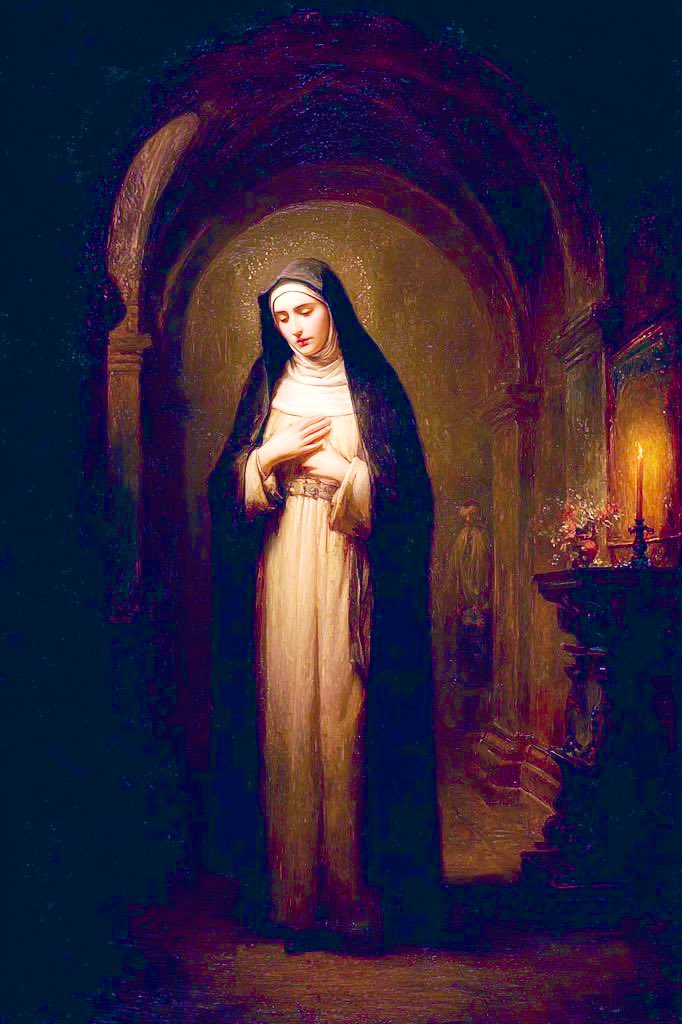
🔹 Saint Teresa of Ávila
Let nothing frighten you,
Everything passes,
God does not change.
Patience achieves everything;
Those who have God,
Lack nothing:
Only God is enough.
Raise your thoughts,
Ascend to heaven,
For nothing be distressed,
Let nothing disturb you.
FATHER DOLINDO RUOTOLO
A Prophet of our Time
Father Don Dolindo Ruotolo was a Neapolitan priest stigmatized miracle worker and “mouthpiece of the Holy Spirit”.
Father Ruotolo had extraordinary communications with Jesus throughout his heroic life, a life that was totally devoted to God and Holy Mother Mary. He referred to himself as “the Madonna’s little old man” and the Rosary was his constant companion.
Much of what our Lord wants flies in the face of normal human inclination and reason. We can only rise to this level of thinking through the grace of God and the help of the Holy Spirit.
We must let go of our problems, stop worrying, and trying to resolve them ourselves. We must believe, trust, and allow our Lord to rescue us from ourselves and supply our wants, needs and resolve our problems as only He can.
Jesus, You take care of it, should be the first words that come to mind and flow from our lips. After all, we have tried to do things our way and look where it has got us.
Just do as the prayer says, open our hearts and minds in love and close our eyes in trust, and ask Jesus to take care of it. He will.
On November 19, 1970 ,Don (Fr) Dolindo Ruotolo died at the age of 88. Padre Pio once said of this priest from Naples, Italy, The whole of paradise is in your soul. His name “Dolindo” means “Pain” and his life was rich with this pain. As a child, a teenager, a seminarian and a priest, he experienced humiliation, which was the realization of the prophetic words of a bishop who said You will be a martyr, but in your heart, not with your blood.
In his profound humility, he was able to hear the words of God. Even with his hidden life, he was one of the greatest prophets of the last century. He wrote to Bishop Hnilica in 1965 that a new John will rise out of Poland with heroic steps to break the chains beyond the boundaries imposed by the communist tyranny. On this postcard, he wrote words of consolation for Poland and all the countries suffering under the communist regime. This prophecy was realized in the papacy of John Paul II.
In his tremendous suffering, Dolindo became more and more a child who lived his self-offering to the Divine Father. I am totally poor, a poor nothing. My strength is my prayer. My leader is the will of God, which I let take me by the hand. My security over the uneven path is the heavenly mother Mary.
One of the treasures from the words that Jesus spoke to Dolindo was the teaching about total abandonment to God. In this novena, Jesus is talking to Don Dolindo and also to you.
THE SURRENDER NOVENA
Given by Jesus to Fr. Dolindo Ruotolo
O Jesus, I surrender myself to you, take care of everything! (10 times)
Nossa Senhora do Perpétuo Socorro
27 de junho
Hoje, fazemos memória de Maria, mãe de Jesus, com o nome de Nossa Senhora do Perpétuo Socorro. Este título chega entre nós através de um ícone, uma pintura de caráter religioso-místico, que data do período bizantino.
Não sabemos quem foi o autor da pintura.
A história do ícone de Nossa Senhora do Perpétuo Socorro ficou conhecida a partir do século XV, quando esta pintura foi levada da ilha de Creta para Roma e colocada na igreja de São Mateus, onde foi venerada por três séculos.
Destruída a igreja de São Mateus, a célebre imagem permaneceu escondida até que, pela providência de Deus, foi descoberta e devolvida ao culto popular.
Em 1866, por ordem do Papa Pio IX, o ícone foi confiado aos cuidados dos Missionários Redentoristas.
Atualmente, o ícone missionário de Nossa Senhora do Perpétuo Socorro se encontra na Igreja de Santo Afonso, em Roma.
O centro da pintura não é Nossa Senhora e sim Jesus. Para se chegar a essa conclusão, basta traçar duas linhas imaginárias, uma ao longo do braço da Madona que forma um ângulo que aponta para o Menino. O mesmo indica os dois dedos da Madona, isto é, apontam para a cabeça do Menino Jesus. Isto mostra que o centro é Jesus Cristo, portanto é um ícone cristocêntrico.
Maria é, assim, "aquela que indica o caminho", ou como é mais conhecida: "a via de Cristo".
Nota-se também o olhar significante de Maria, isto é, o seu olhar está direcionado a quem olha o quadro e, ao mesmo tempo, a sua cabeça indica seu Filho Jesus.
Deve-se observar a sandália do Menino que está desatada e mostra seu pé. Conforme a tradição oriental, mostrar a planta do pé é dizer que se é homem. Assim, esta cena indica que Jesus mostra a planta do seu pé para dizer que ele é verdadeiramente homem.
Outro ponto importante a se observar, se refere às cores das vestes e seus significados. No quadro a Madona se veste com túnica vermelha e manto azul. E o Menino se veste de túnica verde com faixa vermelha e manto ocre.
Na simbologia oriental, verde e vermelho significam divindade. O azul e o ocre significam humanidade.
Oração:
Ó Virgem do Perpétuo Socorro, Santa Mãe do Redentor, socorre o teu povo que ressurgir. Concede a todos a alegria de caminhar para o futuro numa consciente e ativa solidariedade com os mais pobres, anunciando de modo novo e corajoso o Evangelho de teu Filho, fundamento e cume de toda a convivência humana que aspira a uma paz justa e duradoura.
Colaboração: Padre Evaldo César de Souza, CSsR
"Have you sinned? Go into church and wipe out your sin.
"As often as you might fall down in the marketplace, you pick yourself up again.
"So too, as often as you sin, repent you sin.
"Do not despair."
- St. John Chrysostom
If at some time the Lord should grant us the grace of impressing His love on our hearts, all will become easy for us and we shall accomplish great things quickly and without effort.
- St. Teresa of Avila
THE "HOUR SANCTIFIED" ON HOLY THURSDAY, ON CORPUS CHRISTI, AND ANY OTHER THURSDAY.
.
"In order to awaken the gratitude of the faithful towards their Lord and Saviour Jesus Christ, for His institution of the holy Eucharist, on those days when the Church commemorates that act of His love, Pope Pius VII, by two Rescripts delivered through the medium of the Segretaria of the Memorials, dated Feb. 14, 1815, and April 6, 1816, kept in the Segretaria of the S. Congr. of Indulgences, granted
.
i. A plenary indulgence to all who on Holy Thursday, either in public or private, shall, for one hour, practise some devotion in remembrance of the institution of the Most Holy Eucharist; to be gained after Confession and Communion on that day, or some day in the following week.
.
ii. A plenary indulgence, on the same conditions, on the Feast of Corpus Christi.
.
iii. An indulgence of 300 days on any other Thursday, on practicing this devotion with a contrite heart."
São muitos que, considerando a conversão ao catolicismo, são espantados por maus exemplos que acabam vendo. Essa história que a pintura representa, mesmo tendo acontecido realmente, pela providência divina guarda significado místico, pois o Espírito Santo escreve sua poesia com a tinta da realidade.
Jesus e os apóstolos eram espremidos pela multidão. E não era multidão adversária a Cristo, mas turba de admiradores. Essa mulher, tendo fé para cura de sua doença, rasteja entre essa turba e toca na roupa de Cristo. Jesus então diz: "Quem me tocou?". Pedro acha absurda a pergunta, já que a multidão inteira tocava nele. Mas Jesus explica: "Alguém me tocou, pois senti virtude saindo de mim".
A multidão que espreme Jesus são os maus fiéis, que pela boca professam a fé em Cristo, pelas obras o negam. Nenhum deles toca em Cristo, nenhum deles recebe virtude, pois não tocam com o espírito, mas espremem a Igreja com seus escândalos. A mulher entra no meio da multidão e rasteja com fé, pois se aproximando com humildade do altar, e ignorando a multidão de escândalos, se embrenha na Igreja, como que com dificuldade, para que realmente toque em Cristo.
Por isso, seja como a mulher, ignore a multidão, e venha para a Igreja não por eles, mas por Cristo. Rasteje pela humildade, e Jesus te dará virtude quando você tocá-lo pela Eucaristia. E por que ela toca na roupa, não na pele? Porque a substância da carne está sob a aparência do pão.
Esses ensinamentos estão na obra "40 Sermões sobre os 4 Evangelhos", de São Gregório Magno, e traduzida por mim direto do Latim. Disponível na Amazon, Ecclesiae, Vide Editoral e diversas livrarias. Pesquise o melhor preço!
"The true Christian is a Warrior, not because he loves the fight, but because he loves the truth."
- St. John Henry Newman
St. John Henry Newman reminds us that being a Christian is not about looking for fights or arguments. A true Christian fights for something much greater: the truth. Jesus said, “I am the way, and the truth, and the life” (John 14:6). To love the truth is to love Christ Himself.
Newman knew this personally. He was an Ex- Protestant Anglican priest who spent years studying Scripture and Church history. His search for truth eventually led him into the Catholic Church, even though it cost him friendships, his reputation, and much of his former life. He did not become Catholic because it was easy. He became Catholic because he believed it was true.
Most spiritual battles are not against other people. They are against sin, fear, pride, and the pressure to stay silent. The saints were not brave because they loved conflict. They were brave because they loved God more than comfort or approval.
Today, many people stay quiet because they fear being judged or rejected. But Christians are called to stand with truth and love, even when it costs something.
Are we more afraid of losing people's approval than following the truth wherever it leads?
Someone in your life may need this reminder if they are struggling to stand firm in their faith.
💬 Have you ever changed your mind about God, faith, or the Church after honestly searching for the truth?
“Todos eles [isto é, Cristo, os apóstolos, os mártires, os confessores, os virgens e os santos], clamando, nos estão dizendo que as portas do céu não se abrem com a chave de muitos deleites, mas com a de muitas tribulações.”
— São Roberto Belarmino. As Sete Palavras de Cristo na Cruz. Livro 2, cap. 2.
If you think the Miraculous Medal is just Catholic superstition, Fr. John Hardon’s story is hard to ignore.
Servant of God Fr. John A. Hardon was a Jesuit priest, teacher, and theologian. He was not someone who easily believed stories about miracles.
When a Vincentian priest spoke about the Miraculous Medal and the graces connected to it, Fr. Hardon later admitted:
→ “I was not impressed.”
He did not wear medals. He did not own a Miraculous Medal. He took the enrollment prayers, put them away, and forgot about them.
A few months later, while serving at St. Alexis Hospital in Cleveland, Fr. Hardon visited a young boy who had suffered a serious head injury after crashing into a tree while sledding. The child had been unconscious for about ten days.
Fr. Hardon later said that the question was not whether the boy would recover, but whether he would live.
As he was leaving the room, he suddenly remembered the Miraculous Medal.
He searched the hospital until a nurse found one. Another nurse found a blue ribbon so the boy could wear it. Fr. Hardon blessed the Medal and prayed the enrollment prayers.
Then something happened that he never forgot.
According to Fr. Hardon’s own testimony, the boy opened his eyes for the first time since the accident. He looked at his mother and said:
→ “I want some ice cream.”
The doctors were called.
In the days that followed, Fr. Hardon said that tests showed no remaining signs of the expected brain damage, and the boy returned home.
This experience changed him.
The priest who once doubted the Miraculous Medal spent the rest of his life promoting devotion to Our Lady and encouraging people to wear the Medal.
God alone works miracles. Catholics do not believe the Medal is magic. But God often gives His graces through the prayers of Mary and through sacramentals that lead us to Christ.
A skeptical Jesuit witnessed something he never forgot.
If this happened today, would most Catholics believe it, or would they explain it away?
Because miracles like these still happen everyday...
June 21 Saint Leutfridus (Leofred of La-Croix, Leufroi, Leufroy, Leutfrid, Leutfred, Lieffroy)
died 738
.
Extraordinarily holy, but little known, Saint Leutfridus is an example for our mediocre days.
.
He was born of a good family in seventh century Neustria (present-day France), the brother of Saint Agofredus. He left his family to become a Benedictine priest. Teacher of young boys at Evreux, France. Spiritual student of Saint Sidonius of Saint-Saens. Benedictine hermit at Cailly and at Rouen in France. After a great struggle, he founded the Abbey of the Holy Cross (La Croix-Saint-Qu’en) in 690, and served as its first abbot. He was gifted with prophesy and the ability to work miracles and was extremely severe.
.
One day a lady began to ridicule Saint Leutfridus for being bald. The saint replied: “Why do you poke fun at my natural defect? From now on, you will have no more hair on your head than I have on my forehead, and neither will your descendents.”
.
Coming across a man working in a field one Sunday, Saint Leutfridus raised his eyes to Heaven and prayed: “Lord, make this land eternally sterile.” From then on, neither grain nor wheat was ever seen in the field again. In its place, there were only thorns and thistles.
.
Saint Leutfridus had an abundant zeal for justice, but was even more ardently merciful.
.
This principle is important. Saint Leutfridus was both just and merciful. These two virtues must go hand in hand.
.
Saint Leutfridus was even ardently charitable while angry and when reprimanding…these were parallel lines of his life.
.
When one of his monks died, his brothers found three coins in his pocket. This showed that the deceased had violated his vow of poverty. Upon learning this, Saint Leutfridus ordered that his body be buried in profane ground.
.
Afterwards, he made a 40-day retreat, praying and weeping for the soul of this monk, who seemed lost.
.
Those whose piety is merely sentimental would not understand this. Confronted by this situation, they would pray: “Oh, poor man, grant him pardon,” and consider him saved. On the contrary, Saint Leutfridus ordered him to be buried in profane ground and then made a retreat, begging for the monk’s salvation. Our Lord, Himself, possessed this combination of sternness and mercy.
.
After these days of retreat, the Lord revealed to Saint Leutfridus that His mercy had saved the monk’s soul, even though His justice was prepared to condemn him.
.
During the interim between death and salvation, the monk was in a type of limbo. Then Saint Leutfridus made a retreat, did penance and the man was saved.
.
Someone could wonder how this was possible since the man was already dead and judgment takes place immediately when the soul separates from the body. It is hard to say, but we cannot put limits on God’s mercy. Perhaps He left the monk’s soul fused to his body, waiting for the sacrifice of Saint Leutfridus. In any case, this story clashes with the liberal idea that the monk would be automatically saved.
.
Saint Leutfridus was tremendously wrathful against the devil.
.
Often, people react to temptations by becoming afraid of the devil, but I have seen very few who react with holy hatred and furiously fight against him. We should all strive to attain this holy wrath.
.
When Satan approaches, we should be filled with anger and hatred, because the devil is the declared enemy of God and our souls. He wishes us every form of evil. Thus, when we are tempted, we should react with militant execration, like Saint Michael did.
.
Once, a friar called Saint Leutfridus from his cell to tell him that the devil was appearing in the chapel. Recognizing his old enemy, the saint ran to the Chapel and made the sign of the cross over the doors and windows, which closed, blocking all the exits.
.
Wisely, he captured the devil first, so that he could not get away.
.
Advancing towards the devil, the saint furiously beat him. The devil wanted to flee, but all the exits were blocked. Normally, he could have instantly left the body he had taken up, but apparently he had not permission to do so. God wanted to humiliate him further under Saint Leutfridus’ blows.
.
This is a splendid scene. The beating was physically given and spiritually felt, all under the Sign of the Cross. Just as the wicked souls are burned by Hell’s material fire, so too the devil’s soul was made to feel the saint’s blows.
.
Saint Leutfridus beat the body that was merely a doll of the devil.
.
Naturally, these blows tormented and humiliated the devil. We too can increase his torment. This is particularly excellent when Satan provokes an attack. Then, the counter-attack gives glory to Our Lady by showing that her children’s hatred of the devil is greater than his hatred of men.
.
God obliged the devil to flee by way of the belfry, so that he would feel his defeat more sensibly.
.
The devil was forced to flee by way of the tower, under the continued blows of Saint Leutfridus. We would love to have seen the saint deliver the final blow!
.
We can imagine the scene: Saint Leutfridus is an old man with white hair and a white beard, but still fit and possessing chestnut eyes. He is very strong and beats the devil with utter hatred, yet maintains perfect serenity. All the while, the devil’s doll, moaning and writhing, retreats from sight, by way of the belfry.
.
Since we only fight and struggle as far as our anger propels us, just wrath is important. We should strive to develop a holy wrath against the devil that is always vigilant and never sleeps.
.
Just as a mother with a very sick child sleeps with a wakeful heart, we too should sleep with our hearts in a state of continual vigilance.
.
Eternal Father, I wish to honor St. Leutfridus, and I give Thee thanks for all the graces Thou hast bestowed upon him. I ask Thee to please increase grace in my soul through the merits of this saint, and I commit the end of my life to him by this special prayer, so that by virtue of Thy goodness and promise, St. Leutfridus might be my advocate and provide whatever is needed at that hour. Amen.
Consecration to One's Guardian Angel.
.
O Holy Angel of God, here, in the presence of the Triune God and in the love of Jesus Christ, my Lord and Redeemer, I, N. N., a poor sinner, want to make a covenant with thee, his servant and my appointed Guardian, so that in union with thee, I might work with humility and fortitude for the glory of God and the coming of His Kingdom. Therefore, I implore thee to assist me, especially in the adoration of God and of the Most Holy Sacrament of the Altar; in the contemplation of the word and the salvific works of God; in the imitation of Christ and in the love of His Cross in a spirit of expiation; in the faithful fulfillment of my mission within the Church, serving humbly after the example of Mary, my heavenly Mother, thy Queen. Thou, my good guardian Angel, who continually behold the face of our Father in Heaven, God entrusted me to thee from the very beginning of my life. I thank thee with all my heart for thy loving care. I commit myself to thee and promise thee my love and fidelity. I beg thee: protect me against my own weakness and against the attacks of the wicked spirits; enlighten my mind and my heart so that I may always know and accomplish the will of God; and lead me to union with God the Father, the Son, and the Holy Ghost. Amen.
"When you are in trouble and anxiety, go and plunge yourself in the peace of this adorable Heart, which no one can take from you." --St. Margaret Mary Alacoque
“When we are more determined we are less confident of ourselves, for confidence must be placed in God.”
(St. Teresa of Jesus. The Way of Perfection. Chapter 41.4)
A oração “Sub Tuum Praesidium” — geralmente traduzida para o português como “À Vossa Proteção” — é a oração a Nossa Senhora mais antiga que se tem conhecimento, tendo sido encontrada em grego, em uncial marrom, sobre um papiro egípcio. Sua datação é um tema bastante controverso, havendo quem a situe no século III, mas também quem a associe aos séculos VI ou VII.
Nessa breve oração, os primeiros cristãos referiram-se à Virgem Maia como “Protetora”, colocando-se sob sua proteção maternal.
Por isso, nestes tempos de tribulação dentro e fora da Igreja, é bastante oportuno rezarmos diariamente esta antiga oração:
À vossa proteção recorremos, santa Mãe de Deus;
não desprezeis as nossas súplicas em nossas necessidades,
mas livrai-nos sempre de todos os perigos,
ó Virgem gloriosa e bendita.
Curta e compartilhe este post para que mais pessoas conheçam e rezem esta oração.
“Do not think, my friends and daughters, that I shall burden you with many things…I shall enlarge on only three things …it is very important that we understand how much the practice of these three things helps us to possess inwardly and outwardly the peace our Lord recommended so highly to us.
The first of these is love for one another; the second is detachment from all created things; the third is true humility, which, even though I speak of it last, is the main practice and embraces all the others.”
(St. Teresa of Jesus. The Way of Perfection. Chap. 4.4)
“..And while I was feeling really desolate, the Lord said to me:
"Don't you know that I am mighty? What do you fear?"
(Saint Teresa of Jesus. Life. Chapter 36)







![eisvci's tweet photo. “Todos eles [isto é, Cristo, os apóstolos, os mártires, os confessores, os virgens e os santos], clamando, nos estão dizendo que as portas do céu não se abrem com a chave de muitos deleites, mas com a de muitas tribulações.”
— São Roberto Belarmino. As Sete Palavras de Cristo na Cruz. Livro 2, cap. 2.](https://pbs.twimg.com/media/HLlYcSQXoAAr3sc.jpg)