Our Facebook community on our international channel is young - most of our followers are between 24 and 35 years old. On X we lost around 5 percent of our followers during the last year. The community is not growing any longer. Only polarizing content receives significant attention.
We’re moving our communication away from X! After 15 years, it’s time to continue the conversation somewhere new. This account will stay online as an archive – a little time capsule of science stories, discoveries… and to be honest, probably far too many posts about coffee! 😉
@c_groetzinger@Christi79192026 This is our German Facebook account, it‘s inactive since May 2025. Our international account - „Max Planck Society“ - has 167.770 Follower and is growing day by day.
Werner Heisenberg was born #OnThisDay 124 years ago.
At just 23 years old, while seeking relief from severe hay fever on the remote island of Helgoland, Heisenberg laid the foundations of quantum mechanics – a breakthrough that reshaped modern physics.
Only seven years later, at age 31, he received the Nobel Prize in Physics for this revolutionary work.
Heisenberg is also known for the uncertainty principle, which tells us that the more precisely we know a particle’s position, the less precisely we can know its momentum – and vice versa.
Learn how his ideas paved the way for today’s rapidly advancing quantum technologies: https://t.co/Qz4apBnB5d
#IYQ2025 #QuantumCurious
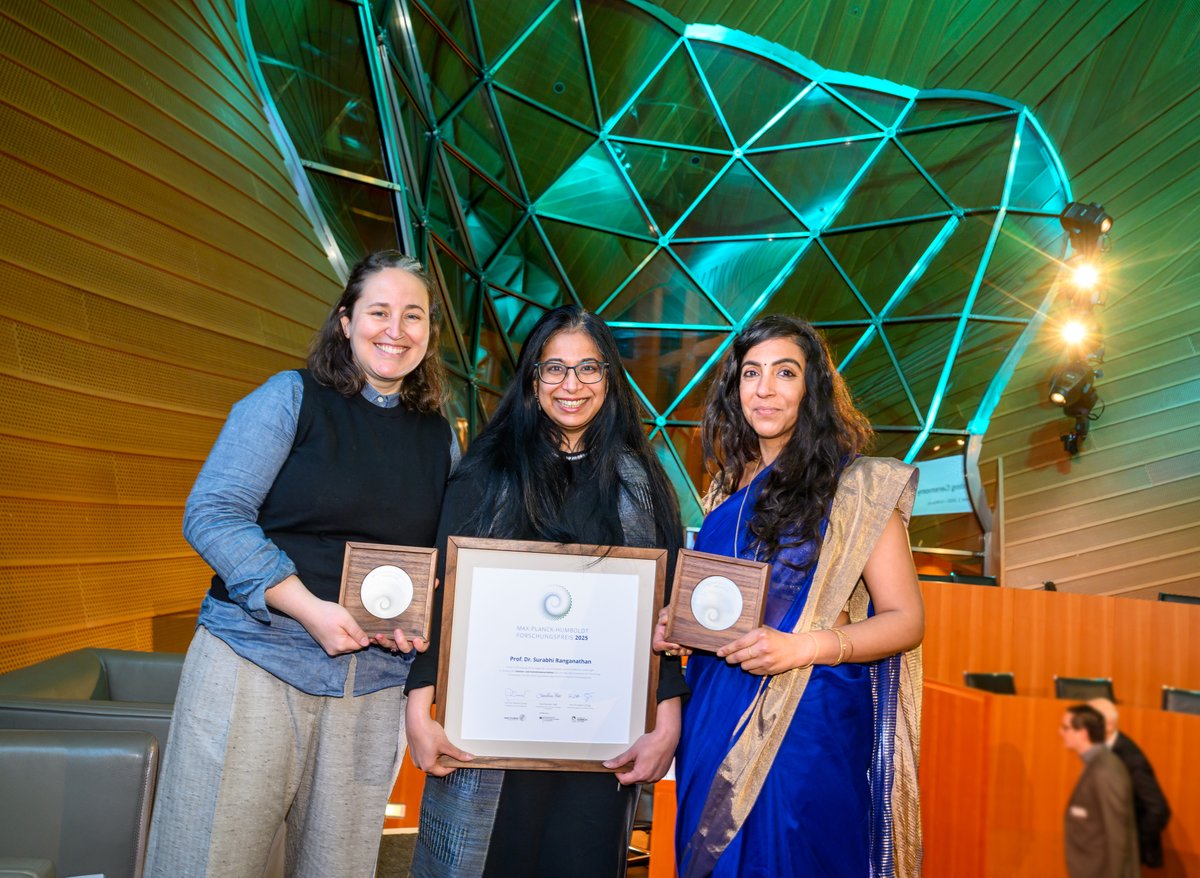
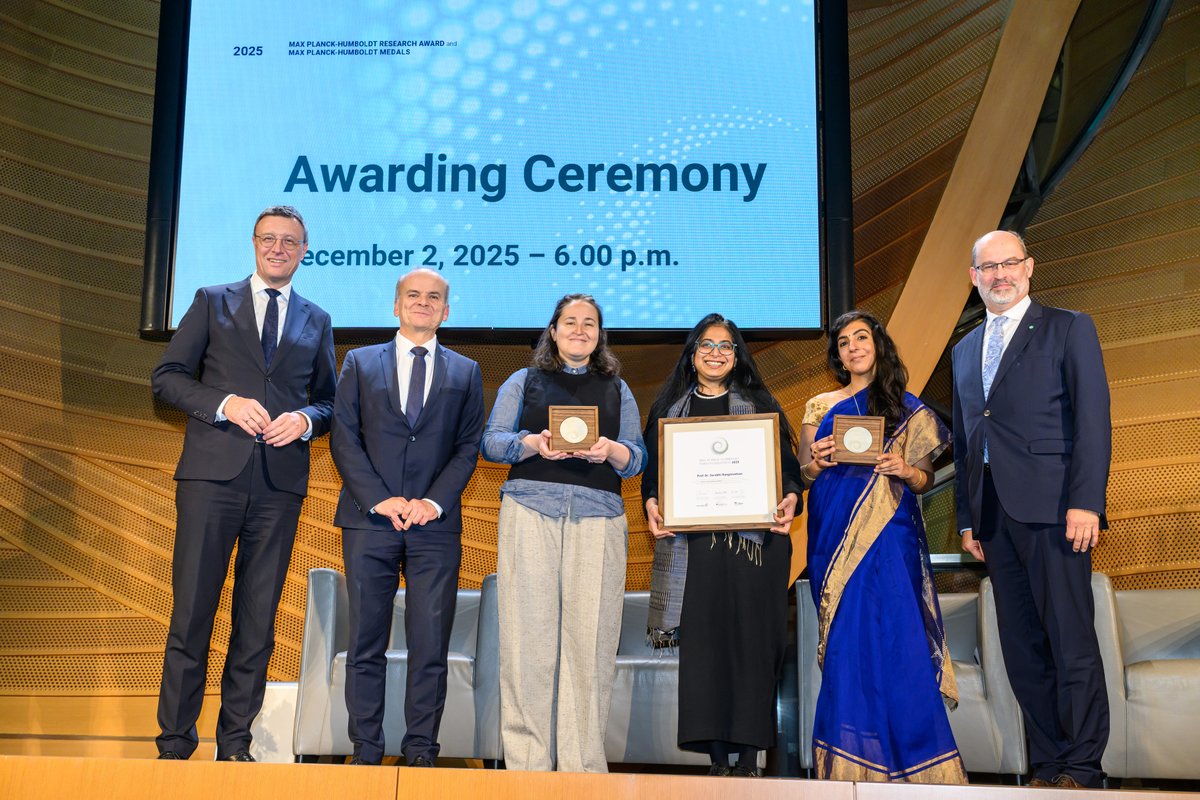
Celebrating 3 brilliant thinkers!🎉🤗 In Berlin yesterday, Surabhi Ranganathan @Cambridge_Uni, Prerna Singh @BrownUniversity & Jamie Kreiner @UCLA received the 2025 Max Planck-Humboldt Award & Medals - presented by Max Planck President Patrick Cramer @mpgpresident , AVH Secretary General Markus Zanner & Parliamentary State Secretary Rolf-Dieter Jung @bmftr_bund.
Wem gehören die #Ozeane? Surabhi Ranganathan, die am 2. Dezember mit dem Max-Planck-Humboldt-Forschungspreis ausgezeichnet wird, untersucht, wie internationales #Seerecht die Nutzung der Meere pr��gt und welche Visionen dabei überhört werden. Ein Podcast 🎧https://t.co/v7XfbFWTO9 @detektorfm
🎉 The new Max Planck House in Tübingen is open! A hub for events, guest visits & collaboration across institutes, combining timeless architecture, sustainability & modern facilities. A new heart for science, exchange & inspiration! 🏛️
👉https://t.co/5tIJZcUppu
@maxplanckpress
66 Max-Planck-Wissenschaftlerinnen und Wissenschaftler gehören 2025 zu den weltweit meistzitierten Forschenden ihrer Fachgebiete. Wir sind damit die einzige deutsche unter den Top Ten der internationalen Forschungseinrichtungen https://t.co/pcfJIFtISe @ClarivateAG
Gema gewinnt gegen #OpenAI : Die Entscheidung des Landgerichts München könnte Auswirkungen weit über Liedtexte hinaus haben, sagt Silke von Lewinski @mpi_inno_comp. https://t.co/aBISu2x9DN @SZ
Today we celebrate the birthday of not one, but two amazing women in science! 🤗🎉Marie Skłodowska-Curie (1867), who discovered #radium & #polonium & pioneered #radioactivity, & Lise Meitner (1878), whose brilliance uncovered the physics behind #nuclearfission. Happy birthday!
In this week’s People of ACM, we interview Meeyoung Cha, Scientific Director @maxplanckpress, and Professor @kaistpr. In her interview, Cha discusses her work applying computing methods to the social sciences. Read the interview here: https://t.co/ZCPLmVkgaF
"Je früher eine #Psychose erkannt wird, desto besser können wir eingreifen." Nikolaos Koutsouleris @mpi_psychiatry erklärt in diesem Podcast, wie er sich präventive #Psychiatrie vorstellt und wie #KI dabei helfen kann.🎙️https://t.co/ITeJC13PHC [YouTube] @detektorfm
Ancient incense, cosmetics and #mummies: how can reconstructing long-lost #smells of ancient artifacts help us connect with the past? https://t.co/Q4Av6f65gZ #ScienceHistory@MPI_GEA
Die Gewinnung des #Plastik - Bausteins Ethylen setzt große Mengen #Treibhausgase frei. Ein Enzym des Bakteriums Rhodospirillum rubrum könnte es zukünftig möglich machen, Ethylen ohne #Kohlendioxid - Emissionen zu produzieren. 👏https://t.co/wg8y8gEseb @mpi_marburg
Politische Entscheidungen greifen tief in unser Leben ein – deshalb müssen sie sich auf wissenschaftliche Erkenntnisse stützen, fordert Patrick Cramer im Interview @spektrum. Ein Plädoyer für Evidenz in der #Politik und für #Wissenschaftsfreiheit. https://t.co/t13m2q46f9 w/th @mpgpresident
Excellence in #science drives #innovation! We are ranking among the top ten European research institutions with the highest number of #patent applications ✨🤩 The Fraunhofer Society is 3rd place, the Max Planck Society 7th place, and the German Aerospace Centre 10th place. https://t.co/12d3HkoKfA @EPOorg
Sind #Kryptowährungen sicher? Ein Gespräch mit Clara Schneidewind vom Max-Planck-Institut für Sicherheit und Privatsphäre über #Crypto Bros und die Frage, ob wir irgendwann alle mit #Bitcoin zahlen. 🎧 https://t.co/Dv9b2hZ3XH @detektorfm











![maxplanckpress's tweet photo. "Je früher eine #Psychose erkannt wird, desto besser können wir eingreifen." Nikolaos Koutsouleris @mpi_psychiatry erklärt in diesem Podcast, wie er sich präventive #Psychiatrie vorstellt und wie #KI dabei helfen kann.🎙️https://t.co/ITeJC13PHC [YouTube] @detektorfm https://t.co/ekBnzzV0pd](https://pbs.twimg.com/media/G4gwuwWWsAAHryl.jpg)


