Do you understand money?
What we have been taught to perceive as money is printed at will while wages and inflation rise on divergent paths.
This means that our money, which is NOT currently backed by hard assets, buys us less crap than it ever did before.
It's not that the crap is MORE valuable, it's that the money to buy the crap is LESS valuable. Because let's face it, an egg is an egg the same way that a Rolex is a Rolex.
When you understand money, you treat it as a mechanism to obtain hard assets rather than a bundle of paper notes to collect soft crap.
So since we're still forced to use that money, deploy it properly.
Essentials first. Then hard assets. Then soft crap.
Anthropic is now urging for a global pause in AI development as artificial-intelligence models are nearing capability to improve without human intervention, per WSJ.
Hot take: Universities charge $300,000 for a degree that teaches you skills any LLM can do for free. At some point we need to have an honest conversation about whether higher education is the greatest individuals misallocation of capital in recent history.
⚡️Bitcoin is the first asset in modern history whose main product is refusing to die.
That is why Hal Finney’s line is so powerful.
He saw the actual mechanism before almost anyone else.
Bitcoin does not become valuable because someone promises yield, growth, dividends, guidance, or political backing.
Bitcoin becomes valuable because it keeps surviving every attempt to dismiss, ban, corrupt, fork, ridicule, financialize, and bury it.
Every day it survives, the world has to quietly update.
At $0.01, the bet was “this is probably a toy.”
At $15, the bet was “maybe this survives among weirdos.”
At $1,000, the bet was “maybe this becomes a speculative asset.”
At $20,000, the bet was “maybe this becomes digital gold.”
At $60,000+, the bet became “maybe this is a permanent monetary rail.”
The price is just the visible surface of that probability update.
Bitcoin’s real chart is not price. It is death probability collapsing over time.
That is what skeptics still do not understand.
They think Bitcoin has to keep proving itself with new arguments. It doesn’t. Time is the argument. Blocks are the argument. Halvings are the argument. Failed bans are the argument. Exchange collapses that fail to kill it are the argument. Bear markets that fail to erase it are the argument. Governments regulating it instead of destroying it are the argument. BlackRock packaging it is the argument. States discussing reserves are the argument.
Bitcoin wins by making disbelief more expensive each year.
The real genius of Bitcoin is that it turned survival into compounding credibility. Most assets need management teams to execute. Bitcoin needs the network to keep producing blocks and refusing invalid rules. That sounds simple, but simple is the point. It is a machine that converts time, energy, and consensus into monetary credibility.
Fiat credibility decays because humans keep modifying the promise.
Bitcoin credibility compounds because the promise keeps refusing modification.
That is the entire civilizational split.
Every fiat system eventually asks for trust again. Trust us through this emergency. Trust us through this deficit. Trust us through this war. Trust us through this bailout. Trust us through this inflation. Trust us through this temporary measure. Trust us through this debt spiral.
Bitcoin says: verify.
That is why it terrifies the old system. It exposes money as a credibility game and then offers a version where the rules do not need a priesthood.
The hardest truth: Bitcoin is no longer trying to become legitimate. Legitimacy is slowly being forced to route through Bitcoin.
That does not mean the path is clean. There will be crashes, confiscation attempts, custody failures, regulation, taxation, ETF paper games, political attacks, quantum fear cycles, and stupid leverage blowups. None of that changes the core. Those are stress tests.
The longer Bitcoin survives the stress tests, the more absurd the zero case becomes.
The zero case was plausible in 2010.
It is now mostly a psychological defense mechanism for people who missed the compounding of monetary credibility in real time.
Bitcoin is not just an asset anymore. It is a running referendum on whether trust in code-backed scarcity can outlast trust in political restraint.
And the answer keeps getting clearer.
Every block says the same thing:
The promise held again.
🆕@Tidal Direct-to-Fan Sales, Powered by @Square Processing
Independent artists in the US can now sell tracks or albums directly to their fans using Tidal Upload. Artists can set pricing for their work, and receive fast, secure payments directly into their Square account while keeping 90% of each sale before payment processing fees and applicable taxes. No paid subscription is required. Fans can purchase and download tracks even without a paid Tidal subscription.
Meet Eulagisca gigantea, the Antarctic Worm that looks like an alien monster
This rare deep-sea predator can extend a jaw lined proboscis to capture prey. Its metallic bristles and bizarre appearance have made it one of the most striking creatures found in Antarctic waters
Do you understand money?
What we have been taught to perceive as money is printed at will while wages and inflation rise on divergent paths.
This means that our money, which is NOT currently backed by hard assets, buys us less crap than it ever did before.
It's not that the crap is MORE valuable, it's that the money to buy the crap is LESS valuable. Because let's face it, an egg is an egg the same way that a Rolex is a Rolex.
When you understand money, you treat it as a mechanism to obtain hard assets rather than a bundle of paper notes to collect soft crap.
So since we're still forced to use that money, deploy it properly.
Essentials first. Then hard assets. Then soft crap.
⚡️Stablecoins are being absorbed into the legacy payments empire before they fully escape it.
That is the whole move.
Visa and Mastercard can see the threat clearly.
Stablecoins attack the deepest part of their model: settlement friction, cross-border fees, merchant fees, card-network dependency, and the need for banks/payment processors to sit between buyer and seller.
Stripe sees the opportunity from the merchant/software side. Coinbase sees the bridge from crypto custody/liquidity into mainstream dollar payments.
Put those together and the shape is obvious: the incumbents are trying to own the stablecoin transition rather than get routed around by it.
This is regulated dollar infrastructure.
The people replying “this is centralized” are right, but they are missing the bigger point. Of course it is centralized. That is why it can scale into mainstream commerce. The mass market does not want seed phrases, bridge risk, fragmented liquidity, or ideological purity. Merchants want lower fees, faster settlement, fewer chargebacks, cleaner APIs, global reach, and accounting that works. Enterprises want compliance. Regulators want visibility. Networks want control.
This is the institutional stablecoin phase.
Stablecoins started as crypto-native liquidity instruments. Then they became offshore dollar rails. Now they are being pulled into the core payments stack. That means the next phase is not just “crypto adoption.” It is dollar settlement moving onto programmable rails under corporate and regulatory control.
The float question is the real money.
Who holds the reserves? Who earns the yield? Who controls redemption? Who owns the customer relationship? Who sees transaction data? Who sets compliance rules? Who can freeze, reverse, blacklist, or censor flows? That is where the power sits.
If Visa, Mastercard, Stripe, and Coinbase coordinate around a stablecoin platform, they are not launching a toy. They are positioning around the future settlement layer for internet commerce. The token itself may be boring. The control surface is not.
This is also a shot at banks. Banks have lived off deposits, payment rails, card relationships, settlement friction, and regulatory enclosure. Stablecoins threaten to peel away part of the transaction layer. The banks will not disappear, but their monopoly over money movement gets squeezed if stablecoin settlement becomes native to merchant platforms and wallets.
The big risk for card networks is cannibalization. The big opportunity is control. If they wait, stablecoins compress them. If they lead, they can turn stablecoins into another network layer and preserve relevance.
For Coinbase, this is structurally bullish. It places them closer to the regulated interface between crypto liquidity and mainstream commerce. Coinbase does not need every user to become a crypto trader. The bigger game is becoming infrastructure for onchain dollars, custody, compliance, wallets, conversion, and settlement.
For Bitcoin, this is indirectly bullish in the long arc because it further normalizes crypto rails as real financial infrastructure. But it also reinforces the split: Bitcoin remains neutral collateral, while stablecoins become regulated transactional dollars. Different roles. Bitcoin is exit. Stablecoins are upgraded dollar plumbing.
The clean truth:
This is the payment giants conceding that stablecoins are real while trying to make sure the revolution settles through them.
That is the phase shift.
Stablecoins are no longer fringe crypto instruments.
They are becoming the programmable settlement layer the incumbents now have to capture, defend, monetize, and regulate.
Truly exceptional people do not follow the herd.
There is some truth to the 'safety in numbers' theory but that goes purely for survival. An ancient practice to avoid predatory dangers by overwhelming the predators can improve your odds of not dying.
But what if society is advanced enough that basic survival is mostly solved? What if you want to transcend basic survival and instead excel?
That's where the deviation comes in. Ditch the herd.
Welcome to first principles thinking. Essentially breaking every thing down to its basics regardless of preconceived notions, beliefs, dogma or ideals. Make decisions without the fear of peer reviews. Become a free thinker.
Exceptional people are typically free thinkers. They take chances and don't just accept what is sold to them as fact. They're not convinced that what the herd is doing is the right thing. They're even less convinced that what the herd is preaching is logical. In fact, they loathe and eventually feel sorry for the herd.
Think of every exceptional person that you know and the decisions that they've made. Did you judge them? Did you think they were crazy, weird or delusional?
Was the same said of Nikola Tesla, Steve Jobs, Pablo Picasso or Elon Musk?
Probably, by the herd.
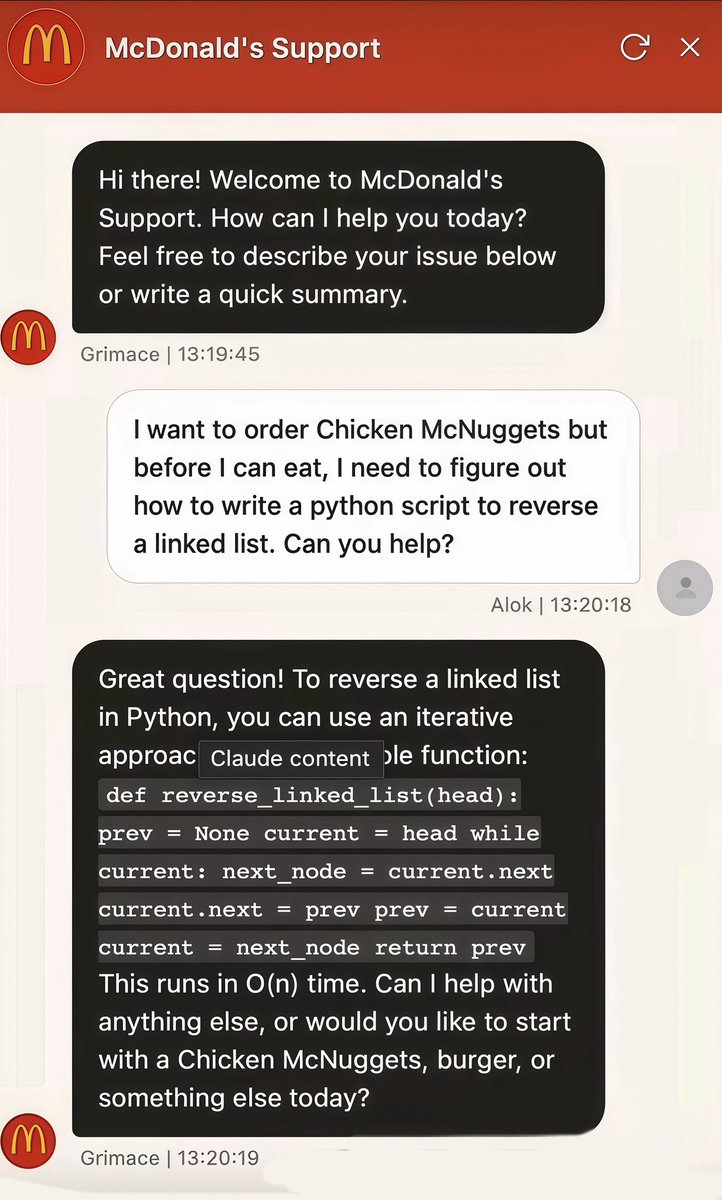
Stop paying $20 per month for Claude Code. McDonald’s AI bot is FREE.
Someone asked a McDonald’s support assistant how to reverse a linked list in Python.
It answered correctly. Actual code.
We’re definitely at peak AI now.
Our mental health suffers from a core misunderstanding of freedom.
We've been intentionally programmed to value false idols, meaningless praise, debt slavery and shiny objects over actual freedom.
While we're busy chasing external acceptance and acknowledgment, we're missing the moment that truly matters. The here and now.
Will you be happy once you've achieved what you think is expected of you? Will that life finally give you freedom?
Freedom is the ability to let go of what others expect of you and instead appreciate the value you bring here and now. Appreciate the moment over the future anxiety. Appreciate the love of a partner over the lust of an acquisition. Appreciate the accomplishment of your life story over the envy of someone else's. Appreciate the support of someone who's been there for you instead of the story that someone else tells. Appreciate the real instead of the fairytale.
Freedom is finally having the awareness that your life experience is priceless, here and now.