GM ☀️
I jst finished checking my @superformxyz dashboard this morning and it is great to see that the daily points are finally starting to grow at a much faster rate.
I'm currently sitting at 364.20 total points with a daily generation of over 1,214.01, and seeing that daily number become three times larger than my lifetime total is a clear sign that this strategy is working.
The main reason for this success is the SuperVaults v2 where I am capturing a 50x boost on my $101.17 deposit.
Almost all of my progress is coming from this one single source, which shows just how powerful picking the right multiplier can be for your account when you want to maximize your efficiency.
My current ranks are 3918 for TVL and 6393 for points, but I have a strong feeling that my points rank will not stay in the 6,000s for very long at this speed.
I’m looking forward to seeing where these numbers land by the end of the week if I just keep everything running exactly as it is rn.
A delivery truck breaks down mid-route. Nobody's in the office. The package still arrives on time, the replacement driver gets paid, and the books balance, start to finish, run by an AI agent.
This is HermesRoutiq: a last-mile delivery company with no ops team. An autonomous Hermes agent watches the fleet, reasons over incidents, and actually runs the business, routing trucks, dispatching drivers, and moving real money.
In the video:
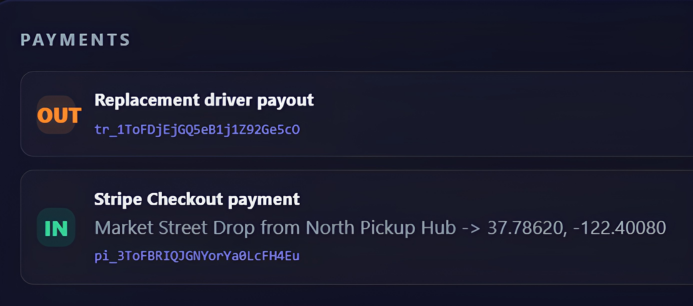
Money IN. A customer orders "Market Street Drop" and pays $9 via @stripe Checkout (pi_…). Hermes prices it within policy and dispatches a driver.
The breakdown. Mid-delivery a truck fails. Hermes detects it instantly, freezes the vehicle, opens an incident, no human alerted it.
The decision. Live in the reasoning feed, Hermes compares recovery options (one replacement vs. split vs. wait), checks its spending policy, approves a budget, and decides, autonomously.
Money OUT. It dispatches a replacement, reroutes around the breakdown, and pays the driver a $4 stripe Connect payout (tr_…, "incident payout for driver-2") — under a hard limit.
Delivered + full receipt. 1/1 in 146s, with the complete incident P&L: revenue protected $9, emergency spend $9, refunds avoided $4, churn avoided $3, 0 human interventions, 0 policy violations.
It learned. Hermes didn't solve from scratch, it reused a recovery skill it learned from a past incident. Every disruption makes the next fix faster.
Hermes works through 24 typed tools (sense → decide → dispatch → pay → provision → learn) and a growing library of skills (breakdown, congestion, payment-decline recovery) it reuses across incidents, all policy-gated through the MCP server.
The full stack, and where each piece lives:
Hermes agent, the operator brain, @nvidia Nemotron 3 Ultra (via OpenRouter) the reasoning model,
NVIDIA NemoClaw + OpenShell sandbox (WSL) securely runs the agent, reached via a Hermes Bridge.
MCP server the agent's typed tools + policy enforcement • Routing service (FastAPI) → NVIDIA cuOpt = assignment & recovery optimization (who drives what, in what order) + OSRM = road geometry & drive-time cost matrix (the real streets)
stripe Checkout (money in) + Connect (payouts out) + Projects (agent-provisioned services)
Supabase Postgres, orders, ledger, decisions, Redis, live sim state , Ambient city simulator, traffic, signals, congestion, Next.js control-room dashboard
Earn → decide → spend → recover → learn..
Fully autonomous.. Thanks to @NousResearch🫶
Hermes Volta just killed my EDA software subscription..
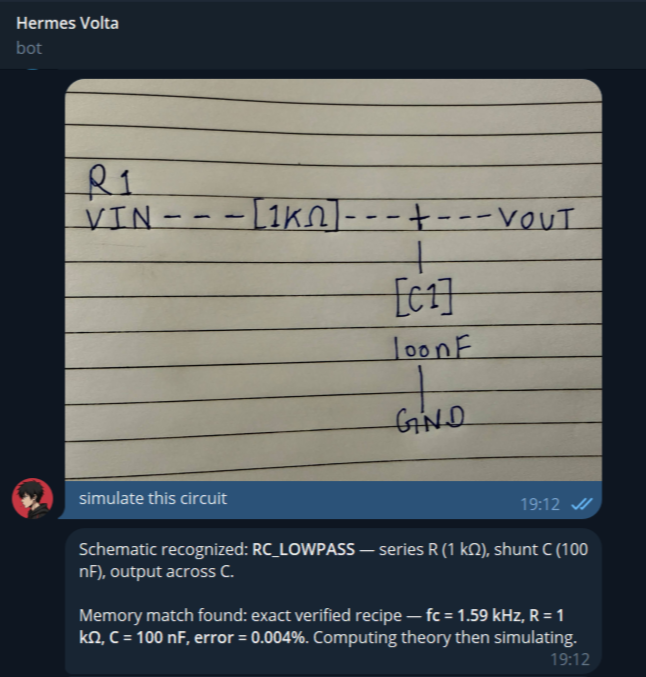
I drew a circuit on notebook paper, photographed it, and sent it to Telegram.
Hermes Volta looked at my hand-drawn schematic, recognized the circuit topology, matched it to memory, ran a real PySpice/Ngspice SPICE simulation with only 0.004% cutoff frequency error, and delivered a full Bode plot, transient validation, PCB layout, production Gerbers, and cutoff report, all without me typing a single component value.
Ready to order on JLCPCB, no CAD software, no component lookup, no manual math required.
Just a photo of my hand-drawn schematic
I built Hermes Volta for The Hermes Agent Creative Hackathon by @NousResearch, pushing Hermes Agent into analog circuit design, from natural language and hand-drawn schematics to manufacturable PCB artifacts delivered to your Telegram.
Built on Nous Research Hermes Agent + Kimi K2.6.
Tech Stack:
Hermes Agent by Nous Research, orchestration, memory, skills, and every tool call.
Kimi K2.6 by @Kimi_Moonshot the brain making every decision.
PySpice + Ngspice for real SPICE simulation, not approximation.
KiCad + kicad-cli + SKiDL for real EDA artifacts, netlisting, PCB layout, and production Gerber zips.
FastAPI for live dashboard pipeline streaming.
Firecrawl for autonomous web search.
Telegram Bot API for multimodal voice, vision, text, and file delivery.
Skills Hermes Volta uses:
The custom Volta skill at skills/volta/SKILL.md teaches Hermes Agent the entire circuit design workflow, topology selection, safety rules, Telegram delivery gate, and learning behavior.
Four reference files back it up: filter math equations, verified E24 component recipes from real simulations, KiCad footprint rules, and extended design guidance.
After every design, Hermes Volta patches its own skill file with verified recipes and gets more accurate over time.
Memory recalls known-good component pairs across sessions so you never start from scratch.
Session search lets you say "@MEMORY.md scale my most accurate design to 8kHz" and Hermes Volta shows the scaling math and ships the new design.
Context references let you ask "@MEMORY.md which design for a guitar pedal?" and get a real answer from your own history.
Tools Hermes Volta uses:
execute_code runs PySpice, Ngspice, KiCad CLI, E24 resistor sweeps, and Monte Carlo tolerance checks.
send_message delivers 8 structured Telegram messages per design, summary, Bode plot, transient validation, PCB layout, filter effect plot, cutoff report with theory fc, actual fc, error percentage, BOM strings and JLCPCB search terms, Gerbers zip, and engineering notes.
Vision reads hand-drawn schematics directly from photos.
Voice mode turns a Telegram voice message into a full PCB.
Web search autonomously researches domains like ECG sensors, drone vibration, and guitar pedal filtering.
Cron schedules recurring tasks like weekly BOM price checks.
Background sessions let designs run while you keep chatting.
Rollback restores any previous design instantly.
RL trajectory logging records every design for future training.
The volta_audit plugin handles design audit and trajectory logging.
20-min demo shows 16 features:
CLI — skills, learning loop, batch parallel agents, memory recall with mathematical scaling, autonomous web search, context references, RL trajectories, and skill growth happening live.
Telegram — voice message to full PCB, hand-drawn photo to simulation, autonomous mode triggered by problem description, cron scheduling, background session, on-demand PCB render, and rollback.
Dashboard — live Hermes stream showing the full pipeline, 4 artifact panels updating in real time, design history navigation, and audit log.
What happens when you give an AI full control of a Mars Rover?
It drives itself, reads every sensor, avoids cliffs, learns from its own missions and sends you a PDF report when it's done.
Built this for the @NousResearch Hackathon using Hermes Agent as the autonomous brain of a NASA Perseverance rover in Gazebo simulation.
No waypoints..
No scripted paths..
Just a natural language goal and Hermes figures out the rest.
Visual simulation: Drove the rover across Mars terrain. Hermes pointed the onboard cameras at the surface, captured 2 photos from NavCam/MastCam, and sent them to my telegram.. then turned the rover to keep going.
Headless simulation: Hermes ran a full autonomous mission end to end, planned navigation, read sensors, checked hazards, generated a PDF mission report and delivered it to my telegram..
Voice commands through telegram also work..
Screenshots tell the rest: 22cm return-to-base accuracy.. 25.3 minutes of autonomous operation. Zero hazards, all systems nominal, Live dashboard tracking every move..
Here's what makes it tick:
7 custom tools. Hermes decides when to drive, sense, navigate, check hazards, capture images, save memory, or write reports.
NASA Perseverance model. IMU, 4 cameras, LIDAR, wheel contact, joint states..
Real sensor data, not mocked..
6 SKILL.md skills + learned behaviors that rank up over time. The rover gets better the more it runs.
Full Mars physics.. 3.721 m/s² gravity, ODE rigid body, friction, collision, wheel slip..
Sensor bridge direct to Gazebo Transport (gz topic)..
FastAPI backend, 20+ endpoints, WebSocket telemetry, Next.js dashboard, Telegram bot with voice, Apple Watch/Siri shortcuts..
One goal.. Full autonomy.. Report in your pocket..
OpenVLA OFT is a smart way to fine tune vision language action models without touching the full network. Small modular updates mean faster training lower cost and easier scaling for robotics and embodied agents.
This approach turns one strong base model into many task specific policies using minimal compute. A practical direction for real world robot learning and deployment powered by @konnex_world
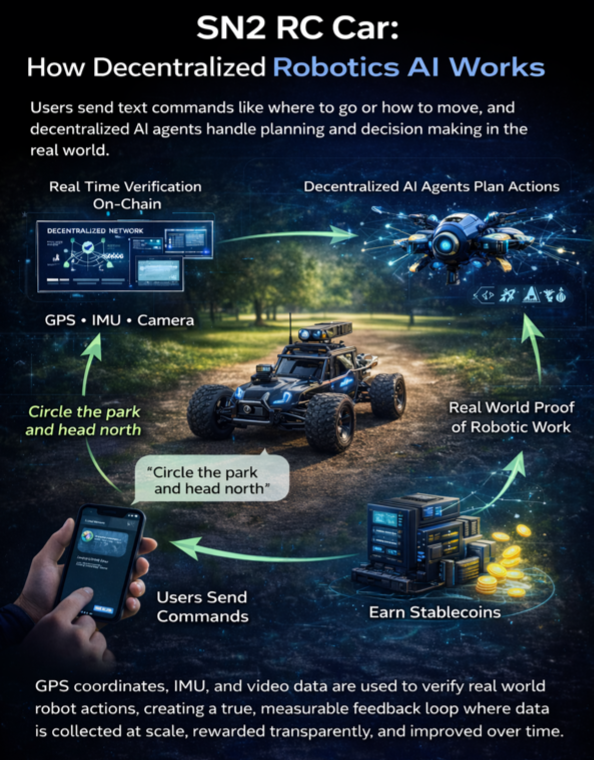
SN2 RC Car is a strong example of how autonomy should actually be built Users give simple high level commands and real RC cars execute them in real environments while decentralized AI agents handle planning and decision making
What makes this powerful is verification GPS IMU and video data are used to prove what happened in the physical world so results are measurable and trustless
This turns robotics into a real feedback loop data gets collected validated rewarded and improved over time Moving autonomy from theory to reality @konnex_world
Konnex SN1 RoboArm is where words turn into real robot behavior inside a simulator. You describe a task in plain language and the network figures out how a robotic arm should move to complete it, tested fully in a physics based environment.
Miners compete by submitting the best control logic, validators replay and score every attempt, and rewards are paid only when the task is done right. It’s basically text to robotics, but verified and incentivized onchain @konnex_world
Konnex is building infrastructure for autonomous robots to operate as onchain actors. AI models handle perception and decision making, while smart contracts handle task assignment, verification, and payments. This removes human coordination from the loop and turns robots into independent economic agents on Konnex.
At the model layer, OpenVLA enables direct vision language to action execution. Camera input and natural language instructions are mapped straight to control outputs. This avoids fragile rule based systems and tightly couples sensing, reasoning, and actuation.
Because OpenVLA is a general multimodal model, it can scale across different robots and environments. Combined with onchain settlement, robots can autonomously accept work, perform physical tasks, and cryptographically prove completion. This is protocol level coordination for real world robotics, not just automation @konnex_world
Konnex dashboard demo is basically a live marketplace for real world robot tasks where you just type what you want done and the network goes to work
Multiple AI miners submit their own solutions then verifiers score them on stuff that actually matters like accuracy safety speed and stability so you get a ranked winner not vibes
Best policy gets executed in the real world and the whole thing settles onchain so it is proof plus payment in one loop, this is what robotic AI should look like @konnex_world
Konnex’s 2033 vision is wild in a good way
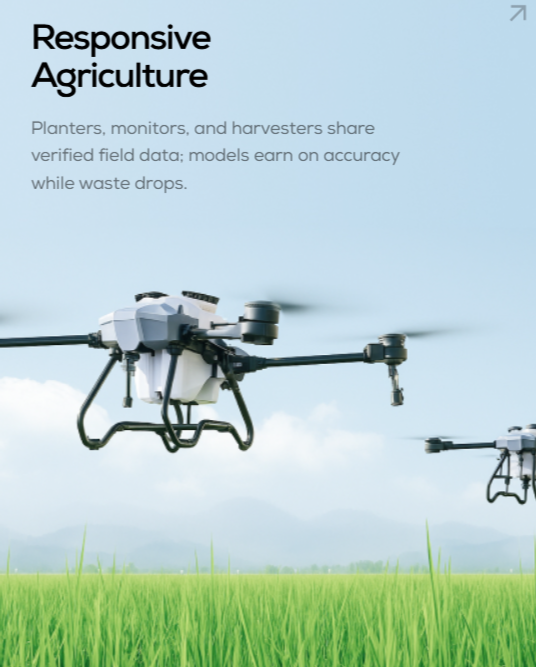
1 order says deliver 1,200 lunches across 600 locations before 12
Then drones bid with live battery and GPS plus collateral so no one can trollA few trusted drones turn into coordinators
They split the city into zones, spin up sub contracts, add penalties, and route work to the right swarm members
No central dispatcher babysitting it allFinish on time and escrow pays instantly in stablecoins
Miss the deadline and your collateral gets redistributed
It reads like a sci fi story but the mechanism is just onchain incentives doing logistics work @konnex_world