A flaw in Person-Δ may be overstating progress in single-cell perturbation prediction models. Pearson warned about this in the 19th century: reusing the same controls induces spurious correlation. Split the controls, and much of the claimed prediction power fades. Link below 👇
In AI-guided discovery, models often turn huge candidate pools into shortlists for costly validation.
We ask: can we put an error budget on AI-generated shortlists before running the experiment? For example:
• Can we keep failed hits below 10%?
• How many candidates should we test to get enough true positives?
• How far down the list can we go before expecting too many false positives?
• If we already have a fixed top-K list, how many are likely wrong?
📢 Excited to share TxConformal, a framework to turn AI scores into shortlists with controlled/estimated false positives, even in tasks where new candidates differ from past experimental data. This is joint work with amazing @KexinHuang5@jure@EmmanuelCandes , in collaboration with Genentech @nate_diamant@gabo_scalia.
We test it across proteins, genetic perturbations, regulatory DNA, clinical trials, ADMET, and antibacterial virtual screening. In a prospective A. baumannii screen at Genentech, TxConformal estimated 80.3 false positives before wet-lab validation; the experiment found 91, within the 90% CI.
Preprint: https://t.co/wL6VxPhAB0
Code: https://t.co/GABjobWlVw
🧵[1/n] 👇
@YingJin531 Very nice work! I think the loop of AI assisted simulation-validation scientific process is forming! Statistics is still very useful at the end of simulation/generation to control the size of wrongly chosen scientific targets and at efficiently planning validation experiments.
Excited to share our ICML 2026 Hypothesis Testing Workshop in Seoul, this July! @icmlconf
🎉This workshop aims to bring together researchers developing modern hypothesis testing methodology and applying it to machine learning problems such as robustness, distribution shift, security, medicine, and LLM evaluation. In other words, if you care about how we make ML claims rigorous, this workshop is for you.
We now have four confirmed speakers:
Arthur Gretton @ArthurGretton,
Yao Xie @yaoxie21851119,
Bo Li @uiuc_aisecure, and
Yisong Yue @yisongyue.
The organizing team includes Xiuyuan Cheng (Duke), Feng Liu @AlexFengLiu1, Lester Mackey @LesterMackey, Shayak Sen @shayaksen, Danica J. Sutherland
@d_j_sutherland, and Nathaniel Xu (UBC).
📌 Submission deadline: 10 May 2026
📌 Notification: 26 May 2026
📌 Camera-ready: 17 June 2026
📌 Workshop date: July 10 or 11, 2026 (TBA)
🚩Check more information below!
🔗Website: https://t.co/kOQBpqu6BO
🔗Submission Portal: https://t.co/8UUTb1P5EA
We’re also recruiting PC members/reviewers.
🔗 Reviewer interest form: https://t.co/1g4fYvjdOR
🏁Please feel free to share this with colleagues, collaborators, and students who may be interested.
#ICML #ICML26
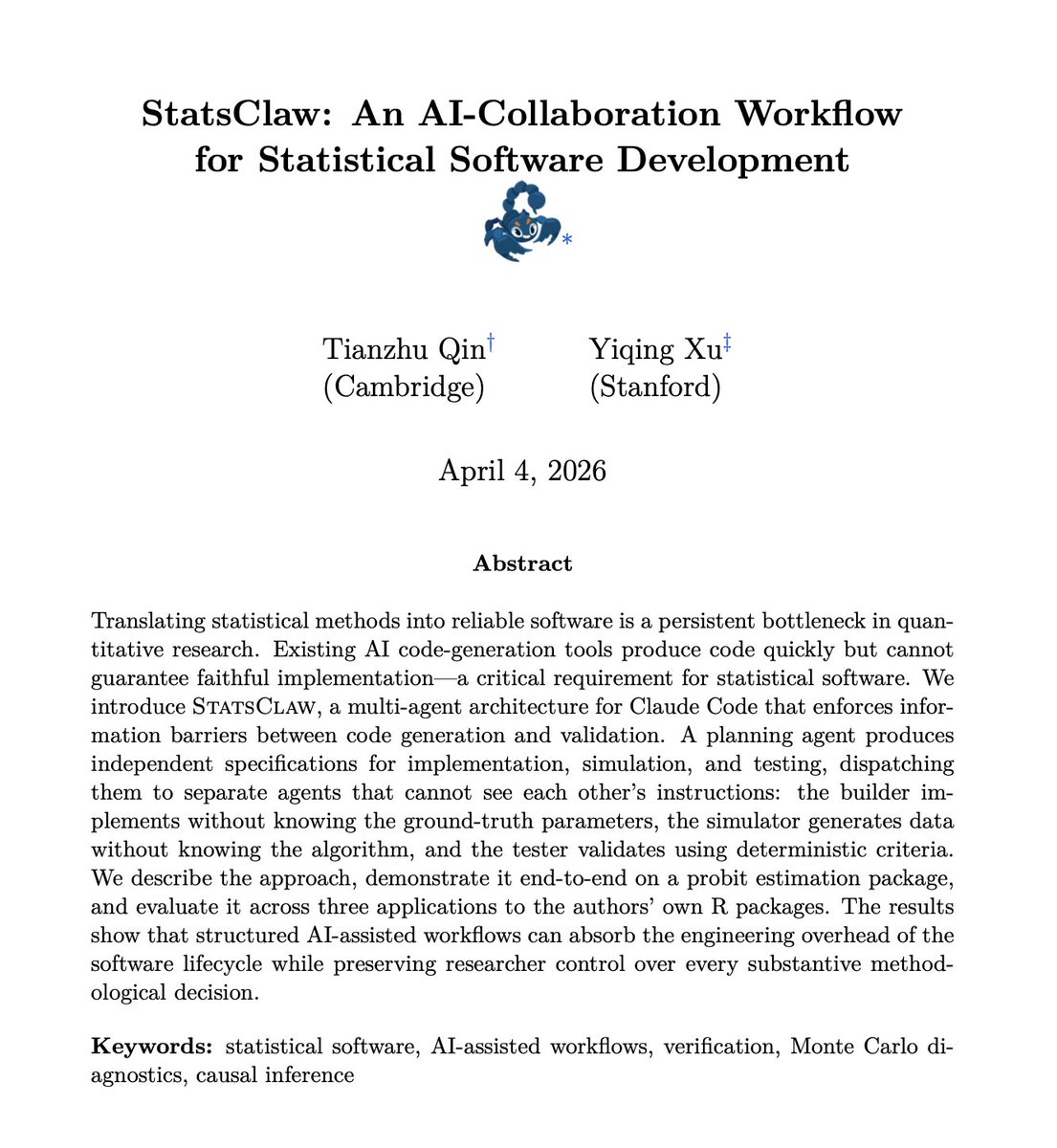
1/ Happy to release StatsClaw — an open-source multi-agent workflow for building statistical software with AI. w/ @Maple_Optboy
Site: https://t.co/4svIckWc4m
Paper: https://t.co/HrzzB4BJcG
Last month, a final-year CSE student DM’d me in panic.
“Applied to 60+ summer internships.
Not a single test link or interview call.”
We spent 2 evenings rewriting his applications with Claude.
Result: 6 interview invites in the next 10 days (5 startups and Microsoft).
Here are the exact 7 prompts that turned it around👇
Yesterday I shared a Claude skill for academic slides.
Now, the underlying guide — no AI needed, works for anyone.
📄 Best Practices for Academic & Analytical Presentations (Free PDF)
https://t.co/XcWvS7xh1j
→ Action titles, structured argument, exhibit discipline, citations
The UCL IMSS Annual Lecture will take place on the 27th April with a keynote from @LesterMackey.
The theme is 'Computational Statistics and Machine Learning', and we will have talks from Alessandro Barp, Paula Cordero Encinar & Po-Ling Loh.
https://t.co/sjLmMokgTx
@stats_UCL
🧠 Can Omni Large Language Models (OLLMs) truly reason the same across audio, vision, and text modality?
🚀 Introducing XModBench: a tri-modal multiple-choice benchmark (text ↔ vision ↔ audio) designed to test cross-modal consistency and capability in omni-modal LLMs.
🔍 Covering 60,828 QA pairs across five task families (perception, spatial reasoning, temporal reasoning, linguistic, external knowledge).
🤯Results show: even top models like Gemini 2.5 Pro struggle:
(i) < 60% accuracy on spatial & temporal reasoning
(ii) Sharp performance drop when the same content is given as audio rather than text
(iii) Systematic imbalance — reasoning is far less consistent under vision/audio contexts than text
📘 Paper: https://t.co/MXgK9bdu2P
🌐 Project: https://t.co/lpLh8shIy1
🤗 Huggingface: https://t.co/0VVs1K9ylw
At 3:30pm UK time, my PhD student Masha will be speaking about kernel quantiles (and associated distances) at the Isaac Newton inst. Tune in at https://t.co/LZhY6BndXH to learn how to use quantiles in RKHS to efficiently represent/compare distributions on general spaces.
I am so very honored to have been chosen to deliver this year’s Lawrence Brown Distinguished Lectures at the University of Pennsylvania’s Wharton Department of Statistics and Data Science over the next few days! For more information, please see https://t.co/r0EgVGJMDi
ISSI on Nov 4: Ziang Niu from UPenn. He will talk about "Computationally efficient and statistically accurate conditional independence testing with spaCRT" (https://t.co/klil6bMem0), and Molei Liu from Columbia University will give a discussion. We look forward to seeing you!
📢 Hi friends! We’re launching a weekly online seminar on Monte Carlo methods, starting on October 1st with Prof. Persi Diaconis. Join us every Tuesday! For more details, visit our website: https://t.co/5AmhPmte7C or subscribe to our mailing list https://t.co/PdpquTV40Z. Welcome!
For anyone looking for a PhD position starting this Autumn, please see this fully-funded PhD studentship at Aalto university. It also includes funding to come visit my research group at UCL!







![YingJin531's tweet photo. In AI-guided discovery, models often turn huge candidate pools into shortlists for costly validation.
We ask: can we put an error budget on AI-generated shortlists before running the experiment? For example:
• Can we keep failed hits below 10%?
• How many candidates should we test to get enough true positives?
• How far down the list can we go before expecting too many false positives?
• If we already have a fixed top-K list, how many are likely wrong?
📢 Excited to share TxConformal, a framework to turn AI scores into shortlists with controlled/estimated false positives, even in tasks where new candidates differ from past experimental data. This is joint work with amazing @KexinHuang5 @jure @EmmanuelCandes , in collaboration with Genentech @nate_diamant @gabo_scalia.
We test it across proteins, genetic perturbations, regulatory DNA, clinical trials, ADMET, and antibacterial virtual screening. In a prospective A. baumannii screen at Genentech, TxConformal estimated 80.3 false positives before wet-lab validation; the experiment found 91, within the 90% CI.
Preprint: https://t.co/wL6VxPhAB0
Code: https://t.co/GABjobWlVw
🧵[1/n] 👇](https://pbs.twimg.com/media/HHkFF2gXoAI9mXv.jpg)