Amid the Iran-US/Israel war, Iran’s geopolitical gambit is commendable.
Since the Iranian Revolution, the Khamenei regime in Iran has remained firmly at odds with Israel and the United States. The shock created by Iran’s missile strikes has unsettled its adversaries and given Tehran some strategic leverage. However, the larger chess game that Iran has been playing since the post-revolution period has become particularly visible in the current war.
Iran has invested heavily in developing and empowering proxy groups across the region to counter the influence of the United States and Israel. In Lebanon, it empowered Hezbollah; in Yemen, the Houthis; and in Palestine, Hamas. The Houthis, in particular, have supported Iran while exerting pressure around one of the world’s most important maritime chokepoints, the Bab el-Mandeb Strait, while Iran itself controls the strategic Strait of Hormuz. Their attacks on US allies in the region have also created additional pressure on Washington and strengthened Iran’s leverage at the diplomatic table.
Had Iran focused solely on developing its conventional defence capabilities rather than building a network of regional partners and proxies, the dynamics of the current war might have been very different. Its long-term strategy has given it additional layers of strategic depth beyond its conventional military capabilities.
This illustrates a broader principle of geopolitics: nations that plan with foresight and build strategic influence beyond their immediate defence capabilities can gain advantages over adversaries that focus primarily on conventional military strength. A similar approach has historically been employed by the United States, which has built extensive alliances and partnerships to project power far beyond its own borders.
Your opinion matters @Gen_RajShukla sir
Under Trump, U.S. foreign policy appears to be in a state of dyslexia. His version of foreign policy is that the world needs the United States. But historically, and in reality, it is the United States that has often needed its allies more than they have needed Washington.
Scaling back military exercise from S. Korea to not to show hostility towards N korea, bluffing against European allies to softness towarda russia, backing the MaCa pact to show iran, usa will not be as active in mid east, adopting anti-India rhetoric to make pakistan a double deckker vessel state, and calling for a G2 with china amid tension with india and japan and other to and acknnowledge china as a super power,are signs that U.S. foreign policy is entering an almost Alzheimer like state.
The entire U.S. strategic setup since the post~World War II and Cold War period was designed to contain the USSR, which was challenging American hegemony. Today, that role has largely been replaced by China. However, Trump’s transactional approach is increasingly isolating the United States from its allies while simultaneously pushing its adversaries toward greater collective alignment.
Even though Mr. Trump will eventually leave the presidential office, but he is ignorant state by thinking the after trump adminstration will continue the same foreing policy. Thus, geopolitical impact of his policies is likely to remain for a prolonged period and make the united states foreign policy more dented than ever before.
@KanwalSibal
#iran
#southkorea
#trump
On the face of it a very negative development for Indian interests.
There is no ambiguity in the text. An attack against any of the three countries will be considered aggression against all.
Does not say the countries will consult each other in such a case. The language is explicit.
Does this mean that if in response to a major terrorist attack by Pakistan India responds. Will this be considered an attack against Saudi Arabia and Turkey?
We will need to explore more options with the UAE , Israel, Greece and Cyprus. And Afghanistan.
We should consult Iran.
This pact is the aftermath of US/ Israeli attacks on Iran, the robust Iranian retaliation against US bases in the region and threats to the highly vulnerable energy and water infrastructure of the Gulf states.
If the US couldn’t protect the Gulf countries, Turkey and Pakistan cannot. On the contrary, by ganging up against Iran they are opening themselves to Iranian retaliation.
This defence pact is not a real deterrence against Iran .If Iran was not deterred by US power, including its nuclear arsenal, it won’t be intimidated by this Sunni defence pact.
India has reason to be concerned about the provision in the pact of enhancing all aspects of defence cooperation amongst these three countries.
Turkey is already arming Pakistan. Saudi Arabia can provide Pakistan financial resources.
Saudi Arabia must clarify that this pact is not directed against India.
We have friendly ties with Saudi Arabia. We are not threatening Turkey.
All this is a fall-out the disastrous US aggression against Iran.
Iran prevailed over the mighty American forces, because it had built detterence over two decades
Lesson- Build detterence which is strong, multilayered and demonstrable.
Build on your strengths rather than countering enemy strengths
@LtGenDPPandey@Gen_RajShukla@palepurshankar
Today, I called on @CMOTamilnadu C. Joseph Vijay to wish him a very Happy Birthday and to discuss the immense potential for deeper cooperation between our two nations across trade and investment, technology, supply chains, manufacturing, pharmaceuticals, and energy!
India needs a major rethink of its erstwhile foreign policy towards the United States. The assumption that dealing with the U.S. under President Trump is merely a temporary phase, which will end with his tenure, may prove to be misplaced. In reality, Trump’s approach to foreign policy differs significantly from that of previous administrations.
Currently, Pakistan appears to be at the center of certain aspects of U.S. policy. The world is increasingly being viewed through a G2 framework, where competition between major powers takes precedence, while a multipolar world is seen as less desirable from Washington’s perspective. The renaming of the Indo-Pacific Command from the Pacific Command may have symbolized a strategic shift, but recent developments raise questions about the consistency of that approach. Furthermore, Vice President JD Vance’s recent remarks regarding Asim Munir highlighted the depth of U.S.-Pakistan engagement, especially as Pakistan remains involved in discussions concerning Iran.
Even in a post-Trump United States, if the Republicans remain in power, there is a strong possibility that Vance could emerge as the next president. Therefore, the current foreign policy orientation may not be a short-term phenomenon. The growing tilt towards Pakistan risks indirectly benefiting China and could create strategic challenges for India.
Consequently, as the United States has shifted gears, India should also recalibrate its foreign policy accordingly rather than waiting for the end of Trump’s tenure.
#trump #pakistan #IranWar #usa
Why give him the same status as his wife?
And unnecessarily bring the India- Pakistan political equation into his personal life?
Does he want to assure Munir that the fact of his wife being Indian shouldn’t reduce confidence in him as an interlocutor?
Vance has to gain the confidence of the Iranians as the negotiations are with them, not with Munir.
One may criticize the United States due to President Trump’s policies, which are undoubtedly condemnable in the context of bullying its allies while appearing more accommodating toward its adversaries. However, the far-sightedness and strategic choices made by post-World War II American policymakers have created the very conditions that allow President Trump to behave in this manner today.
Eurasia
The Cold War rivalry between the United States and the Soviet Union profoundly shaped Eurasian geopolitics. Its impact is still visible in the context of the Russia-Ukraine war, Trump’s desire to acquire Greenland, his personal verbal attacks on the French President, efforts to gradually weaken NATO, and the imposition of tariffs on the European Union.
Despite these developments, Europe largely remains aligned with the United States. This demonstrates the depth of strategic, political, and security linkages that Washington successfully built over decades.
Asia
In Asia, the trust deficit between India and China has been effectively leveraged by the United States in the post-2000 world. Through calculated strategic engagement, Washington has deeply intertwined its interests with those of India in balancing China’s rise.
As a result, it has become difficult for India to strongly react against actions that may be perceived as unfriendly or contrary to Indian interests. These include the Trump administration’s attempts to deepen relations with Pakistan after Operation Sindoor, remarks perceived as disrespectful toward India, and incidents such as the killing of Indian sailors in the Indian Ocean.
Despite these concerns, India remains uncomfortable with the prospect of distancing itself from the United States because two decades of strategic convergence against China have created deeply rooted mutual interests.
A similar pattern can be observed in Southeast Asia, particularly in Japan, South Korea, and the Philippines. The same logic also extends to the Middle East, where President Trump has consistently pressured Arab states to diplomatic recognise Israel.
Moral of the Story
First, the diplomatic latitude enjoyed by Trump’s America is largely the result of the geopolitical architecture that the United States built in the aftermath of World War II.( no alternative)
Second, America’s allies should reconsider whether they are truly pursuing their own geopolitical interests or merely advancing those of Washington.
If they fail to undertake such a reassessment, history may repeat itself under another “Trump II” in the future.
#Irán
#Trump
#G7 #India
#India-#Nepal#OpenLetter to Prime Minister Shri Narendra Modi ji on #12YearsOfSewa
Heartiest congratulations, Hon’ble Prime Minister Shri Narendra Modi ji, on completing twelve years of distinguished public service to the nation and beyond.
As India celebrates this significant milestone, I am pleased to share a few personal reflections, together with the blessings of Lord #Pashupatinath, which you sought during your historic visit to #Nepal in 2014 at the commencement of this remarkable journey.
#12YearsOfSewa #IndiaforGlobalGood
#India-#Nepal#DigitalConnectivity#EconomicIntegration
Should there be any “ifs” and “buts” now? The conversation has moved from aspirations to implementation, from promises to tangible outcomes.
Nepal’s Ruling Party President Shri Rabi Lamichhane called on India’s Prime Minister Shri Narendra Modi, where shared civilisational ties, mutual trust, and a vision of shared prosperity were discussed.
Within days, the two Foreign Ministers concluded the #UPI–#NPI connectivity arrangement, enabling seamless digital payments with immediate benefits for ease of living, trade and commerce, tourism, and broader economic engagement.
What leaders spoke of yesterday as accelerated growth has already begun translating into tangible outcomes today.
@MEAIndia@MofaNepal@hamrorabi@IndianDiplomacy@party_swatantra@BJP4India
#India-#Nepal#OpEd
I write for The Pioneer: “What India–Nepal Debate Often Misses.”
Civilisational ties and territorial sovereignty are not contradictory but complementary. Boundary demarcation and national interests matter. Equally important is the trust that enables neighbours to resolve difficult questions through dialogue rather than confrontation.
https://t.co/tz7j6qa961
Families build bridges before they build fences.
@TheDailyPioneer@VikramMisri@IndiaInNepal@EONIndia
Shared my views with @journoprk@NAYA_PATRIKA on RSP Chair & Former DPM Rabi Lamichhane’s maiden visit to Delhi strengthen #Nepal-#India relations.
रास्वपा सभापति रवि लामिछाने दिल्लीमा, आज भाजपा नेतृत्व र विदेशमन्त्रीसँग वार्ता https://t.co/uJ6jtZZUsL
#Nepal-#India#BoundaryMatters#BorderClaims
In response to a question from MPs Aaren Rai and Padma Aryal during a parliamentary session, Prime Minister Balendra Shah stated that Nepal’s boundary issues with India should be addressed through dialogue, diplomacy and established bilateral mechanisms.
PM Shah further noted that, upon becoming Prime Minister, he learned that territorial claims and encroachments exist on both sides of the border.
He added that the border issue would also be discussed with the United Kingdom.
@ShahBalen@IndiaInNepal@MEAIndia@MofaNepal
Article covers the arc of global power transitions from the fall of France and the UK to the rise of the United States; the Cold War and post–Cold War American hegemony; the emergence of multilateralism and the rise of China, Russia, and India; and the current challenges to Pax Americana, including the weakening of U.S. alliances and assertive unilateralism under Trump.
The most notable part, the gully cricket analogy.
https://t.co/syvmwtgeMQ
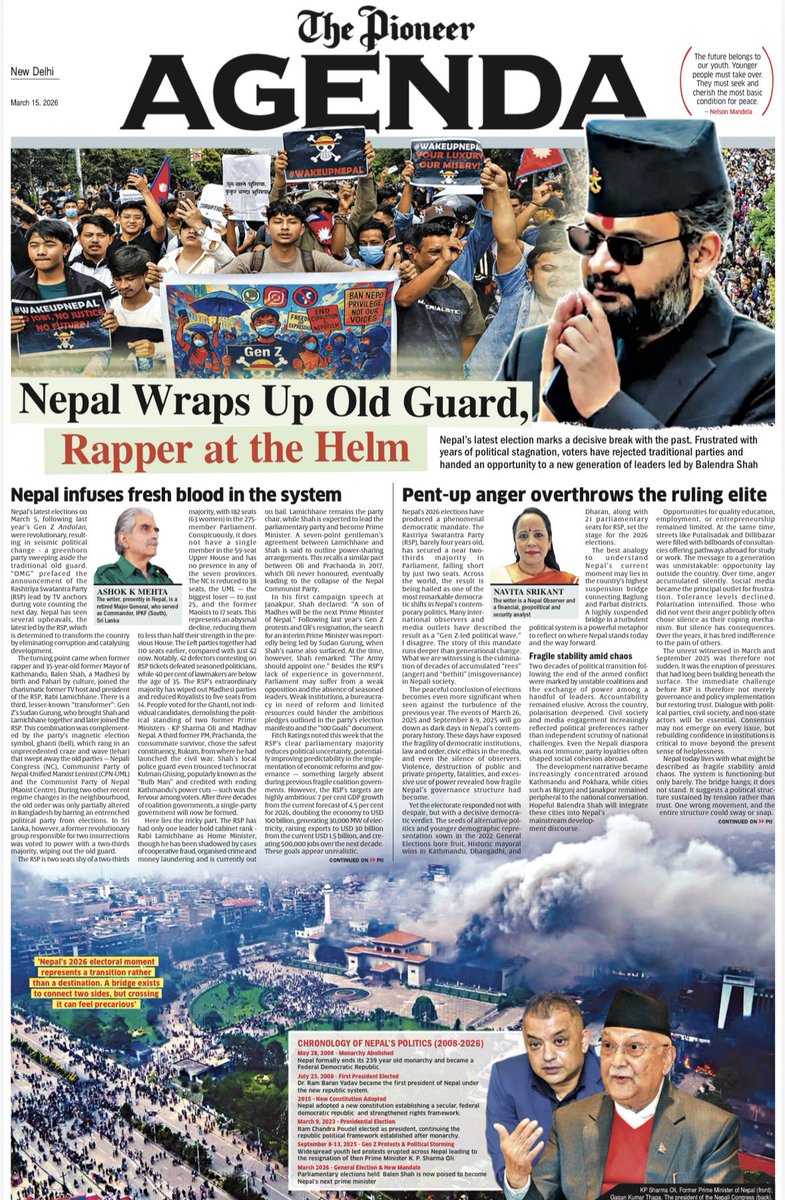
#Nepal#Agenda (Cover Story)
I write for @TheDailyPioneer on Nepal’s Parliamentary Elections, 2026.
Nepal today resembles the world-famous Baglung–Parbat suspension bridge, held by tension, not pillars.
The 2026 verdict reflects decades of anger (rees) at misgovernance (bethiti) and a search for trust in institutions.
This mandate runs deeper than generational politics.
The crossing has begun.
Read more: https://t.co/nrMb8vCmto
@AmbMunu@shisir@MofaNepal@IndiaInNepal
Once the United States relied on the “bait and bleed” principle, a strategy designed to weaken its rivals by drawing them into prolonged conflicts with each other. The same principle now appears to be something China may also seek to exploit.
Washington’s relentless engagement with Iran and its half decade long involvement in the Russia-Ukraine war reduce the strategic gulf, both in hard and soft power between the two rival