AI agents write PRs in minutes, but then we wait for them to be reviewed, and for a human to build confidence to merge them. The missing piece? Production context. Today we're launching Hud Agentic Rollouts 🚀 So you can ship much faster while keeping production safe 💪 @hud_hq
Yesterday we announced @Hud_hq's partnership with @ClickHouseDB. As AI generates more code, for teams to increase *both velocity and stability* coding agents must understand how the code actually behaves in production. ClickHouse+Hud make it possible. https://t.co/tczAU5AIGr
Review was never the goal. It was a proxy for "will this code actually work".
Agents didn't make review pointless. They made reading an unscalable way to answer the question, AND they made it possible to aspire for better verification.
The answer moved to runtime: what ran, what failed, what got slower, what never executed at all.
Drop the proxy. Keep the question.
Cannot help but see the concept of code reviews fading away
Talked with a rock-solid, v experienced engineer who, until recently, reviewed all code their AI generated… till Fable. And figured it’s pointless to do the review, so is stopping doing it, unless it’s for key parts of the product
And this is someone who has always reviewed their and everyone else’s code their whole career
Still unsure what to replace it with as something needs to come instead if code review!
Exciting day for @github users! Building and maintaining agentic workflows within the SDLC just got a lot easier. We've been enjoying this for a while with our customers at @hud_hq, now in public preview!
It's so cool what you can do when @github Agentic Workflows (now in public preview!) and @hud_hq come together. Individual engineering velocity is no longer where the AI bottleneck is - it's in the ability to ship safely to production, bringing in real context needed by agents.
Watch it come to life by my partner and CTO @maywa1ter below.
Many thanks to Idan Gazit and the entire Github team for your partnership, this is exactly the kind of collaboration that pushes the industry forward!
And oh boy, it is such an exciting time to be building software 🤩
Read about the collaboration in the first comment.
The biggest problems in AI-generated code don’t show up in the PR. They show up in production.
In a recent piece, May Walter ( @maywa1ter ), CEO and CTO of Hud ( @hud_hq ), highlights a pattern teams are running into: agents produce clean, correct-looking changes that quietly make systems worse, simply because they can’t see what actually happens at runtime.
A small refactor passes tests and review, but adds extra DB calls to a function running thousands of times per minute. Nothing in the repo catches it, but production pays the price.
That’s the gap. Agents work on static code, while the real signals live in behavior: hot paths, latency, traffic, and dependencies. Adding more prompts or reviews doesn’t fix it, it just shifts the burden to humans.
The fix is giving agents runtime context. When they can see call frequency, latency patterns, and real impact, “optimizations” stop being guesses and start being decisions.
Over time, this turns performance work into a steady stream of small, high-impact fixes instead of a backlog that never gets prioritized. And once feedback loops in, each deploy improves the next decision.
The limitation isn’t the model. It’s the missing context.
Read the full blog here: https://t.co/fJqiG23h32
Most Physical AI models recognize patterns.
They don’t understand the world.
That’s why they fail on edge cases.
BADAS 2.0 is a V-JEPA2 world model trained by @getnexar on real-world videos.
We used the model to find what it didn’t understand, then trained on that.
It generalizes. And we built lite versions so it runs on edge devices, even CPU.
Understanding is the only way this scales.
See how it performs on your own videos. Link in first comment.
Most performance problems don’t get fixed because no one has time to go looking for them.
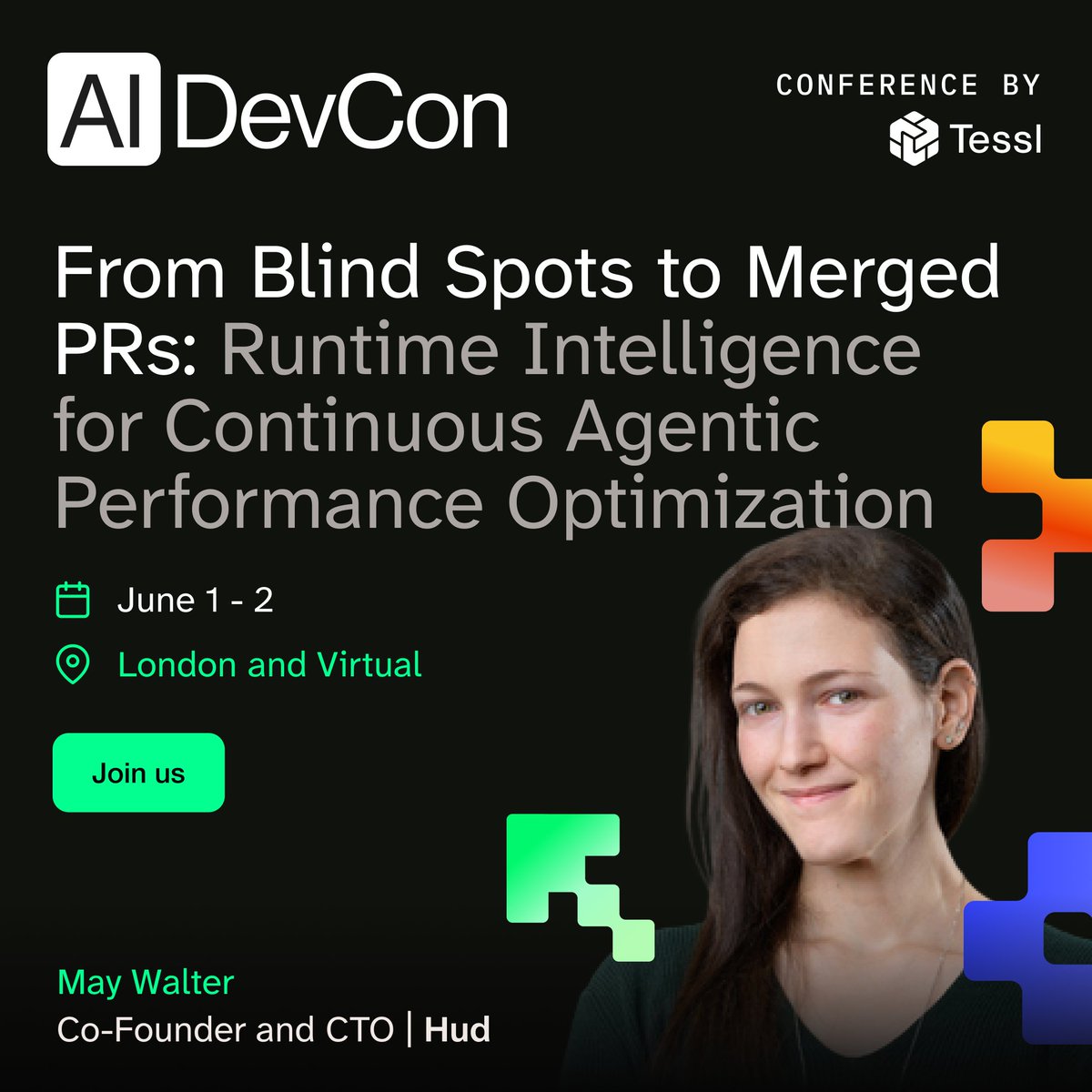
May Walter ( @maywa1ter ) is joining AI Native DevCon London 2026 to show what happens when agents do that work for you.
As Co-Founder and CTO of Hud, May has spent years working deep in runtime systems, security, and production environments. Her work now focuses on bridging a critical gap: connecting what agents generate with what actually happens in production.
In her session, From Blind Spots to Merged PRs, she walks through a real system where agents continuously analyze live runtime data and turn insights directly into fixes.
Not suggestions. Not dashboards. Actual merged improvements.
What this session breaks down
• Why performance issues stay hidden in mature codebases
• How agents can analyze real production behavior, not just code
• A practical approach to identifying high-impact, low-effort fixes
• What it takes to turn insights into reliable, production-ready changes
• How teams can shift from reactive debugging to continuous optimization
This is a concrete, end-to-end example of agents operating inside the SDLC, from detection to deployment, with measurable results.
If you’re interested in moving beyond prototypes and into systems that quietly improve themselves over time, this session is worth your attention.
Join us in London or online: https://t.co/Kl88dtYu4R (use AIND-X-BB-20 for 20% discount)
Sometimes there's a man.
As we scale, and more engineering teams are adopting @hud_hq to bring AI into their engineering work, we aim to bring the world's best talent into our team. We have been trying to lure Haim Yadid (@lifeyx) to Hud since we started the company. Haim is one of the world's top experts on performance optimization and scalability, particularly in Java, and we've been picking his brain since day 1.
And so ... 🥁 ... @maywa1ter and I couldn't be more excited to welcome Haim as our Chief Architect!
Because sometimes there's a man. I won't say a hero, 'cause what's a hero? But sometimes there's a man, and I'm talkin' about Haim here, sometimes there's a man, well, he's the man for his time and place. He fits right in there, and that's Haim.
1/ A quarter has ended at @hud_hq, and oh boy what a quarter it was. There are so many words I can share, but I’ll let the numbers talk.
2x ARR growth QoQ
55% of the growth from existing customers
4x growth in production sessions using Hud
6x MCP calls from AI coding agents
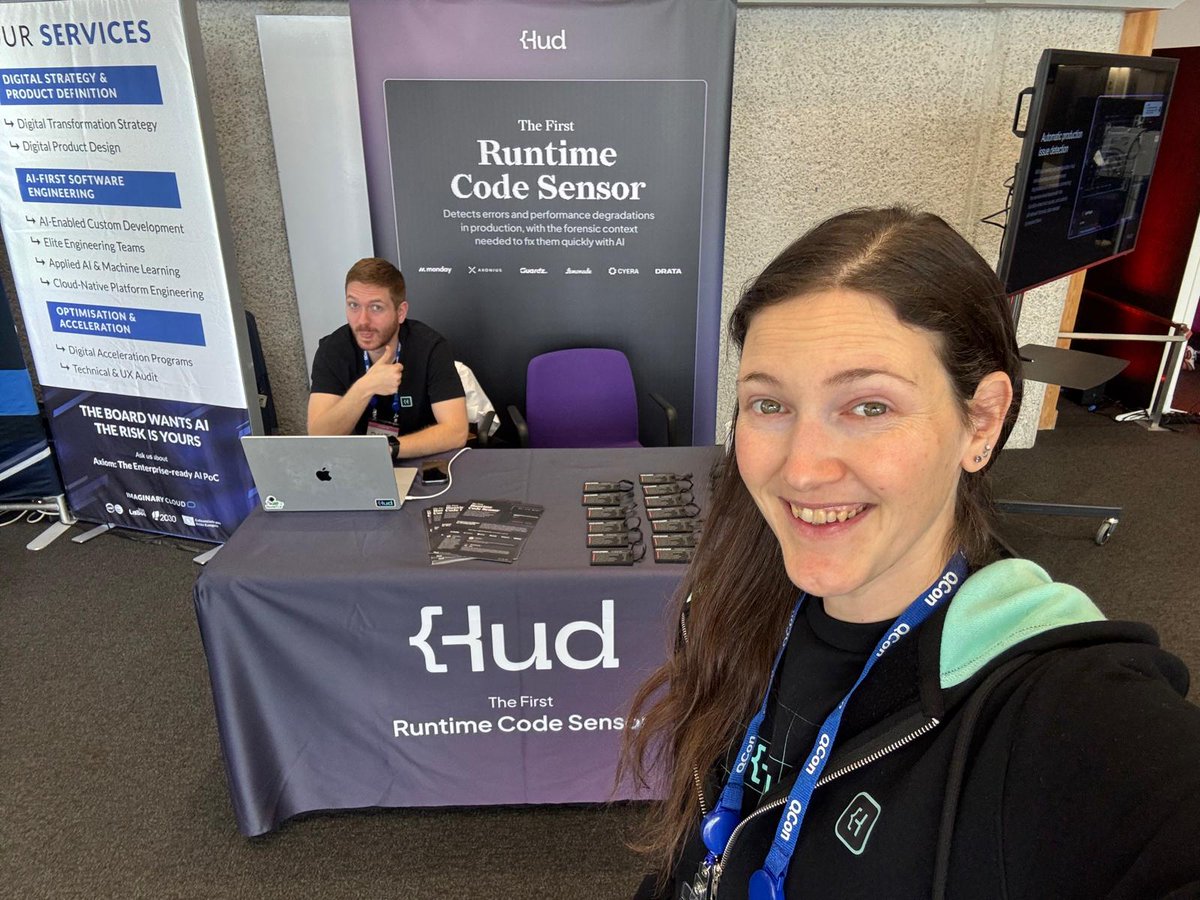
@QCon is officially on with amazing energy!
Giving a talk at 4 PM on runtime guardrails for AI agents in production, including a deep dive into the Amazon dev4 incident that caused by AI-generated code.
Westminster Hall, 4th floor. Or find me at the Hud Booth - #9
Come say hi!
@qconlondon
Virtual Panel - AI in the Trenches: How Developers Are Rewriting the Software Process https://t.co/cXkPcPN73w by @acasals, @maywa1ter, @pcalcado, Mariia Bulycheva, Andreas Kollegger
Oh boy do we agree with #7 by @ttunguz. Agents must be aware of code execution, security vulnerabilities, and data lineage - all in a ubiquitous way. We at @hud_hq are proud to throw our hat into that ring!