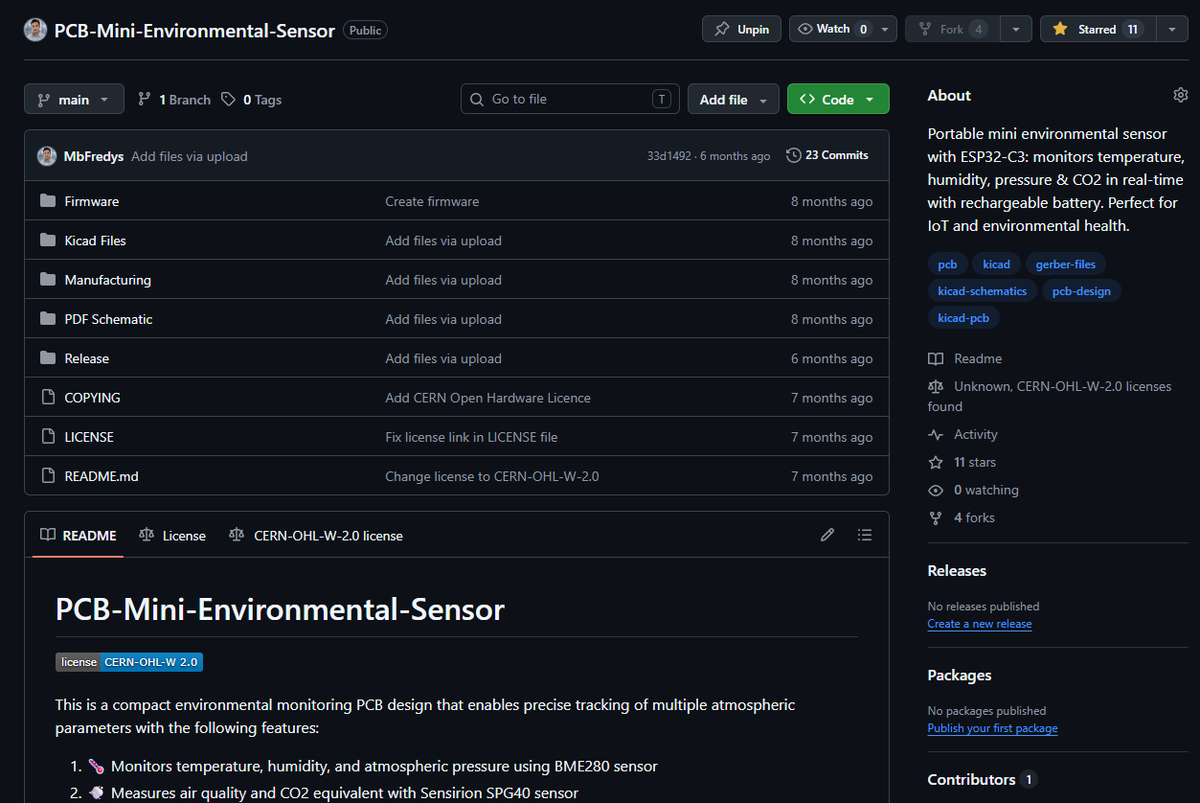
Closed hardware stifles innovation.
That’s why this mini environmental sensor with ESP32-C3 is open source under the CERN-OHL‑2 license.
Schematics, Gerbers, and design files ready to manufacture and modify.
Repository link below.
Third: Interrupted ground planes.
Don't leave continuous ground planes or run power traces under the sensor. On an IoT monitor, care for thermal layout as much as electrical layout.
What other technique do you use?
Second: Thermal isolation.
Cut slots (routed grooves) around the sensor to break heat conduction through the FR4 substrate. Air insulates better than copper or resin. 👇
Serious question:
Do you prefer to completely separate the analog/I2C sensor area from the microcontroller's digital ground plane, or do you trust a single, solid ground plane if the board is smaller than 5x5 cm?
I'm reading your comments. There's an eternal debate here.
If you use a LDO in a battery-powered IoT device in 2026, you're throwing away 30% of your energy as heat.
For this environmental sensor, I used the TPS62203. A synchronous buck converter that approaches 95% efficiency.
Every microamp counts. Choose your silicon wisely.
Designing hardware for the real world isn't about putting expensive components on a 4-layer board.
It's about making an environmental station run for weeks on a toy battery while the power is out.
ESP32-C3, BME280, and SGP40 in a mini form factor. Less is more.
Sometimes robustness is simply about giving each circuit its own environment.
Power electronics live in chaos.
MCUs need peace.
Separating both worlds can be the difference between a prototype and a product.
Hardware lesson:
If your MCU behaves strangely near motors or power stages, don’t blame firmware first.
Your layout and architecture may be the real issue.
Noise isolation is engineering, not luck.
Not every design needs two PCBs.
But when EMI, heat, and transients become serious, separating domains can dramatically improve robustness.
Sometimes simplicity is one board.
Sometimes reliability is two.
A lesson I learned in hardware:
You can’t always “filter away” bad architecture.
If noisy power stages share space with sensitive logic, problems eventually show up.
Good systems start with isolation by design.
When motors, switching loads, or EMI enter the game, keeping everything on one PCB isn’t always the smartest move.
Sometimes, separating power and control is the cleanest solution.
Less noise. More reliability.
Sometimes the best EMI filter is not a capacitor.
It’s physical separation.
When high-current switching, heat, and electrical noise live too close to your MCU, problems appear.
That’s why architecture matters. Clean control. Dirty power. Separate worlds.
In systems with motors or inductive loads, assuming a “clean” electrical environment is a mistake.
EMI + transients + poor current return paths = unpredictable failures.
Robustness doesn’t happen at the end of the design.
It starts with the architecture.
After seeing installations fail for no obvious reason, I learned something:
Electrical noise is not theory.
It’s real.
It’s aggressive.
And it silently breaks systems.
Since then, I design for the worst-case scenario, not the ideal one. That mindset shift changes everything.
Unpopular opinion:
Many “working” hardware prototypes should never be called products.
If you haven’t designed for:
⚠️ electrical noise
⚠️ transients
⚠️ EMI interference
⚠️ real-world failures
You didn’t finish the design.
You built a demo.