💀 Halloween post! "How to create a functional mythology." This is a vampire story I have told no one before. It seemed too dangerous.
The post is also about death, and sorcery, and philology, and The Lord of the Rings, and heroism, and our future.
Been thinking a lot about variations on "The Tolkien Test" for AI (whether an AI can create a coherent epic featuring original characters and an original world.)
(My impression is that current foundational approaches are not asymptotically approaching this capability, but I do not have theoretical reasons why different approaches might not.)
@s_r_constantin Yes, I think that is probably the case! OTOH, some prominent people have claimed to think that having superintelligent AI kill all humans would be good, so.
🤖 Strong agreement: yes, only the most oblivious and obstinate rationalism could lead you to suppose it's sensible to hand over control to AI. Geez. https://t.co/hxcJDmXCDi
Why should we not yield full control of our future to an entity vastly more powerful and intelligent than us? Many people relying purely on "logic" think opposing such a future is a form of prejudice and lack of open-mindedness -- indeed I have heard this argument made increasingly in certain circles.
But David makes a good point here: many of our intuitions around meaning and other such fuzzy concepts may encode ways of protecting us against death or other terrible outcomes, even when we cannot fully explain them from first principles.
David gives the example of our desire not to lose our jobs. I would add, in the context of AI handoverism, the reluctance of most humans to cede control to an entity vastly more intelligent than ourselves. My guess is that this instinct captures something about the dangers of placing ourselves entirely at another entity’s mercy.
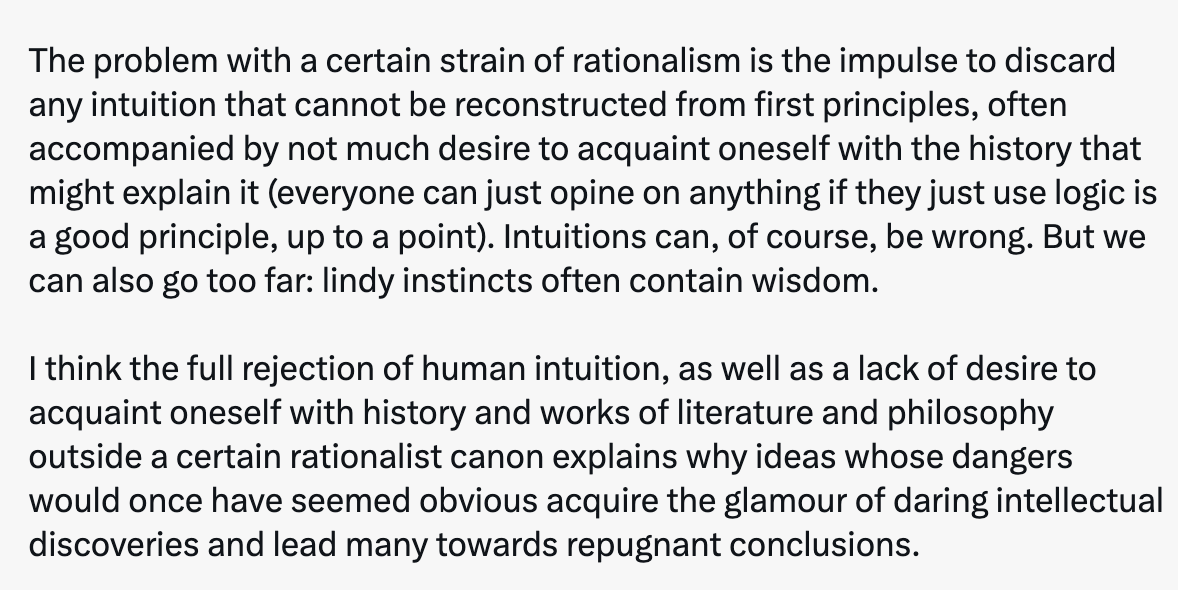
The problem with a certain strain of rationalism is the impulse to discard any intuition that cannot be reconstructed from first principles, often accompanied by not much desire to acquaint oneself with the history that might explain it (everyone can just opine on anything if they just use logic is a good principle, up to a point). Intuitions can, of course, be wrong. But we can also go too far: lindy instincts often contain wisdom.
I think the full rejection of human intuition, as well as a lack of desire to acquaint oneself with history and works of literature and philosophy outside a certain rationalist canon explains why ideas whose dangers would once have seemed obvious acquire the glamour of daring intellectual discoveries and lead many towards repugnant conclusions.
@s_r_constantin Important questions!
Big pic: which "some things" to delegate to machines is key; as is reversibility, like you say.
Technically: the "mashup" process is not at all understood, and "all the books and articles ever written" include a lot of terrible ideas we don't want used.
Announcing a major milestone achieved by my team @GoogleDeepMind: we have proven key security properties of the machine code underlying the Signal messaging protocol. This is the first time the actual production code of a widely deployed protocol has been formally verified – by any method, with or without AI – and at this depth.
More than a research breakthrough, it’s a prime example of how frontier AI can be a force multiplier to counter the speed and scale of modern cyber threats.
Formal verification offers a higher standard of security; however, it’s extremely complex and time consuming, which is why in many cases it’s considered to be impractical. Similar efforts could take teams decades of combined effort. We did it in a month’s time.
Using AlphaProof Code, Google DeepMind's new agentic framework for formal verification that runs on LLMs including Gemini Carbon, we verified the Signal protocol down to the actual code running on devices. This milestone lays the groundwork for a future in which vital systems, from medical device firmware to power grid software, ship with mathematical proof that their protections work.
Reaching that future will take continued research from our community. In that spirit, we're open-sourcing our formal specifications and verification artifacts so others can build on this work.
On a personal note, this moment is of deep significance to me. I started my own research journey more than two decades ago as an intern working on checking the consistency of complex software systems. Seeing this grand challenge made practical with modern AI is extraordinary.
I'm extremely proud of my team members: Swarat Chaudhuri, Andrew Ferraiuolo, Anton Kovsharov, Tej Chajed, Sam Schlesinger, Karn Seth, Jonathan Katz, and Charles Sutton for taking on this grand challenge and delivering, and grateful to the Signal team for their partnership.
https://t.co/kN1eRYQ8fF
@s_r_constantin Important questions!
Big pic: which "some things" to delegate to machines is key; as is reversibility, like you say.
Technically: the "mashup" process is not at all understood, and "all the books and articles ever written" include a lot of terrible ideas we don't want used.
Of Patrick's trilemma I think the obv one to sacrifice is utilitarianism - IMO it's been clear for a long time that it is going to have really perverse conclusions when taken too far, and the interesting/hard question is what is "too far." E.g. @tylercowen raised this critique here https://t.co/0jbyUB5HeA ; I also see this as a big part of the implicit argument here: https://t.co/Po5pWxN5o4
So why do the EAs & other moderns adopt this historically odd & recent approach? The answer, is that they're asking you to construct a utility function. Now, why would someone approach a project of moral improvement with the utility function, of all things, as a tool?
@_Srijit@beenwrekt This seems an excellent question! "Recreational mathematics" is a recognized type of play. I suspect most professionals regard it as trivial, and I probably do too. Generally I advocate "serious play." The question might be: what are meaningful stakes for exploration?
Reflections on @beenwrekt's new post about the AI disproof of the Exponential Time Hypothesis.
"Math may get wrecked in a different way. Not just the activity, the work of mathematics, but the subject matter itself. 🎃 Happy Halloween! Trick or Treat?"
Many hopeful delusions breaking up in the sky now, with debris starting to arc to earth. The repudiation of MAGA and/or AI might precipitate a broader cultural reset. Wondering if this is a historical turning point.
Fearing "loss of meaning" from AI job loss sounds trivial vs. fearing death. But I think desire for meaning evolved to prevent being ostracized, maybe fatally. Most sources of meaning (e.g. helping others, being skilled) are also reasons to support you. So it's a similar fear.
@anielsen108@AlexKrusz Yes; I agree on the timescale. My sense is that cultural/political/economic historians may consider now a breakpoint at that temporal resolution; the end of a several-year trajectory.
@AlexKrusz Either or both: the financials don't work, stocks collapse, recession ensues, AI gets blamed, and/or AI systems do enough bad enough things that everyone decides it's too unsafe to use except maybe in special cases.
@OortCloudAtlas Saw this cute little guy near the summit of Coffintop Mountain this afternoon. I don't remember having seen any like this in the area before. About two inches in diameter; should have stuck a thumb in the pic for scale!