A huge congratulations to Dinithi on earning a Graduate Student Teaching Award (GSTA)! 🎉 This well-deserved recognition celebrates outstanding contributions to teaching undergraduate courses and a strong commitment to student success.@ualbertaScience#UAlberta#Chemistry
Want a detailed step-by-step guide of our nucleoside analogue (NA) synthesis platform? Check out our Nature Protocol (https://t.co/pkMOsm8pvr) where we discuss its use on 85g scale and its expansion to other modifications/nucleobases. @Thirupathichem
We are also looking to hire a technician (small molecule purification) to start as soon as possible #ChemTwitter. Email [email protected] with your CV. Only Canadian citizens and PRs will be considered for this position.
We are currently hiring for a postdoc position (organic synthesis) to start as soon as possible #ChemPostdoc#ChemTwitter. Email [email protected] with your CV and research summary. Only successful candidates will be contacted.
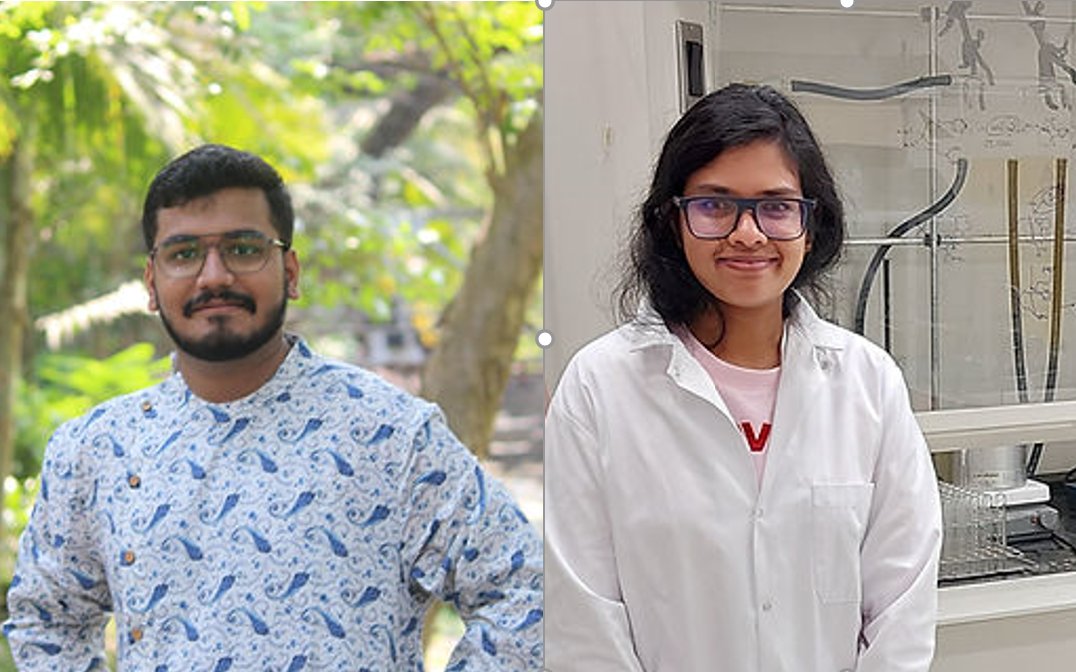
We are proud of lab members @Subhojit_JU_UoA (left) and @DinithiGR (right) for both winning an Alberta Graduate Excellence Scholarship (AGES). Congrats Jit and Dinithi! Keep up the great work! @ualbertachem
We are currently looking for a postdoc (organic synthesis) to start winter 2026 or sooner @Meanwell_Lab#ChemPostdoc#ChemTwitter. Email [email protected] with your CV and research summary. Only successful candidates will be contacted.
Check out our most recent work on chemoselective electrochemical birch carboxylation of pyridines - now published in Green Chemistry https://t.co/ZddewjaKxm
The X-Chem Research Excellence Award is presented to a scientist who has made a distinguished contribution to medicinally relevant organic or biophysical chemistry in Canada. Congrats to Matthew Macauley of @UAlberta on being the recipient of this award. https://t.co/JApot2CcLS
Exciting news for prospective graduate students! We will host your visit to Edmonton and our department during our visiting weekend on Mar 7-8, 2025 (free trip for those eligible!). For eligibility and registration, visit our website at: https://t.co/wySuV2yKqT
We are hosting an online information session about the chemistry graduate programs at the University of Alberta @11:30am MT on Jan 20th. Sign up here: https://t.co/QYV6apySBv
Thank you to Global News Edmonton @GlobalEdmonton for covering our work on developing better ways to make nucleoside analogues. Check out the story here: https://t.co/Bgy4XIYafc
Finally, RADICAL CROSS COUPLING without the exogenous REDOX. We disclose in @ChemRxiv (https://t.co/FYy6i1J7p9) a broadly general platform for achieving transformations that normally required excess metallic or chemical reducing agents or photochemical setups (and their requisite catalysts) or potentiostats for electrochemistry. Now, such transformations can be accomplished with the same ease that one conducts a Suzuki coupling. You can scale up (its homogeneous) or scale down (use cheap parallel screening plates). Moisture is tolerated and base metal catalysis is used. As the best engineers like to say, "The best part is no part". Now, chemists have the option to remove the redox part from radical couplings.
Quick Summary: Sulfonyl hydrazides are disclosed as versatile radical precursors as exemplified with seven new C–C bond forming, redox-neutral cross-couplings with: (1) activated olefins, (2) alkyl halides, (3) redox active esters, (4) aryl halides, (5) alkenyl halides, (6) alkynyl halides, and (7) a trifluoromethylating reagent to forge C(sp3)-C(sp3), C(sp3)-C(sp2), and C(sp3)-C(sp) bonds. Sulfonyl hydrazides are stable and usually crystalline substances that can be accessed in a variety of ways including transiently from hydrazones to achieve a net reductive arylation of carbonyl compounds. Exogenous redox (chemical, photo/electrochemical) additives are not necessary as these functional groups serve the dual role of radical precursor and electron donor. The operational simplicity (homogeneous, water tolerant, dump-and-stir) and practicality of the method are demonstrated as well as applications to streamlining synthesis and mild late-stage functionalization.