I'm going to be honest with you.
Medicine is broken. Not because doctors are bad people. but because the system has turned patients into numbers. 7-minute appointments. Symptom suppression instead of root cause. And a healthcare system that profits more from sick people than healthy ones.
I've spent years studying this. The more I learned, the more frustrated I got, not at the complexity of medicine, but at how deliberately complicated it's made to seem.
At the same time, the internet filled that gap. With noise. With influencers selling protocols they don't understand. With fear-mongering. With contradicting headlines every week. People don't know what to eat, what to measure, what to believe and honestly, that's not their fault.
That's why this account exists.
Not to replace your doctor. But to make sure you walk into that appointment knowing the right questions. To help you understand what your labs actually mean. To cut through the noise and give you what the research actually says, without the agenda.
I'm not here to sell you a supplement stack or a course.
I'm here because I got into medicine to help people. And this is the most direct way I know how to do that.
If that's what you're looking for, you're in the right place.
Nice to see this signal show up in a large real‑world cohort with autoimmune disease on board. If it holds up, GLP‑1s may end up being one of the few obesity therapies that not only cut weight and CV events, but also lower thrombotic and flare‑related ER burden in a group that’s usually excluded from trials.
I’m with you on the hierarchy! sleep, food, muscle and movement do 90% of the heavy lifting. But once those are in place, the synergy with the “exogenous stuff” is hard to ignore, especially for people who were locked out of care by shame or needle‑phobia. The uncomfortable part is that we’ve made it radically easier to add powerful molecules than to fix the environments that broke metabolism in the first place.
Agree the influencer version of cold plunges is mostly cosplay, but this overcorrects. Huberman was popularising a small cold‑exposure study, not presenting a 250% brain‑dopamine RCT, and both fanboys and haters are stretching it. There *are* measurable autonomic and mood effects from acute cold in some people; the real questions are cardiac risk, interference with hypertrophy if you do it post‑lifting, and the fact the data are tiny and highly selected. Writing it all off as “performative waste” is about as unscientific as treating an ice bath like a life‑maxxing panacea.
Fair point on IL‑1β, that’s one of the few pathways where we actually have randomized data hinting at large effects on lung cancer risk. My only concern is that many read “50% risk reduction” on one axis and then assume they can stack antioxidants, vitamin D and melatonin as if the system were linear and fully mapped; we’re nowhere near that level of mechanistic certainty yet, especially in radiation or infection‑driven cancers.
Agree it’s rarely just one thing 3am awakenings can be sleep apnoea, cortisol rhythm, alcohol, reflux, anxiety, all of the above. My point was that in metabolically inflexible people nocturnal dips in glucose are a massively under‑recognised trigger for the “bolt‑awake with racing heart” presentation I see in clinic, and they’re easy to miss if you never look at CGM/overnight sugars alongside those other factors.
@WilliamWallace this data is unforgiving but necessary. ethanol breaks down into acetaldehyde, which actively drives dna damage and wrecks mitochondrial function. the idea that a daily dose of a known carcinogen was somehow "cardioprotective" was always marketing, not biology.
people think it’s anxiety or insomnia, but it’s usually just nocturnal hypoglycemia. if you lack metabolic flexibility, your brain panics when liver glycogen runs low around 3am. it dumps adrenaline and cortisol to force glucose release. your racing heart is literally an endocrine emergency response to a localized energy crisis.
you are actually spot on about the glucagon receptor. glp-1 and gip handle the appetite early on, but the raw energy expenditure and lipolysis come from glucagon. it just takes those first 5 weeks of titration to build up the plasma concentration needed for that specific mechanism to fully override your baseline metabolism.
Ionizing radiation, ROS and inflammation are linked to cancer, but this isn’t a simple pathway you can “turn off” with high TAC, vitamin D or melatonin. Evidence for antioxidant supplements in cancer prevention is mixed – some trials even showed increased risk – and data on vitamin D/melatonin are mostly preliminary and experimental, so we cannot claim they prevent radiation‑ or COVID‑related cancer.
Tbh that makes perfect sense. the half-life of tirzepatide is about 5 days, so by day 8 or 9, the serum concentration in your system is dropping significantly.
the fact that the food noise starts creeping back in right as the drug clears your system is literally just pharmacokinetics in action. it really shows how mechanical that signaling actually is.
For many patients, “food noise” isn’t lack of willpower, it’s a 24/7 signal crowding out every other priority.
Quieting that signal with sleep, circadian hygiene, protein, movement – and in some cases GLP‑1s – is often what finally lets their prefrontal cortex back in the game.
The other uncomfortable truth is that many of the people who end up on retatrutide have already “failed” years of lifestyle prescriptions in an environment that quietly drives insulin resistance. A 28–30% pharmacologic weight cut is huge, but if we don’t use that window to rebuild sleep, food environment, protein, muscle and movement, we’re just putting an ultra‑powerful band‑aid on the same system that broke them in the first place.
@Amonhohohotep the fact that the lowest dose of tirzepatide shut it off instantly proves it was always biology and not a lack of discipline.
I think it is time for the medical community to actually understand the mechanisms so we can start helping patients instead of just blaming them
The sweet spot is much lower than what most people actually think. It's not about doing high intensity training 24/7. Around 60–120 minutes of lifting per week was where all‑cause, CVD and neuro mortality were lowest, and going beyond that didn’t add extra years. The big win here came from combining it with regular cardio. Honestly for most of my patients the problem isn’t too much time in the gym, it’s zero resistance training and almost no walking so fixing that gap beats any longevity hack.
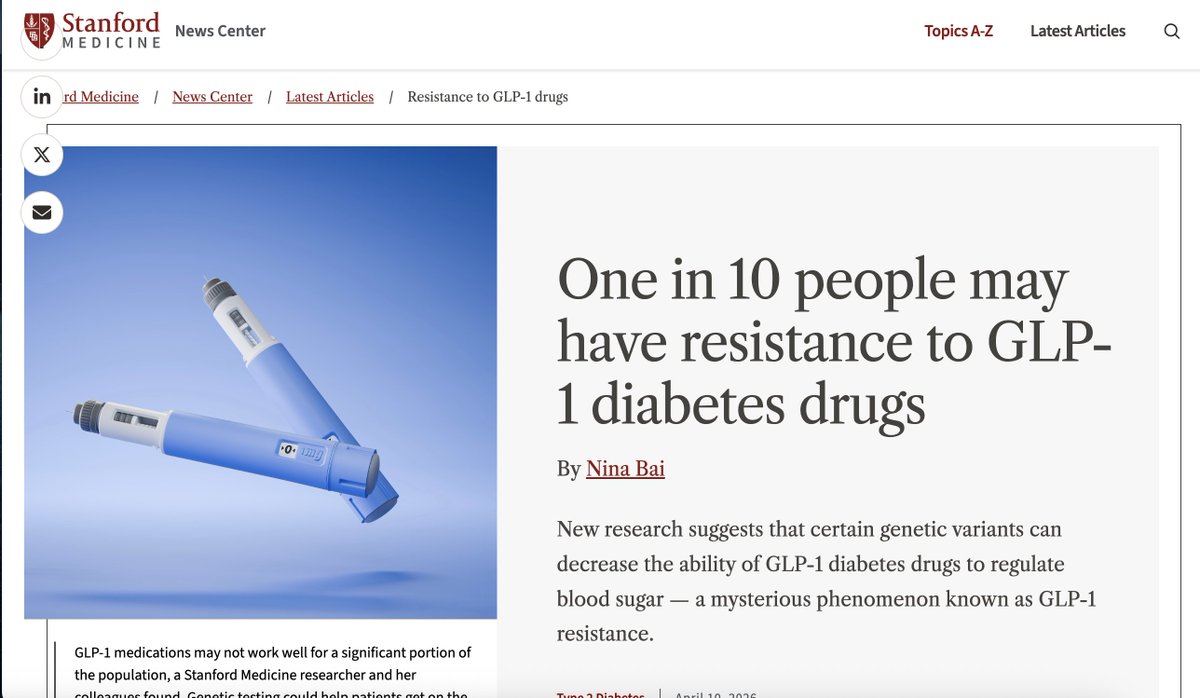
Up to 1 in 10 people may be genetically resistant to GLP‑1 drugs like Ozempic.
A Stanford‑led Genome Medicine study found that some patients pump out more GLP‑1 yet get less effect and weaker HbA1c drops despite good treatment and no similar problem on metformin or other diabetes meds.
In a world where we blame “non‑compliance” when GLP‑1s don’t work, this is a big shift: for a minority of people the problem isn’t discipline, it’s wiring and the next step is using genetics to decide who should even start a GLP‑1 and who needs a different playbook.
This is the part most people underestimate: your 30s and early 40s are when blood pressure, sleep debt, visceral fat and inactivity quietly lay the groundwork for “sudden” heart attacks later on. You don’t need exotic nitric oxide stacks for that , boring habits like 7–8 hours of sleep, walking after meals, resistance training, BP checks and a mostly unprocessed diet move the needle far more than any capsule ever will.
The dose–response curve in that paper is interesting because it tops out earlier than many people think: ~90–120 min/week of resistance training was where all‑cause, CVD and neuro mortality hit their lowest point – with no extra benefit beyond that – and the biggest win came when people also did ~5–15 h/week of moderate‑to‑vigorous aerobic work. Clear takeaway : if you’re doing zero strength work, start; if you’re already lifting 3×/week, more isn’t necessarily better instead add some aerobic capacity
@DrJesseMorse The nitric oxide story is mechanistically interesting, but the clinical signal is messy. Some large cohorts report higher MI/dementia risk with long‑term PPIs, others show no increase or even lower dementia risk after better adjustment for comorbidity and polypharmacy.
@WilliamWallace Seeing vitamin C as a required manufacturing input for cortisol and catecholamines – concentrated in brain and adrenals and mobilized during acute ACTH stimulation – explains stress‑related “deficiency” symptoms much better than the usual generic “immune support” story