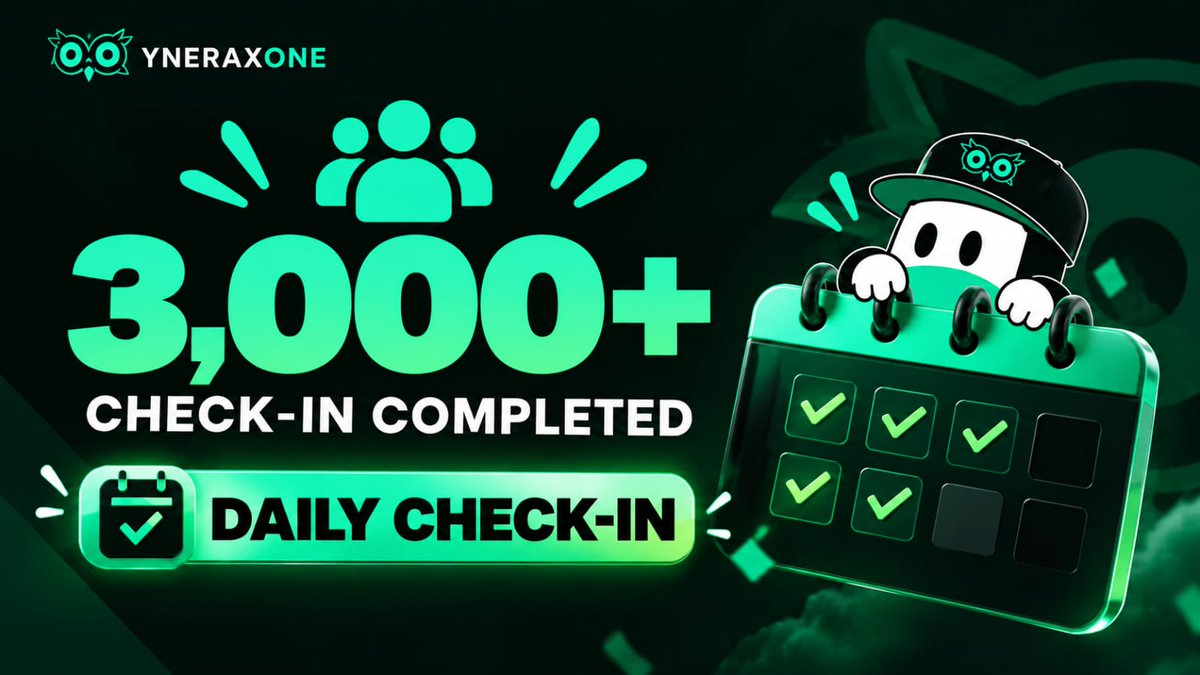
3,000+ users have already completed their check-in✅
Rewards will be distributed to real users only. 🎁
If we reach 20,000 real users, only those 20,000 will be rewarded
Huge news! The Ynerax Early User Campaign is officially live! 🔥
💰 $150k USDT Pool + 4M $YNX Tokens up for grabs.
👥 20,000 Winners!
Complete easy tasks and start earning entries now:
https://t.co/D6jxQKQk11
@yneraxone
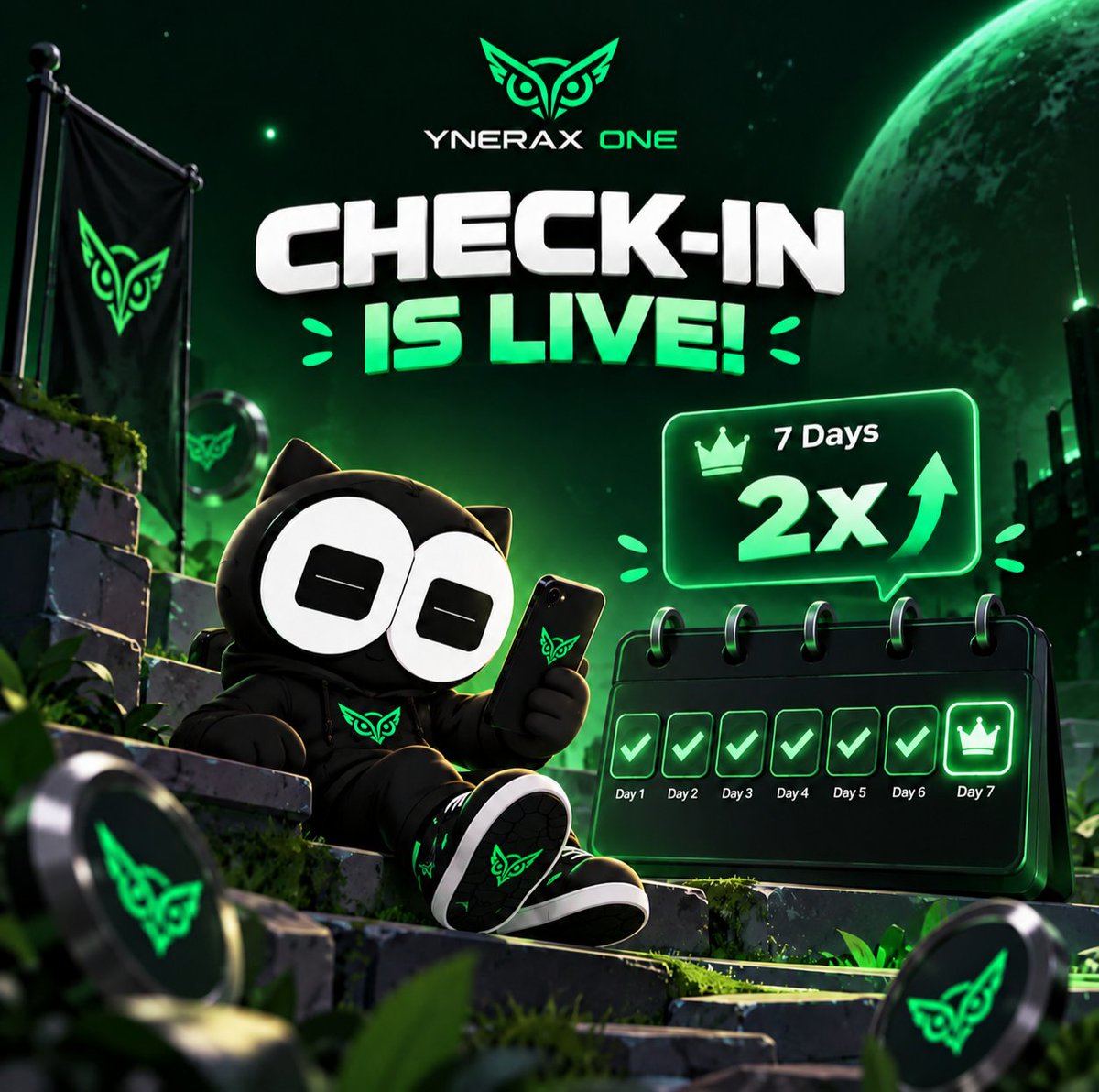
🚨On-Chain Check-In Is LIVE
We’ve noticed an increase in fake referrals, so we’ve introduced On-Chain Check-In to help identify real users and reward genuine activity.
⛓️ Check in on:
• BNB Chain
• Robinhood Chain
• Base Chain
🎯 Daily Check-In: +100 Points
Multiplier:
Day 1 → 1.2×
Day 2 → 1.4×
Day 7 → 2.2×
Check in at least 3 days to qualify for rewards.
YneraX One Early User Giveaway
The YneraX One Early User Campaign is live, featuring a total reward pool of $150,000 USDT and 4,000,000 $YNX tokens.
Reward allocation
$50,000 USDT for the top 2,000 leaderboard participants.
$100,000 USDT distributed to 20,000 randomly selected winners.
4,000,000 $YNX allocated across leaderboard rewards, community rewards, and special bonuses.
How to participate
Sign in with X, complete tasks, and invite friends to earn more entries. Your entries determine your leaderboard rank.
Participate: https://t.co/6BuLomn8oZ
Full details and rules: https://t.co/bGWmzFww3M
Campaign closes: October 15, 2026, at 14:44 UTC.
@DeepSafe_AI is building a robust foundation for verifiable AI outputs and secure cross-chain data. Exciting times ahead for the future of decentralized verification! 🚀🔒 #DeepSafe#AI#Web3#Crypto Security
@DeepSafe_AI
On 24 August, a proposal on Neutron titled "TestProp: Preparation for AIATO: AI Agent Takeover" asked governance to make one address the admin of ten contracts, among them six Astroport pools and two Drop contracts. When voting closed on 31 August, it was rejected. Roughly 10.4 million NTRN voted no; about 0.32 million voted yes.
On 19 September, proposal 9, "AIATO: AI Agent Takeover. Phase 1: Agent Admin Registration", asked for the same ten admin changes to the same address, plus an eleventh. It was filed as an expedited proposal and passed when voting closed on 22 September at 02:24 UTC, with about 37.3 million NTRN voting yes.
Cosmos Hub validators halted the Hub to limit losses of ATOM moved there from Neutron, and say the funds secured at restart are held in a community validator multisig.
None of this was hidden. From 24 August, the title, the ten contracts and the address that would become admin were public on-chain. From 31 August, so was the rejection.
The August vote said no to that proposal. It did not stop the same request from being filed again nineteen days later and passing. It ended a vote. It did not end the attempt.
Proposal 5: https://t.co/c1atRWPk16
Proposal 9: https://t.co/7LorAITXVB
Cosmos Hub halt: https://t.co/11iqGhmtsp
Cosmos Hub restart: https://t.co/kNhbpbafrG
#DeepSafe #Web3Security
As AI and Web3 continue to converge, trust and data integrity are more critical than ever. @DeepSafe_AI is building a robust foundation for verifiable AI outputs and secure cross-chain data. Exciting times ahead for the future 🚀🔒 #DeepSafe#AI#Web3@DeepSafe_AI
TokenB Wallet makes Web3 simple. Chat with AI to trade, manage assets, and use DApps. Market analysis delivered straight to you. The future of crypto is here. #TokenB#AIWallet#Web3@TokenB_Wallet#valhalla
On 24 August, a proposal on Neutron titled "TestProp: Preparation for AIATO: AI Agent Takeover" asked governance to make one address the admin of ten contracts, among them six Astroport pools and two Drop contracts. When voting closed on 31 August, it was rejected. Roughly 10.4 million NTRN voted no; about 0.32 million voted yes.
On 19 September, proposal 9, "AIATO: AI Agent Takeover. Phase 1: Agent Admin Registration", asked for the same ten admin changes to the same address, plus an eleventh. It was filed as an expedited proposal and passed when voting closed on 22 September at 02:24 UTC, with about 37.3 million NTRN voting yes.
Cosmos Hub validators halted the Hub to limit losses of ATOM moved there from Neutron, and say the funds secured at restart are held in a community validator multisig.
None of this was hidden. From 24 August, the title, the ten contracts and the address that would become admin were public on-chain. From 31 August, so was the rejection.
The August vote said no to that proposal. It did not stop the same request from being filed again nineteen days later and passing. It ended a vote. It did not end the attempt.
Proposal 5: https://t.co/c1atRWPk16
Proposal 9: https://t.co/7LorAITXVB
Cosmos Hub halt: https://t.co/11iqGhmtsp
Cosmos Hub restart: https://t.co/kNhbpbafrG
#DeepSafe #Web3Security
Benefit-focused / Straight-talk style
No more “trust me bro” for AI outputs or cross-chain messages.
DeepSafe turns verification into pure cryptography — Ring VRF picks the checkers, TEE locks the process, done. Simple, trustless, solid.
#DeepSafe@DeepSafe_AI
Short & punchy / Meme-adjacent style
AI said it. Chain showed it. Still not enough?
DeepSafe verifies both without asking permission. Cryptographic randomness > vibes.
#DeepSafe#Trustless
A draft posted to bitcoin-dev this month reworks one small piece of taproot backup. It sits in an individual fork, hasn't been assigned a BIP number, and is still in its earliest form.
The draft addresses backup for unspendable internal keys. One existing approach it cites as motivation is to choose a random r and retain it, so the internal key can be recomputed later.
The draft's mechanism derives a chain code from a tagged hash of a normalized wallet policy. That chain code, the fixed NUMS point H, and a selected derivation path together determine the internal key — in a step the draft describes as being done "without additional secret material."
Its Security considerations section states two things: "The policy and selected derivation are enough to reproduce the internal key," and, in the same section, "Seed backups alone do not reconstruct the policy."
Read narrowly, what the draft changes is which inputs are needed to reconstruct that internal key.
Draft: https://t.co/IiCRQuQPcv
@DeepSafe_AI Short & punchy / Meme-adjacent style
AI said it. Chain showed it. Still not enough?
DeepSafe verifies both without asking permission. Cryptographic randomness > vibes.
#DeepSafe#Trustless
How do you actually trust what an AI agent tells you on-chain?
Random cryptographic selection + TEE makes DeepSafe the quiet backbone for verification that doesn’t ask you to believe anyone.
#DeepSafe#Web3Security@DeepSafe_AI
Ever wondered how to verify AI outputs or cross-chain data without trusting anyone?
That’s exactly what DeepSafe nails with cryptographic randomness, Ring VRF, MPC & TEE. Trustless verification for the win.
#DeepSafe#Web3Security@DeepSafe_AI
A draft posted to bitcoin-dev this month reworks one small piece of taproot backup. It sits in an individual fork, hasn't been assigned a BIP number, and is still in its earliest form.
The draft addresses backup for unspendable internal keys. One existing approach it cites as motivation is to choose a random r and retain it, so the internal key can be recomputed later.
The draft's mechanism derives a chain code from a tagged hash of a normalized wallet policy. That chain code, the fixed NUMS point H, and a selected derivation path together determine the internal key — in a step the draft describes as being done "without additional secret material."
Its Security considerations section states two things: "The policy and selected derivation are enough to reproduce the internal key," and, in the same section, "Seed backups alone do not reconstruct the policy."
Read narrowly, what the draft changes is which inputs are needed to reconstruct that internal key.
Draft: https://t.co/IiCRQuQPcv