more TRAnsients & Pulsars group @OfficialUoM. Commensal MeerKAT observations - searching for fast radio transients in real time. Funded by @ERC_Research
Aw yesss! We have your Tuesday @arxiv reading list sorted!
We've got localised FRBs https://t.co/fE0rwHtrUh https://t.co/HXdeT26V4w, a sample of FRBs https://t.co/05opFsMaMu and localisation methods https://t.co/zfvFn4aP7j ! 🥳🌟
You can read about this cool result lead my @MeerTRAP's Mayuresh Surnis in MNRAS https://t.co/WaQVtBfnUH soon and available right nowon @arxiv https://t.co/tQzzigUKte 🥳😎
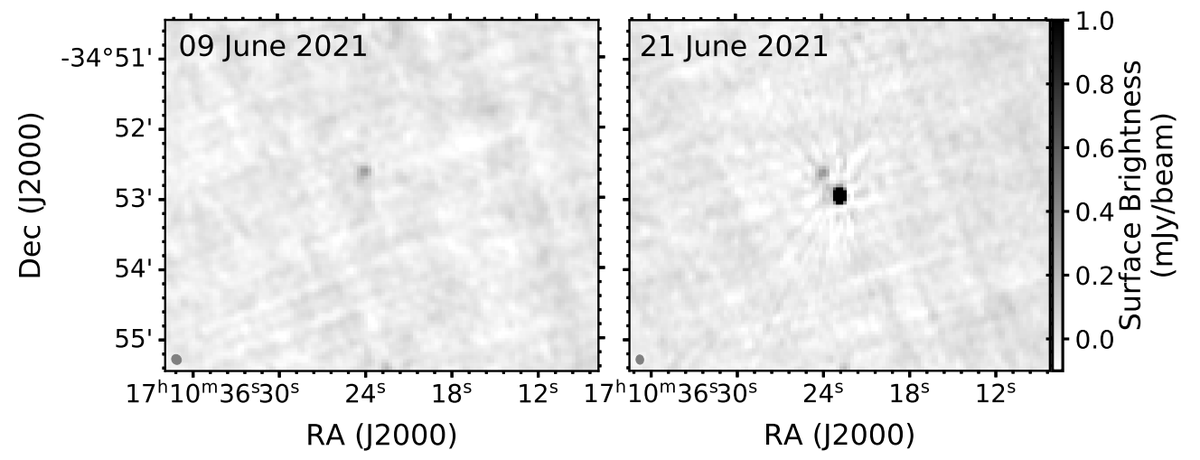
In this paper, teamwork made the dream work for sure! @MeerTRAP found the FRB while we were co-observing with @ThunderKAT_MLSP. So MeerTRAP detected it, then we used ThunderKAT imaging to find it's position! #teamwork
Last but certainly not least, we have FRB 20210405I, the first fast radio burst where we know the position to better than an arc-second! https://t.co/fE0rwHsU4J
@fabjankowski This paper explores how much of the sky @MeerTRAP has covered so far & how many FRB's we've found. This gives us an idea of the FRB rate, what the population we're finding looks like & how that all fits in with other teams and telescopes
And the papers keep coming! @fabjankowski led this one that shares *3* new MeerTRAP fast radio bursts (FRBs), investigates the FRB sample, and presents properties of the MeerTRAP survey so far!
https://t.co/05opFsMaMu
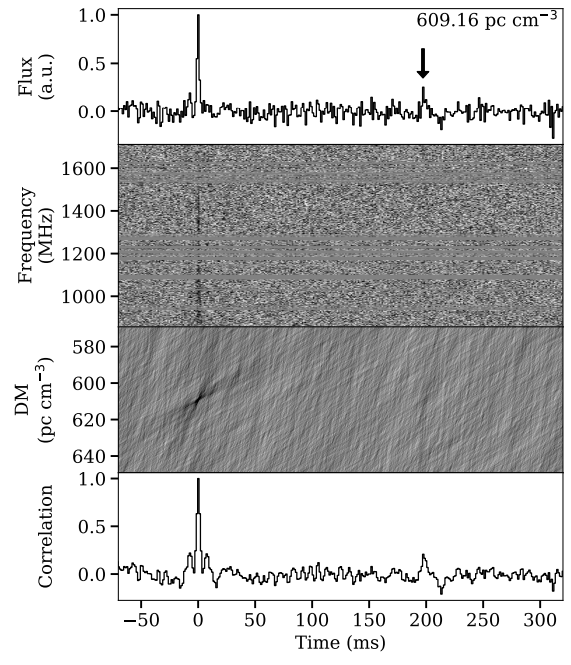
@fabjankowski One of the three new FRBs presented here looks like it has a faint post-cursor, or an extra little peak/burst that came after the original bright burst
@ManishaCaleb@arxiv@SKA_Africa Both of these things, large scattering and bifurcation, are hints that this FRB might be a repeater. We just haven't caught it repeating yet. Hopefully if we keep checking on it we'll catch it repeating!
@ManishaCaleb led one of our latest @arxiv papers on an FRB that looks like a repeater, but hasn't repeated yet 🤔 Like this gif; we can't tell right now if it'll turn out to be a one-off goat or a repeating unicorn
https://t.co/HXdeT26neY
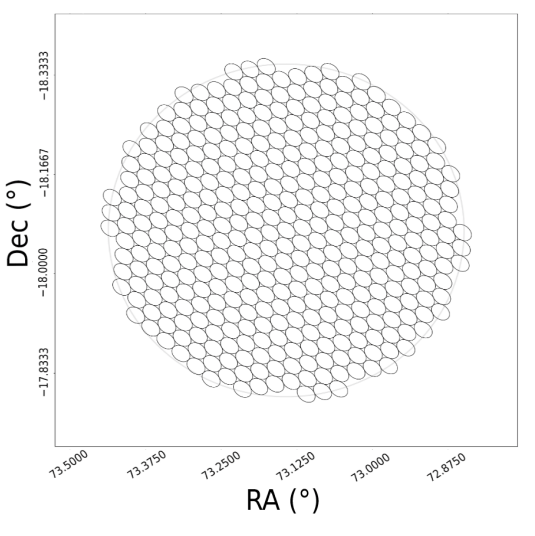
This method is called Tied-Array Beam Localisation or TABLo and is extra handy if you can’t save big chunks of data from your telescope by doing localisation via imaging. Want to use TABLo? Check out Tiaan’s @github repo: https://t.co/aWFADkPBiJ
With the @MeerTRAP pipeline we can (partially) fill our one big beam with more than 700 smaller beams, like adding pixels to your camera. @MC_Bezuidenhout developed a fancy way of using all those smaller beams to get a really good idea of where a flash of radio light comes from.