Just published on @Medium for the first time in 9 years.
What turning 50 taught me about leadership, listening, and the second curve.
The village shaped the first 50 years. I can't wait to see what we build together in the next.
https://t.co/tOVOFhNIUi
4 strategies to actually maximize AI investment: focus on ROE, upskill with the right training, elevate your model users, and optimize your tech stack:
https://t.co/6I7pu6dkA8
Organizations maintain an average of 125 different SaaS applications. Most do not add real value.
AI is on track to repeat that same mistake unless leaders get intentional about how they implement it.
The fix is not more tools. It is shifting focus to Return on Employee, the idea that AI success should be measured by satisfaction and fulfillment, not just productivity.
Less than half of organizations currently offer AI-specific training. That gap is where adoption quietly fails.
The intern who got the job did not stand out because of her technical skills.
She got it because she talked passionately about growing spring onions.
Angela Chen, Microsoft Communications Lead, calls this your most underrated career asset.
In a world where AI is accelerating change faster than most can adapt, the professionals who thrive are not the ones with the most polished résumés.
They are the ones who know themselves, advocate clearly, and keep growing through uncertainty.
Leaders who get this right will attract and retain the talent that others are quietly losing.
Here is how to build career pathways that work for everyone, regardless of where they sit 👇
https://t.co/Tmej872O4S
Companies are quietly rolling back promotions for remote employees.
Only 46% of employees feel adequately supported in their career advancement. In a world where 32.6 million Americans will work remotely by 2025, that number should stop every leader in their tracks.
The problem is not remote work. It is that most organizations are still using frameworks built for a world that no longer exists.
Performance over presence. Outcomes over hours. That is what inclusive career development actually looks like.
Build //localhost continues this week 🌍
Toronto, Gurugram, Cebu City, Zürich, Letterkenny, and Johannesburg - six more cities joining the global build.
Thanks to Dr. Abhishek Mishra, @meetdux Mariel Sabandal, @joslat, Dr. Alexander Wachtel, Srinivasulu Paranduru for keeping the momentum going🙌
Full lineup 👉 https://t.co/9D6fDaak4X
#GlobalAICommunity #BuildLocalhost #AIEvents
All of it is in Dux Quax Issue 3.
If you are not subscribed yet, this is a good week to start: https://t.co/DhRYrHFORC
What is the one AI decision your organization is still sitting on?
Copilot Cowork went live this week. The billing started. And most organizations have no idea what hits July 1.
The math every CIO needs to run before enabling Cowork in their tenant is not complicated. But skipping it will be costly.
Jensen Huang said something at GTC Taipei this week that reframes the entire AI infrastructure conversation.
And a simple question from a friend on the way to a birthday dinner turned into the clearest way I have heard anyone describe what is actually at stake right now.
Treating compliance as a ceiling creates a culture of risk aversion and delayed decisions.
Treat it as the floor and it becomes the foundation for faster collaboration, scalable growth, and AI readiness.
Read the whole piece here: https://t.co/9XryBgilQv
Organizations with effective data and AI risk management are 12% more advanced in technology adoption than their peers.
The myth that compliance slows innovation gets it backwards. Good governance clears the runway for it.
The real question is not whether to hire a CAIO. It is whether your organization is ready for AI in the first place.
Start with your digital workplace maturity. The answer usually follows from there.
Worth a read here: https://t.co/cADRALDnFb
Almost half of companies say they have already created a c-suite AI role or plan to within the next year.
But does every organization actually need one?
More than half of executives actively discourage AI use. Most say they do not understand the technology or do not have proper guardrails in place.
A Chief AI Officer can solve both. But for smaller organizations or those not heavily reliant on AI, the added structure might create more friction than progress.
The governance principle applies to all five: what AI can access is only as good as how your data is governed.
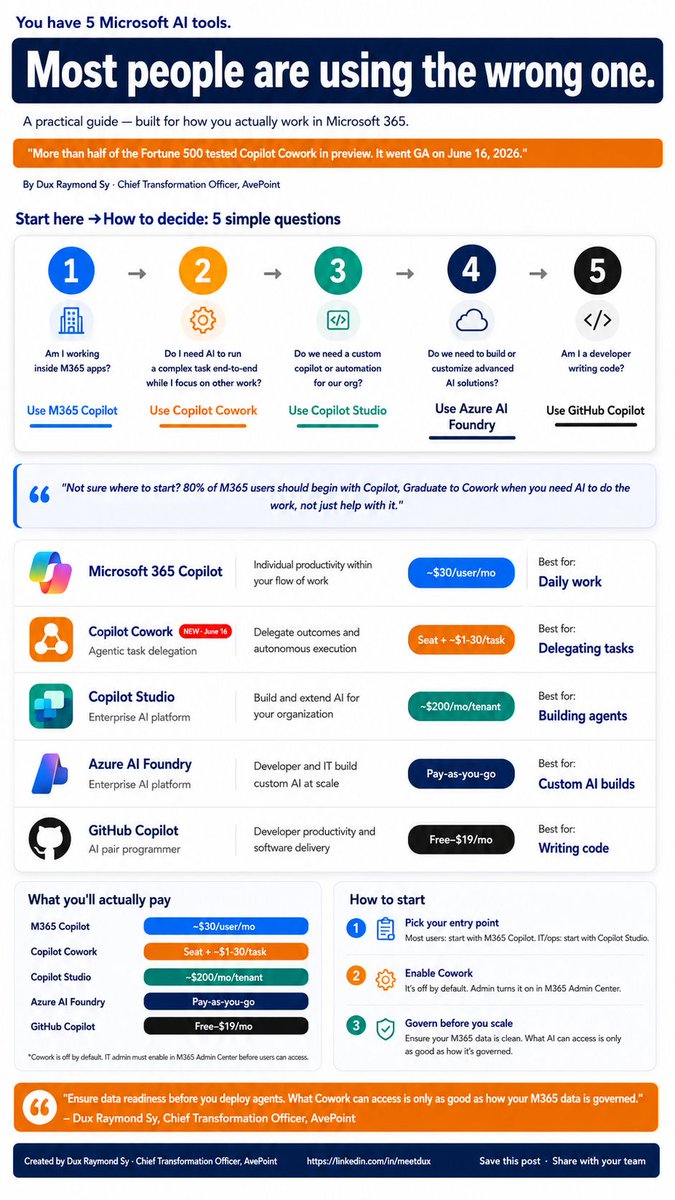
Save this and share it with your IT team or anyone still asking which Microsoft AI tool they should actually be using.
Which of the five is causing the most confusion in your org right now?
You have 5 Microsoft AI tools. Most people are using the wrong one for the job.
M365 Copilot. Copilot Cowork. Copilot Studio. Azure AI Foundry. GitHub Copilot.
Each one does something different - and knowing which to use changes everything.
The short version:
80% of M365 users should start with Copilot. Graduate to Cowork when you need AI to do the work, not just help with it.
90% of the Fortune 500 already use M365 Copilot. More than half tested Cowork in preview. The tools are here. The question is whether your org is using them deliberately.