INSTEAD OF WATCHING AN HOUR OF NETFLIX TONIGHT.
This 1 hour Stanford lecture by Joel Peterson will teach you more about negotiation and getting what you want than most people learn in years.
Bookmark it and give it an hour, no matter what.
A 17th century philosopher invented the technique of reading ten books at once, and almost nobody has used it correctly in 400 years.
His name was Francis Bacon, and the method he described in a single essay in 1625 has been quietly used by every serious scholar from Darwin to Marx to Susan Sontag.
NotebookLM is the first piece of software in history that finally makes it possible for the rest of us.
Bacon's essay is called "Of Studies." It is three pages long. Inside it sits one of the most underused sentences in the history of reading. He wrote that some books are to be tasted, others to be swallowed, and some few to be chewed and digested. Almost everyone quotes that line. Almost nobody notices what comes next.
He said the deepest reading does not happen inside any single book. It happens in the space between books, when you place several of them next to each other and look for the contradiction.
Darwin did this with twenty notebooks open at once while writing Origin of Species. Montaigne did it with the entire library his father left him. Susan Sontag's journals show her reading six books on a single topic in parallel, never in sequence, hunting for the disagreement.
The reason almost nobody does this is mechanical. Holding ten books in your head at once is impossible. Your working memory holds four things. The connections evaporate before you can write them down. The technique only works if you can externalize the comparison.
That is exactly what NotebookLM does.
Upload ten books on one question. Do not summarize them. Run one prompt: where do these authors directly contradict each other, and which contradiction is the most useful.
That is Bacons method.
The thinkers who reshaped fields were not reading more than everyone else.
They were reading sideways.
Winston Churchill fought his depression with bricks. He'd lay them for hours at his country home in Kent. He joined the bricklayers' union. And in 1921 he wrote about why it worked. It took psychology another 75 years to catch up.
He called his depression the "Black Dog." It followed him for decades. His method for fighting it back was as basic as it sounds: laying brick after brick, hour after hour.
Churchill spelled out his theory in a long essay for The Strand Magazine. People who think for a living, he wrote, can't fix a tired brain just by resting it. They have to use a different part of themselves. The part that moves the eyes and the hands. Woodworking, chemistry, bookbinding, bricklaying, painting. Anything that drags the body into a problem the mind can't solve by itself.
Modern psychology now calls this behavioral activation. It's one of the most-studied depression treatments out there. Depression sets a behavior trap. You feel bad, so you stop doing things, and doing less means less to feel good about. Feeling worse makes you do even less. The loop tightens until you can't breathe inside it.
Behavioral activation breaks the loop from the action side. You schedule the activity first, even when every part of you doesn't want to. Doing it produces small rewards: a wall gets straighter, a painting fills in, a messy room gets clean. Those small rewards slowly rewire the brain. Action comes first, and the feeling follows.
Researchers at the University of Washington put this to the test in 2006. They studied 241 adults with major depression and compared three treatments: behavioral activation, regular talk therapy, and antidepressants. For the people who were most severely depressed, behavioral activation matched the drugs. It beat the talk therapy. A 2014 review of more than 1,500 patients across 26 trials backed up the result.
Physical work like bricklaying does something extra on top of this. It crowds out rumination, the looping bad thoughts that grind people down during the worst stretches of depression. Bricklaying needs both hands and gives feedback brick by brick: each one is straight or crooked. After an hour you can see exactly how much wall you built. No room left for the mental chewing.
The line George Mack used in his post, "depression hates a moving target," is good poetry. The science behind it is sharper. Depression hates a brain that has somewhere else to be.
Fifteen seconds. The average person waits an hour in line at the Louvre and looks at the Mona Lisa for fifteen seconds. Then walks away. Every big museum is the same story. People spend 17 seconds in front of masterpieces and move on.
A 2001 study at the Met timed 150 people in front of six masterpieces. Cezanne, Rembrandt, the heavy hitters. The average look came in at 27 seconds. Half the visitors spent less than 17. The single most common result was 10 seconds flat. Then done. The Art Institute of Chicago ran the same study in 2017 and got almost identical numbers.
This pattern has a name. A scientist named Benjamin Ives Gilman wrote about it in 1916 and called it "museum fatigue." The more paintings around you, the faster your brain taps out. Arthur Melton's 1935 follow-up found that when a gallery hung more paintings, people stopped at fewer of them. The time spent at each one stayed stuck at 10 seconds. The paintings were competing for attention. They were losing.
There's a circuit in your brain that only runs when you're alone with your thoughts. Daydreaming. Remembering things. Scientists call it the default mode network. When you focus on anything in the outside world, this circuit shuts off. You need it quiet to pay attention. Except when the outside thing is art that moves you.
In 2012, neuroscientists at NYU put people in a brain scanner and showed them paintings. When someone saw a painting they rated as deeply moving, the self-thinking circuit switched on. An outside thing was triggering the inner circuit. A year later, the researchers followed up with a paper called "Art reaches within."
Look at the Bossard. The title is "Meditation." The setting is the Orangerie in Paris, the oval room Monet helped design after World War I. He wanted it to be what he called a "refuge of peaceful meditation" for a country wrecked by the war. He offered the paintings to France in 1918, right after the fighting stopped.
One man stands facing the Water Lilies. Another sits on a bench behind him, reading the newspaper. You assume the standing man is meditating. Maybe. But the inside circuit only watches one thing: whether you've turned inward. Where your eyes are pointed has nothing to do with it. The guy with the newspaper might be lost in a memory from 1997. The guy in front of Monet might be thinking about what to buy for dinner.
The average viewer clears a masterpiece in 17 seconds. The inner switch takes longer than that to flip. Which is the quiet joke Bossard built into his painting, and also why the title lands the way it does. You can't see meditation from outside the body.
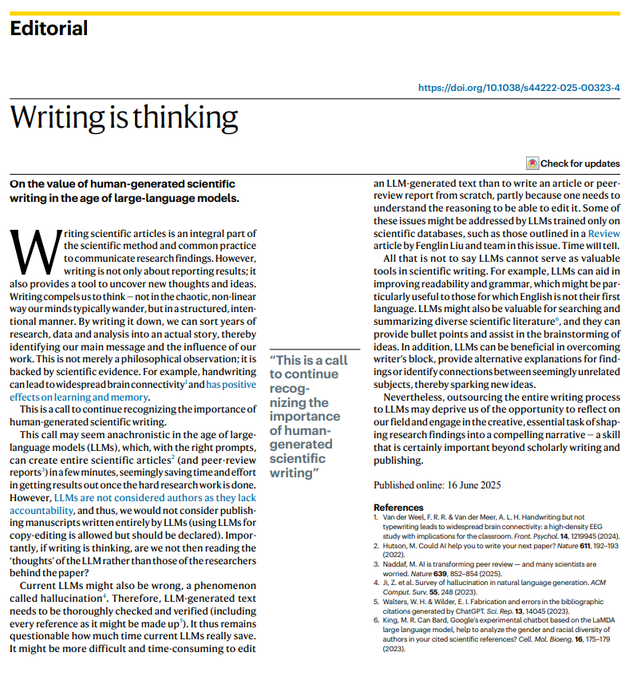
Writing forces your brain to coordinate memory, reasoning, and meaning-making simultaneously.
Every time you write, you rewire toward clearer thinking. Every time you let an LLM do it, you rewire toward consumption.
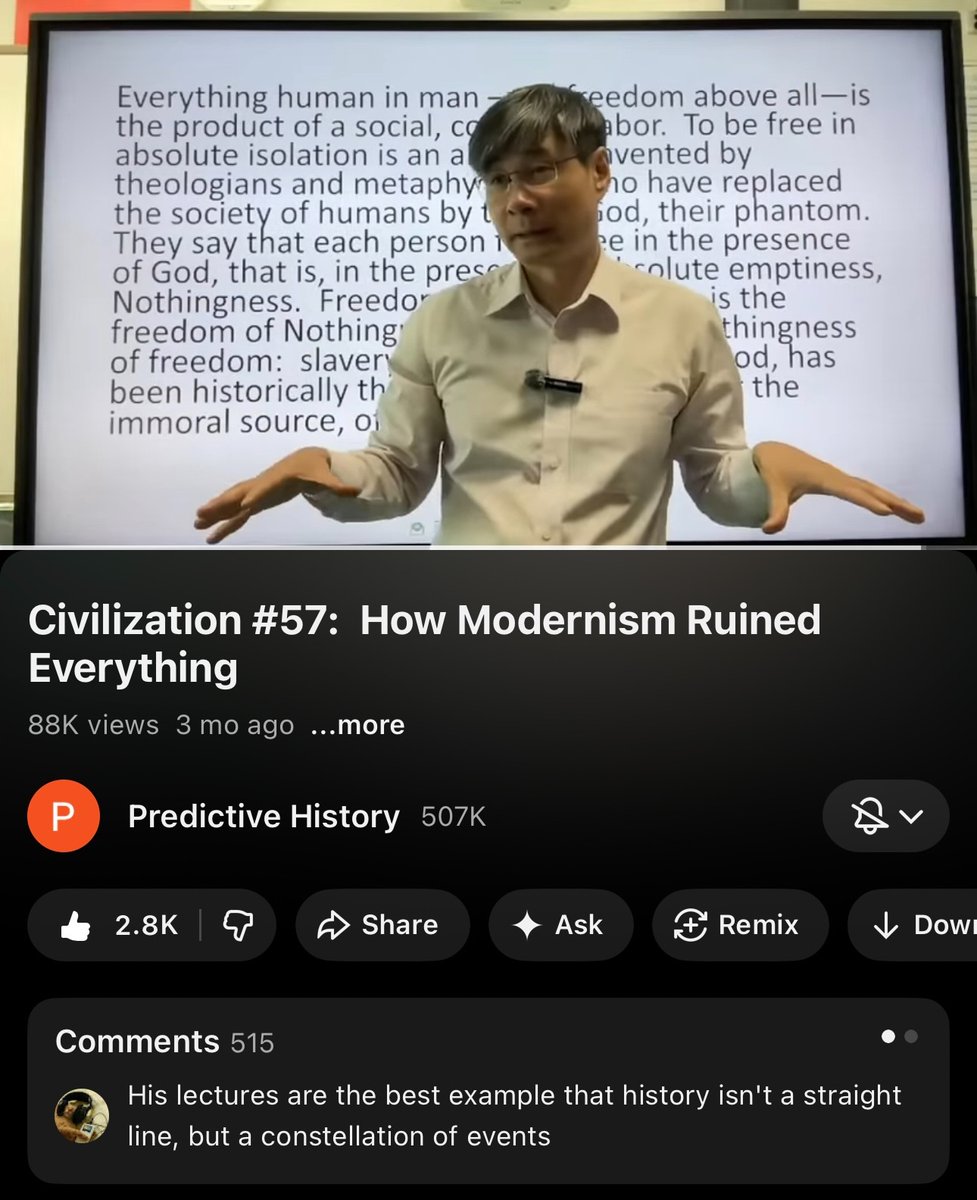
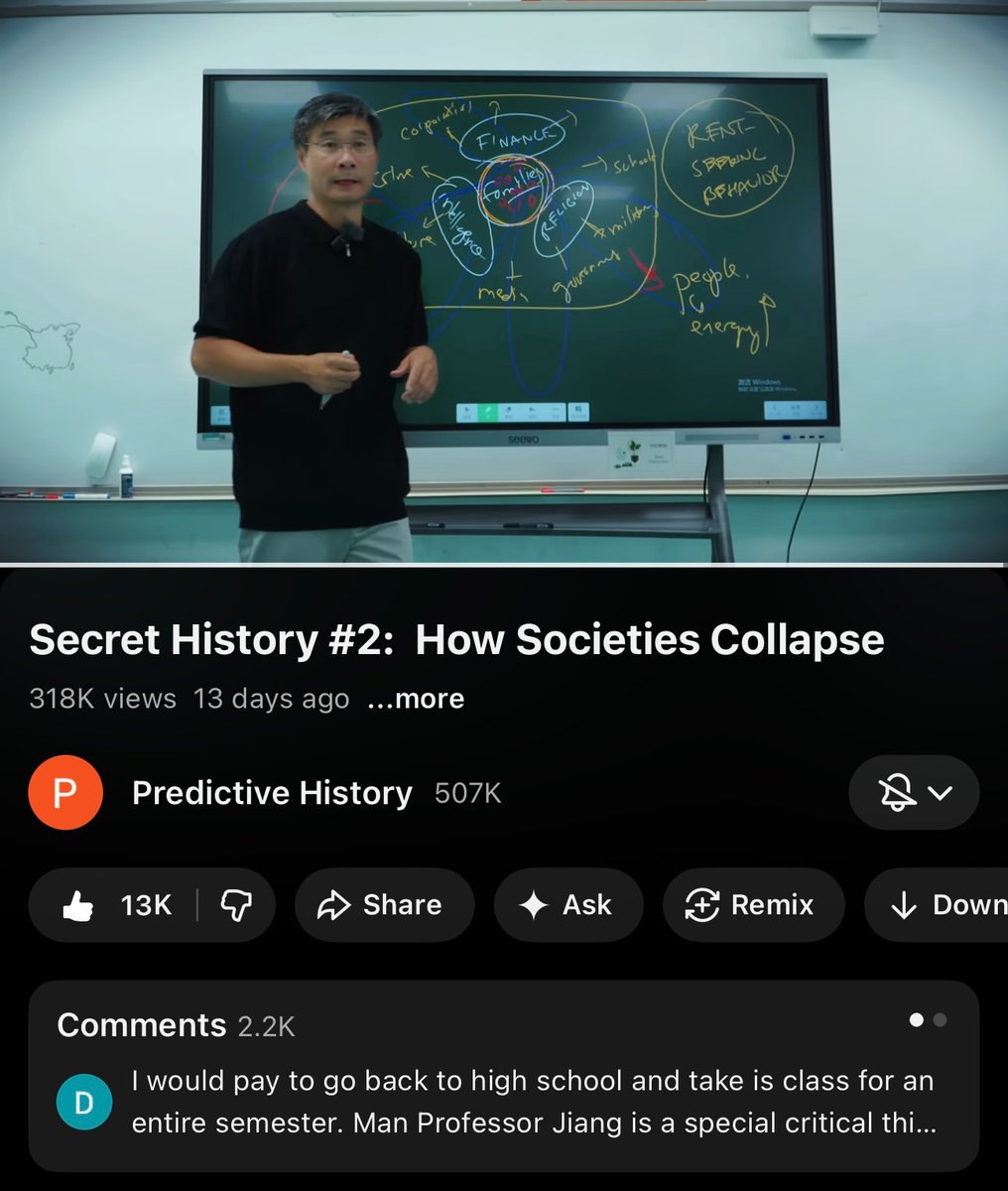
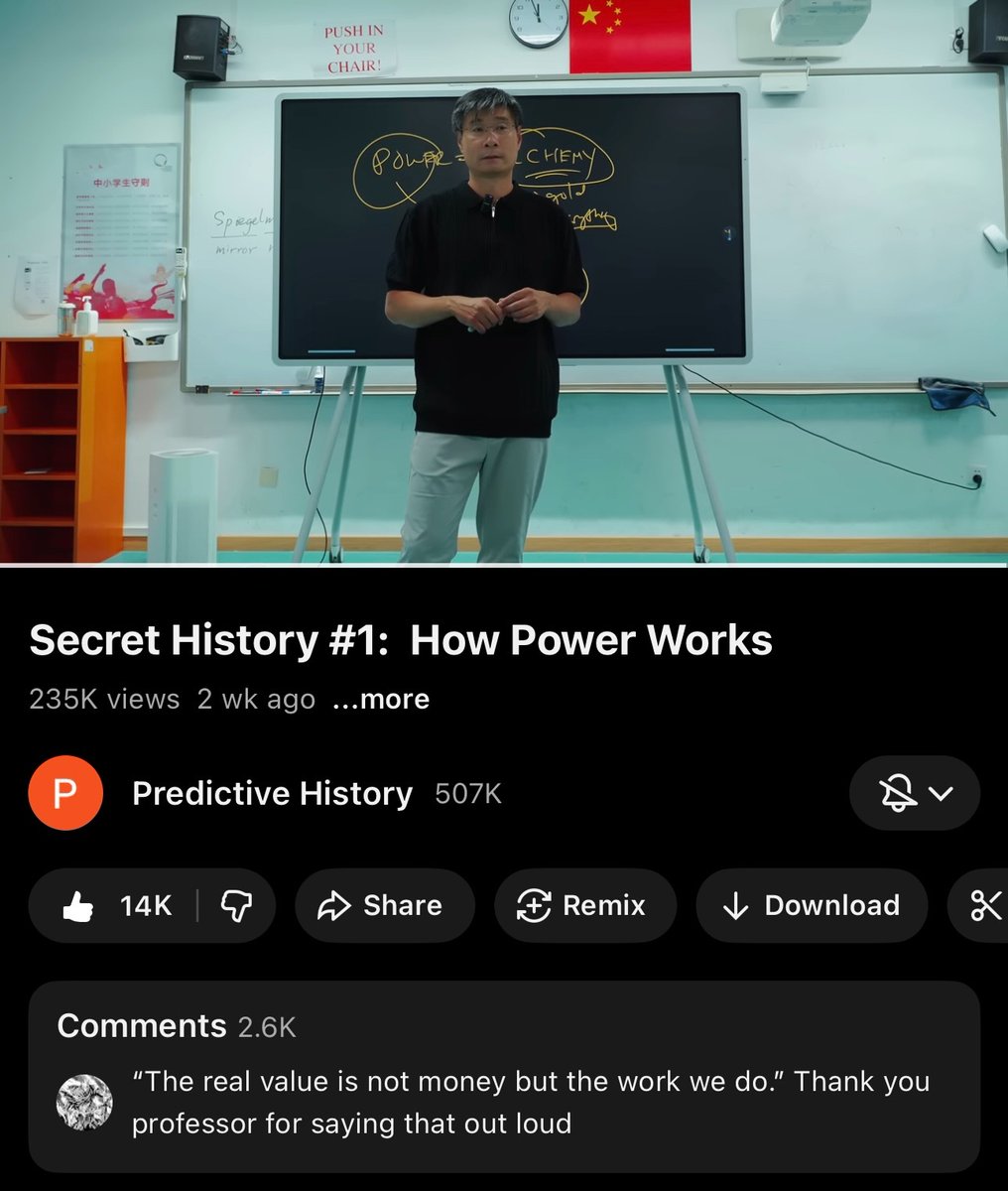
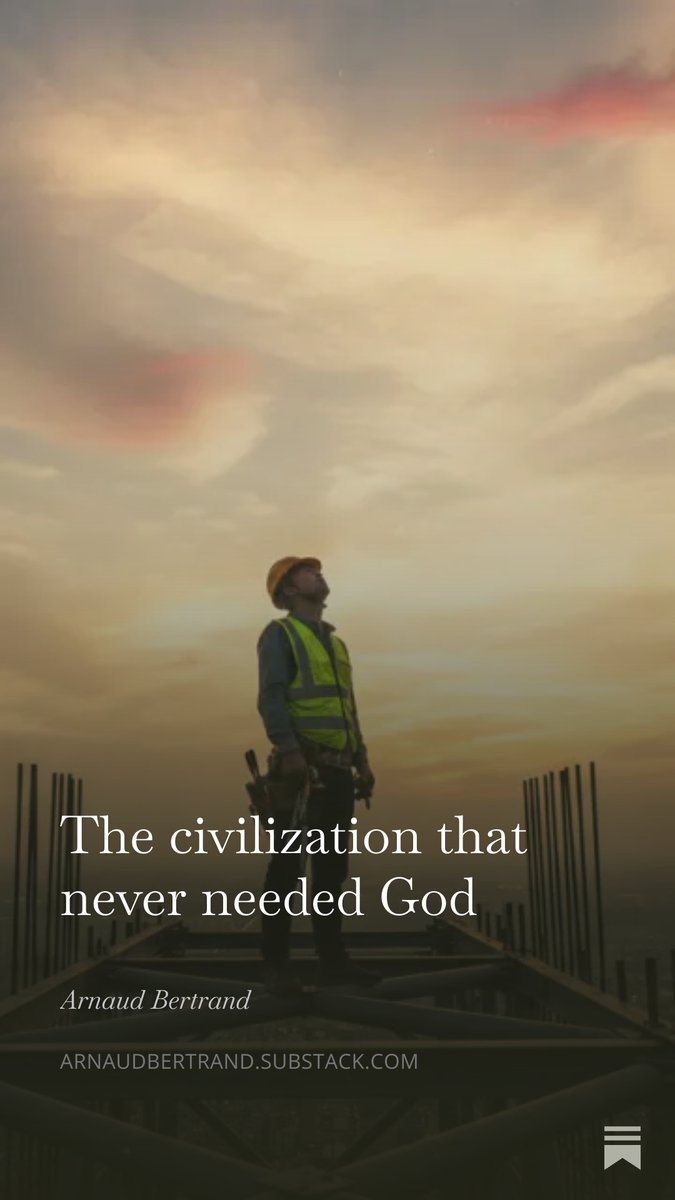
This is probably the single feature that makes China most unique as a civilization in human history: it is pretty much the only one where religion never had a say in political affairs.
We often wrongly believe that China's secularism came with Communism but this couldn't be more wrong. The roots are far, far more ancient than this.
Think about any other civilization - India, Persia, ancient Egypt, European civilization, the Incas: they all had a priestly class that held considerable political power. China? Never.
Never, ever? Actually China, in its very early history, had a brush with theocracy during the Shang dynasty in the 2nd millennium BC. And it is precisely this episode - or rather what came afterwards - that decisively de-linked religion from government affairs.
How so? Because around 1046 BC, the Zhou overthrew the Shang and immediately faced a big problem of legitimacy. The Shang had claimed to rule because Heaven had chosen them. If that were true, then the Zhou had just committed the ultimate act of sacrilege. How do you justify going against God’s will?
The answer the Duke of Zhou (who can thus be credited as the - perhaps unwitting - inventor of secularism) came up with was essentially to say that Heaven's mandate is not a birthright but a contract - conditional on the virtue of the ruler and good governance.
It might not sound like much but this idea completely changed the whole equation: suddenly the legitimacy of power didn’t rest on God’s will but on man’s moral judgement, on whether the ruler had virtue (德, Dé) and governed well. Which meant that, ultimately, the people - as opposed to a God - became the arbiter of whether a ruler is legitimate.
If there is one single decision that most shaped China's destiny as a civilization, it's probably this one. And, as I explain in my latest article, it ultimately shaped all of us in profound ways: through a chain of events involving Jesuit missionaries, Voltaire, and what French Enlightenment thinkers called "l'argument chinois" ("the Chinese argument"), it is this very idea that ended up secularizing Europe too and drove the Enlightenment movement.
That's the topic of my latest article: the origins of China's secularism, how it shaped three thousand years of Chinese civilization, and why - far from being a belief in nothing or an absence of belief as it's all too often depicted - it's on the contrary a faith in humanity itself.
Read it all here: https://t.co/XLwhKFlaNl
I’m a little disappointed by how (many) Indonesian critics reacted to Trump’s Board of Diplomacy (BoD) as if it were shocking. A sophisticated diplomat or international relations scholars should have seen this coming. Great powers shape institutions, see Mearsheimer 2001. That is what they do. When existing forums like NATO/UN no longer serve their interests, they create new ones.
The real issue here is not procedure or morality, but power and leverage. Critics who insist on, or reduce geopolitics to a rule-based forum miss the reality that it remains a landscape of power, where gradients matter more than declarations. This is why reactive diplomacy i.e., protesting after decisions are made rarely shifts outcomes if it is not backed by capability.
The NATO example makes this plain. Senior figures within NATO have openly acknowledged that Europe cannot currently defend itself without U.S. military support. This is not a failure of European values or institutions; it is an admission of structural dependence. Norms, treaties, and shared principles did not remove that asymmetry. Power did not disappear simply because rules existed to manage it.
To avoid geopolitical naïveté, bebas aktif must be read properly. “Free” does not mean promiscuous, and “active” does not mean reactive moral signalling. Active means presenting leadership and plans early shaping the agenda rather than responding to it. For less influential countries like Indonesia, this is not optional. It is how limited structural power is compensated for: by setting the playing field early and ensuring others want to play your game. You articulate clearly and early.
Focusing on, and strengthening, our foothold in Southeast Asia would be a good start.
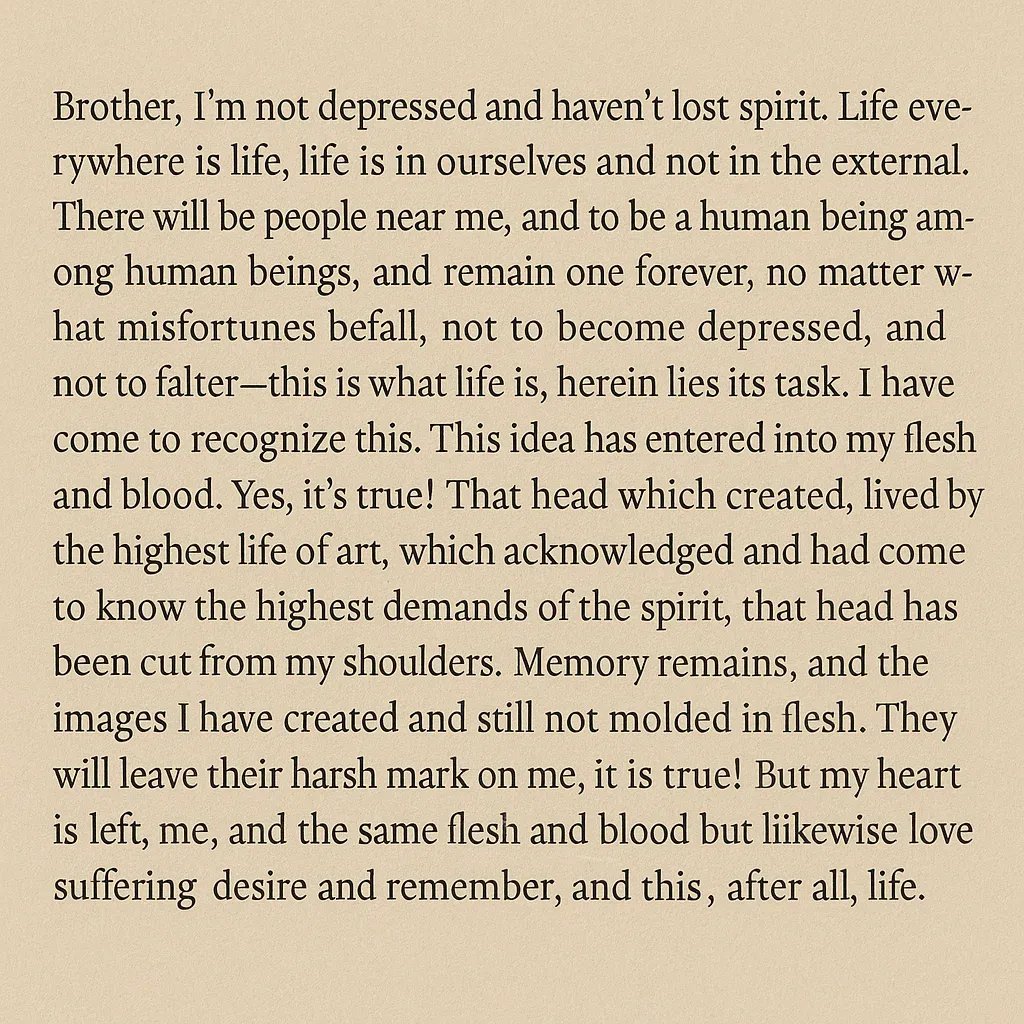
In 1849, Dostoyevsky was sentenced to death and lined up in the freezing cold to be shot. At the very last second, a messenger arrived commuting his sentence. He went back to his cell and wrote a letter to his brother that's one of the most powerful things I've ever read. A powerful reminder to stop sleepwalking through life.
The British Empire didn’t disappear. It just learned a new trick. It realized it no longer needed soldiers, gunboats, or stolen continents. It discovered a far cleaner form of plunder, one wrapped in contracts, trusts, and tax codes, executed not with muskets but with Montblanc pens.
The trick was elegant: Why rule people when you can rule their money? Why occupy land when you can occupy trillions of tbr world’s balance sheets?
Where old empires looted gold, this one loots revenue. Where old empires planted flags, this one plants shell companies.
Where old empires ruled through force, this one rules through loopholes.
The uniforms changed. The extraction didn’t.
The 2025 Corporate Tax Haven Index isn’t merely a report. It is a confession, a glimpse of the operating manual and scale for the last functioning empire of piracy on Earth.
Seven of the world’s worst corporate tax abuse enablers are British or British-wired:
🇻🇬 British Virgin Islands
🇰🇾Cayman Islands
🇧🇲Bermuda
🇯🇪 Jersey
🇬🇬 Guernsey
🇮🇲 Isle of Man
🇬🇧 The UK itself
Add the satellites: Singapore, Hong Kong, Ireland, Cyprus, Malta, and you have the modern imperial piracy map, not red territories, but redacted ledgers.
A colonial spiderweb stretching across oceans, all threads leading back to the City of London, where £3 trillion in global wealth silently passes through conduits built for secrecy and extraction.
The empire didn’t completely fold. It decentralized. It globalized its extraction.
It dissolved borders so revenue could flow freely, in one direction.
While every road no longer leads to Rome, the world’s most lucrative loopholes still converge on London, by design, not coincidence.
The brilliance of the system is its camouflage.
If any other nation drained the world’s tax bases into secret financial warehouses, it would be condemned as corruption, kleptocracy, destabilization.
But when Britain does it? It’s “efficient financial engineering.” It’s “market sophistication.” No... it’s piracy with paperwork. It’s looting rewritten in legalese.
The defeated empire realized that plunder becomes respectable once you teach accountants to be mules and carry the loot.
Once the empire lost its armies, it built something far more durable, a financial gravity so powerful that corporations, banks, and entire economies were pulled into London’s orbit whether they intended to or not.
This is engineered dependence. Control the jurisdictions where profits can disappear, and you don’t just influence corporations, you influence the governments forced to compensate for the revenue they lose. Control the offshore architecture, and you set the conditions for IMF austerity. Control liquidity, and you control sovereignty itself.
This offshore empire of piracy is why Russia is decoupling from Western financial rails. China is building parallel infrastructure. BRICS is designing settlement systems outside the dollar. Africa is rejecting Western development banks.
The Empire metastasized into the financial system that drains the world today. It swapped gunboats for tax havens, soldiers for accountants, and open conquest for “legal structures” designed to move wealth out of nations and into the same imperial core that once ruled them by force.
The genius and the obscenity is that the victims are told this is “modern finance,” while Britain hides behind the very rules it wrote to protect its offshore machinery.
Austerity for the Global South. Loopholes for the multinationals. Moral lectures from the capital of money laundering.
And here’s the part London fears:
That once nations realize they can’t be sovereign while their wealth bleeds into British-run secrecy networks, they face a simple choice:
Dismantle the system, or remain subjects of an empire that pretends it no longer exists.
Because an empire built on financial gravity endures only as long as nations accept its pull. The moment they walk away, the sun doesn’t set on the Empire, it is snuffed out.
Please, read books. Not just captions, or carousel posts, or what made it to the top of your feed. Read books. Long ones. Complex ones. You cannot build a mind with weight on the back of social media ephemerals. Intellectual depth demands patience.
Friedrich Nietzsche warns you, saying:
"Do not fall victim to excessive idealism and believe that telling the truth will bring you closer to people. People love and reward those who can soothe them with illusions. Since ancient times, humanity has only punished those who speak the truth. If you want to stay among people, share their illusions. The truth is spoken only by those who are ready to depart."
Good night
🇬🇧🇮🇱 Now THIS is how you introduce the so-called president of ‘Israel’ ISAAC HERZOG.
@Keir_Starmer why is this war criminal being hosted by the UK when elderly pensioners are being criminalised as ‘terrorists’ just for holding cardboard signs?
In @nytopinion
“The rest of the world is rejecting Mr. Trump’s protectionism,” the editorial board writes. Here's why fears of a global trade war have not materialized.
https://t.co/6eSuBp2RQg
PM Anwar salur peruntukan tambahan RM200,000 untuk RXZ Members 7.0
#BHnasional Sebelum ini PM memberikan peruntukan RM100,000 dan hari ini Shamsul Iskandar mewakili PM menyampaikan tambahan RM200,000, menjadikan keseluruhan sumbangan sebanyak RM300,000
https://t.co/lozOHBnVHG